Photo by Nathan Lemon on Unsplash
Monday morning, which seems a lot like every other day in this pandemic — I have two cats at my workstation (the corner of the loveseat in the living room), and I’m drinking coffee.
Today is work (the ordinary type where I have to grade final exams for classes) and work (the writing type where I look at what I’ve written and what it needs). I’ve done fixes on Whose Hearts are Mountains and Prodigies, and it’s time to apply it to Apocalypse.
You see, now I know what my problem is. I started right into the action and didn’t give the story its moments to develop characters and scene. I hope I’m doing it right this time.
Author: lleachie
First Chapter from Prodigies (rewritten)
After classes for the day, I stepped out of the music building at Lakeview Academy, a private residential school for the arts. I walked quickly down the paths, through manicured lawns, past buildings dedicated to teaching written, visual, and performing arts. I walked under trees that would show their fall colors in a few weeks, past the banks of mums that gave the campus an air of nostalgia. I could walk this path with my eyes shut, as I had walked it for seven years, ever since I was a junior high student nervously clutching my viola. Instead of the scrawny, frizzy-haired biracial child I had arrived as, I had grown tall and slender, and my hair tamed and pulled behind me in glossy tight curls. I still saw both my mother and father in my looks — brown skin, deep brown eyes, a thin and fine-boned nose.
My mother and father, however, had died when I was fifteen, in a plane crash attributed to unknown causes. I found out when Dr. Estelle DeWinter, my mentor, found me in art history class and walked me back to the office to break the bad news to me. Although I felt like I would crumble into nothing, I cried very little through it all; I sat through bewildering appointments with my parents’ lawyers and suffered two years of a guardian who threatened to pull me out of Lakeview. Only the surprising effort of Dr. DeWinter kept me in Lakeview until I became an emancipated minor at 17.
I think I missed what could have been with my parents more than what we actually had; I spent my life in residential schools from age seven, to develop a musical talent my parents recognized as extraordinary. If I inherited anything from my parents, it was my ambition, and from my grandmama I received humility to temper it. What I claim as my own is discipline and my own inexplicable talent, a freak accident of birth.
I walked quickly toward my weekly meeting with Dr. DeWinter. I was lucky to have a mentor at Lakeview that I could identify with as one of the few black students at the arts academy. I entered the Administration Building, an austere Neoclassical Revival building from the beginning days of the academy. Inside, dark wood paneling and white walls lent a gracious, if institutional air. I went to the front office where Mary Kravitz, the secretary, stood guard behind a low partition. “I’m here for Dr. DeWinter, if she’s ready for me.”
“I’ll ring her.” I was punctual, as Dr. DeWinter had taught me. This, she said, was the most basic courtesy of a professional, no matter what accounts of divas in the news would have one believe.
I didn’t look forward to the meeting, because I knew that I would disappoint Dr. DeWinter again. I had not applied for any colleges yet, and it was my senior year of high school. I couldn’t explain to her or to myself why I dragged my feet except that I didn’t want to leave the familiarity of Lakeview. I didn’t know what I wanted to do with myself — anything but music was out of the question, but I didn’t know if I wanted to go into music performance, which was what was expected of me, or fall back on music education. Therefore, I hung back, feeling guilty in my school uniform.
“You can go back, Grace,” Mrs. Kravitz said behind her counter. She hung up the phone and stared back at her computer screen.
I turned the corner and walked down a corridor of shut office doors with their shaded glass windows showing light inside. I reached Dr. DeWinter’s office, with its hand-lettered name on the door, and knocked.
“Come in, Grace,” she announced in her voice, warm and dry like a plucked viola string. I tried to read her mood from her voice and failed. I opened the door and slipped through it, into the familiar office with its jungle of plants in the window. I sat on the wooden chair that looked like it had seen generations of students before me — even Dr. DeWinter herself — and had survived them all.
“Grace,” she said, turning to me from her wooden swivel chair. “How have you been?”
I looked at her, her straightened grey hair swept back into a bun, her oval steel-framed glasses accentuating her nearly black eyes. She was my mentor, she was the mother I had never really had in a lifetime of residential music schools, and we walked through our ritual of the past seven years. “I’m fine, Dr. DeWinter. I haven’t gotten that cold that’s going around yet.”
“Good. How are your lessons going?”
That I could smile about. “I’m currently butting heads against Paganini’s 24 Caprices. What kind of demented genius could write those?”
“Paganini did. And played them, too. What does the music say to you?”
“Impish. I mean, technically very challenging. But the feel of it is that of a little imp, darling and devilish, taunting other violinists.”
“Do you still prefer your viola to violin?” Dr. DeWinter smiled.
“I know I have to give equal time to both instruments, because there’s so little written expressly for viola, and you keep telling me I have a career ahead of me. But my viola — “ Here, I sighed. “My viola is almost like a part of me. It’s like my voice.”
“And of course you’re still getting voice lessons on the side.”
“Yes, but I think my voice will always be for me, not for the public. I have a good voice, I know, with good musicality — but I’m not Norah Jones, and that’s who I’d want to be.”
“I would agree with you there,” Dr. DeWinter said — and paused. Here came the question I didn’t want to answer. “Speaking of careers — “
I would never get away with anything with Dr. DeWinter. “I know, I know. College applications. They’re due November 1st.” I felt my stomach sink as I realized I had disappointed my mentor. “I’ve been looking on the internet, but —”
“But?” asked Dr. DeWinter, eyes boring into mine.
“I don’t know what I want. I know you’re expecting me to go into music performance, because you believe I have great potential — and I know I do. I could probably get myself into some program like Berklee or USC, but I don’t know …” Here I dithered, revealing my indecision and my discomfort at anticipating the future. I had no idea how to be an adult — not even how to budget my money, as I spent money for nothing but tuition, room and board, and the occasional concert dress. I had few clothes that were not uniforms; little contact with the outside world other than field trips to operas and plays and concerts and art exhibits, not to mention performances. I suspected real life was more complicated than that.
“I think we’ve sheltered you too much here,” Dr. DeWinter said after a long pause. “You’re almost eighteen, and you’ve been in residential schools since you were seven.” It was true; my parents had placed me in an enriched boarding school called Renaissance School for the Arts when it was clear that I was a music prodigy, and from there straight to Lakeview.
I felt a flutter of uncertainty in my stomach as I tried to explain to Dr. DeWinter: “I want to stay here another year. Explore my options. Learn — “ I hated to admit the next part — “learn how to live on my own.”
“Most people learn how to live on their own by living on their own,” she said wryly. “I want you to try to fill out a few of those applications, at least one, within the next week. You can ask Ms. Hollis in the school counselor’s office to help you with those, you know.”
“I know,” I sighed. “I just —”
“You really can ask for help if you need it. Being on your own doesn’t mean going it alone. Take it one step at a time.”
If only I knew what that first step was.
Later, after dinner and a string quartet rehearsal, I was back in my room. I had a room to myself, which had been part of the original arrangements for me at Lakeview. I had few belongings, as I needed few. The posters on my walls, something which would surprise most people, were superhero movie posters — Captain America, Wonder Woman, Black Panther. On a shelf were the glass menorah my father’s mother had given me, a tiara I had purchased as a joke, a stuffed-toy Siamese cat, as close to a real cat as I’d ever been able to keep, and trophies I had earned in competitions. The items that declared me a princess, a reputation I had built myself in self-defense from the microaggressions, as Dr. DeWinter called the sidelong stares and condescending conversations I often faced in the classical music world.
I lay on my bed, surfing Facebook on my phone. Various chatters from my classmates, people I knew but didn’t really know. It was as if we lived in parallel universes. In their universes they went home for Christmas, they paired up in the halls and broke up just as quickly, and some of them risked expulsion by sneaking out to the ropes course or behind the gymnasium to have sex. I had not gone there; first, for a protective instinct I’ve always had, and second, because I was saving myself. Not for marriage, but for that career I knew I should have.
Suddenly tears started to flow, blurring my screen. There was nobody I could talk to about this — Dr. DeWinter didn’t relate to me on this level and I didn’t want to talk to the school psychologist about it out of that same sense of self-preservation in my core. So I thought about the Paganini piece and felt ready to tackle it again.
Progress (I think)
I think I’m through the edit of Prodigies — it’s going to my in-house reader now. The edit was about two things — emotions and plotting. I hope I have those in a better place.
I guess Prodigies will go out on my next querying round, and I’m hoping the beginning now brings agents in. They should get to know the main character now.
Now, I’m afraid, it’s time to go back to Gaia’s Hands. I would rather prune very prickly roses than go back to Gaia’s Hands, to be truthful. That book needs so much help, being the first one I wrote. It needs replotting and characterization and dilemmas and … I still don’t know if I want to start it from scratch.
I do worry because I haven’t had an idea for a new book for a while (but Whose Hearts are Mountains wasn’t that long ago, either). On the other hands, I want the existing works to be sharp, sparkly, and compelling. I hope I get closer to that.
Coffee Haiku
How Easy it is to Quit
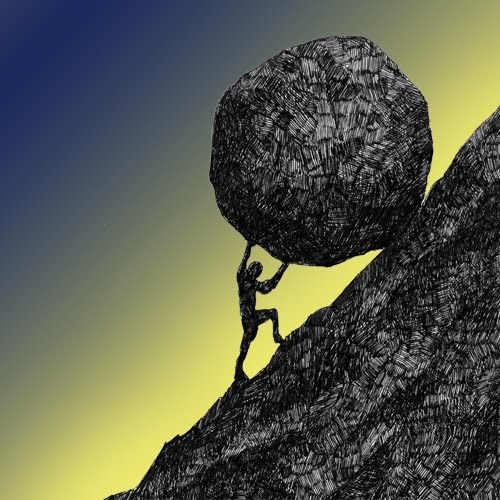
As someone who has started many projects and not finished them, I feel uniquely qualified to talk about how easy it is to quit something.
I have three sourdoughs in the refrigerator downstairs that, if I don’t feed them soon, will expire. I was supposed to feed them yesterday, but said “I don’t want to go through the trouble.” But if I say that day after day, the culture will die out.
I have to push myself to keep the momentum.
This relates to my writing as well. If I don’t write this blog every day, it will probably expire. If I don’t work on polishing or writing or rewriting daily, I will probably abandon writing.
The things that are easy to quit have no immediate rewards to keep me going. It’s human nature to seek immediate reward, and it’s human nature to conserve effort. Doing the things that are easy to quit, then, requires a longer view and an ability to find reward in the process rather than the result.
So I write this blog daily, even though it’s easy to quit. The rewards are nebulous (I average 40 readers a day right now, but hope for more) and I find value in the experience of writing itself.
A Fresh Set of Eyes
I never appreciated the value of a fresh set of eyes until now.
I’m making some needed repairs on Prodigies right now after not looking at it for a while, and — wow. I am finding ways to make good enough into great (I hope).
It seems overwhelming at this point, but I know this latest edit is only making my work better. This is one of the reasons I am glad I haven’t decided to self-publish — because I’m impatient and I think my stuff is good coming out of the first draft (it’s not; I just get excited about things) and I would publish before things were “right”.
I love the process of learning my craft. I get so frustrated sometimes when I don’t get an agent or publisher, but then I learn something new (like Save the Cat plotting) and improve my work.
I hope it’s worth it. That’s always the fear, that I’m spending too much time polishing something that may not get published. On the other hand, it’s gratifying seeing something improve even more.
Musing on Mortality
In the pandemic, I’m thinking of my own mortality.
I’m 57 years old with a spate of minor health problems. I’m of the age where I start to fit into higher risk categories. Given my age, I’m closer to the thing that’s going to kill me than I used to be. If it’s not coronavirus, it will be something else.
I’m trying to come to terms with this. It doesn’t help that 70s music reaches deep into my soul and connects with my childhood, and it’s almost 50 years old, or that I actually find myself saying “I don’t like today’s music.” (That’s not totally true; I love ambient and electronica, Beirut, and modern singer-songwriter types.)
I’m going to die someday. I’ve honestly never looked at it that way before. I’m going to die sooner or later. Coronavirus, cancer, heart disease, old age. I’m hoping for the latter, because I have books to edit and write. I’m hoping my death isn’t painful, that it’s merciful, and that I’ve done what I’ve wanted to do before then. I hope I’m ready for it, or that it catches me so much by surprise I don’t have time for regret.
I don’t know if there’s a heaven, honestly; most conceptions of heaven seem very — well, exclusive, like Heaven is a country club where only certain Christians can enter. (This goes with the attitude of “love everyone, even if you’re certain they’re going to Hell). I have fantasies about the afterlife, that it’s the extended family I never knew how to have when I was younger, and we’re having a big banquet in harmony. I know this is a fantasy and that the only way I will live on is in people’s memories of me, unless (as I sometimes hope) my consciousness mingles with the stardust.
I try not to dwell upon this too much — after all, I have things to accomplish and depression won’t get me anywhere. Still, musing on mortality is a sign of the times.
Hubris
I am re-editing Prodigies again, this time for character development of the secondary characters. This whole discovery process has been humbling. I am hoping that, when I tear everything down like this, that what’s left of my work is worth publishing.
That’s the thing — I don’t mind being wrong. I don’t mind not doing things right — who am I fooling? I hate making mistakes and I grovel to the universe every time I do it. But I’m seeing new things every time I do, and I’m fixing new things. (And I have other novels that need the same treatment, damn it).
Maybe this note is my groveling to the universe. Dear Universe, I’m sorry I made you read my mediocre books. I’m sorry I thought I was a big thing when I was making big mistakes. I’m sorry I ever thought I didn’t need dev editors and beta readers. I am making amends, and I hope they’re good enough.
Now I need to go and write.
What if (COVID-19 version)
What if things will be okay?
What if we emotionally recover from our losses — always remembering, but still living for the future?
What if we find out that money wasn’t what we were looking for?
What if more of us grew gardens as a result of the shortages?
What if we noticed the air was cleaner after quarantine? What if we decided we wanted to keep it that way?
What if we came out of this enjoying our simple outings more?
What if we will bounce back after this — in a new normal, perhaps, but nonetheless?
What if we find something good out of this — if our lives get a bit smaller, a little more precious?
Experiencing Very Little
Not much to say today. I’m in quarantine as usual. I desperately need coffee as usual. Classical music is playing in the background as usual. I’m beginning not to be able to tell the days apart, except Richard is home all day on Saturday and Sunday. The cats are being bad as usual. The view outside my window is quiet as usual.
Although onism is the realization that one will not experience all there is to offer, it’s doubly poignant now with all the ordinary things we’re missing: funerals, weddings, high school graduations. Regular schedules. Daily rituals at the coffeehouse. Extended peer groups.
It’s okay to mourn or even resent the strictures put on us at the moment. But stay safe. There’s so much we don’t know about the virus yet, and what we know is sobering. We need these quarantines to control the number of sick who need extraordinary measures so that hospitals don’t get overwhelmed. But have your feelings, and go on practicing safe existence with social isolation, wearing masks outdoors, and handwashing.
I will never be able to experience all things in this world. But I’m making a list of what I want to experience when this is over.