My Sanctum

As I have mentioned before, one of the things that saves me from severe winter blahs (aka Seasonal Affective Disorder) is my planning for the spring garden. 

I should explain that my garden has rules: everything I plant in it should be, at least in part, edible*. This means that I landscape with edible flowers, herbs, and plants that have been gathered and eaten in American or other cultures. Most of these can’t be found in nurseries or are rather expensive if bought as plants, so I grow them from seed myself in my grow room.**

 Here is a view of my grow room, which is a small basement room that used to be the coal room back when my 100-year-old house was a youngster: 
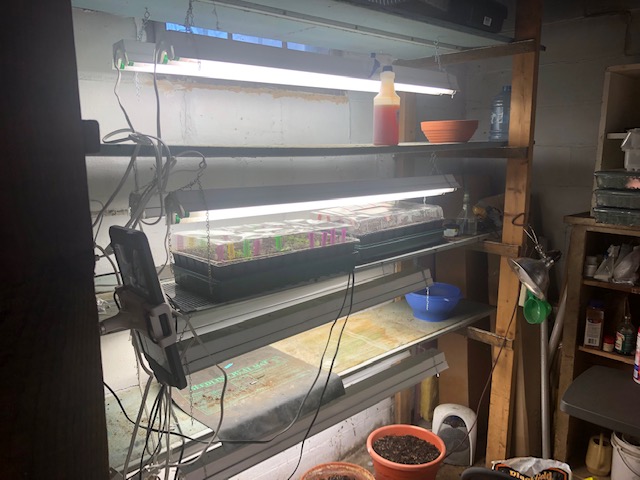
Not very impressive, is it?


The wires are for all the fluorescent fixtures and the heat pads — and the ancient iPad repurposed for record keeping that you see at your left.  The wall that you can’t see is lined with reflective material that was meant to insulate a garage door. Peel and stick — excellent for increasing the light in this room.

The flats you see are for two sets of items I’m growing — the edible nightshades (tomatoes, peppers, eggplant) and a handful of herbs (celery, lovage, yarrow, calamint, perilla, hyssop, alpine basil herb).
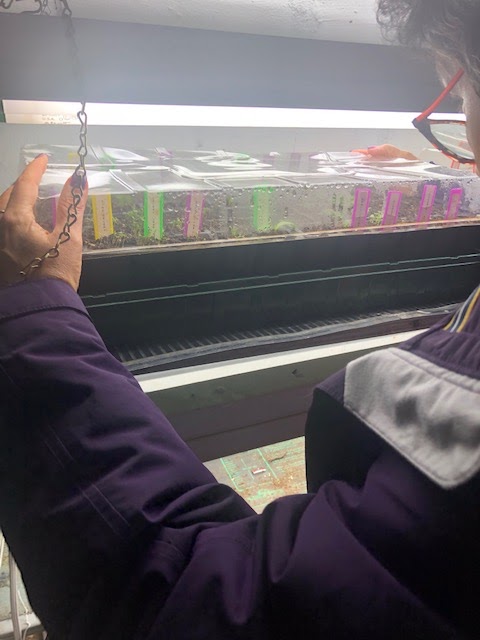
Closeup of my first herb flat

I have more to plant — I’m waiting on seeds for my moon garden and more herbs and for some flowers (and for lots of things that will get planted directly in the garden. By the time I’m done, I will have six to eight flats of seedlings to nurture.

Not all of them will survive. Past seedlings have succumbed to damping off disease (which I fight heroically with cinnamon water spray) and watering malfunctions. Some seeds never come up. On the other hand, sometimes they grow faster than I expected, which is why I’m setting the top shelf (that you don’t see) for taller seedlings to reside. I will save the best of the plants that come up for planting come spring.***

Spring comes to me sooner than to most because of my grow room, with its ugly cement floor and worn shelves. Today I sat with my seedlings, thinning them out so that they could grow strong, and feeling, if not happy, a bit less out-of-sorts.

* This year’s exception is the moon garden, which is comprised of white, night-scented flowers, most of which are toxic to deadly if eaten.

** When I say “grow room”, people think I’ve got one of these high-tech setups advertised on eBay where people grow — well, plants that are illegal to possess or use in this state. Mine is not nearly so exciting.

*** This doesn’t count the direct-seeded vegetables. I have to admit that I’m not as good with these because it gets too hot to weed and there are so many weeds. I’m working on using more mulching and earlier morning weeding.

Light

This time of year depresses me — literally — with its dark mornings and uniform bleakness of the terrain. It’s not the deep despair of my bipolar depression, but a constant sense of flatness, of anhedonia, of just wanting to stay in bed. The festivities of Christmas that buoyed up my spirits have long passed; all now is grey.

My psychiatrist has prescribed 1 hour a day in my grow room for light therapy. There’s plenty of light in the small basement room, supplied by eight fluorescent light fixtures. And, although it’s a small room, there’s a table and chair where I can sit and even an old iPad I use to maintain my plant records.

And then there’s the plants. Right now, I have starts of herbs like hyssop and calamint, celery leaf and Asian celery, and my tomatoes and peppers popping out of the ground. For the most part, they’re tiny seedlings with their seed leaves no bigger than a baby mouse’s ear. But they’re alive, and I almost believe I can feel the light of their lives brightening my day.

In the gloom of this season, I will take all the light I can get.

Valentine’s Day according to economics

When I’m not writing, I am a family economist/behavioral economist. The philosophy behind both of those is that I study the use of time, money, and other resources — in household units and in a manner that accounts for psychology.

Running Valentine’s Day through the economics filter yields interesting results.

Take, for example, Valentine’s Day as a method of conspicuous consumption, and the role of social media in creating the conspicuous part. Today, people will post pictures of flowers, restaurant meals, and possibly engagement rings or jewelry. The gifts may be given from the heart; the need to post pictures on Facebook and Instagram comes from a desire for the world to know the value of the item. 

Or for that matter, Valentine’s Day as an exploration of assortative mating. This is an economic concept borrowed from sociology that posits that people get sorted into couples based on complementary resources and similarity of levels of resources. Thus the stereotype that the rich man gets the trophy wife — there’s a little truth to the stereotype, according to the assortative mating theory. So, in effect, we don’t marry someone out of our league — we marry someone that complements us. And we marry as much for their resources combined with ours as we do love and romance.

And let’s not even mention that chocolate in a heart-shaped box costs much more coming up to Valentine’s Day than it does the day after. That’s pure supply and demand. 

I take advantage of this last economic fact by celebrating Half Price Chocolate Day tomorrow.


Seeking direction again

(Note: I am experimenting with larger print for a reader of mine.) 

Idea for my next book from the idea file:

Luke Dunstan, 6000-year-old Archetype, serves as a liaison between the immortal Archetypes and the humans whose cultural DNA the Archetypes hold. An edict from the Archetypes’ Maker bids the Archetypes prepare to return these memories in the trust of the humans. Facing their loss of identity, the Archetypes draw battle lines; countless human lives are at stake. It is up to Luke and one young woman, Leah Inhofer, to stop the battle of Archetype against Archetype.

*******


I really need to get back into writing. Or at least editing.

I’ve been editing a bit, but even then I often skip out on it because it’s tedious to go through a document to kill all the extra “have had has was were”. I haven’t written on a novel since finishing Whose Hearts are Mountains in December. I have some old ideas in my file (see above) but no new “a-ha” falling in love with the idea motivation.

Writing the blog every day, as I mentioned yesterday, is my lifeline to writing. As long as I write in my blog I’m still a writer. Right?

I’m afraid that if I keep getting rejections, my current lack of commitment puts me in an easy place to just walk away. This might be a good thing for me in the greater scheme of things, but it’s not good when I think about being a writer.  

So I’m musing about what to do. Again. 


Why I write (almost) every day

For those of you who have been following me, you know that I write this blog almost every day, sometimes twice in a day. I write first thing in the morning, right after breakfast, before tending to the other duties of the day. Usually, I write this sitting on my living room couch, lap desk in lap, typing on a Microsoft Surface. There’s usually at least one cat nearby — today, Buddy is taking up Richard’s seat on the couch.

There are many reasons I write this blog daily. The first reason is because it’s a writing habit, I haven’t written on a novel in a couple of months because I’ve been editing prior novels for developmental edits, but I’m still writing. I’m still keeping my fingers limber and my ideas fresh for when I start noveling again. (Is ‘noveling’ a word? My spellcheck doesn’t think so.)

A second reason is because I feel a rapport with my readers. I estimate there are only about 20 of you regular readers, and that most of you are people I know. A few of you I’m pretty sure I don’t know, given that you come from places I’ve never been to like Germany, France, and Portugal.  I like to write for you, and I’m glad you’re reading.

 A final reason is that I hope to be published someday, in which case I’ll need to have a blog, because it’s what writers do. You regular readers know that I fret about whether I’ll be published, and some days I feel down about it. I feel down about it today, as a matter of fact. Keeping a blog helps me hope that the rest of the trappings of being published — readers, recognition — will come to me.

Sasha, my ghost cat

I’m hopeful my ghost cat has moved in again.

I suppose I should explain my ghost cat. Some thirty-two years ago, when I was a graduate student, I owned a small, feisty black cat named Sasha.

I lived in a second floor, one-room apartment in an old house, with the porch roof just outside one window and access to the wooden fire escape out the side window. In the Illinois summers I had no air conditioning, so I tried to keep cool with a box fan and open windows.

I wanted to keep Sasha an indoor cat because I lived on a relatively busy thoroughfare in Champaign. Sasha had her own agenda. She found a way to pop the screen out of the front window, stroll across the porch roof to the fire escape, then bound down the stairs. She would eventually sneak upstairs with one of the other residents and sit outside my apartment door until I returned home.

Until the time she didn’t. Tommy, the alcoholic hippie down the hall, strolled upstairs that evening to announce that he put a dead cat in the dumpster and figured it was mine. My friend down the hall and I actually raided that dumpster at 10:30 at night to find the reeking garbage bag that contained the remains of my Sasha, and buried her on university farm property.

Soon, another cat found me, a grey and white polydactyl I named Kismet, who followed me halfway across town to become my cat. It was fall by then, and I no longer needed to keep my windows open. Kismet, like all young cats, would go into a chasing-nothing sort of frenzy, running around the small apartment, bouncing off the walls.

Except. Except that he would stop at the window, the window that Sasha used to break out of, and peer around the corner to the side of the porch, then run around to the side window as if watching something go down the stairs. And then friends would come and ask me if I had a cat, and I explained that Kismet was out somewhere, and they would ask, “What about the black cat?”

Eventually I moved, and moved again, and moved halfway across the country and back again, and I forgot about Sasha. But then, day before yesterday, my cat Chuckie started chasing around the living room. I thought nothing of it because cats do that. But then he turned a hard right and slammed into the French doors to the dining room. He stared into the dark room as if he saw something we didn’t, something that crept away from him.

If Sasha has found me again, I welcome her with open arms.

Thinking of chocolate.

Today in Maryville,MO,  the First Presbyterian Church holds its Nth annual Chocolate Festival. Consisting of two parts — the chocolate dessert bar and the take-home chocolatey cookie and candy bazaar — it’s an opportunity to treat oneself to a pre-Valentine’s Day indulgence.

Chocolate has become synonymous with Valentine’s Day in the US (So has Halloween, but Halloween candy isn’t GOOD chocolate). Probably because in the lab, chocolate consumption has been linked to oxytocin secretion by the body, and oxytocin is the cuddle chemical. The jury is out on whether you can bribe someone to love you by giving them chocolate, however. (Note, you can also get oxytocin by hugging a friend, an animal, or even a stuffed sloth.)

I prefer my chocolates at the extremes — very bittersweet dark chocolate and white “chocolate”, that cocoa butter confection that just melts. Mass-produced American chocolate leaves me cold; Belgian and Swiss chocolate make me very happy. Chocolate caramel, chocolate truffles, chocolate-coated marzipan … but not chocolate-covered raisins or gummies.  My favorite chocolatier in the US is L. A. Burdick, but I can’t afford their chocolate (well, I could, for a treat. However, I can’t afford their shipping.) They produce their chocolates with imaginative fillings that vary with the seasons and holidays. They just got done producing their Lunar New Year Asian-inspired chocolate palette; now they’re in the middle of Valentine’s season now.

I’m looking forward to the Chocolate Festival today. Don’t tell anyone, but I actually like caramel better than chocolate, and my favorite dessert at the festival tends to be the chocolate pecan pie bars. This doesn’t mean that I won’t eat good chocolate when it’s shown to me.

Making Peace with Winter

I’m definitely dealing with the winter blahs.

I’m not depressed-depressed, just feeling bleak. My life matches the outdoors — icy gray, devoid of new growth. I have no new ideas for writing right now, no inspirations, no breakthroughs in getting published.

I need to make peace with this winter. Do I always need to be productive, always striving toward something, always trying to make something blossom in my life? I don’t know; I feel best when I’ve just sent out queries, in love with the potential of my work being brought to a wider audience. I feel worst when I get a rejection — I got another one last night. Thus is the way of winter.

How does one weather winter? By sheltering oneself against the chill and waiting. Maybe this is what I need to do — take a break from writing, from editing, from sending out queries, from calling myself a writer. Maybe I need time to figure out how to reinvent myself again, as that’s been a big part of writing for me — trying to reinvent myself.

Maybe I will become something new come spring, when the ice melts and seeds come bursting out of their shells.

Excerpt from Voyageurs

Here’s an excerpt from Voyageurs, the next book I will put through the query process:

(Wanda and Harold met me just outside the soup kitchen, on the cracked sidewalk, negative two years from my natural time — 
“What now? I groused. “I was just about to eat lunch at the Mission.”
“Don’t be a bitch,” Harold said loftily, as Wanda looked down her nose at me as if I’d crawled out from under a rock. “We’ve got an experiment we need you to do.”
“Why me? I’m a Junior Birdman. You’re the King.” I knew, deep down, that I would do whatever Harold dared me to.
“You’re faster than I am. I need someone fast to do this. I bet you can’t do it, though.” Harold examined his hands, probably for invisible dirt specks, as I’d never seen him with his hands dirty. 
“You bet I can’t do what?” I demanded.
“Change the outcome of that game over there.” Wanda interjected in her haughty voice. 
“But that won’t work!” I groused. “The rock principle will keep it from changing. You can’t change time.”
“I’m going with you,” Harold reassured me. “We’re jumping a minute into the past to that shell game over there and you’re going to tip over the right cup so the mooch sees he’s getting conned.”
I protested. “By ‘we’, you mean me. How would I know where the ball landed?”
“You know,” Harold gritted his teeth. “You always know. I’ve seen you run that game.”
“You can’t change time. I try to change time and the cup won’t tip over. It always works that way.”  I’d tried it — I could win the game with data I’d gleaned from the future, but I couldn’t change the outcome of the game itself.
“But what if I change one or two other things at the same time?” Harold smiled, and I felt his charm dissolve my reluctance. “How would the timeline know which event to change? With one or two other changes at once, I hope to confuse things so that you can tip the right cup and ruin the game.”
“But what about crossing ourselves?” I demanded. “I only get what — four minutes before crossing myself kills me?”
“You’ll have to do it quickly, I guess,” Harold shrugged. “Unless you don’t think you can — “
“Alright. I’ll do it.” I always knew I would.
We jumped to three minutes before the start of the round, and Wanda came with us as witness. She and Harold stepped back while I walked up to the game, which involved a mooch and a grifter as we called victims and fraudsters on the street. 
I needed to reach in and tip the cup with the ball under it at the exact moment that the mooch would guess the whereabouts of the ball — and jump before the grifter caught my wrist and took me behind the nearest building to beat me to a pulp. I wondered why Harold would subject me to that risk, or the risk of crossing myself and being crushed. But he had faith in me …
One exhilarating moment later, I tipped the cup, revealing the ball to be in a different cup than it appeared to the mooch, and I jumped back to my present time without dying. I bent over, gasping and laughing.
“You’re the best,” Harold clapped me on the shoulder. “I knew you could do it. I think we should make a game of this. Call it — Voyageur. Like Traveller, but provocative.”
Then we blinked out of sight before the irate con artist reached us.)