A Place I’ve Never Written About

I’ve been reading a lot about “incels” — men who call themselves involuntary celibates, but who have such a repulsive worldview of women that it’s understandable why they’re not finding partners. They look at unattainable women as bitches and women who enjoy sex as sluts and women who are involuntarily celibate as cows. In other words, they’ve dehumanized every possible woman they could have bedded. Naturally, they’ve taken to valorizing men who kill as many as these women as possible.

When I was younger and single, I had a lot of what would be called dry spells. I was appealing only to a select group of people, many of which were interested because “fat girls are easy”. (Note: we’re not.) I once even called myself celibate, until a sassy friend said, “There’s a difference between being celibate and not getting any.” So, as you see, I was in the same boat our incels were in.

I didn’t become a man-hater, although I’ve always been too much of a feminist to give in to “fat girls are easy” and too proud to gush over any guy who looked at me. So I took matters into my own hands.

I fantasized about a place of solace.

I named it the Brigadoon Sparrowhouse, “Sparrowhouse” for a place where free spirits, which I had nicknamed “sparrows”, lived, and “Brigadoon” for the play about a mysterious village that appeared only every seven years.  In my mind, the Brigadoon Sparrowhouse popped up somewhere in the west central part of Urbana, the funky area where college professors and the occasional house full of poor, progressive students lived. I didn’t know where it would be, but it would appear when the light filtered just so through the trees as they shook droplets from their limbs. In my mind, in the moments I was most in need of human contact.

The door to Brigadoon Sparrowhouse was always open to me. I would walk in, and find myself standing in the middle of the living room, a slightly chaotic place with couches and chairs, all with their newness worn down by use. The living room wore dark paneling, an artifact of the era in which the room had first been remodeled. Pillows and an afghan brightened the room, and a woven wall hanging completed the look.

I would sit on the couch and cry, soaked from the rain and feeling like I would never get warm again. I would grab the afghan and curl up in it. I was alone; it was always a chance I took going there.

Soon, someone would show up, someone who was free and not currently connected with someone. Usually, it was Mark, who looked gloriously unlike the people I knew. He was tall and thin, with waves of auburn hair pulled back in a short ponytail. His face was narrow and pale and Irish; his eyes nearly the same color as his hair.

“You’re freezing,” he would say and wrap his arm around me, hugging me close.

“I got caught in the rain while I went walking,” I would stammer. “I didn’t know where I was going.” Often, I would think, I didn’t know where I was going.

“Something’s up, then,” Mark would say. “Tell me what’s up.”

I would tell him what was up — I felt like I was wrapped in a bubble and unable to talk to other people; I looked at the shining beauty of a friend and couldn’t reach them; I believed that nobody would ever love me.

“We love you,” Mark would say with his arm around me. We. The Sparrowhouse.

Sometimes Mark the sparrow and I would make love, up in his bedroom, a chaotic room with white walls, a mattress on the floor and a chest of drawers with sacred objects on its top — a stone with a hole, a cowrie shell, a bowl made of stone and a feather. Our union would grow out of a discussion, and tears, and solace. I felt the poignancy, because the sex was borne of agape, not eros or ludus — it was a gift, a reassurance that isolation would not be forever. It was not charity, but humanity answering humanity.

I did not fall in love with Mark, knowing that he was a figment of my imagination, just like the Sparrowhouse, which would disappear when I stepped out of it.

My Yard

I live in a two-story foursquare house that was built in 1905. It’s what is known as a kit home, as it has simplicity of lines and design elements that were found in mass-produced home kits that could be delivered and assembled at the home site.

The previous owners were a man named Robert Pleasance and his wife. By all indications, Mr. Pleasance was a bit of a tinkerer. Remnants of an engine lift in the garage, a workbench and old-fashioned intercom system in the basement, the handmade concrete birdbath with fountain (that regretfully didn’t work anymore)…

The yard, as a result, has beautiful bones as a landscaper would say, and just as many quirks that I acknowledged with a shrug. On the plus side: the back yard was fenced in with chain link, except for two gates leading from side yards to back yard, which were old-fashioned iron fence and gate, painted white. There were stone steps to the back that, although weathered, were not a complete ruin; The back yard was just right for a small patio and a decent garden.

The quirks: Mr. Pleasance had torn down an old brick one-car garage once he built his big garage/workshop (which looks uncannily like a pole barn with foldout doors) and built a hill with fine dirt and scree from the demolition. In other words, he reproduced a Mediterranean hill in a non–Mediterranean climate, which meant nothing but weeds, and even scarce ones at that. I appreciated the recycling at the same time I wondered what I could possibly do with this hill other than let the weeds grow. Also, there was a trellis serving as a grape arbor, but the grapes had been neglected and the arbor more so — it had been cobbled together from narrow iron pipes and cattle panels, and had started listing to the left. The grapes, still alive, had abandoned the trellis for the fence.

We’ve been wrestling with the yard a little at a time. Much of the backyard is a cluster of raised beds for vegetable gardening (heirloom and quirky varieties you can’t get in a store) which surround a small patio and grill. (If we have guests, we’ll have to move off the patio, it’s that small.) The bars that remain for the trellis will be used, with the cattle panel, to grow squash temporarily until we get the trellis back. Then we will plant more grapes and make the shady garden into a meditation nook or something.

The hill — we’ve found things that are falling in love with the hill — herbs. It turns out many herbs grow on scree — thyme, mint, sage, oregano, rosemary — and we’re getting good results with these. The tarragon, surprisingly, is growing better than anything I’ve seen grow before. We still have a lot of the hill to fill up, but we’re pulling weeds to keep it looking like it will become the quirky haven we hope to see.

Waiting for my new computer

I have a computer — a five-year-old MacBook which has served me well, as long as I didn’t care about having more than 230 MB of storage, a separate video card, and an OS that occasionally forgets to perform the “click” part of “point and click” six times a day and has to be restarted. Obviously I mind, so I’m getting a new computer.

I’m getting a new computer with some interesting specs:

  • 7th Generation Intel® Core™ i7-7700HQ Quad Core 
  • Windows 10 Home 64-bit English
  • 16GB, 2400MHz, DDR4
  • 128GB Solid State Drive (Boot) + 1TB 5400RPM Hard Drive (Storage)
  • NVIDIA® GeForce® GTX 1050Ti with 4GB GDDR5
I don’t really know what any of this means, except that the hard drive has a separate boot disk and the main drive is over 4x bigger than what I have, and that it’s a gaming computer.
I’m a writer. Why do I need a gaming computer?
The simple explanation is that I’m using a program called Sketchup, available free in its most basic form on the web, to render maps for places I write about. For example, three of my books take place on the ecocollective (a collective, but not communal, living arrangement) called Barn Swallows’ Dance (It doesn’t really exist, but if I did, I’d probably live there). I wanted a map of the place because I have at best shaky visual memory, which I believe I’ve said before. So I put together a layout of a map of Barn Swallows’ Dance on Sketchup using already created components, not realizing they were three-dimensional. They were!
That gave me lots of potential, but lots of frusrtration, because my computer was much too slow to act on the objects in my map. I thought they were at ground level, but in three dimensions, they were floating in the air! And I would adjust them according to what I saw on the screen, but there was a delay, so the objects went from floating in the air to buried in the ground, and my computer wouldn’t let me find the down-to-earth mode. It was like a very slow-motion game of whack-a-mole.
That was two years ago, and I’ve long gone past writing those books, although I am sending Mythos (the first) to my beta-readers soon. (Note: Do you want to be a beta-reader? Please email me at: lleach  (it’s a link) if so.)  I still would like to fix that project, because what’s there is intensely cool.
I also have a new project that goes along with the book-in-waiting Whose Hearts are Mountains, which is currently last in the writing queue. It also takes place at an ecocollective, one built largely underground in the desert. The housing is based on a conceptual idea (and I will have to find and credit the architect involved.). The tube habitats he drew up have not been created in 3-dimensions, so I would have to do that myself, probably in pieces. No, I’ve never created my own piece before, but it’s another skill to learn just for myself.
I wish all the things I learned were useful to others — teaching, of course, is. Writing — the journey is still out. Disaster mental health — very useful to me and to my college for accreditation, but I would also have to take a master’s in counseling or social work to become certified in disaster mental health. (No, I am not doing that) I might be useful in consulting with the city or county, but I’ve had a history of not being taken seriously by the guys with trucks that do the planning. If I could get the Ministerial Alliance to quit quibbling over butts in pews long enough to see that they need to mobilize so we could certify disaster case managers (which I am qualified to do)… sorry for the divergence. It’s a sore point. 
Anyway — odd little hobbies like my gardens (and trying to get rare seeds to grow), fishing, and the Sketchup design are things I do for myself. I push myself to get more competent (I don’t seem to be able to do things without that drive to improve unless I’m super-depressed) Hobbies are flow activities; they’re things I lose myself in and it’s like meditation, only with a satisfying level of challenge. I’m hoping Sketchup rendering becomes another flow activity for me.

And I hope that computer will help.

Really fun revising

My new beta reader is likewise challenging me, in a good way! Her first chapter notes on Voyageurs is that she didn’t feel close to Kat, even though Kat narrates that first chapter. If a reader doesn’t identify with a main character, they don’t read further.

I had to go through that chapter and figure out why she didn’t feel close to Kat, and why she felt closer to Ian (who was Kat’s partner in the scene). I came to the conclusion that Kat made a lot of observances but had very few feelings and reactions. There’s someone on the bench dressed like a widow in all-black, she sits like a man, oops — she is a man. But I didn’t have enough of Kat’s reactions — scared, agitated, frustrated, conflicted.

I had been told “show me, don’t tell me” at some point in my writing development. The problem is, when I take a piece of advice, I take it to the point of applying it perfectly (hello, I’m anal-retentive) and go too far in the other direction. So Kat observed, and I figured her observations would give her an edgy, defensive feel — they didn’t.

The trick here is to let Kat have reactions and emotions without it sounding like “I felt sad”, “I did this,” although I guess this has to happen a little. Here’s the introduction after two beta-readers. Beta-readers: have I addressed your concerns? Other readers: Do you want to know Kat better or is she a little too prickly?

p.p1 {margin: 0.0px 0.0px 0.0px 0.0px; font: 12.0px ‘Times New Roman’; min-height: 15.0px} p.p2 {margin: 0.0px 0.0px 0.0px 0.0px; font: 12.0px ‘Times New Roman’} p.p3 {margin: 0.0px 0.0px 0.0px 0.0px; text-indent: 20.2px; font: 12.0px ‘Times New Roman’} p.p4 {margin: 0.0px 0.0px 0.0px 0.0px; text-indent: 22.5px; font: 12.0px ‘Times New Roman’} p.p5 {margin: 0.0px 0.0px 0.0px 0.0px; text-indent: 22.5px; font: 12.0px ‘Times New Roman’; min-height: 15.0px} p.p6 {margin: 24.0px 0.0px 0.0px 0.0px; text-align: center; font: 12.0px ‘Times New Roman’; min-height: 15.0px}


May 19, 1814 (Kat)

I stepped out of shadow and stepped into the line at the gate. I had dressed like a gentleman in a smoky blue coat set off with a cravat and a striped vest. I hoped the trousers set off my tall stature and disguised the lack of manly bulge of my calves. I glanced down at myself; I looked like the men who had money, as I intended to. It took a short time jump to the Regency era and light fingers to liberate the outfits from the racks at a London clothier. 

The red-faced man collecting money, who resembled a walrus I had seen in the Kansas City Zoo, waved me on. I strode confidently through the gate of Vauxhall Gardens, as men do. From a grandstand, some musicians played something I didn’t recognize, something that sounded jaunty and Germanic. 

A woman in widow’s weeds passed through the gate right behind me like a wraith and strode around me. I knew she would receive scorn not only because she walked in alone, but because she marred her period of mourning for frivolities. I admired her gall and wished I could accompany her to reduce some of the harsh judgments against her, as a daring gentleman would, but she slipped away before I could offer.

However, I had come here to solve a mystery, not to engage in gallantry. An unknown someone had left a note in my (Twenty-First Century) mailbox that read, I know you are a Traveller. Meet me at Vauxhall Gardens at 8:00 PM on May 19, 1814. I will be on the first bench beyond the lights to your right. As we Travellers — time travelers from legend — kept our lives and talents secret, I felt a queasiness in my stomach thinking of that note. It could be an ambush; my contact could try to kill me or disappear me, as had been done to my mentor Berkeley back in 2015. Still, I stood in Vauxhall, the setting the stranger had picked, a land of perfume and intrigue and dalliance. 

I thought I knew of all the Travellers. A few of us had met up recently at the 1904 World’s Fair, Wanda and Harold and I, to see the wonders there. We had connected by email to set a rendezvous, as we lived in far-flung cities, and Wanda had to make her face look pale under her bonnet because St. Louis had been even more racist then. We interacted as we always had — Wanda, fretful and suspicious, Harold egging me on to do something outrageous by the rules of that time, me on my guard against Harold’s capriciousness. I think that time he wanted me to raise my skirts up to my knees, which would have been disastrous socially.

We all ate ice cream cones, of course. That was what Travellers did — lived as sightseers through time, observed, partook in the activities only as much as it wouldn’t break the Time Laws — although the natural laws of Time tended to prevent influential changes to the time line.  It was not like Travellers to experiment with Time, except perhaps for the daredevil stunts of the Voyageur game, such as crossing oneself in time or base jumping into another era. As I was at the top of the Voyageur boards, I guessed I experimented with time a bit. I flirted with painful crushing death from crossing myself, and I stayed alive. I was rather proud of being legendary.

As I walked toward the dark, I felt the note in my pocket as a talisman.  My foray into meeting an unknown Traveller could be dangerous. I carried a sword cane, standard for gentlemen of this era, as defense. I had practiced the maneuvers needed to arm it, with a flourish that would speak of my experience. I, of course, didn’t have experience.

 Torches set along the perimeter lit my way, throwing suggestive shadows on sheltered nooks. I heard a cry in the night; I would interrupt the unseen couple’s intimate business if I guessed the wrong nook. I walked toward the first bench I spied to the right, set in one of those nooks in the darkness, and there sat a single figure in all black — the widow. She had pulled knitting from her bag and set to it amid the strains of a single trumpet.

Still, this was the first nook. I would ask the widow if she had seen a man nearby. 

 Through her veil, I tho
ught she watched me.

I ventured into the deeper darkness, and her words, said in a husky voice, startled me. “You are not a man. You walk like a woman.”

I grumbled, annoyed at the fact that I had been made. I had learned to fool numerous mooches in games of chance as well as the occasional cop, but I couldn’t fool this widow. I knew that, with my tall, slender build and choppy hair, looking male was as easy as binding my breasts, wearing a proper male costume — which I lifted from a shop down the road — and walking like a man, which I apparently hadn’t done. 

 I peered at the widow’s black skirts and lace which blended into the night, and I realized that she sat with her legs slightly spread – “You sit like a man,” I countered.
I had missed the most obvious sign of a Traveller out of time because of the dark — a Traveller sees other Travellers out of their timeline in slightly diminished colors. We are so used to this that we react instinctively. An ordinary person would never notice, so we stay hidden in plain sight. But the darkness of Vauxhall masked all the leaching of colors, and the widow wore black, so there was no way of knowing.

“Katerina Pleskovich,” the other said in a voice slightly changed. “It’s good to see you in person.” I could have sworn the stranger chuckled. The flicker of a nearby torch revealed, under a black lace mantilla, a fine nose and dark lakes for eyes.

“Okay,” I said sternly, shaking the clouds from my mind, “You have the advantage on me, and that makes you look like a stalker.” I stiffened up, my hand ready at the handle of my cane in case he was a threat to me. I didn’t know how to use a cane, but I understood how to use a knife, and hoped the cane sword was similar. 

“Ian Akimoto,” he said, standing and pushing back his bonnet. In the moonlight, he was truly post-racial with glossy dark hair, wide-set Asian eyes, a long, thin nose, full lips. And an odd swirl of freckles on his high cheekbones.  Not handsome, exactly, but perhaps appealing. I could not help but chuckle at this innocent boy.

He took my hand. He still wore the black gloves, which accentuated his blocky hands. He brought my hand up to his lips, a courtly gesture of the era we found ourselves in, until I pulled it away. “How do you know about me?” I snapped. I glared at his beautiful eyes, his parted hair. The darkness around us revealed no secrets of how he knew about me.

“Berkeley told me all about you,” he sighed. “And you’re even more magnificent in the flesh.”
“Berkeley?” My stomach turned into ice and I struggled to breathe. I thought as quickly as I could, a talisman against my shock – My mentor had gone by Berkeley; his real name was Alexander West. Only other Travellers would know him by Berkeley; I did, as I was the last person he had mentored. Or so I thought. 

“Berkeley disappeared ten years ago. Nobody, none of us – “ by which I meant Travellers, but not necessarily the man who stood before me — “None of us know where he is.” I felt tears in my eyes and strove to keep them hidden, knowing that weakness could be dangerous.

“He’s in hiding; I’m sworn to secrecy as to his location.” He raised his hands in front of him to stall questions.  I still stood – my knees wobbled, but standing gave me the appearance of control.
“Trust me, Berkeley’s okay.” Ian sat again and patted the wrought iron bench beside him. I sat. “I can’t tell you further. It’s a Traveller thing.”

“How do I know you’re even a Traveller? You could have heard some old stories from Berkeley and thought to impersonate one of us.” I was on a roll, spurred on by my suspicion. 

And not very much sense, it turned out. Ian quirked an eyebrow. “Don’t you trust the evidence of your eyes? You can see I’m slightly bleached, can’t you? I’m sorry I have to stay silent about Berkeley, but it really, really is for your own good.”

I could not see the bleached colors because of the lack of light. “You don’t get to tell me what is and is not for my own good,” I shot back. “I’m not from Regency England.”

“And Berkeley’s safety,” Ian added softly. I felt a chill.

“It doesn’t make sense,” I muttered, clutching my cane. “I’ve never heard of you.” He wasn’t a Traveller I knew, nor did he frequent the Voyageur website, but then again, only a select group of Travellers played that daredevil game. I would know, being a seasoned Voyageur myself. 

Where did he know me from? “Do you have a flight name?” I insisted. If he was a Voyageur, he’d have given himself a nickname, a flight name only known among comrades. I remembered that Berkeley but would not let me choose a modest nickname —

“Kat,” the rotund, balding Berkeley had said, steepling his fingers together in his easy chair, a customary glass of brandy at his side. “You stand there in front of me with a crimson wingsuit, and you mean to tell me you want to name yourself “WildKat”? You are the most skilled Traveller in this generation, a female who has to stand up against these self-aggran
dizing men – you need a name that represents your rank, not one that makes you sound like a football mascot.” 

“Ok, then. What should I call myself?” I snapped.

“Wizard. That’s the name given to all the most daring and skilled in technology, in sport — computer wizards and pinball wizards and medical wizards and word wizards dot our history. Most of them are male. You, Kat, are a woman — and the wizard of  jumps even at your young age. As much as I don’t like the risk, at least own your heritage.”

Berkeley’s acerbic voice rang in my ears as I looked up and Ian looked at me with feigned impatience. “Seabhag,” he said, breaking the silence I had left. The bh sounded like a harsh v. I wondered what language it was.

“Mongolian?” I asked. The band had started up in the distance, playing another oom-pah sort of tune.

“Scots Gaelic,” he smiled. “Hence the freckles.” Seabhag’s grin gave him a sly masculinity which warred with his black mantilla.

As Ian had told me his flight name, I felt obligated to give him my flight name, but he beat me to the punch after a short pause. “And you are Wizard. Berkeley said you’re aptly named.”

Before I could unleash my indignation toward him, he laid a gloved finger to my lips and said, “More people walk toward us. We should take the hint and leave.” Ian linked his hands around my waist and we blinked into elsewhen.

June 1, 2015
I credited Ian for landing us safely in a tight space – that maneuver showed at least an intermediate-level skill. I tried to assess where we were in the absolute darkness, but I couldn’t for one reason —

“Ian?” I said. “You can let me go now.” I must have twisted around in the jump, because I had buried my face in his dislodged bonnet. Historical garb didn’t mysteriously evaporate once you got – oops, I couldn’t unsee that mental picture.

Ian turned his back to me and pled, “Could you please unbutton those maddening little buttons down my back?” 

“There’s no light in here. I don’t want to have to grope to get your gown off.” 

Ian worked his way to the far wall, skirts swishing, then flipped a light switch. I saw his colors resolve, the subtle washed-out colors of a Traveller who had stepped outside his natural timeline.

“Now can you get me out of this evil dress?” Ian cajoled as he stomped back, holding his skirts off the floor.

I glanced around at the whitewashed stone walls and dark wooden furniture of the one-room cottage. I had fallen down a rabbit hole where little made sense. As I unbuttoned, I saw the white muslin and stays of a proper corset.

“Corset?” I asked him, stifling a giggle.

“I’m a Method actor,” he mumbled as he untied the laces so that I could tug the corset over his head. 

I intended to do more than release him from the fussy trappings of Regency women’s clothing. I pulled the back of his corset wide to make sure I saw what I thought I saw – coffee-colored, freckled swirls on his otherwise golden back, the irregular swirls of Blaschko’s lines. Although all people had Blashko’s lines as part of their embryonic development, visible swirls were a sign of chimerism, or of two embryos fusing; or an outward sign of a Traveller as if we came from fused embryos. Though the Travellers knew nothing of our origins, all of us had Blaschko’s lines dark enough to be seen without ultraviolet light. I had my own lines — light caramel swirls on milk-white skin, in contrast to my dark-haired, large-eyed waifish looks. My index finger, of its own volition, reached out to trace one of the swirls, and Ian caught his breath.

“I’ll give you till forever to stop that,” he whispered.

“I’m sorry,” I muttered, and stepped back. I wanted to lazily trace those swirls all evening. They mesmerized me, like bodily imperfections often did. 

Without warning, he dropped the dress and petticoats to the floor. Below the clothes, he wore black stockings with garters – black, of course, which he quickly dispatched. Then the pantalets hit the floor. I didn’t know whether to laugh hysterically or scream. 

Although it felt illicit, I enjoyed his casual nudity – compact, lightly muscled, the Blaschko’s lines undulating across his torso. He had let his hair down from its bun, and it was dark brown and wavy and touched his shoulders. My first impulse was to – no.

I did not know him. I had been burned by impulse before. I couldn’t go there.
Ian turned around, saw my face, and said, “I’m really sorry, but those pan
talons were scratching me in a sensitive place.” 

“I don’t know you,” I snapped. “I know I sound like a total bitch here – whenever here is – but if this is an invitation, I can’t. I won’t.” I noticed I had clenched my fists. 

He crossed over to a large black trunk. I suspected he rummaged for clothes that weren’t black, scratchy, or feminine.

I asked him, “When are we?” It had to be somewhere between the 1970s and my present time.

“Modern time — your time. The middle of uncharted Scotland, where I somehow inherited an ancestral cottage.” That explained the stone walls, the use of conduit to provide electricity to lights and appliances, and the tiny size of the space. The space held a kitchen and a wood-framed futon and a dresser and very little room to stand except the space we occupied. He had landed us both in that space in a time jump from 100 years ago without collisions – I upgraded my assessment of his skill.
After he had dressed in a pair of black sweats and a t-shirt that said “University of Okoboji”, he strolled back over to sit on the couch. For the second time that night, he patted the couch and I sat down next to him, heaven knows why.

“Can I ask you some questions?” I leaned toward him. It seemed natural, because he seemed unprepossessing, personable, and gosh darn nice despite flashing me. Then again, the last man who I’d thought that about turned out to be none of those things. I leaned back, thinking of questions.
“Sure. Be aware I can’t answer all of them. And in advance, I apologize. I truly can’t. I hope you’ll trust me despite this.” His shoulders had slumped and his eyes grown weary – I would recommend he never take up poker, because his face wore emotions so completely. 

“Love the freckles,” I said as I patted his cheek in an impulse.

“Woof!” he grinned and rubbed his head against my hand and buried it in his hair. Dangerous. I pulled my hand away from that thick, vibrant hair.

He looked sad, but he simply sat silently and let me ask the next question. “How do you know Berkeley?”

“He taught me advanced Traveller lessons. My parents were Travellers, but they died when I was fifteen in a time travel accident. They were not Voyageurs, not even on the Voyageurs’ radar, so you may not have heard about them. They hadn’t taught me all I needed to learn when they died, so I felt fortunate I found Berkeley when I did. He got me caught up.”

“He did more than that,” I replied. “You have higher competence than average – I haven’t assessed your full competencies yet, of course.”

“You can any time you want.” he replied softly.

“I have time, then?” This was danger, yet it called to me.

“All the time in the world.” I suddenly realized that I didn’t really know what competencies he wanted me to assess, nor which competencies I wanted to assess. So I leaned over and kissed him on his pale, freckled cheek. 

Before I knew it, we lay on the futon, his body on top of mine. He laid his hands on my cheeks as he kissed me open-mouthed. As I kissed him, I felt like I had jumped off a cliff only to have my wing suit catch my fall so that I could follow the lines to sometime new and unknown. But I dared not go further.

So I executed one of the most advanced maneuvers of all – I rolled out from under him and traced my steps back home via 1814 London.

I landed in my home – Berkeley’s former home, a well-preserved Painted Lady in 2015 Kansas City, Missouri. I landed prone, on my back, on the bedroom floor, like I had been thrown in judo.

I called out to Berkeley as I always did. The house was silent, of course.


Hi, my name is Marcie, and I am eight years old. I had my birthday two — no, two months and seven days ago, and I’m counting down to the next one. It’s only ten months and three weeks from now! Time flies like a dragonfly!

Aunt Laurie said I can talk about words today. Let me first say that words are very important, because without them, we would all just stare and wave our hands around and if that kept up, how would we get pie? It’s easier to say, “please pass the pie”, especially if it’s that really gooey chocolate chip pie Aunt Laurie won’t make anymore because it’s too fattening. I think being fat just means you’re very happy because you got to eat the whole pie.

Ok, words. There are little words like “please”, “may”, and of course “pie” and those are good words because they get things done. Then there are the big words like Aunt Laurie writes, like “flabbergasted”, “preternatural”, and “multicolor” and I have to look them up in the dictionary. Why can’t she just used “frustrated”, “spooky”, and “pink and blue and green and orange”? Aunt Laurie says that you have to use the right word for the right thing, and preternatural isn’t the same as spooky, although it tends to weird us out. Think of someone who can read minds, or who’s thousands of years older than you. That’s preternatural. Why doesn’t she just say “spooky guy who could be your great-great-great-great-great a billion times over grandfather?”

Yesterday, Aunt Laurie told me I was right. Yay! I’m awesome! She said her beta-reader said her words were too big and if she wanted to be read, she would have to make them smaller words. Like “pink and blue and green and orange” instead of “multicolored”. She said this would be hard for her because big words love her. A lot like cats, I think. And did I mention that Aunt Laurie has a lot of cats?

I think I smell pie. Bye!

Mood and writing status today …

I need to write on Prodigies today.
I’ve been getting work done in other places — taking the class is most important; editing what my betas are telling me about my books is important (I love fixing problems!); writing this blog is important, gardening is important …

Writing Prodigies is important, So why is this getting none of my attention? Because it’s been difficult getting my mind back into it. Yes, it still bothers me that I haven’t gotten published, and I do lose my motivation to write, especially when there are so many more things I want and need to do.

But I finished my weekly class activities the first week of classes, and I’ve set up 1/3 of my internship visits up. I’ve gotten the basic layout of my renovated class together, and I have to wait till later in the summer to get the rest done. I’m antsy — I don’t want to spend all my spare time vegetating on the couch.

So I’m a bit cranky today. I’m working on it.

A happy note about bad things

Sometimes the things I need are not the things I thought I needed.

I needed the bad yearly evaluation, because without it, I would not have been able to talk honestly with my boss about what I had been going through for the last two years illness-wise. I would not have gotten the kick in the butt to do better, nor would I have realized that my boss cared about how I was doing.

I needed to have my writing rejected, because I would never have been pushed to get beta-readers on the job. Not only do they help me improve, but they are reading my stuff and that feels good.

I needed to feel like I was the most uninteresting person on earth (isn’t depression grand?) so I would see the places where I am geekily interesting — edible plants and herb garden, persistence in fishing even though I catch nothing, wanting to learn everything, moulage, the ability to talk to anyone about anything, addiction to coffee, dedication to writing …

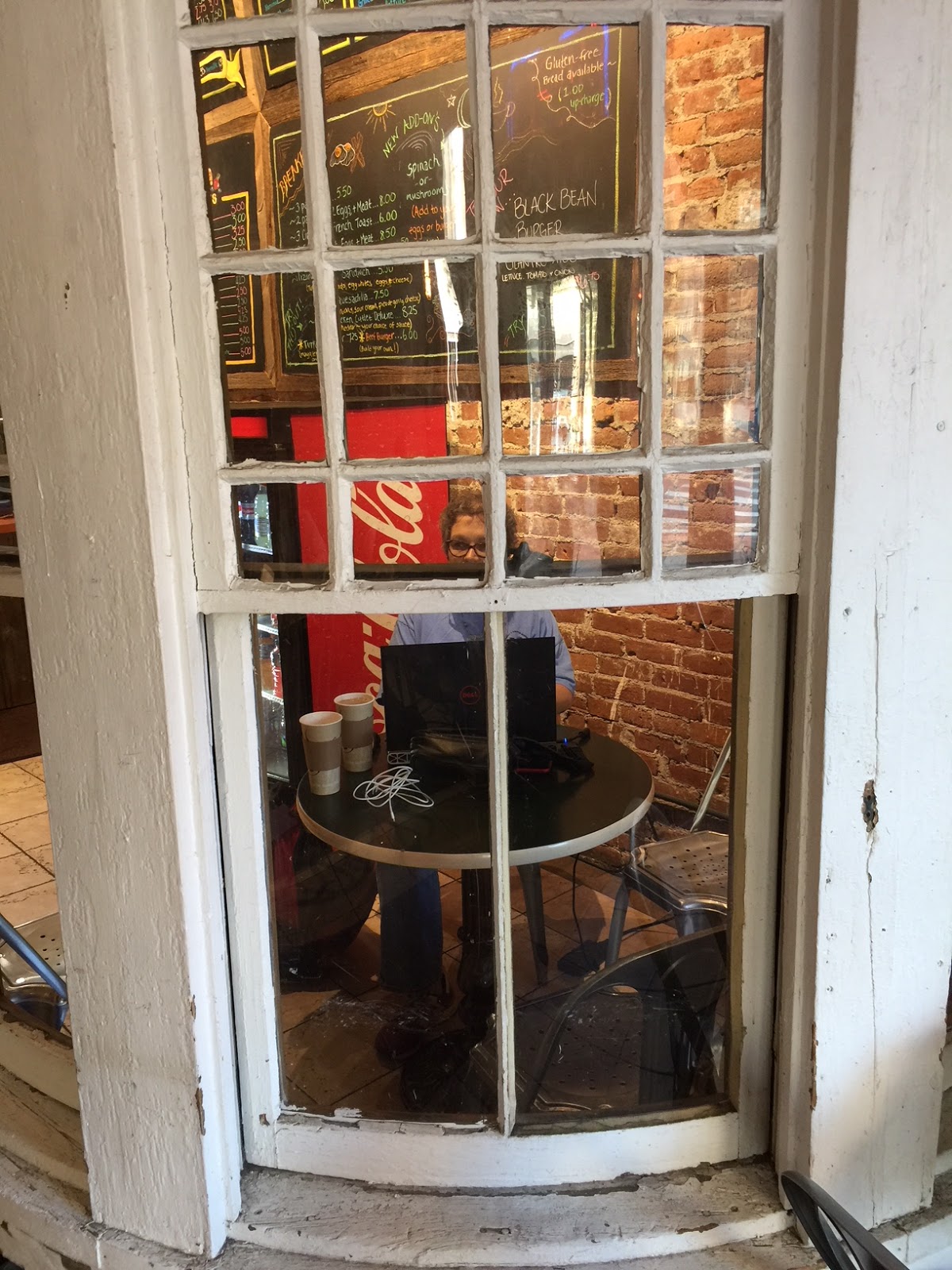
I needed to have that terrible school year — two terrible school years filled with depression and illness. Even though I have a lot of work (writing, disaster mental health class, redesigning a class) this summer I feel relaxed because I can take a day to go off to St. Joseph and drink at a quirky old coffeehouse.

I needed to break my heart on that crush, because it showed me how understanding my husband is about my periodic idiosyncracies in looking for the muse, a person who subtly infuses my creative soul with energy. (Crushes would lose their power if one did anything about them, so they’re supposed to go nowhere. Dear muse, if you are reading this, thank you.)

I needed to feel alone, because if I hadn’t, I wouldn’t have realized how much it means to me that I have readers. I love you all!

Well, Kindle Scout didn’t bite on Voyageurs, as I thought they wouldn’t. However, I’m not too bothered because it’s on the road to improvement. And I’d rather have a solid book than a published one, strangely enough. Although I would like to be read as well.

Going Back to School

Today is the first day of my Disaster Mental Health certificate program.  I can’t believe I’m going back to school after getting a PhD and this late in my career, yet here I am. 

As it turns out, I have a good role model in my father. My father got his high school diploma and learned electronics in the military. I remember growing up with him taking a correspondence course in electronics with all these little paper booklets that were individual lessons. Later, he would go off to Dublin, Ohio to take various courses on the changing technology of his job, installing telephone switching equipment. A lot of his colleagues didn’t take the company up on their training, believing that the union would protect them. The union did not protect them, and so they slowly got transferred and laid off. Eventually, my dad was one of the few remaining workers in an increasingly automated system. AT&T would hand him a building full of equipment and a 32-page schematic and tell him to throw the switch and lock the door when it was done. In addition to this, he took a pastry chef class at the community college, and my family let him make the pie crust from then on out.
I did my first lesson this morning, and I found the material engaging and worthwhile. Maybe I haven’t forgotten how to be a student!