A good start to my NaNo novel —

“Once upon a time, there were beings who looked like people, only they weren’t the people you see every day. For one, they were stronger than ordinary people, and they lived a lot longer than ordinary people do. They existed to help people understand who they were and where they came from.  By the few who knew them, they were called Ancestors, Archetypes, or sometimes Alvar.

“They lived in a realm far away, yet as close as a thought. In this realm, they existed rather than lived, mere vessels for the ancient memories they held. Some of them tired of this passive role, and wanted to go Earthside to see these people they represented. So they jumped to Earthside, which was only a thought away, defying their Oldest. These Alvar occasionally chose to bring children into the world, which defied their Oldest to a degree that could not be forgiven. Of those Alvar were born the Earthed Alvar, who lived among people.

“There was one of the Alvar who was born of the male Kiowa Alvar and a female Alvar of legend, Lilith. They left him (for Alvar were born full-grown) with the Kiowa to learn about them and to help them. All he remembered of his birth was that two people, his parents, told him he was special and that he was never to give it away to anyone. 

“The Kiowa shaman named him “Old Man” even though he looked young, and as time passed, he did not age as the others did. Eventually, the band felt frightened of him because of his lack of aging, and he left to join other bands of the First People to hide his true age. He understood that others grew old and died, and he didn’t understand why he didn’t. He also wondered why he had never been young like the babies born to the Kiowa.

“Eventually, he was kidnapped by evil people who put him in chains, people who didn’t realize he was Alvar, but he escaped by jumping – something he had forgotten he could do – back to the place where the Kiowa, his original people, banded. They had gone away, but he became a cowboy, moving from place to place and job to job so that his true nature – which he didn’t understand – wouldn’t be detected.

“He lived like that for years, and finally found himself at a place of learning, so he could discover who he was. He fell in love with a woman named Allie, who looked at him as if she knew him, and asked him lots of questions that tipped close to uncovering his secret. One day, Allie took him to talk to their professor, and she, Mari, told Will that she was different in the way he was.  Mari told Will and Allie about the Alvar, and Allie grew to love him even though he was not like her. 

“One day, they made a child, born fully grown as children of Alvar and humans were born. All of the pain of Will’s past washed over him at the sign of his offspring, and his mind shattered. He disappeared before Mari or Allie could stop him. Allie never stopped loving him, or the child they had together, and she surrounded that child with all the love she could muster, love enough for two.”

“Mom,” I groused, “that’s not a bedtime story for a child – that’s an anthropological treatise.” I wasn’t joking – My mother, Alice Schmidt, was a preeminent anthropologist who studied Plains cultures at the arrival of white people. The story went that she had been trained by the famed Native American anthropologist MariJo Ettner, who disappeared ten years before and left her research notes to my mother. Alice Schmidt disappeared soon after, when my dad retired, and an anthropologist named Elaine Smith was hired halfway across the country from where Alice and her husband disappeared. I remember the safe house when we were in transition to our new identities, and the day I became Annie Smith.

“What do you expect?” my mother asked, her green eyes laughing. “You ask an anthropologist to tell a bedtime story, and you get anthropology. If you told a bedtime story, it would be a fable about an encrypted ghost that terrorized hackers.” Mom, of course, was right – not only because I had chosen to become a sociologist specializing in urban legends, but because I was my father’s daughter – and my father had been, before his retirement, a key government encryption expert. In other words, his programs were the ghost in the system.

“So that’s the bedtime story you told me?” I chided, hiding the fact that I couldn’t remember my childhood once again. 

“It was the best I could do,” Mom shrugged, then looked at me searchingly, as she often did. My dad strolled in – although I was my father’s daughter, I didn’t share his blond hair and blue eyes. My looks came from my mother – dark wavy hair and pale skin and freckles. “I packed up your car,” he sighed. “Could you pack more stuff next time so I actually get a workout?”

“What, and give up my life as a pauper?” I snorted, and hugged my father, who came to just above my chin. I hugged my mother, plump where I was slender. I studied their faces, which looked just a little older, just a bit more worn, than my first memories of them fifteen years before.

p.p1 {margin: 0.0px 0.0px 8.0px 0.0px; text-indent: 37.1px; font: 13.0px ‘Courier New’}

It was the last time I would see them. Three months later, they were murdered by assailants unknown.
Halloween — costumes and meanings

Welcome to Halloween, the holiday that (at least in the US) has developed from Puritan horror to childhood candy splurge to adult party excuse. (Note: I am not talking about the pagan Samhain or the Mexican Day of the Dead — these festivals should be acknowledged in their own right and not just as versions of US halloween.)

I grew up in the childhood candy splurge years, which held their own horrors — rumors of needles and razor blades and poison slipped into candies — mostly untrue — led my mother to ban trick-or-treating by the time I was six. Instead, my family went out to eat in our Halloween costumes, which meant I celebrated the adult Halloween as a child, only without alcohol.

I actually love the adult Halloween, because it gives me the opportunity to dress in silly costumes now that I’m too old to trick-or-treat. I don’t find this overly childish — or any more childish than I was when I asked the Christmas Fairy in the Walnut Room at Marshall Fields to grant me a wish. After all, masquerade balls have existed since the 1500’s in European culture, and no doubt in other cultures as well.  We must feel a need to be someone — or something — else, an alter-ego to the person we are.

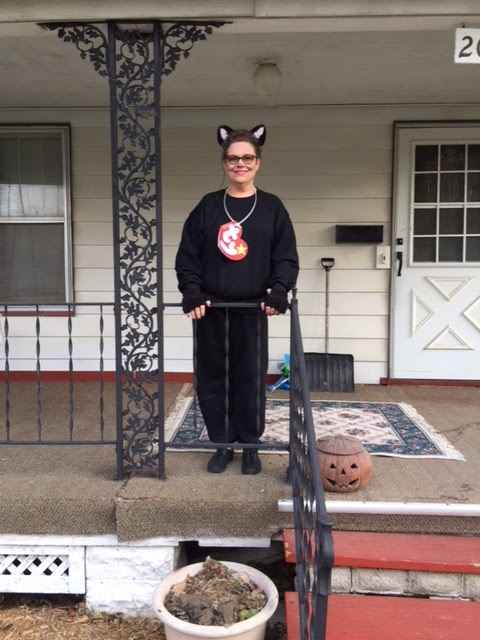
Today I’m dressing as Lauren, a limited edition Beanie Baby cat, complete with tag and Comic Sans jingle:

I am Lauren,
I’m a cat.
There is nothing
wrong with that!

I often dress up as cats. I have dressed up as my cat Kitty; a playful cat with Richard as Responsible Cat Owner to collect pet goodies for the Humane Society, and now as a Beanie Baby.

The Writer as a Beanie Baby

I don’t wear “sexy” costumes — like sexy firemen, sexy cops, sexy robbers, sexy schoolgirls, sexy Little Red Riding Hood … I have no problems with the fantasies running around in your heads — or my head — but sexual fantasies don’t translate well to real life, and they translate even worse to Halloween costumes. These costumes happen to be cheap mass merchandise store purchases rather than quality cosplay costumes, and render sexy as “cheap and tawdry”.  I once donned a cat-in-a-miniskirt-and-fishnet-tights costume just before sneaking out of a departmental Halloween party in grad school. (Casimir Ihe, if you’re reading this, I remember you said, “Jesus Christ, what the Hell is THAT?!”)

 There might be a reason for “sexy” costumes, though — maybe today’s sexual fantasies are yesterday’s ghosts, spirits we are frightened of and try to control, to subdue. The erotic, after all, has been a frightening force since hunter-gathers shifted into agricultural, then feudal, then industrial society — as long as paternity has been an issue, because Eros disrupts family lineage. The ancient Greeks, who came up with the word Eros, viewed erotic love as a force that led to insanity and tragedy. So some people find “safe” ways to play with Eros, by putting on costumes on Halloween that allow them to indulge sexiness without consequences. as some people find “safe” ways to play with Eros in real life by having fantasies of sexy firefighters (Nope, not my fantasy), or by dressing in fantasy tropes like red dresses and Lolicon cosplay.

Whatever your costume, Happy Halloween!

And NO, I am NOT a furry, nor do I have sexual fantasies involving cats.

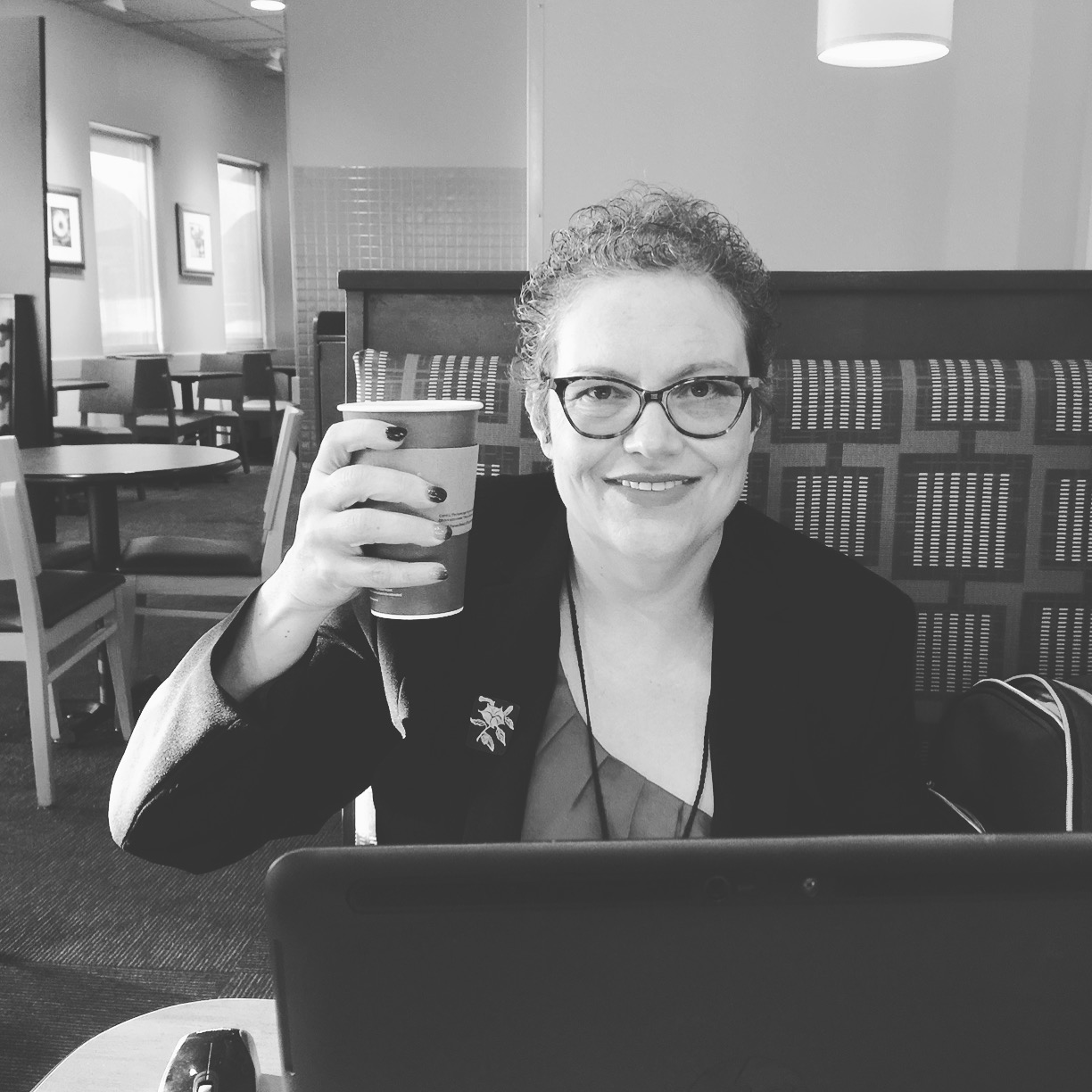
To My Readers — a virtual cup of coffee

All of us have excellent stories to tell.

The shortest story I’ve ever been told: “I was going to do my banking today. So I went to the bank, and it’s on fire.” 
The short story best relying on imagination: “Remember when there was a bounty on coyotes in Missouri? My mom hit one and threw it in the trunk to take to the sheriff. Too bad it wasn’t dead.” 
The best short story I played a role in: “I had a dream last night we were all late for the bank robbery. That was alright, though, because we were all zombies.”
I collect other people’s stories — the one about a friend playing war games in a park, who runs into some woods to take a leak at the edge of a cliff, only to look down and find himself exposed above a two-lane highway. The one about the hunter attacked by a rabid deer and the one about the woman who shot a deer while sitting on the toilet. My grandmother Iverson’s malapropisms and my great-great grandmother who could stop bleeding by the laying on of hands. Silly and clever and maladroit and mournful — I hold stories for people. And holding stories makes me happier than almost anything (except coffee).
I know all of you have stories of all kinds. I would love to sit with each and every one of you (assuming none of you are slashers or stalkers) over a cup of coffee (or beverage of your choice) and find out who you are from your stories. 
I know this vision is against all the rules of the Internet, where we all read each others’ Facebook posts without remarking, and half the posts are reposts anyhow. 
So, again, I’d like to hear your comments, and more importantly, hear your stories. (We’ll have to imagine the coffee.)
Here’s to you, readers!

The Beauty and the Desolation

I’m going to start this with the lyrics of a song that tears my heart out every time I hear it. Last night I lay in bed (with headphones on) listening and feeling haunted by the words. Thank you, Neil Young:

 There is a town in North Ontario
Dream comfort memory to spare
And in my mind I still need a place to go
All my changes were there

Blue, blue windows behind the stars
Yellow moon on the rise
Big birds flying across the sky
Throwing shadows on our eyes

Leave us
Helpless, helpless, helpless, helpless
Babe, can you hear me now?
The chains are locked and tied across the door
Baby, sing with me somehow [ … ]

The plaintive song, highlighted by pedal steel guitar, flows like a slow dance tune played in a swept-out barn lit by hundreds of fireflies. It describes life in a relatively slow northern town in Ontario, where one can see the horizon and the sky for miles. So beautiful, but so lonely, like the mood of the singer. He can remember that gloriously desolate moment, but he can’t return there for real, because it would not be the place he’d left.

The song is called “Helpless”, and every time I hear it, my heart aches as if someone has cracked my ribs open and exposed my heart. I’m frozen in place, staring at that midnight sky with the stars, all the stars, and seemingly thousands of Canada geese in their v-shaped flight.

I think about my own childhood in a small town in Northern Illinois. I can only remember Marseilles (pronounced Mar – SALES, I’m afraid) in grey tones — the slushy grey of winter afternoons as I stared out at the darkening sky waiting for my dad to come home. The sickly green-grey of oncoming tornado weather; the damp grey of slogging home from school in rainboots. The wispy grey of the secrets.

Like Mr. Young, I can’t go home again.

More on Retreats and Mini-retreats

Every morning, I participate in my writing ritual —  I write this blog and try to get my writing goal done for the day (somewhere between 1000 and 2000 words unless I get to a difficult part). Early mornings are my time — it’s 6:20 AM Central Daylight Time and I’ve been up for an hour.

You also know that, every now and then, I need a writing retreat — somewhere with a unique atmosphere, someplace that’s a Place. Someplace that’s preferably a short drive so that precious writing time isn’t eaten away by driving time.

My favorite retreat: Starved Rock Lodge. Admittedly, one of its draws is that I grew up near there. However, being a national-park level log and shingle lodge hidden in a state park doesn’t hurt, either. The Great Hall, with its varnished logs and towering ceilings and comfortable chairs and eclectic visitors, stimulates the imagination like little else. I will not be going home this Christmas, to my heartbreak, because in my opinion, Starved Rock Lodge is the epitome of Christmas — for locals as well as for travelers, including the Jewish families from Chicagoland who have reunions there.

One of my other favorite retreats: The Elms Hotel and Spa in Excelsior Springs, MO. A massive stone-and-wood building in a neo-Tudor style on the outside, the inside harks back to the 1920’s with parquetry floors and dark wood. It’s not hard to imagine that it was the stopping place of gangsters and their molls from Kansas City. One time there, I happened to mention to our waitress that I was on a writers’ retreat and she let Richard and I use an unused part of the restaurant, complete with a couch and a sleek black fireplace for ambiance. She also kept us supplied with coffee (thank you, Laura Sanders!) The bonus: Using the spa, for a massage and an afternoon in the Grotto, which features comfortable lounge chairs, a sauna, a steam room, a whirlpool, a steam shower, and an icy shower. Even if you can’t afford the massage, the Grotto alone — $25 a day — works to help clear a writer’s mind.

Sometimes my husband and I can’t afford (timewise, money-wise, or both) a weekend retreat, so we take a day retreat rather than go to a cookie cutter corporate coffeehouse. One exception on corporate coffeehouses — our local Starbucks is located in the campus library, a spacious and warm space which only needs a fireplace to be perfect in its atmosphere. “Meet me at Starbucks” may be the most welcoming phrase you’d hear on campus, and I hold my Friday office hours there. But because it’s so familiar, I don’t use it for a serious “get in the writing mood” space.

Today, we’re travelling 45 miles to a writing space in St. Joe, Missouri. There are two coffeehouses in St. Joe, and although neither of them are Starbucks, one of them works better as a writing space than the other. Hazel’s, the one I don’t take writing mini-retreats at, has good coffee, but has the ambiance of the gift shop at a Cracker Barrel — lots of gifts for sale scattered across shelves and surfaces — lots of visual stimulation I can do without. The other coffeehouse — Mokaska — is closer to downtown, and has a spacious and old-building look to it: high punched-tin ceilings, exposed ductwork and scaffolding for lights, and old woodwork at the counter. We’re going to Mokaska.

Would it be cheaper to have a writing retreat in the home? Yes, but we don’t really have a good room for it. There’s the dining room, which has the ambiance of the Christmas tree we never took down, but the 20’s era dining table proves to be awkward to use a laptop on. There’s the spare bedroom of our circa 1919 home, but it’s long and narrow and full of bookshelves and Richard’s Star Trek ship collection, so the ambiance it provides could best be called “claustrophobic”. My normal writing place is on the couch in the living room with my laptop and a computer desk. All fine and good, unless I need a change of scenery, and then I retreat.

Have a happy Saturday (Friday? Sunday?) all!

Delusion

I look in the mirror and I don’t recognize that person. In my mind, I am a plump witch sitting in the corner of a room that glows with a crackling fireplace, peering over my glasses at you. I am a waif with huge eyes and fairy wings. I stand on the edge of a cliff, my hair streaming behind me in a storm. In my mind, I am never, ever ordinary.

And then I look in the mirror again, and damn it, I see a round woman with hair that curls into a grandma perm without any effort. I see bookish glasses, a tight mouth that turns into too, too much when I smile. A face to be forgotten, like those of a vanguard of women my age.

Do you blame me for preferring fantasy? Do you ridicule me for wanting to be the protagonist of my own life? Do you scorn me for standing here smelling roses and taking up the space a younger, more beautiful woman could be standing in?

Don’t tell me about it. I prefer my delusion.

Words

Sometimes
words weigh heavily upon my shoulders,
and a touch on my elbow prickles for half an hour.

I’m never “fine”,
but swimming in a torrent of words
about my pursuit of one crystal accomplishment.

Sometimes,
I feel my words
fall to the ground without being heard.

Word Sprints

Word sprints help you write fast, hence the name. They may or may not have a prompt to help you with a topic to write on. They can be timed (10 minutes, 20 minutes, an hour); they can be word counts (100, 200, 1000 words); they can be housed on Twitter (NaNo Word Sprints), done in groups or individually, and can even take the form of competitions.

The whole purpose of word sprints is, like NaNoWriMo, to get your words on paper. You can edit later. I may be using more word sprints this year because I’m not having as many conversations with my characters as I usually do. (I need a good amount of time at a coffeehouse this weekend with Richard to help flesh out plot and character.)

Not everyone believes in the common philosophy behind NaNo and writing sprints — that is, that the words need to get put on paper, in whatever form, before you can polish your work into a novel. This columnist is very much against NaNo, thinking it gives less talented people a license to make their friends read their bad work. (I would have welcomed her point of view had she not come off as a caustic snob who likes to piss on others’ dreams).
************

Here’s the result of a ten-minute word sprint for my WIP, with the prompt of “Someone is getting thirsty”:

The next day I’d wished I’d stayed at the curious place where I had dropped off the stranger the night before. The air shimmered with the heat; I sweated until I couldn’t sweat more. My goal was to drive out of Owayee and back toward the larger highways, because everything in this heatbox looked the same — the short scrubby shrubs, the baked-mud ground pebbled with rocks of varying size, the lack of true greens and flowers. Was it simply going back the way I came? Even with a map, I wasn’t quite sure what highway I looked at. 

There was a lake by where I’d dropped off the affable, enigmatic Daniel. If I could get back to the lake, I would be near water and could take shelter with the commune. They had offered me shelter, but I wanted to continue on my quest. 

Of course, my compass, I thought, and grabbed it from the passenger’s seat with one hand. Of course, as luck would have it, the compass couldn’t recognize true north. I thought the commune had been true north from where I was on the road. 

I drank the last dregs of water from my jug, remembering that I’d filled two five-gallon water bags from the commune’s reservoir. They had been generous. Mari, the leader, had smiled at me and said, “We have plenty more where that came from, Annie.” I felt like crying as the nausea hit me. Then I felt the truck shimmy as my front right tire ripped from the rim.

***********

Is this a first draft? Yes. Upon reexamining it, I know it’s going to take some more filling in, and some wordsmithing. I use “of course” two times consecutively to start sentences. I don’t like “true greens and flowers” as a phrase, exactly, because it brings to mind lettuces rather than vibrant green hues. “There was a lake” should read “I recalled there was a lake”. Her recall of the commune could be slightly more descriptive.

But that was 25 words a minute on something I hadn’t thought about five minutes before.

I’m okay with that.

NaNos — your first draft (with footnotes!)

Dear NaNos (and other readers):

The first draft is not the time to polish your manuscript, or second-guess your ideas or get judgy* about your writing. You can do that later, after you’ve gotten 50,000 or so words on the page**. The first draft is the place to get your ideas on the page — whether that is fleshing out an outline (planner) or channeling creative spirit without constraint (pantser***).

You will be tempted to thoroughly read what you write. Don’t do so — keep writing the words. Keep letting the ideas flow. Don’t censor yourself when you write at first draft point — welcome the plot absurdities and scenery-chewing, the mystical subways and talking trees****. You have plenty of time later to decide whether to keep them or not*****.

The 50,000 word first draft is not to make you a novelist. It’s to make your future as a novelist possible through helping you break through the psychological barrier that makes you think you’re not a novelist******.

So go for it! It might change your life!*******

**********************
Footnotes:

* although colloquial, I like this word better than “judgmental” simply because of the sound of it.

** this is not actually the length most novels should be for the market. It is, however, the winning number of words for NaNoWriMo.

*** as in “flying by the seat of your pants”.

**** oops, I’m the one with the mystical subways, not you. You know what I mean, though.

***** hint: If they detract from the plot and character, get rid of them.

****** NaNoWriMo has loopholes one can exploit if one doesn’t want to write a novel. There’s all sorts of other projects one can undertake — a script, an autobiography, historical fiction …

******* or maybe not. But it’s worth trying.

P.S.: The autumn and the faun

 I live at the border between this prosaic world and others of thundering dark and seafoam and terra cotta, the worlds that enchant. I myself am not an enchantment, not the conjurer of wild visions in violet and silvery green and the wispy white of silken web. I am forever in exile from that world, being only a scholar with words.

In the spring, I met a faun, slender and pale as cream, freckled and innocent as a wild beast. Homely as only gingers can be, long-faced and jug-eared under his masses of hair. I asked him for a story.  I had forgotten — nobody can catch a faun in stillness very long. He smiled at me and ran off, no words spoken.

All summer, I played hide and seek with the faun. I would not tame the beast, because one can only live at the edges of those other worlds if one does not try to own them. I just wanted to hear his story, find the source of his fleeting magic. Fauns do not speak — they smile, and then disappear. I will never learn if that smile was meant for me, and the thought of that makes me feel sad, like I do when I get to the end of a book.

Now it is autumn, and I sense he is strolling across a filmy border to where he belongs. I will write in my warm house with chilly sunlight streaming through the window, where I belong. I will never know what words he would have for me. But I have seen him.