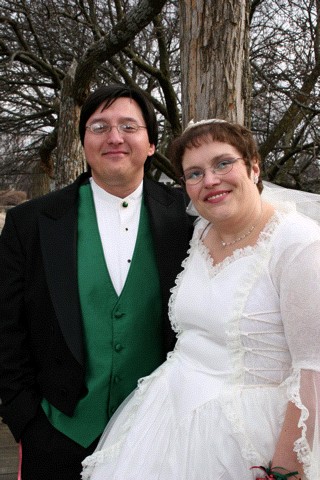
A Geeky Love Story

Have I explained how Richard and I met 13 years ago?

We met on Match.com, which was a thing back then. The full story is much quirkier. Let me explain:

I was a 41-year-old tenured professor who found the pickings in Maryville, MO very, very slim. I had only had two dates in the first seven years of living there, and both of them were men who hadn’t quite grown up (and both denied that they’d gone on a date with me. No idea why.)

I had shied away from online dating, because I was very skeptical. However, at a professional conference, I sat in on a session featuring Life Coaches, who are very talented people who help clients get out of their comfort zones and set new goals. One of the presenters said, “We can work with any problem. Does anyone have a problem they wish to explore?” Me, being the risk taker I am, announced in a room full of 400 people, “I’d like to find a husband.”

After a demonstration of how life coaches help break preconceived notions, I walked out of the room to deal with the bathroom lines. On my way out, an adorable plump woman tugged on my sleeve and whispered, “Try Match.com. That’s how I found my husband.”

When I arrived back home from the conference, I decided to experiment with three online dating sites: The want ads on Craig’s List, Match.com, and eHarmony. Craig’s List was a cesspool of married men whose wives didn’t understand them. I finally got forcibly removed from there because a man I jilted who wrote execrable poetry alleged that I had posted pornographic content. eHarmony would have been a good place if I were conservatively Christian and wanted to be a stepmom to someone’s kids. Match.com was intriguing — I got a lot of “I think I’d date you if you didn’t live so far away.”

And then there was Richard. A bit funny looking, very geeky and quirky, a lot like the people I hung out with in college. He wrote to me weekly, but he came off as — well, oblivious. Even so, I didn’t immediately click with him, and I had two other men in the periphery —  one comically inept, the other a bad boy — that I might have been dating but wasn’t sure.

Richard and I had a meetup in Des Moines as I was on my way to visit my parents in Illinois. My mom called me while I was on the trip and I told her I was meeting up with a guy named Richard at the Barnes and Noble. She asked me his last name and I honestly didn’t know it, so I called Richard and asked him his last name so my mom wouldn’t think he was an axe murderer.

Then Richard invited me up to Des Moines for a Mannheim Steamroller concert. I can get into that family-friendly electronica stuff (although I prefer Dream Theater) so I said yes, and we ended up with our first date. Except that Richard discovered that I was going to eat Thanksgiving Dinner at the local Hy-Vee cafeteria. He invited me up to Thanksgiving dinner, which was an eclectic affair held by one of his friends. That ended up being our first date.

The next day, I introduced Richard to one of my favorite rituals — watching people shop on Black Friday. We said hi to a woman who talked with us briefly, and he later pointed out that she was his supervisor when he used to work at a bookstore —

Then I remembered stopping into a bookstore, where a spectacled man with black hair and Asian eyes recommended a book by an author his fiance loved.

Which is how Richard and I met, more than thirteen years ago.

Boy, Do I Need a Break!

I get off work at 1 PM today, and after that? Spring Break. Americans don’t get as much vacation as do people in many European countries, and when we do get vacation time, we frenetically spend our vacations going places — usually places in the southern portion of the country where it’s over 60 degrees.

That’s not what I intend to do with my spring break. We have such a paltry train system here that long-distance car driving is the only way to travel distances, and the scene from the interstate is less than enchanting. I’m also not fond of beaches and drunken crowds (which is what happens at Palm Beach, Tijuana, Fort Lauderdale and other southern beach properties.)

If I had the money to travel for spring break, I would travel to one of the following:

  • Thailand, to apprentice to a fine cook there and eat durian till I’m banned from public transportation;
  • Vancouver Canada, in the hopes I discover my next career there (not likely to happen)
  • The British Isles, hoping to secure a non-tourist tour that exposes me to real life.
  • Somewhere in Europe, but only if invited, and knowing my husband is coming with me.
In other words, I want slice of life, authentic food, and connections with real people.
What will I be doing for Spring Break?
  • On Saturday March 17, I will be watching the World’s Shortest St. Patrick’s Day Parade and eating traditional Irish faire at the Historical Society. Oh, yes, and celebrating my 11th wedding anniversary (in case you’ve wondered, I’m part Irish (and Welsh, German, Ojibwe, French, Polish, Dutch, Irish) so a St. Patrick’s wedding day makes sense. On the other hand, Richard (although his name is Leach-Steffens) is German and Chinese. 
Us, eleven years ago. We get better with age.
  • On Sunday March 18, we’ll take a trip to The Elms in Excelsior Springs again for a reasonably priced two-day writing retreat. I don’t know if Richard will write, but I plan to work on Whose Hearts are Mountains, the next installment in the Archetype books. (I’m saving finishing Prodigies, a YA novel, until Camp NaNo in April.)
  • From there, it will be garden work and finalizing my annual portfolio. Not much we can plant now except peas, lettuce, cabbages and maybe root vegetables.
Overall, not exciting. I’ll probably post during vacation (like I managed during Atlantic Hope, Missouri Hope, and New York Hope — nothing can stop me, not even depression) 
But here’s a new thought — if you want to, send digital postcards to lleachie@gmail.com. It’s the next best thing to having coffee with me.

If I’m going to put Voyageurs in Kindle Scout next month, I might as well give you a segment now to tweak your curiosity:

p.p1 {margin: 0.0px 0.0px 0.0px 0.0px; text-indent: 18.0px; font: 12.0px ‘Times New Roman’}

We stood outside a solarium, where we viewed a tree line of dead trees and towering plants with huge, decorative leaves. I strolled closer to one to touch one, and Ian grabbed my wrist and hissed, “Don’t touch that. It’s a giant hogweed, and it will permanently scar your skin. And possibly make you go blind.”
“Whoa,” I muttered. “Thanks for the tip.” 
We walked to the solarium, and I noticed that the dirt was beyond cracked. No grass grew, and dust eddied at the slightest breeze. The air felt like a blast furnace. Even the sun looked hazy and malevolent.
“This is what a dying earth looks like. He opened the solarium door, which should have been locked but stood slightly ajar. Inside was Carlie, and she cradled a thick black book.
“Kat, come here,” Carlie said in a slightly rough voice. “I have a secret to tell you. Hurry.” 
I studied the woman’s white, spiky hair, her cheekbones hollowed by disease and age, her wickedly defiant smile dressed up in old woman’s dress —
I hurried over, although I knew what she would say before I heard it, because I knew her more closely than anyone could.
My mouth must have hung open. “Oh, yes,” she said with a chuckle. “You do recognize yourself, don’t you?” She regarded me with ice blue eyes, the same as I regarded her with.
I held her hand for a moment and savored the rare moment of meeting myself, not knowing whether I would be crushed or boomeranged, not caring.
My vision grew dark and I felt drawn through a tiny hole …

Dusting myself off and trying again

It looks like I’m going to subject myself to another round of the Kindle Scout campaign process.

I’m just finishing one more edit of the book Voyageurs for a possible Kindle Scout campaign. It, like Gaia’s Hands (which, with fewer than 15 days left, will not make the cut for publication), is a standalone book for the moment. Voyageurs doesn’t happen in the same space as the Archetype series, so it wouldn’t break up a series (which would make it unattractive to an agent).

Voyageurs is very different than Gaia’s Hands. Where Gaia’s Hands is a delicate, pastoral slice of magical realism, Voyageurs features the sardonic daredevil Kat Pleskovich and the bookish Ian Akimoto from the disastrous ecological future called The Chaos. What begins as a string of suspicious deaths among the Travellers, or time-jumpers, becomes the uncovering of a plot to destroy the world.

Although it would be easy to dismiss this book as a time traveller romance, I’ve skewed things a little too much to use that label comfortably. Present-day Kat’s streetwise manner and her prickliness make her anything but the girl who needs a big man to protect her. Ian from the future, frail and bookish, has more empathy but a tendency to try to ingratiate himself to Kat. Their mentor, Berkeley, is a frustratingly droll time historian who revels in the Socratic Method. The bad guys? You’ll have to read the book.

I would call this book a crossover — soft SF with a touch of mystery and a relationship that helps pull things together.

If you have any ideas about the timing of the book campaign, please let me know.

Thank you for sticking with me!

Moving Forward in More than One Way

I have to share this, because even though it doesn’t have to do with writing (directly), it’s so funny I have to share:

I’m going back to school.

I had long been of the opinion that, once you got a Ph.D. and hit a certain age, you would never need any more schooling. I would have been correct, except for a perfect cluster* of events:

  1. Six years ago, my department at the University got disbanded because they had to cut something, and Family and Consumer Economics (Home Economics or Human Ecology for my overseas friends) was a low-cachet major.
  2. Because I had tenure, they couldn’t fire me without due cause, so they put me in the Behavioral Sciences (Psychology and Sociology) department.
  3. Our school accrediting body, the Higher Learning Commission, decreed that if faculty were in departments they didn’t have a graduate degree in, they should at least have 20 graduate hours in the discpline. This rule appeared within the past three years. I’ve been here for 20.
  4. I fall short of that 20 hours — I believe I have 12 hours in psych/soc classes at the graduate level.
  5. We’re going through re-accrediation here, and our provost has been hired in part to guide us through the new accreditation.
  6. I was advised to take some grad level classes in an aspect of psychology/sociology by my chair — I was never told I would be fired, but I was told that doing so would “make me look better”.
  7. Taking the grad classes will not improve my pay. In fact, I will have to pay for the classes. It won’t help me get to full professor status, because I don’t publish enough research. I’m literally doing this to help my university get reaccreditation.
So I have to enroll in graduate classes … and I couldn’t be happier, because I get a benefit none of them can take away from me — I get to learn and improve. I move forward, which is the best feeling to me. 
I have applied to an online program at South Dakota State University for a graduate certificate program in Disaster Mental Health. I decided this by 6 PM last night, and by 8PM I had turned in my application materials, ordered a transcript, and secured three letters of recommendation from my colleagues with disaster management in their background. A reminder: I became Emergency and Disaster Management faculty simply by virtue of teaching a class in their major. The interest in casualty simulation (moulage) and CERT (community-based first responders for disasters) came from that. 
As I will be taking only one class per semester, I don’t expect it will make too big a cut in my time, and I even suspect that the book about the care and feeding of roleplayers might be a independent assignment. I will continue to write, because I can’t relax by vegging — just by doing**.
So here I am, a PhD taking more college classes, even though it’s ten years till I retire. Life is strange, isn’t it? 
****************
* To my international friends, “cluster” is short for a very salty military swear word that rhymes with “fustercluck”.
** “Doing” is a strange word. We’re expected to read and pronounce it “DO-ing”, but if you look at the word the wrong way, it looks like a sound effect that rhymes with “Boing” and mimics the sound of a fry pan hitting a cranium: “DOING!!”

Besides writing and moulage in my life, there’s gardening.

I dream of the first emerging sprouts speaking to me.

The stretch of the first seedling breaking through the soil with the tiniest pop assures me that change is possible. And each seedling, each plant, has purpose. The lowliest weed has purpose —  dandelion makes a wine whose pale nectar will break your heart. The scrubby lamb’s quarters tastes better than spinach, and purslane is rich in Vitamin A and Omega-3 fatty acids. What is toxic to man may treat your illnesses — the toxic foxglove can be processed into digitalis, a heart medicine that you might have heard of. Even the otherwise useless Cannabis sativa* is a bioaccumulator, pulling heavy metals from the ground and sequestering it in its leaves.

My basement is full of seedlings to go into my summer garden. They live in the former coal room, now a room of grow lights and reflective insulation material on the far wall, with a window that the law enforcement officials can look at and make sure I’m growing tomatoes. This may not be enough.**

Right now, the tomato/eggplant/pepper plants are partying on the top shelf with the cardoon which I thought I wouldn’t get to grow. The perilla seedlings are numerous and vigorous. Hablitzia, yarrow, pinks, and savory are popping up a little more leisurely, and I still can’t get sea kale to grow from seed. The basil — I’m a basil fanatic, but I still may have to give some away. That’s not all the seed flats — I am nearly out of room on my plant shelves, and there’s a dwarf lemon tree I hope gives me lemons for lemonade someday.

At night, when I go to bed, I imagine I hear the plants sighing in their sleep. When I feel down, I contemplate sneaking down to the basement and joining them in the dark. But I am human, and cannot sleep in a garden bed, so I wish them a silent goodnight.

***********
I’ve gardened since I was about five years old, when my second cousin Dale Hollenbeck gave me a plant of his that was dying to see if I could nurse it back to health. I did, and I did the next one he gave me. I had a lot of failures, largely because of my lack of understanding about soils — it turned out that Illinois’ hardpan soil wasn’t a great planting medium for cacti — or much else. It was at that point that I wanted to learn anything I could about plants.

My neighbor Johnny Belletini, who was somewhat of an adopted grandparent (I adopted him), taught me one day that weeds weren’t nameless and had uses people didn’t know about anymore. I was fifteen; he taught my his recipes for dandelion greens and dandelion wine that day, and I made my parents leave the lawn unmowed until I picked all the flowers to make dandelion wine***.  We did everything wrong, but the result (don’t ask me how I know) was a sacrament, sunshine in a glass.

When I was seventeen, my second cousin Francis Koenig**** worked in a state park for a while and had an encyclopedic knowledge of those previously nameless weeds. At the time, I had begun my lifelong interest in edible plants. He would visit me at my parents’ house, and my family would sit mystified as he and I talked about plants — their genus and species names, appearance, habitat, and uses.

Nowadays, I have an odd quest, and that is to landscape my entire yard with edibles. I have raised beds for annual vegetables and for perennials, I will add edible weeds (tastes like spinach) like quinoa and orach and giant lamb’s quarters, and I will add herbs to the rubble-and-dirt hill by the stairs to the backyard.

Many of the edible plants I’ve never eaten before. The moringa thicket in a pot in the basement apparently has excellent nutrition for a green tree, and the scarlet runner beans are a favorite in Britain. But I’m fascinated by vegetables and fruit that can’t be found in a grocery store, just as I am interested in people and places you couldn’t find near a shopping mall.

Later this spring, I’ll give you a virtual tour of my garden (if I can get my SketchUp software running on a four-year-old Mac with no graphics capability to speak of. If you want pictures, let me know.

Thanks for keeping me company.

******************

* I do recognize that C. sativa is not useless; I was just having a little fun. The plant has proven useful for wasting syndrome PTSD, chronic pain, muscle pain, glaucoma, and mental health issues. (Grinspoon, 2018). In addition, it is used as a sacrament in the Rastafari religion.

** There is also a window where any curious law enforcement officer can look into to assure themselves that there is no Cannabis grow operation here. I still feel a certain sense of unease about having a grow room in my basement. I’m not kidding. Not Marijuana

*** I made my first batch of wine at age 15. I did my research first — although there was a law against drinking until age 21, there was no law against making wine at any age unless you made over 200 gallons a year and/or sold it.

**** Francis Koenig died of drowning in 2009. I point this out where I otherwise would have because 1) he was family and 2) he lived lonely because of his neurodiversity. I believe he was on the autism spectrum, as he worked at a sheltered workshop until he retired. I want you all to see that the neurodiverse have lives and feelings and deserve to be members of society to the extent they feel they can. Thank you, Francis, for telling me that hawkweed had edible roots — I look for it often, and I think of you.

************

Grinspoon, P. (2018). Medical marijuana. Available: https://www.health.harvard.edu/blog/medical-marijuana-2018011513085. [March 13. 2018].

The conclusion — for now.

It can’t be helped.

As I crawl out of the other side of my depression, I find that writing is too much a part of my life to quit it.

My characters are almost family members, their stories important to tell. My husband and I talk about them:
“Do you think Grace’s parents had talents?”
“No, but I think they figured Grace had a latent music talent, and that’s why they hid her in the Renaissance Children school.”
I sometimes wish I could have coffee with one of them — the fey Josh; the acerbic Lilith; androgynous, impish Amarel; intense and troubled Greg.

Their worlds are hidden in plain sight from mine, and if I turn around just right, I’ll be at Barn Swallows’ Dance or the coffeehouse where Jeanne and Josh met or the Ancestors’ Room in the Chinese restaurant in McKinley Park neighborhood or the meeting room in the main Kansas City library, sitting in while Future Past meets. I have not managed to find these places in real life, so I write to create them.

About publishing — I’ve decided I will try Gaia’s Hands, the one that’s currently not winning the Kindle Scout process, with a Quaker press. My only sadness about this is, if it’s published, it will be preaching to the choir. I’ll turn Voyagers in to Kindle Scout somewhere around then. If those don’t sell, at least I’ve published and can kick that off the bucket list.

I will always be looking for leads. If you have a friend of a friend who knows of an unusual publishing house, please let me know.

From the sequel of a book I haven’t finished

Last night, I had a vision of looking out a window at a muddy sky at rain sheeting down upon the tops of buildings. I felt like I was waiting for someone, and that if he arrived, there would be an intense conversation. The room was a chunk of the top floor of an old brick building, spacious and dark but for the light from the window.

When I tried to write a poem about it, I realized that I wasn’t the person looking out the window. I told my husband, and he pointed out that I was Ayana (from my book Prodigies) waiting on Grzegorz (another character from Prodigies) that would happen in the next book. (I have visions and Richard interprets them — we’re spooky around here sometimes.)

Maybe I better keep writing.

***********

Reader from Poland — I need your help with the highlighted portions below. The XXXXs are where I need the Polish phrase for the English phrase that is also highlighted. 

*************

Ayana stared out the window of her garret apartment, hardly noting the amber-grey clouds dumping sheets of rain on the tarred roofs of the shops surrounding her. It had been a week since Greg had left the apartment with nothing but the clothes he wore and what he could stuff in the worn military backpack he carried.

She had made a mistake, she had intuited in the aftermath of the argument that broke their relationship. No saving face there — the bout had scoured civility away. She couldn’t figure out how the fight started, except that he had said one word  — “xxxxx”.  Marriage. And then he had said he’d take care of her and the child she carried low in her body. She had panicked, fearing the loss of her autonomy. And out of her panic, she had lashed out at Greg. And he had lashed out at her. She couldn’t tell if it was her rejection of his offer or the words she used. She didn’t remember what she has said except that it was in his native tongue.

The knock on the door startled Ayana.  She stood from the chair by the window, feeling the discomfort in her back as the baby’s weight shifted. “Who is it?” she called out both in English and Polish as she plodded toward the door.

“XXXXXXX,” she heard Greg’s low, rough voice say.

We need to talk.

She flipped the light switch and a soft but inadequate glow bathed the room. She gazed out the peephole to see Greg, wet hair straggling around his face and down his shoulders, his coat soaked. The peephole distorted his wild-eyed looks so he looked like an oni, a demon, and the expression on his face did not bely his seeming.

“Yes, we need to talk,” Ayana murmured as she turned the locks on the door.

Greg stepped in, and he didn’t look any less frightening. His eyes looked shadowed, his skin bone-pale.  He bent and tugged his boots off at the door. That was oddly the custom in both their cultures, odd because those cultures were otherwise so different. Ayana watched him, her heart aching at the familiar scenario.

Ayana stood frozen, speechless, because she wasn’t prepared to cut all ties with Greg. She wasn’t ready.

“I brought blackberry syrup,” Greg twisted his mouth. “We can’t make the baby unhappy, can we?”

“Why do you feed me?” Ayana seethed as the two of them walked to her couch that folded out as a bed. “I think I can fend for myself.”

“Hasn’t anyone ever done anything nice for you?” Greg muttered. “I want to do for you and the baby like I never got to do for Anna.”

Ayana felt a hint of what she feared, being trapped by Greg’s solicitousness. “Where is Anna, anyhow? Tell me she is not with her mother!”

“Anastasja will never be with her mother again. She would be always in danger of her life if she were. No, I have taken her to Shemisław’s. She happens to think of Shemisław as her grandfather. She’s safe while I go through this madness.”

“Madness? Is the PTSD with you again?” That would explain the hollow eyes, the beaten down demeanor.

“No. I was mad when I last left you, and I was mad when I didn’t come back sooner. I walked around like a zombie –“

Ayana studied Greg’s Medusa locks. “I thought you were a demon,” she smirked, feeling a bubble of optimism, then sobering again. “This food thing — is this part of taking care of me? Will you keep me small and harmless? Will you make me stay home with the children and not work with you and Shemisław?”

Ayana glanced again at Greg, and he looked as if he was stifling a laugh. “It’s hard to picture you being small and helpless when you can swear in — how many languages?”

“All of them,” Ayana shrugged. “Including ASL.” Again, the bubble of amusement tickled her mood. “Don’t forget my skills of evasive driving.”

“I don’t know if Iwanow Jr. will ever forgive you for what happened with his Varsovia outside Wroclaw,” Greg grinned, and Ayana remembered her joy in Greg’s fey moods, his quirky sense of humor, and his daring. She had become daring, a spy against the Renaissance movement because of him.

“When you said you’d take care of me, did that mean keeping me shut up inside the house and not working with you?” Ayana hadn’t spoken so clearly in their last argument, choosing instead to use the subtle language of her homeland. She heard the sharpness of her voice, and wondered if she had lost her Japanese communication style forever.

“Oh, you don’t know how much I’d love to,” Greg’s face fell into grim lines. “My whole family died in the bombing of my parents’ house, and I think now and again that I could have saved them if I had only been at Sunday supper instead of busking downtown. Especially now that I know my talent, although I would have exposed myself — and possibly killed myself — resurrecting five people. I would die to keep you from getting killed.”

Ayana noted that Greg had scooted closer to her. She felt his warmth, and it was welcome. “I would die to keep you from getting killed as well,” Ayana sighed. “And I want to work with the others, the Renaissance Children, and to do that I would have to carry at least some of the load and use my talent — and my skills — to help with our forays into Second World Renaissance and their compatriots.”

“I should have taken that into consideration. I warn you, though, I am going to try to protect you from danger from time to time, and feed you whatever you want when you’re pregnant, because I’m a bit of an old-fashioned chauvinist at times.” Greg took her hand in both of his.

“And I’m going to have to tell you to back off, because if you were expecting me to be submissive, they failed to teach me at the orphanage.” She waited a beat or two, and asked the question that sucked all the air out of her lungs when she thought of it. “Are we still together?”

“Would the thought of marriage scare you — that is, if I make my best effort not to make you small and harmless?”

“Could we not do a Catholic service? I’m not willing to convert.” Her Buddhist/Shinto roots kept her from being totally assimilated into a Western culture that more openly courted violence.

“As I’m sure my talent would send me to Catholic perdition when I die, I think I should avoid the Catholic church myself. Can I tell you I love you? I’ve tried to tell you, and you’ve not been receptive to that.”

Again, the bubble of happiness, the effervescent feeling of joy filled her.