The Art of First Sentences

When I sat down to write this morning, one topic refused to be ignored.

That topic? First sentences.

I first learned about the magic of first sentences from an essay by the great (and late) SF writer Edward Bryant. If you have not heard of him, it’s because he specialized in short stories and anthologies. I aspire to write like him, even though his stories were macabre and his happy endings equivocal. Cinnabar, one of his anthologies, was one of my formative reading experiences in high school.  He wrote wonderful female characters that put Heinlein’s accomplished pinups to shame. (Yes, I read Friday, and it scarred me — sex symbol spy decides what she really wants to be is a mother. Madonna/whore much?)

Anyhow, Edward Bryant wrote an essay about the importance of first sentences in writing. They exist pique curiousity, to suck the reader in, and set the stage for the story. He cites one example from an anonymous author in a workshop that he considered perfect: “Today the Pope forgot to take her Pill.” I don’t know about you, but I’m angry that that book was never written, because I’ll never know the end of it.

The sentence I wore on my arms for Dear World makes for a good first sentence: I wrote a love song to a sparrow”. For God’s sake, why??? Now you’re invested in the story.

I work hard to come up with good first sentences. I don’t always succeed. Sometimes I forget that I’m supposed to put work into that first sentence. This morning, I looked at the first page of my WIP, and saw that the first sentence started with “Once upon a time”. It made sense in one way, because someone was telling what looked like a fairy tale, but yuck. That sentence is anemic, trite, and uninspiring. The new first sentence?

When the storyteller finally spoke, her voice took on a tone that reached from my past and echoed into my future. 

The beauty of that sentence is that it’s the key to the book.
The other beauty of that sentence is that it belies the revelation half a page down that Mom is telling the story and it’s supposed to be a child’s bedtime story.
But the story reaches into the protagonist’s past and echoes into her future.

Musing about the Rainbow Bridge

Right now, I’m sitting in bed coming down with something. A cold, the flu, my imagination — I’m not sure. I barely notice the clutter — the clothes racks that substitute for a closet, the pile of stuffed toys on the cedar chest, bins of summer clothes — but I do notice the round black-and-white cat who cleans herself at the foot of the bed. Stinkerbelle, after a long period of antisocial behavior, has settled into her second kittenhood at age 11, where she clings to me and occasionally cleans my face.

What does Stinkerbelle dream of? She’s a simple creature — she likely dreams of food. Lots of food. And enough petting that she actually gets tired of it. Maybe she dreams of playing, because her arthritic hips no longer will let her do so. They give her trouble merely walking, and jumping on the bed requires three tries now.

Maybe she contemplates the Rainbow Bridge. All pets go to the Rainbow Bridge when they die. When they cross the Bridge into the endless meadow, all their infirmities of life are somehow made irrelevant. They can run, they can play, they can see. The rain that bathes the plants somehow doesn’t drench their fur, so they can run in the raindrops.

At the Rainbow Bridge, they thrive until their owners come, and when we arrive, they remember us and escort us to the endless meadow. I wonder about the dogs and cats who were never adopted, and I’d like to think that some of us pet lovers would adopt them there.

Somehow, we owners think we’re going to Heaven or Hell and our pets think we’re going to the Rainbow Bridge to meet them. Maybe the Rainbow Bridge leads to Heaven. But remember — all pets go to heaven. Have we created in our imagination a better afterlife for pets than we have for ourselves?

Dear World and the Transformational Story

  • Reflect on a personal story about who you are, who you were, who you want to be:
    • Write phrases about yourself free-writing
    • Pick a phrase and tell a story about it
    • Tell the story to someone else
    • Review the notes they’ve taken
  • Find a phrase in those notes that tells your story.
  • Have a portrait taken with you “wearing” your story.
  • Share the portrait with others
This is the basic model of how Dear World helps you find your story.
I’ve been thinking about this in terms of storytelling and why we tell stories. Yesterday, I taught about open-ended questions in Case Management class. Open-ended questions do not use words like who, what, where, when, why, how, how many, or how much. Rather, they tend to take a form like “Tell me about …” and variations. In other words, they ask the client to tell their story, which gives the case manager the information they need to help the client and, perhaps more importantly, provide the client the opportunity to tell their story, often traumatic and sometimes sordid, to a nonjudgmental, safe party. It becomes an affirmation of the person, perhaps the first they’ve ever gotten.
I see similarities in the two processes above, case management’s open-ended questions and Dear World’s script for finding stories. The idea in both is for the listener to be a facilitator, and not a shaper, of the story. I see differences in the processes above, mostly dealing with the shape of the final message — one a narrative in a report, one a media-friendly portrait.
How can I get your stories?
You see, I want my readers’ stories. I want to listen to them, to acknowledge them. However, we’re on a social media platform where I write and you read. Most people don’t even comment on blogs (Hi, Chris! Hi, Lanetta! Hi, Lynn! I love you!) because they come here and read quickly, just like everywhere else on the Net. So for me to ask for your stories seems too much to ask.
Tell me who you are in one sentence. 
You don’t even need to tell me your name.
I’m listening.

"I wrote a love song to a sparrow"

I didn’t tell the story I thought I’d tell.

No stories about hardship, no stories about resilience. Somehow, the Dear World storytelling process got to my inner core in less than twenty minutes.

I told a story about love, creativity, and sparrows.

When I was a child, I talked to sparrows. And trees. And squirrels. Mr. Shady Tree lived down the street from me. He had been trimmed to look like a child’s lollipop tree. Now and again I would stop by to visit him. I would offer him invisible TV Dinners and banana splits. He never spoke to me but I felt a sense of comfort talking to him. I talked to the birds in his branches, too. I remember the sparrows best — they were flighty sorts, hopping in small groups from branch to branch, then scattering when cars drove by.

I quickly gathered a reputation from my classmates for being “weird”, and this led to a lot of harassment on their part and a lot of shame on mine. I cared less and less about their “normal”. I isolated myself rather than face the shame.

When I hit adolescence, I discovered more beauty in my world — boys. I felt as if I could study every inch of their faces — their skin, translucent or spotty, their eyes, the truth behind their cryptic scribbles in their notebooks. I could never draw them, never even remember their faces. So I wrote poems. In junior high, I showed the poems to my best friend, and she raised the window sash and announced my crush to everyone outside during lunch. I would spend the time between classes being admonished by the other girls that So-and-So wouldn’t possibly like me back.

The two lived together in shame in my mind — birds and crushes.

One day in college, I wrote a love song about a sparrow. I confess, it wasn’t really about a sparrow — it was about a young man on a bus. He had long, honey-brown hair and round glasses and a faint dusting of freckles and a strong, curved nose. His build was delicate, bird-boned. The rain had drenched him as it had me, but he looked at home in a misty forest, and out-of-place on that grimy bus.

So I wrote the song. Looking back, I had a revelation about this song —  no, two: I had found a way to both talk about my strange reality where birds and trees could understand human speech and maybe even take one on a journey, and I had found a way to talk about crushes without revealing them. I also found acceptance for myself as the child who others found “weird”.

Oh, the song? Here it is:

CHORUS:
Pretty, pretty –
I would not take your feathers,
I would not steal your flight,
I only want to watch you
Spin stars into the night
I’d love to hear your stories,
I wonder where you’ve been,
I wonder where you’re going to
Pretty, pretty.
Who am I to seek you out –
A child who talks to birds.
I’d love to tell you something,
But I stumble on the words.
The poetry of birdsong,
The music of your voice
I wonder where you’re going to
CHORUS
And where am I to look for you?
I’ve squinted at the trees
To watch the flutter of your wings
Float past me on the breeze
The poetry of birdsong,
The music of your voice
I wonder where you’re going to
CHORUS
And who am I to seek you out –
A child who talks to birds.
I’d love to tell you something,

But I stumble on the words.

A story of resilience

This afternoon and tomorrow, I have the privilege of participating in the Dear World college tour. Apparently, it’s a chance to tell one’s story, followed by a portrait with a pertinent phrase from one’s story written on one’s face and body (don’t worry, it’s not a nude portrait).

I’ve been thinking about what my story is. I thought at first it was about my bipolar and my fear of stigma about that. But I realized that the true story is bigger, the worries about it are bigger, the payoff is bigger.

My story is not about survival, and it’s not about recovery.

My story is about resilience. Resilience is defined as the ability to recover quickly from adversity.

As a child, I faced a lot of adversity — by the time I was sixteen, I had been raped once by acquaintances, sexually abused a handful of times, and endlessly bullied at school. I had grown up in an atmosphere of unpredictability, threats of abandonment, and broken promises. (If I have any relatives reading this, I am sorry if you struggle with this account of my childhood. But it did happen.)

But there were also some of the things in place that helped me not just survive, but flourish. My father was a pillar of stability. There were teachers at school who recognized my intelligence and encouraged me to use it. My speech therapist, Miss Gimberling, who I met with from kindergarten to fifth grade, encouraged me to draw and talk. I later learned she stood in for a school psychologist. My intelligence may have helped. Since then, I’ve survived a marriage failure that hooked into my trauma, bounced back from my department at the college being disbanded and being thrown into a department I didn’t think I had a lot in common with, and gotten through the negative experience of inpatient behavioral health ward.

But with all this and bipolar disorder going on, I earned a Ph.D in 1993. I’ve taught as a professor for almost 25 years. I’ve learned a lot, using knowledge instead of defensiveness in meeting the world. I still have to use all those strategies I’ve learned to cope, and sometimes I struggle when the medication fails. I still have bad days. But I’m willing to take those two steps forward before one step drags me back.

And I’ve always enjoyed life. I’ve always collected people’s stories, told stories, laughed at random moments nobody else laughs at, communed with nature, indulged my alter-egos, worn obnoxious lipstick that matches my outfits, followed the exploits of famous internet cats, taught classes outrageously, sworn egregiously, worn cat outfits for Halloween, set Big Audacious Goals and accomplished them, fallen in love, fallen in limerance, fallen in limerance AGAIN, and gotten kissed by more people than you might think, in usually ludicrous circumstances. And to look at me, you wouldn’t believe I’m anything but an older woman with obnoxious lipstick.

I wonder if I should be writing this. Introspection doesn’t necessarily fit into a blog about writing. Except it does, because it explains where stories come from.

Personality and a Mood Disorder: Questions in my Mind

The musing below is something that might eventually get edited for the creative/nonfiction book about living with bipolar. I feel I always take a chance writing about being bipolar in this blog –I don’t want to be considered a lesser being just because the jilted fairy godmother showed up at my christening and said, “Just for not inviting me, this little girl is going to have MOODS!”

Thank you for reading.
*******

When I first got my diagnosis in 2012, I was devastated in a way I hadn’t been when I was earlier diagnosed with simple depression.

There’s a certain degree of difference between being diagnosed with depression and being diagnosed with bipolar disorder. In the former, the disorder can be separated from one’s personality easily. People talk about being followed by the “black dog” when they’re depressed. The “black dog” is described as outside, not inside oneself.

In the case of bipolar disorder, however, both the ups and downs are exaggerated by the disorder. People tend to view their positive moments as their genuine self, even saying “I am genuinely happy right now.” If one’s highs are held suspect, the natural reaction seems to be “Who am I? Who would I be without this lifelong disease?”

I estimate my bipolar became active when I was in high school, if not sooner. My mother described me as “an exhausting child”, and I wonder if that was my bipolar ratcheting up back then. My bipolar has had plenty of time to affect my personality:

People describe me as extroverted, outgoing, and a bit eccentric. However, the things I love to do most are more introverted — writing, puttering around in my grow room, and having one-on-one conversations with people. I think the “bigger than life” me — the one who teaches classes, the one who participated in theatre in high school — came from my feelings and experiences while hypomanic. I’m pretty sure my hand and facial gestures come from there as well.

I say what’s on my mind, even when most people would stay quiet. If I don’t, I feel a pressure — figuratively, not literally — in my brain demanding to let the thought out. Is this why we call it “venting”? 

I’ve developed an internal censor and some tact over the years, because when I first came back to the Midwest after five years teaching in New York state, I scared my students. (For the Americans in this readership, think “Consumer Economics by Gordon Ramsey”. Isn’t it “Dave Ramsay”? Not when I taught it.)  I still deal with that pressure, and that mindset that if we would just drag things out in the open, we’ll all feel better.

I get crushes because beauty strikes me like a stab to the heart. Richard finds my crushes amusing because he trusts me not to pursue anything past friendship. He’s right to trust me. I used to tell people I had crushes on them and that I didn’t want to do anything about it. (Yes, they were flattered. Yes, they thought I was strange. No, they never had a crush on me back.) Some of my poetry is an attempt to relieve the pressure.  I’m pretty sure that crushes are not hypomania themselves, but a high I learned from hypomania. When I become hypomanic they become extremely painful rather than amusing.

Depression has not really shaped my personality, because as it is for other people, depression is not me. Depression descends upon me and separates me from all I love with a black shroud. But I’m sure my unleashed imagination, my curiosity, my optimism, my straightforwardness, and my occasional flamboyance (and bold choice in lipstick) were gifts — yes, gifts from hypomania.

A Writer’s Confession

After the great reception I got for yesterday’s “No Coffee” post, I wonder if I should label every one of my writings as “No Coffee”. Ok, I guess not — it’s perhaps a bit disingenuous to do so, like carving a ten-foot man out of gypsum and dirtying him up a bit and saying you dug him up in your backyard.

To be genuine, I have to confess some things:

  1. Sometimes, I daydream about getting published and critics remarking that I have Something to Say. In reality, getting an agent is one struggle, getting published is another, people even reading what you have to say is yet another.
  2. I don’t want to get published badly enough that I want to write with a commercial sales end in mind. I don’t have to support myself with my books, and I don’t want to write for the market. For those who read in the SF/F genre, I want to be Ursula LeGuin, not Laurell K. Hamilton. There’s nothing wrong with the latter, but her books offer lots of gore and over-the-top (and I mean over-the-top) sex and not a lot of thinking. In other words, she writes for a mass paperback market that wants fast gratification. I’m not sure wanting people to think is necessarily a good thing, but I can’t write like Laurell K. Hamilton. 
  3. I often doubt my ability to write. I wonder if my intros are catchy enough. I wonder if enough happens in my books. I never wonder about my characters, because I know that’s my strong point. 
  4. I do often wonder, even if I’m not depressed, whether I will put writing down eventually. I have seven novels with two on the way, plus one or two non-fiction items. I’m currently feeling more rewarded by the seedlings in my basement — so far, a god-awful number of cardoon, so many that I can’t put all of them in my garden; the tomatoes/peppers/eggplant that were just planted; the moringa tree’s new shoots after I thought it had died; the seeds in peat moss in the refrigerator so they’ll sprout in a couple months. I plant them and am rewarded by visible growth. They live in the garden and feed my husband and I. Sometimes the plants fail, but it’s easy to learn how to keep them alive next time.
  5. We still have no coffee. Our bean order is coming in today, and if I’m really lucky, I’ll have time to make a pot at work (New Guinea, great for a press pot!) .
I do think I’ll continue writing, at least for a while. My reasons, however, may change. My books bear fruit, if only for myself, and that will have to be enough.

No coffee. No. Coffee.

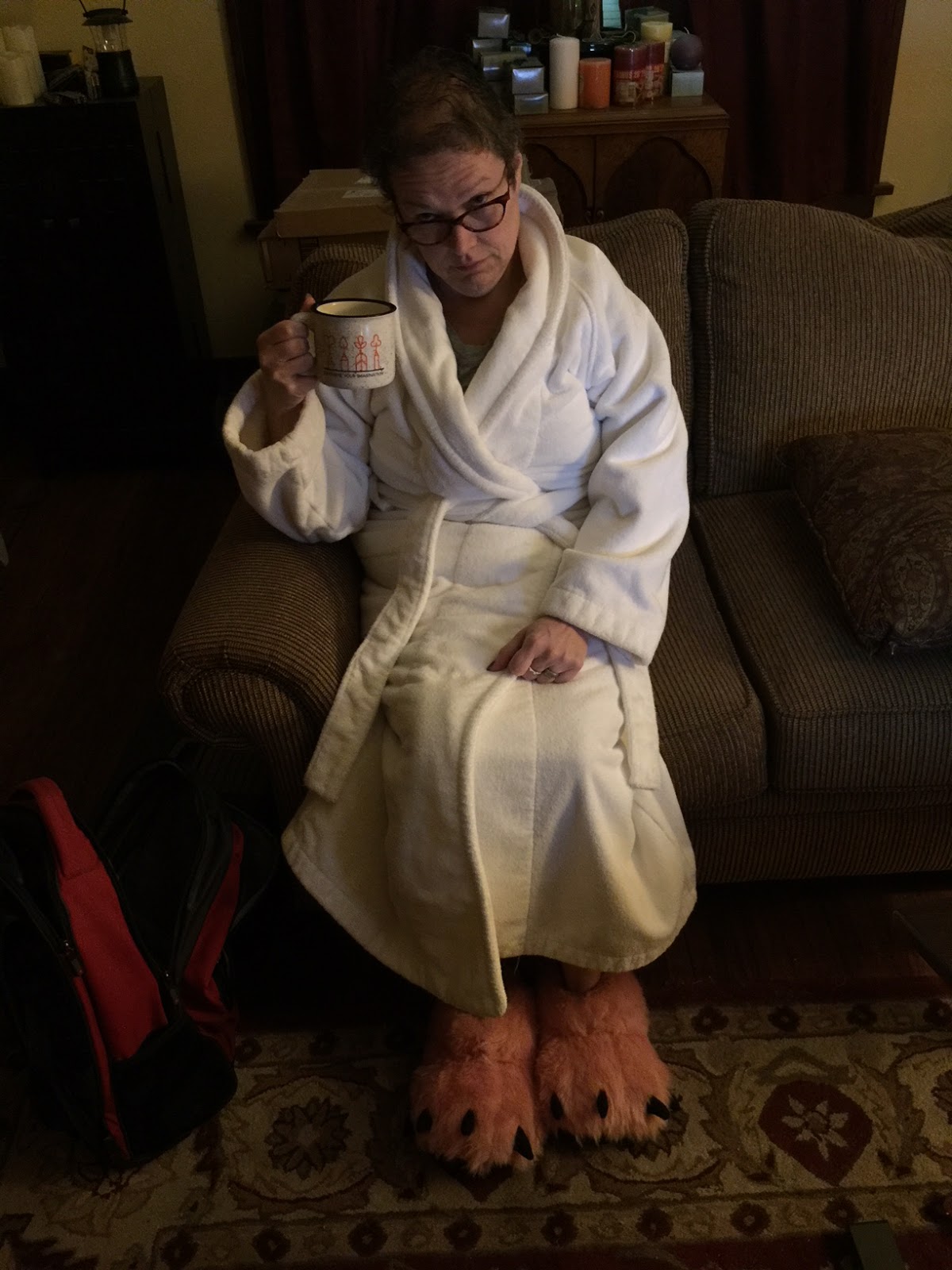
There is no coffee in this cup. We have no coffee. My words — I cannot find my words. I feel my brain cells slowly dying, each death a pinging in my skull. My thoughts are turning grey, withering. It is the cruelest thing I can think of, remembering the taste of coffee yet not being able to turn that memory into real coffee. I took my mug of coffee so much for granted yesterday, as we so often do our privileges in life, until I woke up this morning and there was no coffee. None …
For the love of God, please send coffee.

A Writing Day

I think I’m ready to have a writing day at the local Corporate Coffee. I’m ambitious about it right now because it’s a Saturday and the only other thing I must do this weekend is plant a flat of tomatoes, peppers, and eggplant. I’m cautious about it because I’m on a new medication with the usual bevy of unusual possible side effects, and I’m still coming off the depression. But sometimes I fake it till I make it.

I’m going back to adapting/changing/editing Whose Hearts are Mountains. The concepts I get to play around with are: How do you survive undetected through centuries, even millennium, if you’re effectively immortal? What tradeoffs are there for effective immortality, higher physical capabilities, and the ability to talk to each other telepathically? How do you relate — if you do — to humans? What “tells” are there that might give you away? What if you were one of these mythical beings and you didn’t know it? How would you react if you find out? Most of this is character, not plot, which figures. I love my characters most of all.

I don’t know if I will send any more queries out, to be truthful. Or if I do, where will I send them, because I’ve gone at least halfway through the fantasy agent list with only rejections to show. I’m still not considering self-publication, because the irony is that if you’ve self-published, you won’t be able to get that book published mainstream. I’m reconciling myself with the possibility that the world doesn’t need my books. But I will write anyhow.