First Snow Lives On.

My husband read my passage on First Snow yesterday, and he asked a lot of questions:

  • “Did you get this ritual from somewhere?”  I believe I invented it in December of 1984. There are friends of mine who now have their own rituals. Sometimes they post on Facebook and tell me they miss me. I miss them too.
  • “Do you celebrate it every year?” I’ve missed a lot of years. One time I was in the hospital and missed it. Some years we don’t get snow in November and December, and it seems too late if the first snow happens in February. 
  • “What are the rules?” Funny you should ask:
    • There has to be enough snow expected to cover the grass outside — at least one inch.
    • You need one person minimum, and there’s no set maximum.  However, as you can’t plan ahead of time, the number of participants is limited by who’s available. It’s harder to have guests as you get older or live in a small town.
    • You can either sit in the snow and cold, or bring a bowl of snow inside. 
    • Participant(s) will toast with a beverage associated with wintertime. This includes, but is not limited to, eggnog, hot mulled cider, mulled wine, wassail, brandy, or blackberry brandy.  Regardless of how many participants, there’s only one cup.You can fill the mug more than once.  It’s a ritual; we don’t care about germs.
    • The cup is passed around in a circle. Each participant takes a sip of it and proposes a toast. The first toast is always “To the snow”. The last toast is usually very silly, as all the important things have been toasted to earlier. They get sillier more quickly if the mug contains an alcohol-based fortifying beverage.
    • The toasting ends when all the beverage is gone or all have run out of ideas for toasts. Or frozen to death.
Over the years, I’ve collected stories around First Snow. There was the year (ah! my college days!) when three of us decided to sit on the Old Stone Bridge in Champaign, a small arch over a creek, toasting the First Snow with a mug of blackberry brandy, swathed in an old sleeping bag — and in violation of park rules twice over, with the alcohol and the lateness of the hour. And then the cop showed up. I piped up and told him we were celebrating the first snow and this was hot cider. I babbled out the whole ritual to him. The cop looked down, likely incredulous, and instructed us to finish quickly. It makes me sad to think that if we had not been white college students, it could have ended badly.
The best toast ever was made by Jon Jay Obermark, on a balcony that bravely held eight people and a mug of cheap brandy (E&J, what else?). “To that star up there … and that star there … and that star over there!”
********
It turns out there will be a snow tonight in Maryville. A first snow for the season. 
Richard and I will bring in a bowl of snow as the honored guest, and drink a mug of Irish coffee, my only alcohol for the year. Outside, darkness will press on the windows, and in the First Snow ritual, we will find the light in fellowship. The first toast we will drink will be to the snow; the second, to the people from our past and present, scattered all over the world.
“Through the years, we all will be together, 
if the fates allow … “
First Snow — a Christmas scene

Years ago, I wrote a story called “First Snow”. I searched my crypt of past writing for a copy so I could post it here, but I have no copy. The only copy of the story resided on a computer system/community that no longer exists called PLATO. (For those who spent time on PLATO before there was an internet to play with, I was lleach/pasrf, lleachie/pasrf, laurie/pasrf, and lauren/pasrf. Also mylovelifeis/cursed). If you’re interested in the system that had chat capabilities, advice notesfiles, and serious, unwashed gamers while the Internet slept in someone’s dreams, check out this book: The Friendly Orange Glow

I have the choice of lamenting the loss of a pretty little vignette, or I could try to rewrite it like I am doing with Whose Hearts are Mountains.

***********
Through the years we all will be together,
if the fates allow …

Snugging up my coat and tightening my scarf with mittened hands, I stepped out the door of the computer lab. I noticed it had started to snow while I stared at the terminal typing to wraithlike friends, sharing myself more freely than I did in real life.

The first snow of the season crunched underfoot as I walked under the streetlamp, surrounded by the old, settled buildings of the engineering campus. I had heard the rumor that the University would tear the old University Fire Department down for a shiny Public Safety complex.  I shook my head; the squat, grimy beauty of the current building would be no more. Too many changes. I stepped forward, because there was no way to walk but forward.

The night seemed bereft of people, of noise; nothing except me and the silence. And my thoughts.

My best friends would graduate soon. First, Mike, who would be gone in three days before I could ask him what his family was like. Then Alex would graduate in spring. Others had already drifted away, and I would not hear their stories again. That was the problem with holding people to my heart — they drifted away, and I would let them go.

The snow fell in earnest, shrouding all familiar landmarks in a coat of white. Street lights and phone poles stood starkly against the billows. My footprints stood in stark relief as I turned around and viewed them, the only footprints marring the snow. Each step was into uncharted territory; each footprint showed that I had survived that part of the journey, but that I had survived it alone.

Alone — no, not alone. I held the memories of my friends; I held their stories. There would be no new stories when they left, no new memories made, but there would be what I held now.

As I crossed from the campus to the shady streets of Urbana, I stopped in front of the University High School, its Gothic hulk softened by snow. I glanced up at the streetlight — an old-fashioned globe light — to see the swirling snow fashion it into a star of sorts, close enough, and I let my husky voice rise:

… through the years, we all will be together,
if the Fates allow —
hang a shining star upon the highest bough … 

And that was what I would do when I got home. I would decorate the tree in my tiny apartment, hanging the star at the top, and drink a toast to memories and to the first snow. Like snow, friendships could melt at a moment’s notice, but memories would last.

Time Machine: a 25-year-old first draft of the WIP

I might have mentioned that I started the idea of the current WIP, Whose Hearts are Mountains, twenty-five years ago. I might not have mentioned that the inspiration for it was a long nap necessitated by a kidney infection with no codeine for the pain.

I found my old notes for the jokingly-named Dirty Commie Gypsy Elves, which read more as background notes than as the first chapter it was intended to be:

*****
 I stood at the edge of the desert, wondering if a legend was worth risking my life for.

I was leaving nothing behind. My parents were killed five years before in a Klan raid of the Underground Highway for smuggling blacks accused of “insurrection” out of the white supremacist territories. When they died, I was half a nation away, snug in the coccoon of academia.

Two years later, my coccoon was destroyed in the Blue Collar Riots of 2012. I was taking a coffee break in a faculty lounge discussing fast-food horror stories of the 1970’s as folk legend, when the building fell under siege. After three days of being held hostage by some nameless faction, I was one of five hostages to survive. I did not, however, survive unscathed.

The Blue-Collar Riots were the beginning of the final collapse of the nation. The world economic failures brought the riots and the local wars to a stunned silence. Meanwhile, I had acquired a truck, tooks, and survival gear through barter and black-market trade, and became a wandering anthropologist, studying the drastically-changed society for no one but myself.

I first heard the legends in the District of Columbia, where a shell-shocked militant struggled to keep the remnants of the States together. I had shared bread and cheese with a black transient on the charred steps of the Lincoln Memorial. He told me stories he had heard, in a voice as thick and dark as the nights in Washington: stories of a shining city in the desert, where wild and beautiful folk lived, enchanting people with their soft songs and wild abandon.

*****
Notes from 20 years later:

  1. When I first wrote this, three people thought I was a prophet, and one wanted to rush right out and create the commune. I passed on both. However, I look at the current state of things in the US and wonder if I was just a few years off.
  2. I apologize for my clumsy handling of race. Did I really need to state the transient was black? Does it serve the story any? A description of him would have accomplished the task much more sensibly and sensitively.
  3. Speaking of description — Where is it? This reads more like notes, but my name and address are at the right side of the document as if I wanted to submit it for query! I’m pretty sure that each of these paragraphs is now a whole chapter in the current book, which is why I’m not offering a “then and now”. 
  4. Questions that should be asked: What is the main character thinking? How did the Blue-Collar Riots progress to wars? How did the financial situation worldwide create a “bang” scenario and not a “whimper” scenario — in other words, why did the US fall apart in a few years with bomb damage instead of just wither away? And what was she doing in those three years?
  5. The mysterious folk in this version were supposed to be Sindarin who didn’t go over to where the rest of the elves went. Elves have shining songs, but have the wild abandon of a Presbyterian elder. 
My husband asked me why I didn’t complete this twenty-five years ago, and the answer is stunningly simple: Because I knew it needed detail, and I couldn’t get my hands on it. To be more specific, I didn’t have the Internet and I was totally stymied as to what deserts in the US were like.  And, as a grad student, I didn’t know how I could arrange, much less pay for, an educational trip to the desert. 
So I’m writing it now. With more detail. As two books. 

I’ve received two same-day rejections from my latest 3-a-day query sendouts. That’s a little hard on my system, although at the same time I appreciate not waiting. Someone once told me that querying is a lot like dating — you have to face a lot of rejections.

I’ve had to face a lot of rejections in dating — A LOT. In the days before wingmen, there was no buddy to woo the — oops, now I remember the really dimunitive circus acrobat who showed me his 12-page Bulgarian drivers’ license while his taller comrade tried to woo my tall, blonde, vivacious roommate Kristy and our other roommate, Beth, cleaned up the pool table like the pool shark she was. (Yes, that sentence should be read all in one breath, because that’s how it happened.) That was a true wingman. And he was cute, but I wasn’t into one-night stands in a performer’s train berth.

College stories aside, back to the topic of rejection. I have lots of practice in accepting rejection from the dating side of things. Some guys gave me nice rejections — “If I were straight, I’d date you”. Some gave me mean rejections — “You’re fat. You must have a self-esteem problem.”

I’ve had lots of rejections for jobs too. The nicest one told me who they hired, and she had 20 years experience and a textbook under her belt. The most frustrating one basically said they couldn’t find a qualified candidate for their consumer — or family — or whatever — faculty job despite 206 applicants.

I have about 12 queries out now — oops, ten — and I send three out every day. I will send 72 out by the time I’m done. And if this time is like last time, I will have 72 rejections. Some rejections are form letters. Some are really nice, and I wonder if those are form letters as well. All of them tell me to keep trying.

I keep trying under the assumption that I haven’t found the right agent yet. And if I keep trying, I will find the right agent. I accept that my writing style and ideas aren’t necessarily simple enough for genre fiction (like science fiction and fantasy), but maybe too non-mainstream for literary fiction. I’m in an odd place.

As a Friend (Quaker), I believe that I am called by the Divine to write secular books about fighting societal ills in the present, but set in a near future with fantastic elements. I’m called to write, but maybe for a purpose that has nothing to do with getting published. I don’t know. But if the world needs my novel, as NaNoWriMo believes, I need an agent.

Writing with Cats

One of the things that doesn’t become obvious when you read my blog is that I have five cats: Stinkerbelle, Me-Me, Snowy, Girlie-Girl, and Charlie. Each of them have multiple nicknames:

  • Stinkerbelle: She’s the rotund black-and-white cat. She goes by Stinky, Soccerballee, Turnip Head. She’s 11 years old and lives next to the food dish. We have to prod her every now and then to see if she’s still alive. She’s not sick — she’s just that lazy.
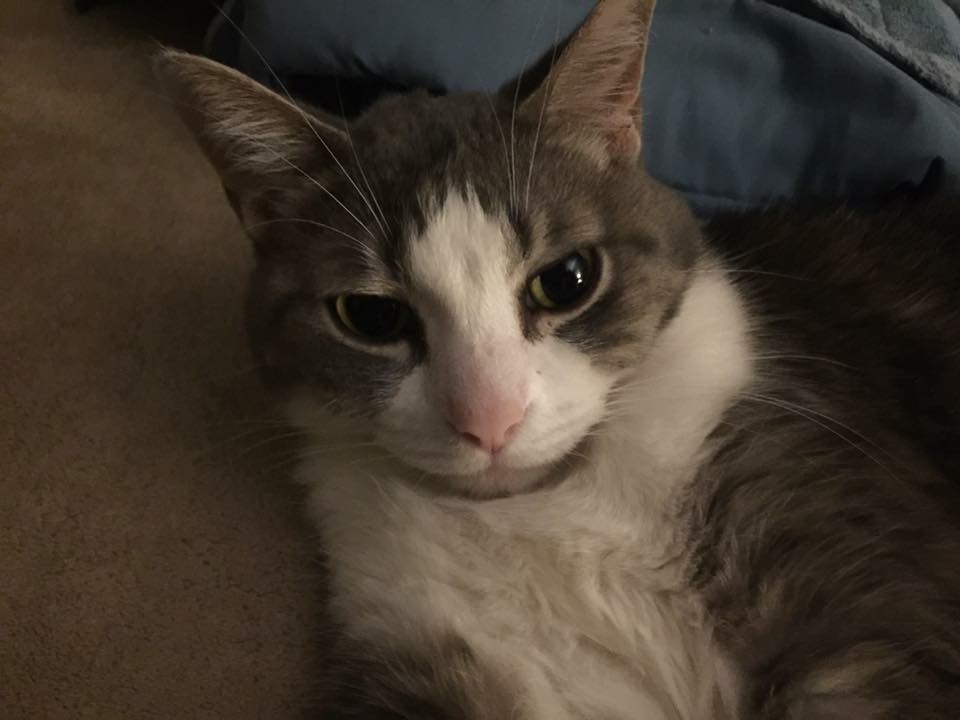
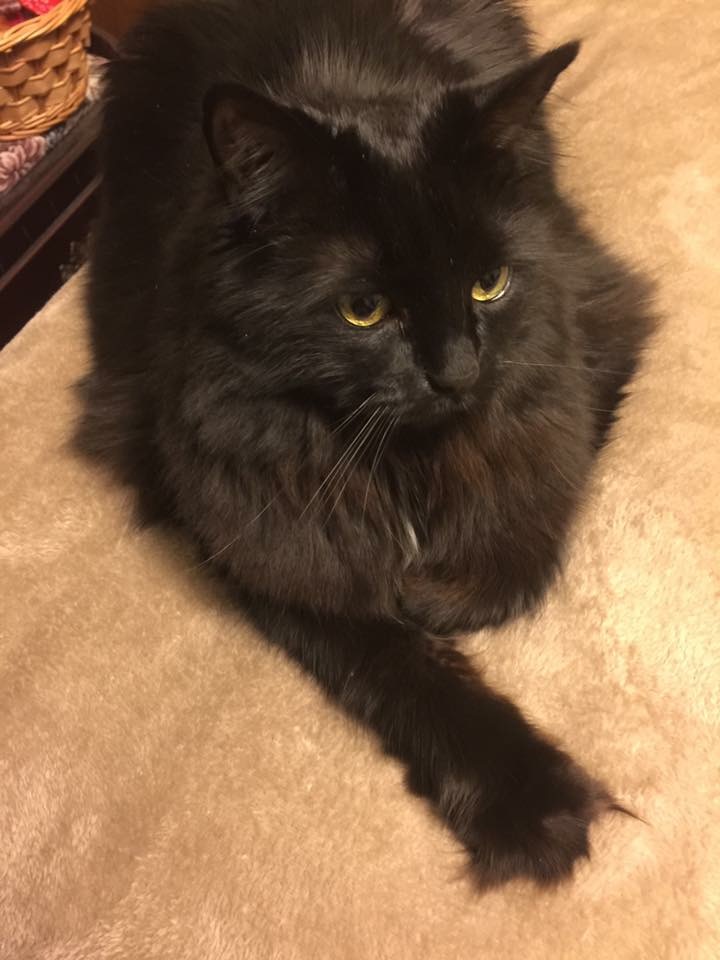
  • Snowy: Almost pure black longhair. She goes by Ironic Cat, Snewy, and No-ee. She’s the prima donna of the batch, sitting with paws politely crossed.
  • Girly-Girl is a patched tabby. We call her Squirelly-Girl, Twirly-Girl, Cattywumpus and Butterbutt. Very prosaic, as if she were a farm cat in her last life. She can jump four and a half feet from the loveseat to the couch and jump over me on the couch with minimum effort.
  • Me-Me is a petite blue tabby and white. We call her Meemerz, Weemerz, Meemer-butt, Wiggle-butt and Weebles. Pretty little con artist, but pretty independent.
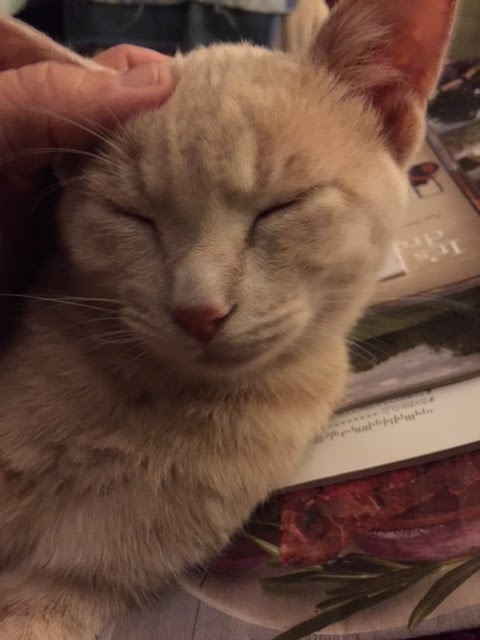
  • Charlie is a six-month-old buff tabby and the only male in the bunch. He goes by Chuckie, Chuckles, Chuckroast, Chuckie Monster and No! As you might expect, pure energy and mischief.
Snowy, AKA Ironic Cat 

Stinkerbelle when younger

Me-Me, who looks like she took this selfie. 

Girlie-Girl, my editor

Charlie, in a rare non-evil moment.
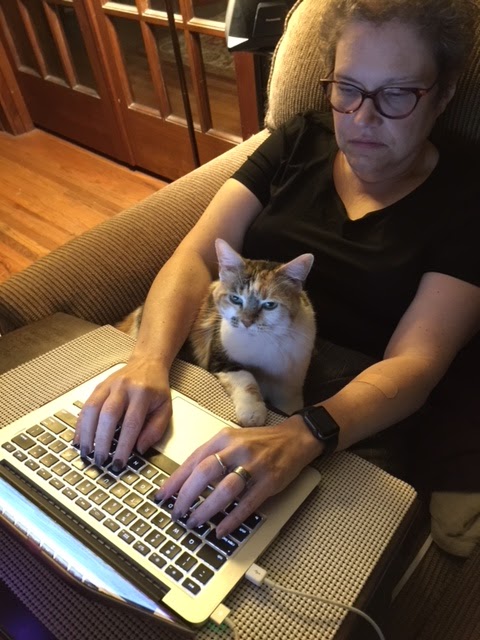
The average morning early writing goes like this:
  1. Snowy sits on the arm of the couch next to me. A few minutes later, she gives me The Paw. Then both paws.  On my right arm while I’m typing. This is a signal to drop everything I’m doing so I can pet her. One hand is now occupied.
  2. Girlie jumps on the couch on the other side of me and plasters herself against my leg and purrs, even though I’m not petting her. Just wait.
  3. Girlie starts giving me The Paw. Only one paw, but she pokes at me in her rapid Kung Fu fighting strike. I pet her with the other hand.
  4. Snowy feels neglected because I’m not petting her hard enough, She starts headbutting up against my arm. I pet her twice as hard.
  5. Me-Me lounges on the floor, waiting expectantly for something. Charlie saunters down the stairs; Me-Me jumps up. They touch noses, the equivalent of shaking hands in the ring. Then they start whacking at each other.
  6. Girlie jumps off the couch to turn the twosome into a free-for-all MMA match, employing her Kung Fu fighting strike to the middle of the pile. Nobody is yowling, which makes me wonder if they like to fight.
  7. Snowy jumps off and saunters to the loveseat, where she sits on the back, since she doesn’t have to compete for attention anymore.
  8. The three-way fight on the floor breaks up with three cats scampering. Girlie jumps on the loveseat with Snowy, Me-Me sprawls on the ground, and Charlie bites my toes, then scrambles off.
  9. Snowy runs over to me for reassurance, with both paws and headbutts. 
  10. Richard turns on stereo.
  11. Snowy stands on my lap, in my face, meowing, headbutting my face. 
  12. Charlie sharpens his claws on the speaker. Richard yells, “No!” 
This is life with my cats.

My Attempt at Writing Santa

I really don’t know how to write in the romance novel trope:

  1. I’m much more interested in relationships than sex. In fact,  I can’t write sex scenes without laughing.
  2. I don’t like the traditional gender roles expected: He’s strong rich and powerful, she’s beautiful (and maybe accomplished, but not as much as him). 
  3. Because I never wished for That Guy, I am out of touch with that particular female fantasy.
That being said, here’s an excerpt of a “meet cute” from my novel, The Kringle Conspiracy,  which was rejected by Harlequin for the above reasons.  I think it’s a fun exploration of the Santa mythos for adults.

*******

Marcia stood in front of a store she had somehow missed her first time down the block. She wondered how she could have missed it, as she could see through its windows well-crafted wooden toys and children’s furniture, not to mention dollhouses, rocking chairs for adults, and small carvings. Perhaps, she thought, she had dismissed it because of the “Closed” sign that hung on the door.

p.p1 {margin: 0.0px 0.0px 0.0px 0.0px; text-indent: 18.0px; font: 12.0px Courier} p.p2 {margin: 0.0px 0.0px 0.0px 0.0px; text-indent: 18.0px; font: 12.0px Courier; min-height: 14.0px}

As she stood there, nose pressed against a misty show window, she heard the jingle of keys. Her reverie broken, she turned to see the flannel-shirted man, a short, rugged-looking redhead with a close-cut beard, turn a key in the lock.

“Sorry I wasn’t here,” he said pleasantly as he pushed the door open. “I had to get some – hey, weren’t you just in the Book Nook?”

“Yeah, I was the one who chatted with your Santa friend.”

“My Santa friend – oh, yeah, Jack. He’s actually retired Air Force, believe it or not, but he comes out of retirement every year to play Santa for the community.”

“He does a great job. So, is this your store, or do you just work here?”

“This is my store.” He indicated the door with a flourish and stepped behind the glass counter full of small wooden sculptures.

Marcia stepped through the door he held open and instantly gravitated toward a wooden car that sat on a glass shelf, a cut-out with wheels. Of plain, unpainted wood, the car showed painstaking craftsmanship in the smoothness of the finish, the pleasant contours that comforted a hand. Marcia pushed it, feeling the “clack-clack-clack” the wheels made as it traveled down her invisible road. “I bet little kids really like this.”

“Not just little kids, apparently.” From behind the glass counter, the man grinned at her, a grin that removed all mockery from his words. Marcia realized that he was not as young as she had thought in the coffeehouse. He had the slightly weather-worn look fair-skinned men get in their thirties, with laugh lines around the eyes. The faint freckles and red hair, she thought – those must have thrown her off. 

“Oh, wow,” she breathed as things clicked in her head. “When you said this was your shop, you meant this was your shop.”

“Well, yes?” One eyebrow quirked itself at her.

“I mean – you make this stuff, don’t you?”

“Absolutely.” 

“Wow, you have a real talent!” She looked at the walls, the shelves with toys, the dollhouses, the hobbyhorses all glowing with warmth. I mean, I used to play with trucks like this, but they never felt so good. I bet your dollhouses have stairs that really go up to the second floor!”

“Where else would they go?” The shopkeeper chuckled, and Marcia sighed happily.

“I’ve always hated dollhouses that you can’t really walk through. And dollhouses that are all out-of-proportion to themselves.” Marcia talked rapidly, breathlessly, then stopped. “Listen to me get so worked up about toys!”

“And what’s wrong with that?” He casually strolled over to where she stood by the car, still idly pushing it.

“Nothing, I mean …”

The flannel-shirted man cut her off with a question she hadn’t expected. “Are you from around here?”

“No, I’m on sabbatical here till the end of the month.” She was relieved to talk about something she felt comfortable with instead of babbling. “I’m a grant reviewer for a private foundation.” 

“Sabbatical, eh? That means you’re a professor?”

“Got it in one. Just got tenure last year, and the college thought they could spare me one semester of leave to recover.”

“I should have guessed you were a professor.” 

She glanced over her shoulder, and saw that he played idly with a pen. “Why?”

”Because you don’t miss anything. Luckily, though, you’re not one of those stuffy arrogant types.”
Again, his smile, the raised eyebrow, took all potential sting out of the words.

“What makes you say that?” Marcia asked. “I might be stuffy and arrogant for all you know.”

“Because you still know how to say ‘wow’.”

“Wow – er, I mean, thank you!” She felt her cheeks grow warm.

“See what I mean?” 

Marcia’s cheeks grew even warmer. Fortunately, as she glanced up at a simply elegant mantel clock, she found an excuse to flee – “Oh! I’ve got fifteen minutes to get back across town!”

“Here, take this with you.” The man handed Marcia the pen he had played with, and she discovered that it had a business card tied to the end of its smooth, curvy, turned-wood body.

“Kris Kringle’s,” Marcia read aloud. “How odd … but this shop is yours and not the Santa guy’s?”

“My shop. I’m Kris.” 

“Kris – oh, no, not Kringle, is it?” Marcia laughed.

“Nope,” he chuckled, “Kriegel. But you can imagine what it was like for me in grade school. I decided to use it to my advantage.”

“I know all too well. I’m Marcia Wendt – as in ‘Marcia Wendt to Hell?’”

“Oh, dear,” Kris Kriegel said sympathetically. “You do understand, then.”

“Well, nice to meet you, Mr. Kriegel, but I do have to go. This pen – it’s too nice to give away, isn’t it?” Marcia felt torn – the pen was glossy and fat and entirely too pleasant to the hand. 

“No, really. It
s yours.” He curled her hand around the silky wood with both his hands, which felt warm and calloused.

“But why?”

“So you won’t lose the business card, of course.”

An excerpt from my work in progress

As we stepped outside into the night, I saw a group of young men standing in the yard, lit only by the odd lantern. I noted that Hakeem’s colleagues from the alliance wore gang colors — in fact, they wore the colors of opposing gangs, one group largely Latino and one Asian. They regarded each other with a wary cordiality, and I wondered if this alliance could blow up into violence at a moment’s notice.

The heads of each group — one wearing a grey bandana tied around his upper arm, one a red bandana tied around the opposite arm, like their followers — came up to shake my hand. “I hear you’re a Schmidt,” the Asian man with short-buzzed hair and acne scars squinted shrewdly at me. “I have uses for a Schmidt.”

“I’m sorry,” I said very politely — and very uneasily. “I have a quest I’d like to go on.”

“We could make it worth your while,” said the babyfaced Latino leader with a tattoo of a teardrop under his eye — a sign he had done time in prison or even killed someone.

“I’m really sorry. Part of me would love to, but I’m haunted by a story.” I felt nervy telling this to a gang leader, but I boosted my bravado with the reminder I had cheated death once already.

“Let’s tell stories later. I might have one you’d like,” the Asian leader shrugged.
I inwardly sighed in relief, because I was likely surrounded by more firepower than I’d been in the hostage situation. 

We moved, with myself the only one not in black, toward the looming refinery. I probably should have been to reduce my visibility in the night. “Break up,” each gang leader whispered to his crew, “two by two.” I stuck with Hakeem, the broker, who looked almost undistinguishable in his faded black hoodie. We drifted, two by two, by differing paths, toward a door in the back. 

When I arrived at the door, I expected to see the glow that distinguished a Schmidt 4000 on battery power. I saw none. Rushing to the lock, I realized that the battery had been stolen. I tugged at the handle dumbly, feeling the others’ eyes boring into my back. Of course, the handle didn’t give, because a Schmidt lock with a stolen battery stayed in the locked position. 

Frantically, I put together all I knew about Schmidt locks from my father. When a battery died in the lock position — ahh, that was it. The wafer drive could be used as an override key, a secret perhaps only I knew. I reached up my sleeve for the — 

No, I couldn’t do that. Any one of the people in the huddle around me could kill me for what I had tucked up my sleeve. They were gang members who were heavily armed, and I was a woman whose only weapon was a shotgun with birdshot back in my truck. 

I took a deep breath. “Are you people of honor?”

An anonymous voice near the back snarled, “Those are fighting words — “

Hakeem jumped in. “The lady has to keep her trade secrets. She’s a Schmidt — “

“I already gave you that secret,” I told the leaders. “You’re the only ones in the world who know I’m a Schmidt. That gives both of us a responsibility. On my side, I will have to answer any call of yours I can if it’s a life-or-death matter with that lock. Deal?”

“We already made that deal with you,” the Latino leader, stocky with curly hair half buzzed, half-curly, intoned.

“This other secret, though, this trade secret, is deadly. It could get me killed if you know, and it could get you killed if you know. It’s Pandora’s box — you can’t put the secret back in. The secret’s like a deadly virus — if you can’t keep it contained, it will kill you.” I hoped to God — mine, Hakeem’s, or anyone’s — that they would listen, because all that I said was in some sense true.

“Can you get that door open with it?” The Asian leader spoke.

“Yes, but everyone has to turn their backs, so they don’t see what I have.” Everyone turned their backs. “Ok — “ I said before turning to the lock, and saw Hakeem turn slightly —

“Hakeem, no,” I yelled. One of the red bandanaed men turned and clocked him. Hakeem spun to the ground.

“Fair shot,” Hakeem groaned, straggling upward. Everyone again turned their back to me.

p.p1 {margin: 0.0px 0.0px 0.0px 0.0px; text-indent: 18.0px; font: 12.0px ‘Courier New’}

I had one frightening moment when the first pass of the wafer didn’t click the lock open. Then I took a deep breath, flipped the wafer — and the locks snicked open.

The explosion of visits yesterday — I’m curious.

Yesterday’s post hit 173 readers, which is three times the average amount of reads I get for a post!

Thank you, everyone! Please come back! 
I wish I knew who all of you were so I could thank you personally. 
I wonder how many of you are people I know and how many people came to visit for the first time. I expect that one-third of you are regular readers, and that half of those are people I know. (Hi, Lanetta!) 
That means 2/3 of you visited because you were attracted to the concept of graduation either through my Facebook (in which case you know me), Twitter, or search terms on Blogger, or because you were just bored. Or maybe you were an agent, but I only gave my blog address to one agent so far.
I have no way of knowing who you are, and as they say, curiosity killed the cat.  Each of you has a story. Each of you has a reason to visit — whether it be “Because I’m graduating,” or “Because I was bored,” or “Because I’m a regular reader”, or  “Because it sounded interesting,” or “Because I know you,”or “I have no idea”. Each individual reason has a story.  
I wonder how many of you will be back to read this post. In a way, it doesn’t matter, because this IS the Internet, where we read anonymously and write anonymously, even if we’re writing nasty dreck on Facebook. For all the information-sharing, we don’t really know each other here. 
But what if we started to?

Graduation as a Ritual of Closure

A little story about myself: In the darkest moments of my graduate career, when I wasn’t sure I had the energy to finish, one shining beacon would keep me going — the thought of being able to wear the professorial hood at other people’s graduation. When I received my PhD, after the ceremony where I rented my cap and gown and hood, my academic advisor gifted me with a hood in University of Illinois regalia colors, and I wear it to this very day to students’ graduations.

According to “A Field Guide to College Professors”, this hood belongs to
someone with a Ph.D. from University of Illinois. You can tell from the
navy blue with orange stripes.

I teach three classes and handle the internships in my department, Behavioral Sciences, at Northwest Missouri State University. Between students in my classes, advisees, and interns, I work with about 150 students a year. I can tell the graduating seniors in the class after midterms — this is when they start counting the number of days until they graduate, and they’re extremely accurate. In fact, one class posted the number on the board every class period. A student in another class could calculate the days to commencement to the hour.

When one of my students asks if they should go to Commencement, I say “YES!” Why? There are some downsides to commencement (graduation) ceremonies — for example, they run long, gowns are hot and sweaty, commencement speakers are boring more often than not, and there are big crowds at the cookies and punch.

However, without going to commencement, students may never feel like they’ve graduated. Commencement ceremonies provide a sense of completion and closure through their ritual — the graduation gowns, the processional, the professors in academic regalia, the discomfort of the flat cardboard caps that students often decorate, the selfies with friends and professors.

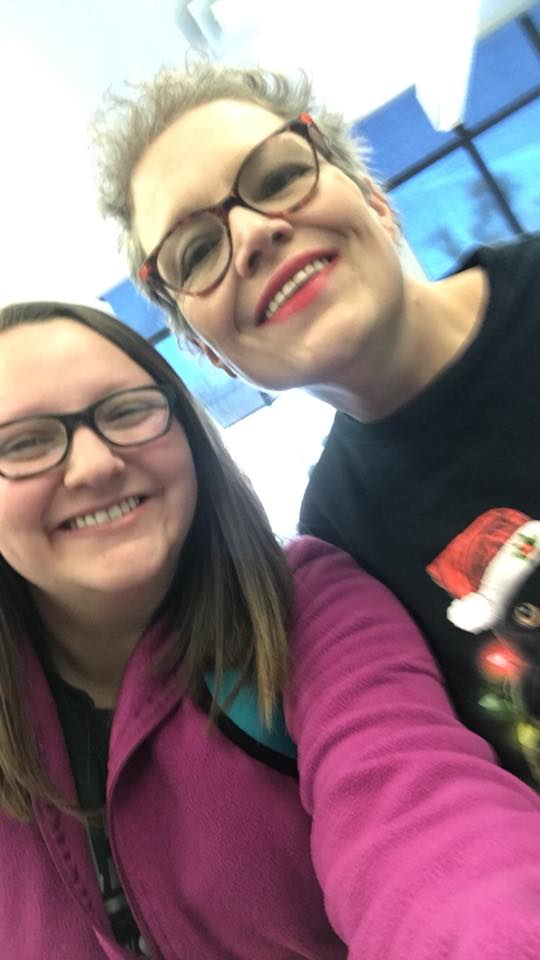
This selfie with a student was taken right after the final for the class.
Hi, Maggie!

Graduation and its ceremonies create a sense of completion and closure, as I said earlier. More important, they provide a rite of passage, something that is spiritually important. In the US, we have a crisis of rituals for passage into adulthood — high school graduation used to be the rite of passage into adulthood, but we no longer consider it so because of college. However, not all high schoolers go to college, so those teens no longer have a rite of passage. On the other hand, we don’t consider college students as adults, nor do they consider themselves as adults. This might help explain things like street gangs, which provide a sense of family and an initiation ritual that could serve as a ritual of passage.

I try to include rituals in my writing, as they’re so important in keeping a society together. We have religious ritual, academic ritual, holidays. Some of us have individual rituals, like mine of having my annual alcoholic beverage (Irish coffee) on Christmas Eve. Social/community rituals tie us in with our “people”, our community, our society. They give us a definition and a sense of community.

Something to think on.