Post-Mortem of a Crush

Note to readers: I do not have multiple personality disorder. I am just very aware of when aspects of my personality were forged by experience. This is just a writing exercise, thinking of a situation when I had a crush once.

************

Did I mention that I contain multitudes?

My fifteen-year-old self followed you like a puppy, wriggling for a little attention. My seventeen-year-old self, the intense one, stood dumb, disconcerted by beauty. The older and wiser me just wanted to learn what it was like to be artistic, having taken such an analytical career as academia.

My younger selves meant no harm. They didn’t wish to make your body tense up while reading online, wondering if I spoke about you or not. They didn’t mean to worry you. Sometimes our inner selves can be needy. I’m sorry if I was a problem.

You may not have even noticed. I think this is very likely. You have your own needs, your own multitudes, your own shadows, your own occupations. This might just be what dazzled Fifteen.

You may not ever read this blog. That’s okay; I have no idea who reads this. Just know that I needed to say it, being full of childhood Catholic guilt at a moment’s notice (I think Seven takes care of that). But my multitudes need closure.

My Latest Adventures in Querying

I’ve been brushing up my query letter for Voyageurs after having gotten a comment from an agent that I should. (I believe she said “This is a good source for learning how to write a query letter.”) Beautiful response, but I felt the burn across the Interwebs.

Here’s the new, improved query (the generic version; this will get tweaks to personalize it):

Dear Recipient,

My name is Lauren Leach-Steffens, and I have a thought for you to entertain: What if climate change had been accelerated deliberately through manipulation of the past? In the book Voyageurs, climate change becomes a plot hatched by a murderous time traveler. Voyageurs, a book of 89,000 words in the science fiction genre, explores the use and limits of time manipulation in the vein of Gregory Benford’s Timescape.

In Voyageurs, time travelers Ian Akimoto and Kat Pleskovich sleuth a spate of death threats against Kat and her mentor. They discover that a collection of seemingly unrelated threats and deaths lead to a 100-year-long swath of illegal time tampering. At the end of that trail lay the climate crisis that engulfs Ian’s era. Nobody has reversed time before – will Ian and Kat take on the dangerous task to try to reverse the time damage done?

Lauren Leach-Steffens is an associate professor of family economics, and she has published several academic articles. Extensive exposure to economics, psychology, and sociology has greatly influenced her characters and world building.

Warm regards,

Lauren Leach-Steffens
*********

Hope this works.


An Enemy of Creativity — Envy

Last night I had a dream in which I was hanging out with an ex-boyfriend of mine who had had a comic published and going into animation. (Note: said ex-boyfriend failed composition the first time he took it and can’t draw, although his best friend in college had a flair for comics illustration.) He announced his feat to all and sundry, from a science fiction convention to the barista at the coffee house. I was quite getting sick of it, but I was also getting envious because I wasn’t getting published.

The dream segued into an art classroom much like my high school art classroom, where I struggled with great inspiration but the inability to render my imagination into a pleasing reality (just like high school). I was actually trying to sculpt a flower petal-by-petal with shortening and cornmeal, for unknown reasons. I got into an altercation with a woman I know of, who I know to have no small amount of artistic talent. She impatiently flounced around the crowd of tables and made her displeasure known. “What kind of an art room is this! There’s too many people, no room to move — “

“There’s another class in the normal art lab,” I tried to soothe her despite my exasperation.

“Ethics, I’ll bet,” she sniffed.

I envied her the ability to think highly enough of herself and her talent that she could be a disagreeable prima donna.

*********
In the dream, I explained both of these scenarios to my husband, the first one in person, the second by phone. Upon analysis, I decided the dream was about envy — envy of someone who manages to break through and be regarded as excellent in their field. The fact that both were unpleasant about it suggests that I’m afraid to do what they did to get ahead of me — namely self-promotion. I’m envious about that ability to say “this is why you should read me” instead of merely “this is what I wrote”.

I struggle with self-promotion. A combination of Midwestern Humble upbringing, insecurity about my writing, and a sincere desire not to make others feel small makes it hard for me to assertively sell myself. Yesterday I read a primer on “how to write a good query letter”, and it exhorted the writer to mention how they had met the agent previously, and how the author’s book was in the vein of other writers the agent handled. I haven’t met any agents, but I suppose I should see who’s handling the authors I follow, although I don’t know if my books are like theirs. To me, this seems like so much presumption and schmoozing, which I’ve always avoided with all of my Quaker heart.

All that said, envy is an enemy of creativity. Why? Because it twists a writer in knots and flares up all the insecurities they’ve kept buried. It’s hard to be creative when you’re miserable and self-absorbed.

How to deal with envy? Own it, feel it, but contradict the messages in your mind that say you’ll never get published (never is a long time), your stuff is worthless (you don’t know its worth; don’t judge), nobody will ever read it (this is a deep, dark pessimism you can get rid of simply by finding beta readers), agents don’t like it (agents don’t get to read in depth; polish what you have).

I do this all the time. It’s almost become a ritual of cognitive journaling.

Back to the dream, and my husband. I’m also envious of him, because his first book has just the sort of rollicking, light SF in a John Scalzi vein that will raise attention before mine will. I’m encouraging him to finish and market the book because he deserves to be published, all while being envious.  I know that if he gets published, I will have to wrestle with the belief that my calling is to stand at the starting line and watch the runners speed past me. I’ll have to do more cognitive journaling, I guess.

A little happy cry

Today, my colleague Mary Shepherd presented me with the sheet music to the lyrics I showed you the other day. I heard the chords and melody on her music program — it’s simple, yet creates the mood which switches from anxiety to anger to defiance. It’s what it needs to be.

It’s exhilarating to have the final product in my hands. What’s more thrilling is that Mary would like a recording of it if someone ever records it, and we talked about sorting out royalties with a lawyer if it sells. It’s pie in the sky, I know, to think it will make any money or get more than a limited audience, if any. But I want to hear it sung. I want to make it happen.

Does anyone want to talk to me about singing it?

Ready to try again

This morning, I woke up wondering why I write.

It’s been six months since I’ve sent out my query materials to agents. It’s been six months since I received a rash of rejections from said agents. I have learned some about how to improve my writing since then. I haven’t, however, gotten over the dejection I feel when I get rejections, dejection I’ve written about in these pages and that you’ve read.

If I send queries again, I will invariably get rejected.
If I do not send queries, I’ll never get published.

I’m going to have a busy Christmas Break, between tweaking my classes for Spring (I have a day job as a professor in Behavioral Sciences), writing on my book that suddenly became two books, and editing something well to offer up to the agents. I wish I could afford to pay a real editor, but we can’t right now, so I have to limp along and hope my own skills are up to it. I worry that this puts me at a disadvantage.

I’m apprehensive. But I need to have an external reason to write, because writing takes up a lot of my time, and I would like it to pay off in some way — earning money from writing is good, but being heard and being read is a bigger payoff.  I don’t want to think writing is just a time-consuming hobby that I do all for myself while clutter still inundates my office. I want to think the world needs my novels, and that an agent would recognize this.

Executive Decision

Oh no — Whose Hearts are Mountains is now two books, which makes more sense plotwise, given that one book can’t hold “She’s found her goal and it’s a doozy” and “She needs to save the world”. But that means I have to come up with a lot more words.  I’m editing book 1 and adding at least 30,000 words to it, then writing book 2, which has become a lot more potentially interesting.

This will allow me to do what I don’t do enough of — describe, describe, describe and give people space between action moments, which I’m told people want.* I struggle with this, because there’s a fine line between tight and exhausting, and a fine line between detailed and verbose. And then there’s word counts, because 50,000 words is not enough for a novel.

So I’ve changed direction in one fell swoop, giving myself work but different work. Good thing I’m done with everything except giving exams and turning in grades now.

Wish me luck!

*************

*At the same time, I don’t want to give the extensive detail of Lord of the Rings — “and by the Sindar it is called ‘Blah’, while by the men of Dunedain it is called ‘Bleagh’, and to the Hobbits it is called ‘Aargh'”. Don’t get me wrong, I love Tolkien, but his linguistic digressions are like reading through the “Begats” in the Bible.

Don’t worry about editing — yet.

I’ve been running into some difficulties writing on Whose Hearts Are Mountains, and the reason why is because I’ve been ignoring one of the big lessons of NaNoWriMo — don’t worry about editing until I’m done with the first draft.

It’s hard not to — I’ll be writing and suddenly realize I’ve contradicted myself. I fix contradictions when I see them, and then I get off-track because it takes a while to hunt them down. And then I start worrying about “Have I gotten enough foreshadowing here?” and “Did I forget this plot thread?” and then I get all muddled up and want to cry.

What I need to do now is write. I need to get those pure ideas on the page and hash out the continuity and the foreshadowing later.

I need to play with the story first.

Then I can do the editing.

**********

I’ll have unexpected time this week to write: I got done grading the big assignment in my classes — seven hours of straight grading, at the end of which I thought my eyes might be bleeding. Now for the easiest week of my semester, because my finals are multiple-choice and online, which means they grade themselves.

Meet Allan

In the current work in progress, I get to write a character I haven’t visited with for a while, a supporting character who I first started writing about when he was 26; he’s 41 in Whose Hearts are Mountains.

This interview takes place during the time period of Whose Hearts are Mountains, which is set in 2035.  I sit in the Great Hall of the collective Hard Promises, a large octagonal building, whitewashed inside and out, with quilts displayed on the walls. At the back is a kitchen with a pass-through window. I am reminded of the plainness of Quaker Meeting, where the meeting room could double as a dining room with no difficulty.

Allan Chang approaches me with a loose, unguarded stance. At forty-one, his long, deep-brown wavy hair has gone grey and a little bushy; he keeps it restrained with a leather thong. Of average height and a lean, almost fragile frame, he seems pretty ordinary, if a little unkempt, until he makes eye contact — then his dark eyes compel me to search my soul. Allan Chang has one foot in the ancient Chinese practice of Wu and one foot in what could only be called urban shamanism.

Me: Hi, Allan. It’s been ages since I’ve seen you last.

Allan: (hugs me): Yeah, it’s been forever.

Me: What’s with the hugging? You didn’t used to be a huggy person.

Allan: My Lady Tina’s been rubbing off on me. That girl hugs everyone. Besides, it’s good for a shaman to do that. You get a feel for people. And the otter likes it.

Me: How’s the otter doing?

(A chittering noise comes from the vicinity of Allan’s back. He turns and pulls up the wifebeater he’s wearing, and I examine a large blackwork tattoo of an otter across his back. It winks at me.)

Allan: Damn thing isn’t even fading, which is more than I can say about myself.

Me: You look —

Allan: Like a crazy prophet. Which isn’t so far from the truth. That’s what I get for shooting smack for five years.

Me: What have you been doing with yourself lately?

Allan: Barn Swallows’ Dance has been seeding other collectives. Valor started a neighborhood committee up in Altgeld Gardens, and they built a collective in Chicago on some park land. Call it Hard Promises. The Forest Preserve went bankrupt and sold them the parcel; Luke financed it with his arcane money tricks. Tina and I applied for membership and got it. It’s a cool place; their customs are founded on African diaspora folk stuff, which is cool to work with. They don’t mind having an Asian mongrel shaman.
Oh, yeah, and then the Oracle showed up in the Milwaukee Avenue subway station —

Me: An oracle?

Allan: Yeah. It speaks in your head. I have to go there with people to summon it, which is a weird thing altogether. If I ever train up a shaman to replace me, they’re gonna have to do their vision quest in an abandoned subway station. Totally glam.  Yeah.

Me: Do you have any prospects?

Allan: There’s these two kids, a boy and a girl. They like to fight with each other, and they’re regular comedians. I’m waiting for them to do crazy things, and then I’ll know they’re shamanic.

Me: Do shamans do crazy things?

Allan: Totally crazy. You have to be crazy to hear a sense in your head that something’s wrong and travel halfway across the state to answer it, and then get involved in a war for humanity.

Me: That was the Apocalypse, wasn’t it?

Allan: It’s so weird that we can’t talk to anyone else about it or else they’ll freak out. ‘Yeah, we saved your lives in 2020 and you didn’t even notice.’ But that’s what being a shaman is — you gotta be humble or else you’re the demon you’re trying to exorcise.

Me: Changing the subject — How are you and Celestine doing?

Allan: Me and Tina — still the best thing ever happened to me. When I get down, she picks me up — or kicks my ass; either way works. She doesn’t look a day older, and she competes in pretty down and dirty arena fighting.  You know, the scary kind on a rooftop with lots of cornstalk hootch. I’d kinda hoped she’d stick with dance instead of street fighting, but I doubt the dance studios are open right now.

Me: Do you know my future?

Allan: I don’t do futures without the Oracle. But I can tell you we have something in common — we both live our lives with our skin off, you know. We keep it real. (Gives me another hug). I gotta go — Celestine’s expecting me to pick her up from a fight in the Gardens.

Me: Bye, Allan

Allan: See ya.

I contain multitudes …

Do I contradict myself? Very well, I contradict myself. (I am large, I contain multitudes)

                               — Walt Whitman, “Leaves of Grass”
********
I was thinking about the poem I wrote Dec. 7th, which I consider intense and moody; and my rebuttal on Dec. 8th, which I consider flippant and a bit silly. Those are both me. I am someone who wants  to ask a question that changes someone’s life in some way; I want the answer in a way that reveals their essence. Then I turn around and break the silence in a squeaky voice that owes to classic Chicago children’s television.

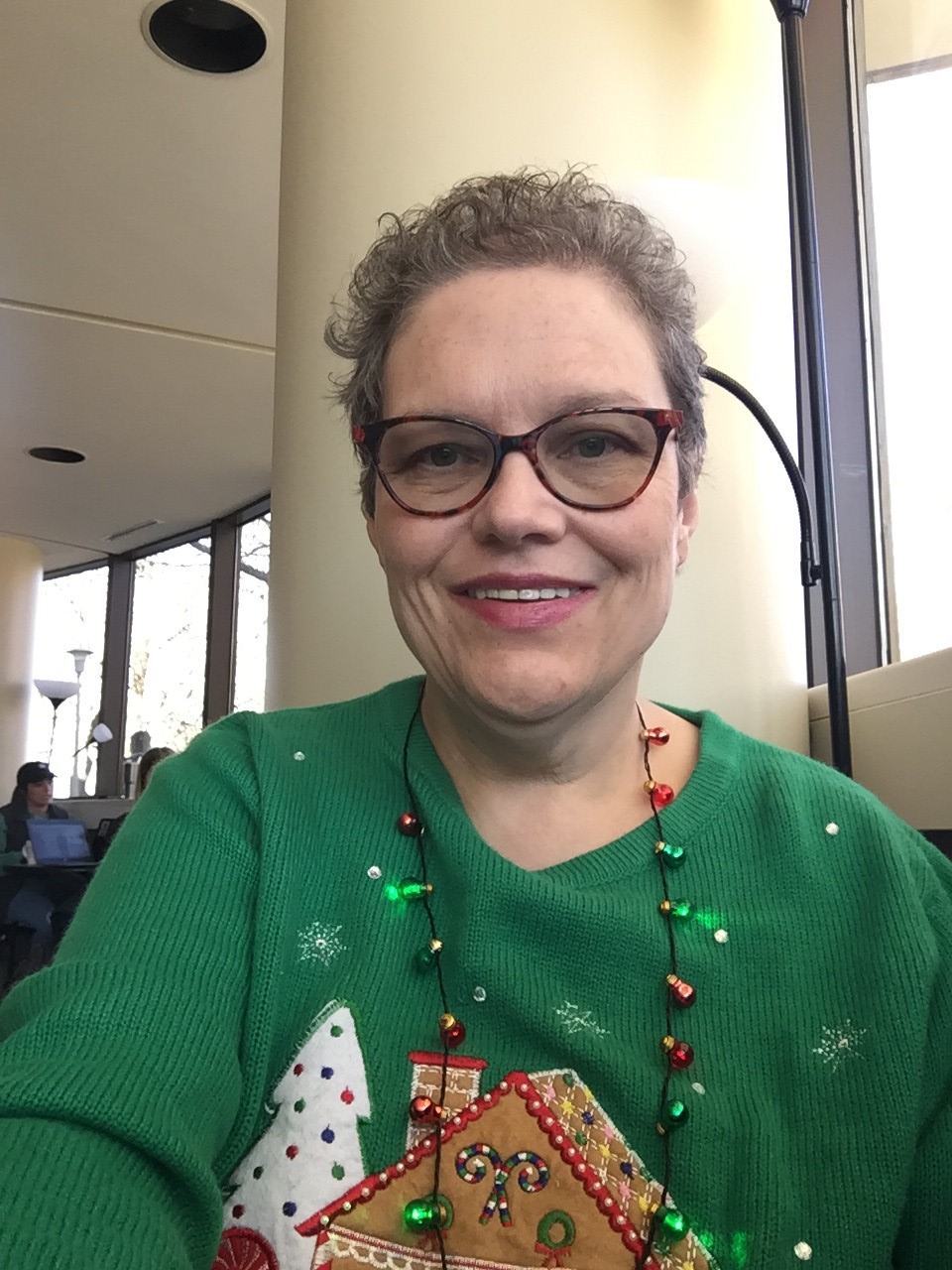
I do not look like either of the people introduced above as they look in the common imagination. My intense,  moody self should look pale and slender in Gothic black lace and blood-red fingernails. My silly self should look like the manic pixie dream girl trope: Young and bouncy with clothing that looks like a hipster Raggedy Ann doll. Both of these selves will have to deal with dwelling inside a middle-aged woman with short, spiked hair, nerdy glasses, and a style called “classic” in the fashion industry. Except for today, when I’m wearing an ugly Christmas sweater and a string of flashing Christmas lights.

I wasn’t kidding.

I probably contain more multitudes than this; everyone does, but as you’re not aware of the multitudes I contain, I am not aware of the multitudes you contain. 

We often don’t know the multitudes we ourselves contain, and we’re afraid to name them ourselves. As much as we don’t like to look at our inner Shadow, we also don’t want to claim our fantastic inner selves — the hero/ine, the rock star, the vamp, the Lady in Red — for fear that we will look ridiculous.  We want someone else to give us a nickname. We want someone else to tell us who we remind them of. We want to define ourselves through the meaning that someone else gives to us. We want to see how they see us, because if we admitted we saw ourselves that way, people would laugh.
Sometimes we’re disappointed if our friends see us in the most prosaic way. I once asked a boyfriend “Why do you love me?” His response: “You’re useful for some things.” My multitudes wanted to kick his butt.
The more fantastic of our multitudes often live unrecognized until we find a way to try them on. Reading, dance, acting, writing, music, oral storytelling, fantasy — any way we can try on that other self safely.
When I write, I see myself as that older, intense, provocative woman who asks the questions that change people’s lives. Men fall a little bit in love with me. It’s just fantasy, but the fact that I can see that suggests it’s a solid part of my inner landscape and a sample of the multitudes I contain.
*********
The fact that I’m writing songs, poetry, and philosophical treatises means:
a) I’m procrastinating from grading
b) I’m procrastinating from writing my book
c) a and b above

The Problem with Poetry

I will illustrate the problem with poetry, using yesterday’s poem as an illustration:

Tell me a story —
tell me about the echo in the hallway
when you sing,
(What’s there to say? It echoes.)

tell me of silence.
(If I told you, it wouldn’t be silence.)

Tell me the word that will help me understand you,
the word of your truth.
(Coffee.)

Tell me your name.
(You already know my name.)

*******
Well, THAT was an interesting conversation. Not at all what I expected.