
Tell me a story —
tell me about the echo in the hallway
when you sing,
tell me of silence.
Tell me the word that will help me understand you,
the word of your truth.
Tell me your name.
Category: Uncategorized
Part 3: Writing a song: the words person and the music person
Yesterday afternoon, Mary Shepherd and I sat in a music practice room with a slightly off-tune piano, my lyrics, and her notes. In a small room with cinderblock painted glossy beige, I sat down with her as she explained how she had gone about writing the lyrics. She also explained that she hadn’t played piano since eighth grade nor did she play guitar, but as a music major in her undergrad years, she did understand a bit about writing music.
“You said it was a folk song, and it was definitely a folk song. I decided to go with ballad style instead of rhythmic,” she explained as she pulled out her composition book.
“You understand it then,” I chirped, “because that’s the spirit I wrote it in.” Folk music was a subversive part of my childhood, a gift by my Aunt Peggy, who would play and sing folksongs on a ’70s small boxy white keyboard sort of thing which looked like this:
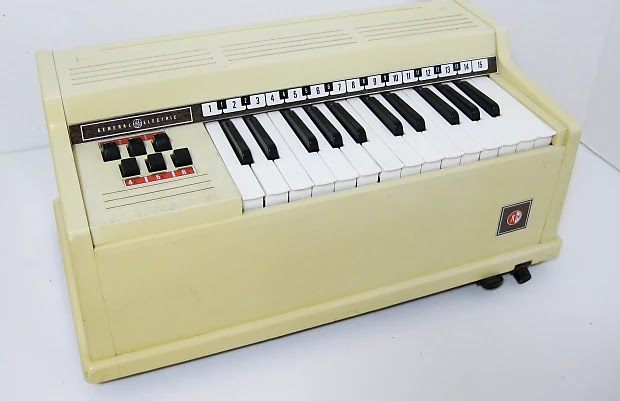
So, we set to work, and — she captured it. Folk ballad style, with musical emphasis at the right places. I was happy weepy by the end of the session. It’s now with her to note the slightly different rhythms in the verses because it’s folk music and that means that my rhythm is not necessarily straight iambic tetramater (four feet/measures per line, four accented beats per line, second syllable accented as in duh DUH duh DUH duh DUH duh DUH) . Folk music tends to get its interest by being mathematically loose; I tend to not care about the number of feet/measures as much as I care about four accents per line.
Perhaps the most valuable part of the session is that I learned about mathematics and creativity after we’d corroborated on the song. I had not seen mathematics as creative at all, thinking it was just analytical left-brain stuff. Not at all, Mary assured me — she used mathematics to create quilt block patterns, find problems that needed to be solved, and even understand music. Music is very mathematical, Mary tells me — John Cage’s compositions come to mind, as does traditional Balinese Gamelan music and even the basic concepts of measures, beats, and chords. Certain mathematic progressions sound better than others.Mathematics and music composition live in a different world than I do, but it was a fascinating world to visit.
Now, on the whole left brain/right brain thing, I’m supposedly equally proficient in both (left brain – math/analytical; right brain — creative) but I prefer to live in my right brain because the scenery’s prettier to me, and I wander to the other side when needed (like editing and my job). I think Mary’s the same way — balanced in the right brain/left brain processing, but she lives in both hemispheres at once. What a wonderful place to be!
Part 2 of Yesterday’s Post: A Song Emerges
I used to be a singer-songwriter before I divorced my guitarist twenty years ago. Not an incredibly good one, because my husky contralto voice wasn’t trained or crystal-clear, but good enough for folk music. My ex would write intricate tunes on his guitar in his semi-fingerpicking style, and I’d listen to it, and the conversation would go like this:
Me: I have words that fit with that.
Him: How can you? It’s seven-fourths time.
Me: Try me.
Nowadays, we’d say “Hold my beer” instead of “Try me”, but this was the early 1990’s.
I believe that I posted some of my old lyrics here — I don’t sing those songs now except a cappella, because I didn’t get the chords in the divorce, nor did I learn to play guitar. My ex still performs and has CDs out I hear. For any reader who knows him, please tell me if he ever performs the stuff we wrote together, because there are intellectual property issues involved there.
Anyhow, I hadn’t written a song since 1997, because even if I had tunes in my head, I would not be able to write them down or play them on a guitar. My voice has become somewhat rusty out of lack of practice and age and the medication I take.
Yesterday, I posted the first song I’d written in maybe 20 years (see the post called “Christmas in a Time of Despots”). It didn’t take me long to write because I’ve been stewing for weeks about our current sociopolitical situation here in America.
On Facebook, I posted the same thing but asked if anyone could come up with the music part. And one of my musical colleagues/friends answered!
Sometime soon I will get with her to play with the music/words and have a song! For the first time in twenty years.
I don’t know if you’re reading, Mary Shepherd, but thank you!!
Christmas in the time of despots
By the way, I don’t need you to be Christian; I’m not Christian in the way most churches recognize. But here are more thoughts on Christmas.
I was thinking of my least favorite Christmas song (“All I Want for Christmas is YOOOOOO”) and asked my husband if there were any recently written Christmas songs that didn’t peddle a fantasy, either about snow, mistletoe, family Christmases, etc. or at the praise song level that didn’t address the social justice aspects of Jesus’ message. Older songs actually address social justice issues, from pointing out Jesus’ lowly birth to Masters in the Hall mentioning that Jesus would cast down the proud. We need social justice more than ever, but the dialog is sorely missing at Christmas, drowned out by jingle bells and commercials.
I wrote this out of my sadness and depression in this season, watching the humanity of the United States slowly bleed out drop by drop by legislation and regulation that favors the rich business people at the expense of the poor, people of color, and the LGBTIQA (sp?) community.
I dared myself to write the social commentary I wanted to see. I don’t have music for it, so if anyone wants to contribute that, let me know, and maybe I’ll become a singer-songwriter again:
I’ve memorized the carols
As I wade through Christmas crowds,
With lyrical exhortations
To casteth down the proud
The mighty have proclaimed themselves
So far above the fray
They stake their claim in Jesus’ name
But they forgot to pray.
I have to sneak to pray the words
I’m not supposed to say:
CHORUS:
I want a real Christmas
I want the Peace on Earth
I want the Good Will promised
With Jesus’ lowly birth
I want to see the lions
Give shelter to the lambs
I want to see the low raised up
And the Kingdom born again.
I’ve read the Christmas story —
The migrants on the road
There to appease the government
Despite Mary’s heavy load
I’ve read that Baby Jesus
Was born among the poor
But now we’re told the poorest
Deserve to live no more
And we would starve poor Jesus
If he returned once more.
CHORUS
It’s hard to see it’s Christmas
With trees in black and white,
My mind seems far too weary
To deal with all the spite
I light a single candle
For strength on every day,
To love and give to all creation
Any way I may,
And every day to shout the words
I’m not supposed to say:
CHORUS
Removing the Growth of Words
Yesterday was a good editing day.
Generally, a writer is supposed to write the first draft, blocking out the basic action of the story, and then edit. But I had gotten into a muddle, and I knew it, and I couldn’t write more unless I found the muddle and corrected it.
I knew the muddle originated in the chapter that was half again as long as the other chapters, but I had to decide which material drove the plot and which material was extraneous and superficial. That gave me a formula to work with.
It turned out I had tried to give too much background on my mythical beings, the Archetypes, and their half-human offspring, the Nephilim: “Here, Anna, here’s everything you need to know about your ancestry.”
Last night, I asked myself the following questions:
- Do people give hours of expository dialogue in real life? No.
- Is this just going to give Anna Schmidt, the protagonist, information overload? Yes.
- Have I written myself in a corner, because I’ve overexplained one plot line to the detriment of the other (She’s in danger, the whole world’s in danger?) Yes.
- Am I going to have to edit this mess to proceed? I’m afraid so.
The murder of two thousand something words (and not even great words) later, I’m happier with the chapter. Not final draft happy, but first draft happy.
The moral of the story is that some words harm the story as a whole, and surgical excision is necessary.
One more thing: Portugal reader, who are you? You make me curious.
The Two Trees
I have struggled with the symbolism of the Garden of Eden story my whole life. Seriously, I started questioning it at age seven, and none of the lovely young Jesuits who interned at my grandmother’s church gave me an explanation I could accept.
In the Garden of Eden segment in Genesis, God creates a paradise, and then he creates Adam and Eve, who he calls his children. And he tests them in a way that plays over and over again in creation: God says “Don’t eat the apple”. The serpent, representing peer pressure, says: “Hey, try the apple.” Eve says, “Hey, let’s eat the apple.” They eat the apple, and their eyes are opened, and they see their world and they make a big fuss of nudity.
I understand that this is an origin story that predates Christianity, and that its intention is to come up with an explanation about why there’s pain and suffering and menstrual cramps, but the problem is that the story has unintended consequences that cause more harm than pain, suffering, and menstrual cramps.
These are the reasons why I have trouble with this story (my viewpoint is probably biased by western culture and feminism. I do not apologize):
1. Adam and Eve, God’s children, have done only what generations of teens have done since: disobeyed their parents after having been given incomplete information on the consequences. God has, in effect, underestimated the intelligence and drive in his creation, and as a result, he exiles his children from the Garden with no remedy.
2. Questioning one’s parents is one of the hallmarks of growing up. Many an argument at the Thanksgiving dinner table has developed as a result of one’s values having changed by going off to college. In effect, then, God has punished his children with the nuclear option for growing up.
3. Although both ate the apple, Eve earns more than her share of scorn for eating first and then handing the apple to Adam. This casts Eve in a maternal role over Adam, rather than acknowledging Adam did it by his free choice. Therefore, Eve is put in the tricky position of being both Adam’s mother and his spouse. This continues as a myth in today’s relationships: women are put in the position of “taming” their partying bad-boy boyfriends into “real men”, and the men secretly blame them for destroying “the good old days”. Ironically, it also justifies the belief that women can’t make reliable decisions and that men must make them for their families. If you take this to its logical conclusion, women end up being made responsible for men who won’t actually listen to them.
4. As a professor, I tell my students that my job is to prepare them to reach beyond and accomplish things I haven’t accomplished. I’m told that parents want their children to have it better than they do. Why, then, is God such a bad parent in this tale? Why doesn’t he want Adam and Eve to possibly outreach him?
The Genesis tale appears to be about obedience. However, unrelieved servitude is not any more laudable than unrestrained freedom.
What about a balance?
I myself envision two trees, each representing an extreme — freedom and responsibility, rational and artistic, introverted and extroverted, individualistic and communalistic. We take a bite of each to understand the extremes, and pledge ourself to a balance of the two we can live with, because the extremes both have their damage.
Take a bite of each — the yellow apple tastes like the most perfect apple you’ve ever tasted, the one that tastes like a memory, like comfort, like nostalgia. The red apple tastes like impossible things, as if molecules of violets and woodsmoke and applejack from a mason jar and a taste of apple pie and tiny strawberries.
Of course, in my version of the Garden of Eden, Adam had to choose between Eve and Lilith. He chose Lilith, and ever since, people questioned the myths they were presented with.
The Nerve Center of a Small Town
When I first moved to Maryville, a small town in Northwest Missouri, I asked my department chair where I could take my parents for Sunday breakfast. She said, without hesitation, “Hy-Vee Cafeteria.” Hy-Vee is the local grocery chain and their cafeteria is nothing fancy. But if you want to get a feel for Maryville, the cafeteria should be your choice for breakfast.
The cafeteria sports vinyl booths with abstract patterns in subdued grey-blue and grey-pink that have become more subdued with wear, and mismatched black chairs at low-maintenance blond tables. Out the plate-glass windows I can see the purple-rose of dawn through the Christmas trees for sale.
At 7:00 AM, a man in a yellow-green safety jacket applies himself to his eggs and coffee. I’m A group of men, some younger with the blue-green colors of the high school, have finished breakfast and say their parting words. The group of farmers, one in a grizzled beard declaring that “I won’t vote for him next year, “ left a few minutes before, as a man in a cowboy hat and a woman with faded orange hair and glasses choose a booth for themselves as the boys’club of six AM shifts to middle-age couples in plaid flannel and sweatshirts and jeans.
In an hour or so, young families will trickle in, some I would recognize from the university, some I’m less likely to recognize from town. Families here live in a different Maryville than I do, one that has Christmas parades and pageants and high school football. Townies live in a different Maryville than I do, one that has tractor parades and benefit dinners and the Live Nativity. My culture lies in fragments across the United States, in coffeehouses, on the cliffs of Starved Rock, in the leche at a bakery in Hermosa Park, in the South Lounge of the Illini Union, in a thunderstorm in the Catskills.
But we all end up in the cafeteria at the local Hy-Vee for breakfast.
A Heads-up
I’m moving into the end of the semester, a time of grading and great stress. To make the season merrier, I’ve been exiled from my building for today and tomorrow due to — yes — bed bugs. Office hours in Starbucks aren’t so bad, though. Because of the piles of end-of-semester grading, I will be writing and blogging sporadically over the next couple weeks.
Also, I feel a bit blue this time of year because, as you might have noticed, there’s not much peace on earth and very little good will toward anyone who isn’t our own people. It’s been hard to be an idealist lately. The naive child inside me feels pretty battered lately.
Please send love and hugs and good wishes my way, preferably in a way where I can read it.
Going back and editing early
My final total for NaNoWriMo is 74,171 words — but the novel, Whose Hearts are Mountains, is not yet done. I’m actually going back to what I’ve written already and editing before I write the last section — in this case not subtracting, but adding foreshadowing, correcting details and making the earlier parts consistent with what I learn about the character later.
Why am I doing this instead of plowing ahead and going back later? Because the things I want to correct are bugging me. Like what signs do we have that Anna has the push-pull of a human side (wanting touch and contact) and Archetype sign (reserved, not emotive)? Not too much. Do we know about her stepfather’s past? No, but hoo boy, I discovered it yesterday and it’s big. Do we know why her natural father is so broken? No, I need to put that in. Do I have the chronology right? I hope so, because I’m really bad with time.
I hope this busts my writers’ block. I hope this makes me feel better about this novel. I need coffee now — today’s coffee is Costa Rican Tarrazu, roasted last night.
Decoding a Poem I Wrote in High School
I wrote this poem in high school: *
Quand PJ, ma petite chatte **
vient, elle me demande ***
“c’est vrai, est-ce vrai?” ****
et je répond “c’est vrai”. *****
* This is the only French I knew besides
“Bonjour, Guy!”
“Bonjour Michel! Ça va?
“Oui, ça va. Et toi?”
“Pas mal.”
People who took high school French in my age cohort will remember this as the first conversation in Son et Sens, the high school French 1 textbook.
** Was PJ a petite cat? Bwahahahahaha, no. She was a watermelon on sticks.
*** Did PJ demand anything of me? Food. She demanded food.
**** Was PJ an existential cat? No, she was Stupid Like A Box of Rocks. She liked drooling on feet.
***** What was I discussing with my obese, slabor cat? (See **** for explanation of “slabor”). What is true? What is really true? It’s lost to the ages, friends.
I was so pretentious in high school.
 Words Like Me