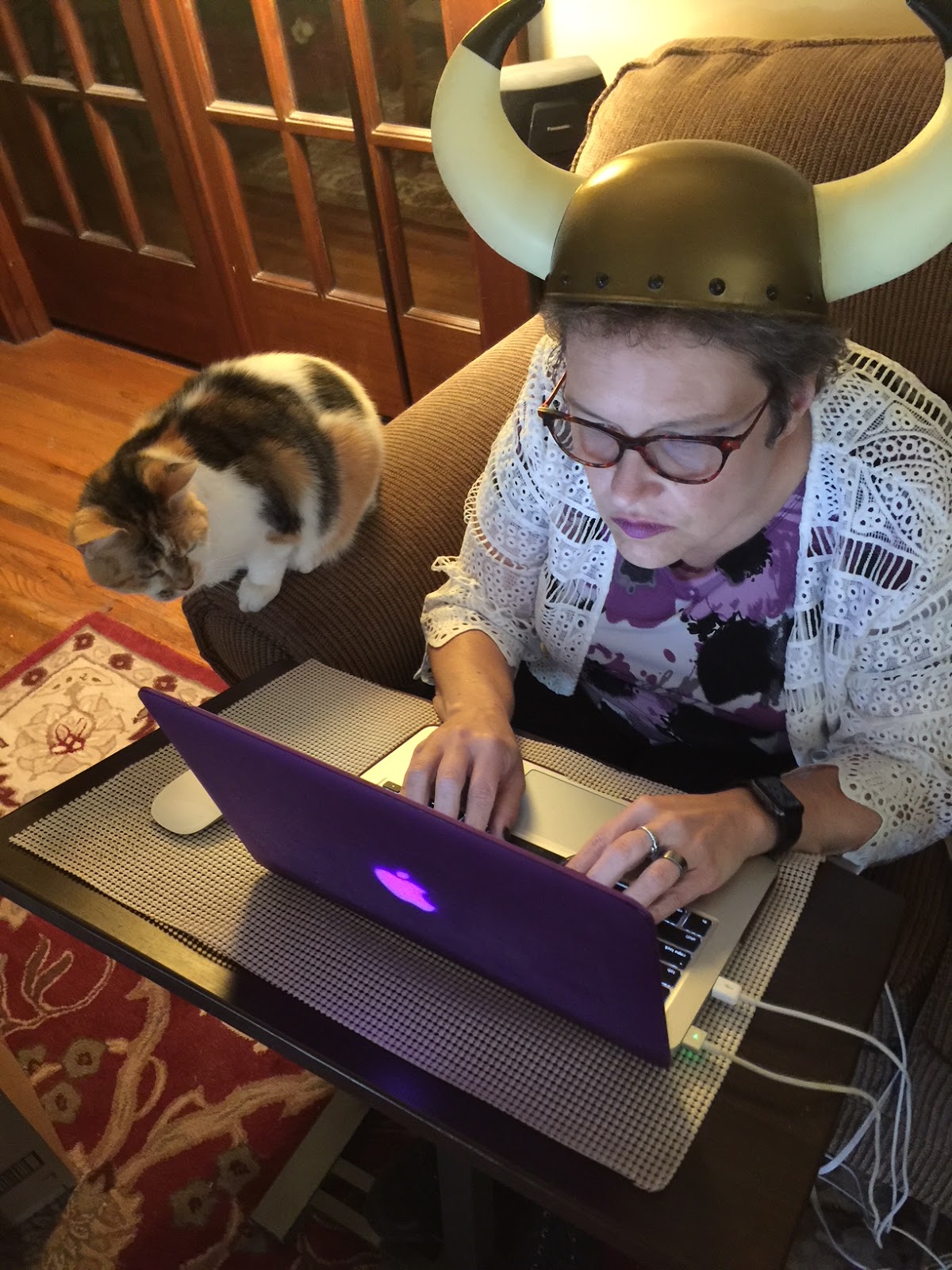
A really quick note

4000 words to go! Phew!

Also: Google Earth and Wikipedia — next best thing to being there in the Owyhee desert. I could never have written this book in my twenties, because the research I’ve done on desert-hardy goats and sheep, natural predator control, biodiesel, underground housing …

You get the idea.

Also — love you all. Quiet time for me now.

Plans and plans

Barring a catastrophe — which I don’t expect, but who does? — I should be at the 50,000 mark by Friday.  I had a fabulous writing day yesterday, with 2000 more words than I thought I’d write. (I wrote a total of 4000 words.) Then I will have met my Big Audacious Goal and made up for my failure at NaNo last year, when I had a meltdown during Trump’s election as one of the millions of American women who wished we’d had been given a trigger warning.

I’ll finish writing this draft until I run out at about 90,000-100,000 words. For those of you who have never written a novel, that’s not as big as you think. The average science fiction book is about 100,000 words and other genres around that.

I fully expect that, on reread, this first draft will be pretty messy with plot holes, poor word choice, and lack of description. I still struggle with how much description to put into a book. The irony is that I love writing descriptive passages, but all I know about the terrain around Elko, NV (where my protagonist is currently at) is what I see on the Internet. I’ve hit the Internet quite a bit in this writing run, and I suspect I will some more.

I will probably put Whose Hearts are Mountains (this work-in-progress) into a hibernation when I’m done so I can look at it with fresh eyes later. My writing will probably alternate between finishing Prodigies and finding an editor for the ever important first three chapters to be sent to agents and publishers. Then I will go through another cycle of sending to agents, hoping that I will be lucky this time.

Thanks, all, for reading.

Once upon a time

My goal was 2000 words today. I’m already at 3000, and I might get more done today.

******

Thought on my mind:

Once upon a time, I had a muse.

What is a muse? In Greek mythology, they were the go-to goddesses of the Arts. There were seven, one for each of the Greek arts. In popular imagination, they are people who inspire artists, writers, and the like. Muses are usually women, but only because women do not take their birthright as artists to claim a muse. I am not like other women; I will have my muses.

Once upon a time, I had a muse.

Why did I want a muse?

There is a type of energy one can only get from a giddy affection for someone. It’s an affection that has no future, has no lust, has nothing but regard for the other person and — oh, the beauty! The beauty of that person!

It’s pure ludus, as the Greeks would term it — an infatuation that would only shatter were reality to intrude. It’s embarrassing, painful, and distilled into perfection when the person merely utters, “hi”.

When that person says “I’m following your progress”, then that person becomes a muse. That ludus energy gives a creative boost that’s like being high on the pictures behind your eyes.

Once upon a time, I had a muse.

Who is my muse?

I will never tell you. I will never tell him.

Once upon a time, I had a muse.

Notice that phrase is in past tense. My muse has gone.  All I can do when a muse disappears is let him go, and hope he forgives me.

Melancholy, foggy morning haiku —

A melancholy, foggy morning haiku —

I stepped into fog —
Perfect leaf laid on my porch,
memory of flame.

IF the above had happened, it would be a mystery — the verb should be “lay”, as in “the leaf sat there”, yet the verb I use here is “laid”, as in “someone put this on my porch”. I meant to do that, to go with the word “perfect”, to indicate that there’s a puzzle here. Why do I think the leaf was placed there? Who — or what — would have laid a leaf on my porch? Why? Does the poem hint at a mystical creature? Will I be disappointed if I figure out the the wind blew the leaf from three houses away and landed it, somehow perfectly, on my porch?

What is the significance of the perfect leaf? What flame is it a memory of? Does this influence who or what I think laid the leaf?

Haiku makes us want to feel, to ride along with the words, rather than think. Thinking is for later.

*************
Today, I start the home stretch of NaNo. I’m way ahead of the game, because I’m a little compulsive about numerical goals, and because gosh, this book has spent thirty years in my mind. I have 10,000 words left to win NaNo — but approximately 60,000 words left to finish the book. And one book half-done (Voyageurs), one three-chapter chunk I’m learning from editing (Voyageurs), and who knows what I can do with the others, knowing what I’ve learned lately.

And then I have searching for editors again.

BAG accomplished!

Big Audacious Goal of the Day accomplished:

4000 words written in about 5 hours (four hours if you subtract the interruptions).
Total: 40,315 words — 5 2000-word days for the win!

How accomplished:
1) Fireplace program on the projection screen
2) One cup of Kenya Nyeri
3) One cup of Phoenix Valley Oolong
4) Occasional visits by Girly-Girl and Snowy
5) Promised myself I would stop in 15 minutes if I couldn’t concentrate

Today’s plot points: A town of the dead, smash-and-grab shopping, and two feral children at a rest stop.

10,000 to go!
Love you all!

This morning: Reluctance to write

I’m not sure why I’m not motivated this morning. It’s bright and early (or at least early) in Maryville, MO; Girly-girl the deadpan calico cat sits next to me and purrs —

If a picture’s worth a thousand words, why do I write?

It’s a perfect day for writing: warm inside, rainy and misty outside. There Will Be Coffee Soon. I have all day to write —

At 5 AM, 4000 words (my weekend goal) is much too daunting.

How shall I deal with this?

1) Break the goal down into a couple parts — four blocks of 1000 seem workable.

2) Start writing for fifteen minutes and let myself quit if I’m still not into it.

3) Drink. The. Coffee. First. It’s Kenya Nyeri, home roasted, and sure to taste somewhere between a good solid cup of coffee and heaven in a cup.

4) Write a more fun part first. Actually, this beginning part is a good, dramatic part — it begins with the protagonist reading a journal left by the last survivor of a plague — but is the plague still contagious?

5) Alternatively, tackle the hardest part first. Right after this segment is a part I haven’t really conceived of first, and it’s kind of a transitional part. These are hard to write without sounding like a voiceover in a movie script: “As a matter of fact, my adventures were just beginning …”

6) Forgive myself if I don’t make the goal. I’m way ahead, as is expected from someone who loves personal challenges.

Talk to you later!

Lions and tigers and bears and deadly viruses …

4000 words today, with the following plot quirks:  survivalist with dreams of using ricin; lions, tigers, and bears; a ghost town; a tornado; and the most boring stretch of highway in the US (I-80 in Nebraska). Good writing session, although I’m not writing as fast as I used to.

My eyes are so strained, they’re practically bleeding; it’s naptime for me.

Send me love, because I could use a little today. Terribly gloomy out, and I just killed an entire village with a viral plague.

Dream sequences

I love writing dream sequences. They allow me to write abstract sequences that nonetheless hint to future developments of the plot.

My idea here is that we do a lot of subconscious processing when we dream. One theory of dreams, which does not sit well with non-scientists, is that the objects and happenings in our dreams are processed and reviewed to put into long-term storage. If your newfound Aunt Martha reminds you of your long-departed Aunt Mary, you’re as likely to dream of Martha as Mary that night, because your short-term memory connects Martha and Mary. The next morning, you think to yourself, “Oh, that’s why I felt the presence of a ghost — Aunt Martha reminds me of my dearly departed Aunt Mary!” often without remembering the dream.

Non-scientists like to believe that dreams are ripe for interpretation. Freudians have set symbols they look for in dreams, focusing on the Freudian hallmarks, the urges and taboos we sublimate to be acceptable adults: sex, defecation, and death. An interesting situation in Freudian interpretation: dreaming of turning on a faucet symbolizes sex.  Dreaming of having sex with someone does not. Many dream interpretation books on the market are at least semi-Freudian in their interpretations.

Meanwhile, Jungian interpretation focuses on the people in your dream, and how they resemble the archetypes that feature heavily in our stories and deeper psyche. So the Jungian dream would look at the animus (your darker self), mentors, quests — in other words, Jung puts your dream through a Star Wars filter.

Others’ take on dreams is that they give messages — not only the result of subconscious processing above, but prosaic messages from the outside that the brain connects — much like the scientific theory above — but precognitive messages, messages from mystical connections, messages from others alive or dead, messages from our most inner self.  Even though this sounds like mental illness, we all know people we call superstitious that have these beliefs. The person who dreams of deceased Aunt Mary believes that anything Mary said or did in the dream is a direct message. They may believe that they themselves are the next family member slated to die.  A common belief is that cardinals carry messages from the dead, so someone might dream of a cardinal instead of Aunt Mary.

When I write about dreams, they have elements of subconscious processing of mysteries with a touch of the mystical — but just a light touch. Generally, a series of seemingly unrelated data come together through subconscious reasoning — but still may not be interpretable to the dreamer because of the need to disbelieve. At the end, I introduce the mystical finger pointing to a future revelation. That’s just how I do it, and I’m sure the Freudians and Jungians disagree.

I wrote a dream last night and I’m really proud of it. I may show it to you later.

**********
This morning I start at 32,000 words, give or take a couple. My goal is to be finished by Friday, which gets me to the 50,000 goal 14 days ahead of time. I will continue writing, except at a slower pace, and I will have a writers’ retreat (with massage! And sauna and steam bath and hot tub oh my!) at The Elms in Excelsior Springs for Thanksgiving with Richard!

Love you all.

For the love of a mystery

I confess: I love a small mystery.  I don’t just mean big mysteries of murder and espionage, although I adore Agatha Christie. I mean an answer that begs to be revealed, a message that needs to be decoded, a package without a sender (and without wires, grease marks, or the smell of explosives), an anonymous letter with only a line of poetry.

I find mysteries tantalizingly frustrating. Frustrating because the mystery turns over and over in my mind, like a beautiful wooden box with no entry. I fumble at the box, trying to find the twist or turn or shake that will get me access to the box because I desperately want to know what’s inside. Tantalizing because the mystery is by definition a message, and the message by definition is a mystery. 
I find mysteries romantic. By romantic, I do not mean “only permitted from a significant other or, if single, a potential suitor”. I mean that mysteries carry a whole story — why is the information concealed, kept secret, or denied? What is the importance of the information? What are the consequences of the information being concealed — or revealed? 
I have been the recipient and the perpetrator of many mysteries. My aunt sent inspirational poetry to me anonymously when I was ten, and trying to solve the mystery of who the sender was got me through a very difficult period in my life. I once sent a line of my poetry to a guy I’d met in high school, and when we started dating, I discovered he’d put it on his wall, not even knowing it was me (and I proved myself a goddess when I claimed it). An old college friend anonymously sent me a CD for a 20-year reunion concert of my favorite local band — or at least I think it was him. 
I find myself putting small mysteries into many of my novels. The protagonist asks, “Who sent me this message?” or “Why do I recognize this?” or “Why did this person say that?” or “What does this dream mean?” 
My wish list for secrets:
No nastygrams — if you want to be nasty or mean, say it to my face
No postal bombs or anthrax
No pictures of your junk
Yes to subtlety
Yes to difficulty in solving
Yes to something you’d like to share
Coffee is always good
*************
Now at 32,000 words. Today’s writing included a dream sequence, calligraphy in a foreign language, and doubts about a character’s “insanity”.
Love you all. Talk later!

Technology in the background

When I was five years old, the object that most epitomized the grownup life I wanted to live was this:

This is a Western Electric circa 1965 Princess phone in its dial configuration (I thought touch-tone was so ugly). For some of you, many of you in fact, “Western Electric”, “Princess phone”, and “touch-tone” are terms you’ve never heard, and the term “land-line” is a term you’ve heard of and consider an archaic technology.

This was the phone I got:

My first cell phone looked like this:

No putting it in a pocket like I’m used to now.

Technology anchors the story in time and place — a protagonist can call someone on the phone, but describing the phone ever so briefly reminds the reader of when the story takes place. Describing can be succinct, like “She called on the bag phone”, or more interactive, like “she unzipped the vinyl bag, raised the antenna, and put the headset to her ear.”  To a reader who has never seen a bag phone, the description will give them pause.

In actuality, there is no era without technology, no matter how primitive that technology is.  Technology is simply “the collection of techniques, skills, methods, and processes used in the production of goods and services or in the accomplishment of objectives” (Wikipedia, 2017). Therefore, fire, torches, Betty lamps, tallow candles, lanterns, gaslight, incandescent bulbs, fluroescent bulbs, halogen bulbs, and LEDs are all light technologies depending on the era.

My current work in progress is set 15 years in the future after a national economic and governmental collapse. The country, now countries, have lost electricity, gasoline (petrol), and long-distance trucking of food and supplies. Their technologies, therefore, have been created from knowledge, ingenuity, and scavenging. The main fuel used is bio-diesels made from rendering of dead cattle, plant matter, and sewage. Wood, of course, still work, as do scavenged stores of gasoline and kerosene, but these are rare. Solar installations and wind turbines supply power until parts need to be replaced, because machining has not yet converted to diesel-generated power.  People have developed diesel generators and kerosene/diesel refrigerators. They have begun to pick up old arts like weaving, hand-sewing, and preserving food by smoking. Economies are very localized, and trade is done by barter.

That is their level of technology. It’s not as advanced as ours, but it may help them crawl upward to their own technologies, developed from the available materials, mimicry of the scavenged goods, ingenuity, and need.  Without me writing about it, however, nobody will understand how different their world is than ours.

*********
I’m writing pretty fast — my goal today is 32,000 words total, or 3000 additional words for today. If I have to take a break, I have a wide cushion.