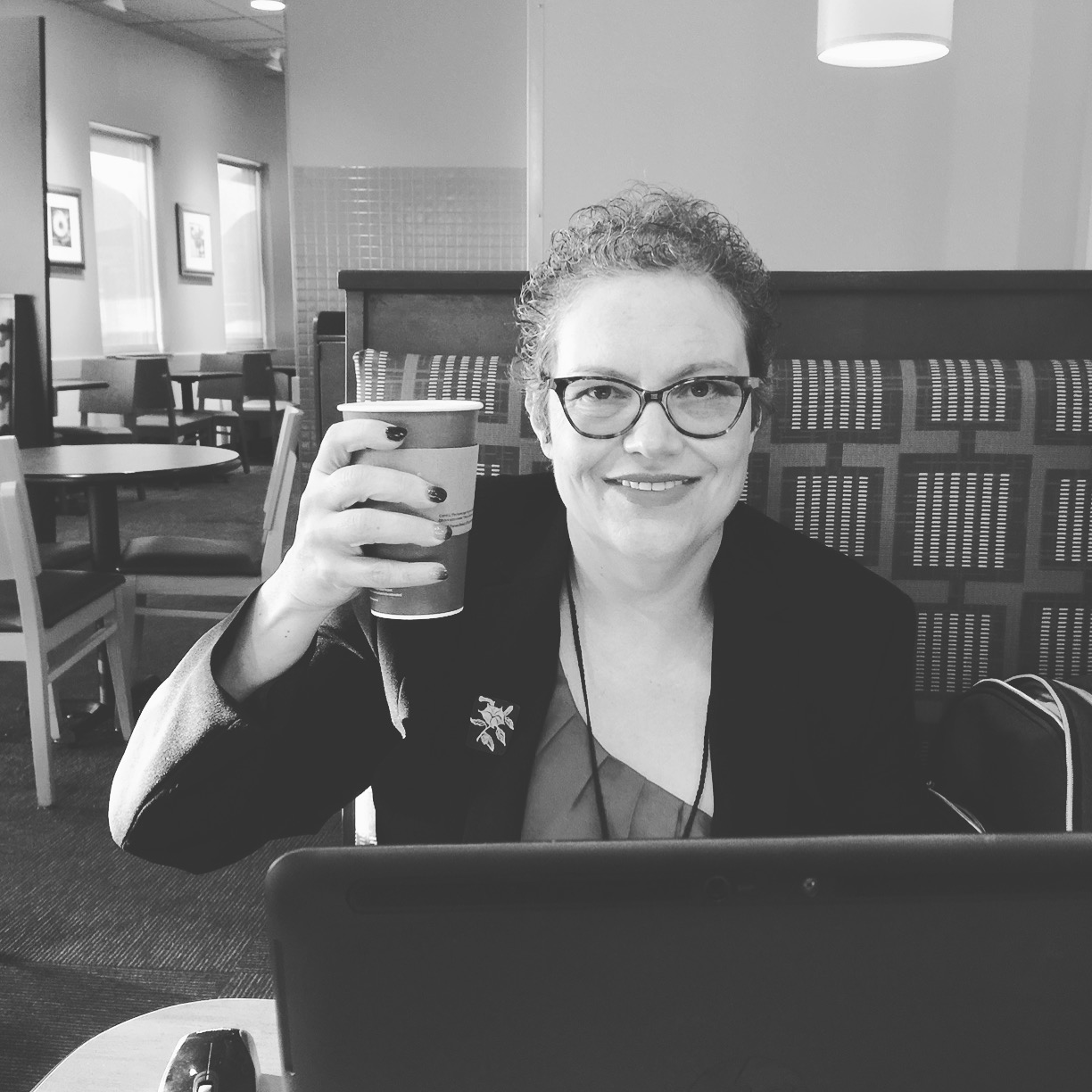
Big Audacious Goal reached for today.

Officially at 13,000 words (give or take a few!) One quarter of the way through!

*******

Afterward, I dreamed that my dad yelled that I had written the story all wrong and that the aftermath of the collapse on Duluth, MN would look nothing like I’d written it. I fled to the bathroom, and tried to put makeup on for some high school banquet I was about to be late for. I had put on skin correctors of different colors for different parts of my face, except they were glossy and glittery in patriotic red and blue and would not smooth in.

I walked into my room, and clicked the mouse on my computer, reading the notes I had taken when I interviewed a Texas secessionist for my story. I remembered standing on the loading dock as he stood there, semiautomatic rifle slung across his back, explaining that the patriots needed to get the country back from the foreigners. I wrote down the words, sickened.

I tried to dress as quickly as possible, sensing that I would never arrive at the banquet that I would be honored at.

I woke up, reminding myself that the words are important and wondering if I was ever going to get them out in an order that would compel people to read them.

Update on Big Audacious Goals

First 2000 words today — done.

Second 2000 words — OMG, I’m never going to make it! (*scrolls through map*) Where is she going to cross the Canadian border at, International Falls or Fort Frances? When is she going to start noticing the changes in US culture since the collapse? Why the HELL is she going straight into the Jungle? My brain HURTS!

I guess it’s going ok.

Quick post — Big Audacious Goals

Every now and then, it’s good to have a Big Audacious Goal, but only if you have a Big Audacious Plan to go with it. Goals without plans are called … wishes. And I’d rather fail at a goal and learn from the failure than wish about it for the rest of my life.

Goals should be SMART, according to the planning experts. That stands for Specific, Manageable, Action-oriented, Reasonable, and Time-bound.  Writing plans can be as elaborate as an outline that includes every chapter of every scene, or as simple as “I will spend two hours in the morning typing whatever comes out.” Either works, because in their own ways, they’re Specific, Manageable, Action-Oriented, Reasonable, and Time-Based.
Big Audacious Goals have those parameters as well, but also stretch our definition of Reasonable. NaNoWriMo, for example, sets a Big Audacious Goal of 50,000 words in a month. That’s reasonable at 1,667 words a day, or approximately 2-3 hours a day, but it’s more than a new participant has likely ever written in a day, which makes it a BAG. 
My Big Audacious Goal for this weekend will be to write 4000-word days today and tomorrow. The amount is very specific, and I’ll know when I reach it. It’s manageable on a weekend for someone like me who hasn’t gotten anything else planned and whose husband will be putting on a big pot of 13-bean-soup on the stove. The goal is action-oriented — write and write and write. Although that’s a lot of words, I have written 3000 words/day for the last three despite having to go to work, so it’s a reasonable stretch goal. And it’s time-based — 4000 words today, 4000 words tomorrow.
I might not make it. It won’t be the end of the world if I do. But I’m motivated by the way this 30-year-old idea is turning out, and an 8000-word weekend will get me 1/3 of the way toward the goal in 5 days! 
Wish me luck!

PS: Heart as Large as an Autumn Moon.

I don’t want anyone to think I’m an expert at this. I have not yet found an agent or gotten published. I just consider this blog a way to communicate with people, let people read my stuff, and teach myself by teaching others. That being said, the alternative name for this blog was “The Words are Important”. I chose the name “Words Like Me” because of the pun in English — “Do the words like me or ARE they like me?” (Both, I think).

Words are my way of expressing myself, because my voice has grown rusty, I have pretty noticeable coordination problems at times, and my ability to draw improved till fifth grade and then stopped. I am from a creative family — in fact, I sometimes think I am the least talented. My mother designed embroidery projects that became poster art and painted Easter eggs with flowers. My father designed projects; the china cabinet he made me out of an old wooden crate and panes from our 100-year-old house is my most prized possession. My sister does photography and my mother told me repeatedly that she wrote better than I did. My youngest niece has considerable graphic talent.

I feel the need to express myself. I had a childhood of emotional and sexual abuse and bullying. I once had a classmate try to run my boyfriend and I over with a car. I was an easy victim because I was emotionally sensitive and socially awkward. I survived because I have uncanny emotional strength, not because it wasn’t all that bad. I’m still socially awkward at times and emotionally sensitive, but I get away with it because I’m an adult now. And because it provides the fuel for me to write.

My writing includes themes of overcoming dystopia through human resilience, finding beauty in people around me, and moods, moods, and moods. I want you to read these. If I write these things, I do so because I wear my heart on the outside.

I want to know you. I want to know you if you write; I want to know you if you don’t write. I want to watch your creativity, even if you don’t think you’re creative. I want you to critique me (honestly) or just say “Hi”! I want you to take my words and tuck them into your heart and go out and love one another.

My heart is large enough for new family members. If you want to be family, let me know.

Day 3 Nano — Plantsing Away (with story segment)

I think I remember telling people I’m a Plantser in NaNo parlance — I plan, but only so far, using a set of scene synopses instead of a full outline. This is easy to do in Scrivener, which uses a notecard schema for chapter and scene synopses.

When writing, even at 2000 words a day,  I’m restructuring my outline by adding and moving those scenario cards. Yesterday, I realized that NOTHING plotwise was happening between visiting The Jungle, a geographical entity which includes Chicago and Detroit, and Salt Lake City. That’s hundreds of miles, folks. 1400 miles to be exact. I’m sure I could skip over that segment of flyover country, but given that one of the themes of the story is self-discovery (“It’s ‘Eat, Pray, Love’ meets ‘North by Northwest!’) I easily could give my protagonist a few pertinent experiences there. I’ve added a chapter — actually, two half-chapters — to facilitate some adventures here.

I do minor editing on spelling and grammar in the writing stage, but don’t get too bent out of shape about it, because that’s not the idea of the writing stage. The idea is to get a first draft (or in the case of NaNo, half a first draft in a month).

OOPS — back to writing!

*********
Today’s excerpt, written yesterday:

I considered my options for getting off-campus. There was a riot outside the building and my captors within. I didn’t believe the police, or the Guard who had joined them, would be any more sparing of bullets than my captors had been.  

The steam tunnel doors hung open. I had heard about the legendary steam tunnel system — maps of the tunnels existed, handed down and providing adventures to generations of students who could withstand the heat. The cameras that protected students from heatstroke no longer functioned, so the risk was higher than in bygone eras. I taught all of this in Intro to Anthropology each year.

I, however, did not have a map, and imagined myself wandering through the tunnels, some of which were low enough that the explorer had to crawl through. There were rumors of dead ends and caved-in sections — wait. Somewhere in my notes, up in my office, I had documentation of a Charles DeWitt who had, in 2020, painted guide signs in glow-in-the dark paint. All I needed was a flashlight, which I found on a hardhat by the tunnel doors. I flipped the switch; the light functioned.
Now, a destination. I thought about where I was, Hartley Hall, at the north central point of the Quad. My destination was under the Quad to Alfred Wyndham Lab, the science building nearest the east gate. I knew that the tunnel would be anything but straight, given how the tunnels branched out to serve all the buildings. 

What I would need besides the light? I took a long drink from the utility sink in the corner and relieved myself in a dank, muddy corner — I didn’t care about anything but being safe. What else — lock picks. I didn’t have lockpicks in case any doors were locked. Lockpicks — I searched for the smallest bladed screwdrivers I could find, precision screwdrivers, which I found in a large drawer on a workbench labeled SHOP. I swiped the two smallest screwdrivers and a diamond file so I could file them thin if needed. My father, the cryptographer, had taught me how to disable locks from simple tumbler locks to advanced cryptobiometric ones.

p.p1 {margin: 0.0px 0.0px 0.0px 0.0px; text-indent: 18.0px; font: 13.0px ‘Courier New’}

Then I charged through the doors into the unknown.

Facing the inevitable plot glitch

I’m a morning person. When I’m in the middle of writing a novel, I must stew over it in my sleep, because I wake up with insights on the plot. This morning, the insight was that I had outlined a major plausibility problem that will have to be fixed.

The problem is as follows: The commune, Hearts are Mountains, faces a major threat on their horizon, the neighboring country of Free White State. FWS was founded during The Fragmentation by idealogues among white supremacist groups and nationalist ultra-conservative Christian groups, who had in commonality a desire to create a “pure” state.  Their territory comprises a good portion of what used to be the Pacific Northwest states in the former US and borders the high desert where the commune resides underground (literally).

One of the main characters, William, works as a border guard for Free White State — and a spy for Hearts are Mountains.  He appears to be a Native American mix; however, he passes well for white such that living and working in Free White State isn’t a problem for him.

Anna (the protagonist) and Daniel (from Hearts are Mountains) visit William for intel. At least that’s how I wrote the outline. The problem is that Daniel appears as a black/Native American mix. That’s going to get him, maybe the three of them, killed in Free White State. A shortened novel, and not an ending I’d wish to write.

I puzzled over this dilemma this morning and realized: William is an Archetype. Archetypes can teleport! (At least they could over the past four books I’d written about them.) He could teleport to Hearts are Mountains without any of the indoor or outdoor surveillance catching him just by crawling into a shed.

Problem solved!

A good start to my NaNo novel —

“Once upon a time, there were beings who looked like people, only they weren’t the people you see every day. For one, they were stronger than ordinary people, and they lived a lot longer than ordinary people do. They existed to help people understand who they were and where they came from.  By the few who knew them, they were called Ancestors, Archetypes, or sometimes Alvar.

“They lived in a realm far away, yet as close as a thought. In this realm, they existed rather than lived, mere vessels for the ancient memories they held. Some of them tired of this passive role, and wanted to go Earthside to see these people they represented. So they jumped to Earthside, which was only a thought away, defying their Oldest. These Alvar occasionally chose to bring children into the world, which defied their Oldest to a degree that could not be forgiven. Of those Alvar were born the Earthed Alvar, who lived among people.

“There was one of the Alvar who was born of the male Kiowa Alvar and a female Alvar of legend, Lilith. They left him (for Alvar were born full-grown) with the Kiowa to learn about them and to help them. All he remembered of his birth was that two people, his parents, told him he was special and that he was never to give it away to anyone. 

“The Kiowa shaman named him “Old Man” even though he looked young, and as time passed, he did not age as the others did. Eventually, the band felt frightened of him because of his lack of aging, and he left to join other bands of the First People to hide his true age. He understood that others grew old and died, and he didn’t understand why he didn’t. He also wondered why he had never been young like the babies born to the Kiowa.

“Eventually, he was kidnapped by evil people who put him in chains, people who didn’t realize he was Alvar, but he escaped by jumping – something he had forgotten he could do – back to the place where the Kiowa, his original people, banded. They had gone away, but he became a cowboy, moving from place to place and job to job so that his true nature – which he didn’t understand – wouldn’t be detected.

“He lived like that for years, and finally found himself at a place of learning, so he could discover who he was. He fell in love with a woman named Allie, who looked at him as if she knew him, and asked him lots of questions that tipped close to uncovering his secret. One day, Allie took him to talk to their professor, and she, Mari, told Will that she was different in the way he was.  Mari told Will and Allie about the Alvar, and Allie grew to love him even though he was not like her. 

“One day, they made a child, born fully grown as children of Alvar and humans were born. All of the pain of Will’s past washed over him at the sign of his offspring, and his mind shattered. He disappeared before Mari or Allie could stop him. Allie never stopped loving him, or the child they had together, and she surrounded that child with all the love she could muster, love enough for two.”

“Mom,” I groused, “that’s not a bedtime story for a child – that’s an anthropological treatise.” I wasn’t joking – My mother, Alice Schmidt, was a preeminent anthropologist who studied Plains cultures at the arrival of white people. The story went that she had been trained by the famed Native American anthropologist MariJo Ettner, who disappeared ten years before and left her research notes to my mother. Alice Schmidt disappeared soon after, when my dad retired, and an anthropologist named Elaine Smith was hired halfway across the country from where Alice and her husband disappeared. I remember the safe house when we were in transition to our new identities, and the day I became Annie Smith.

“What do you expect?” my mother asked, her green eyes laughing. “You ask an anthropologist to tell a bedtime story, and you get anthropology. If you told a bedtime story, it would be a fable about an encrypted ghost that terrorized hackers.” Mom, of course, was right – not only because I had chosen to become a sociologist specializing in urban legends, but because I was my father’s daughter – and my father had been, before his retirement, a key government encryption expert. In other words, his programs were the ghost in the system.

“So that’s the bedtime story you told me?” I chided, hiding the fact that I couldn’t remember my childhood once again. 

“It was the best I could do,” Mom shrugged, then looked at me searchingly, as she often did. My dad strolled in – although I was my father’s daughter, I didn’t share his blond hair and blue eyes. My looks came from my mother – dark wavy hair and pale skin and freckles. “I packed up your car,” he sighed. “Could you pack more stuff next time so I actually get a workout?”

“What, and give up my life as a pauper?” I snorted, and hugged my father, who came to just above my chin. I hugged my mother, plump where I was slender. I studied their faces, which looked just a little older, just a bit more worn, than my first memories of them fifteen years before.

p.p1 {margin: 0.0px 0.0px 8.0px 0.0px; text-indent: 37.1px; font: 13.0px ‘Courier New’}

It was the last time I would see them. Three months later, they were murdered by assailants unknown.

Halloween — costumes and meanings

Welcome to Halloween, the holiday that (at least in the US) has developed from Puritan horror to childhood candy splurge to adult party excuse. (Note: I am not talking about the pagan Samhain or the Mexican Day of the Dead — these festivals should be acknowledged in their own right and not just as versions of US halloween.)

I grew up in the childhood candy splurge years, which held their own horrors — rumors of needles and razor blades and poison slipped into candies — mostly untrue — led my mother to ban trick-or-treating by the time I was six. Instead, my family went out to eat in our Halloween costumes, which meant I celebrated the adult Halloween as a child, only without alcohol.

I actually love the adult Halloween, because it gives me the opportunity to dress in silly costumes now that I’m too old to trick-or-treat. I don’t find this overly childish — or any more childish than I was when I asked the Christmas Fairy in the Walnut Room at Marshall Fields to grant me a wish. After all, masquerade balls have existed since the 1500’s in European culture, and no doubt in other cultures as well.  We must feel a need to be someone — or something — else, an alter-ego to the person we are.

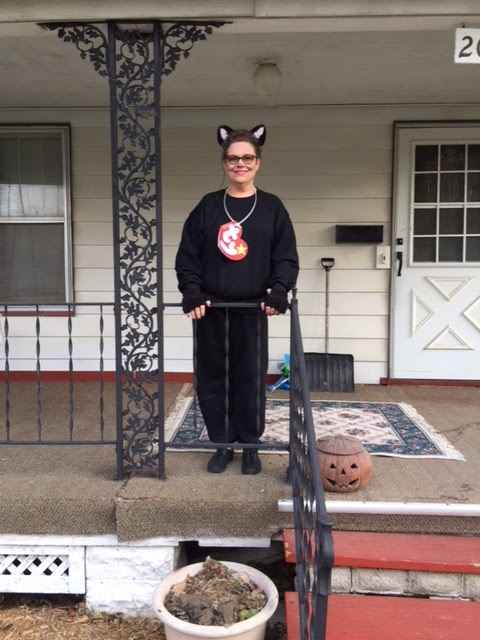
Today I’m dressing as Lauren, a limited edition Beanie Baby cat, complete with tag and Comic Sans jingle:

I am Lauren,
I’m a cat.
There is nothing
wrong with that!

I often dress up as cats. I have dressed up as my cat Kitty; a playful cat with Richard as Responsible Cat Owner to collect pet goodies for the Humane Society, and now as a Beanie Baby.

The Writer as a Beanie Baby

I don’t wear “sexy” costumes — like sexy firemen, sexy cops, sexy robbers, sexy schoolgirls, sexy Little Red Riding Hood … I have no problems with the fantasies running around in your heads — or my head — but sexual fantasies don’t translate well to real life, and they translate even worse to Halloween costumes. These costumes happen to be cheap mass merchandise store purchases rather than quality cosplay costumes, and render sexy as “cheap and tawdry”.  I once donned a cat-in-a-miniskirt-and-fishnet-tights costume just before sneaking out of a departmental Halloween party in grad school. (Casimir Ihe, if you’re reading this, I remember you said, “Jesus Christ, what the Hell is THAT?!”)

 There might be a reason for “sexy” costumes, though — maybe today’s sexual fantasies are yesterday’s ghosts, spirits we are frightened of and try to control, to subdue. The erotic, after all, has been a frightening force since hunter-gathers shifted into agricultural, then feudal, then industrial society — as long as paternity has been an issue, because Eros disrupts family lineage. The ancient Greeks, who came up with the word Eros, viewed erotic love as a force that led to insanity and tragedy. So some people find “safe” ways to play with Eros, by putting on costumes on Halloween that allow them to indulge sexiness without consequences. as some people find “safe” ways to play with Eros in real life by having fantasies of sexy firefighters (Nope, not my fantasy), or by dressing in fantasy tropes like red dresses and Lolicon cosplay.

Whatever your costume, Happy Halloween!

And NO, I am NOT a furry, nor do I have sexual fantasies involving cats.

To My Readers — a virtual cup of coffee

All of us have excellent stories to tell.

The shortest story I’ve ever been told: “I was going to do my banking today. So I went to the bank, and it’s on fire.” 
The short story best relying on imagination: “Remember when there was a bounty on coyotes in Missouri? My mom hit one and threw it in the trunk to take to the sheriff. Too bad it wasn’t dead.” 
The best short story I played a role in: “I had a dream last night we were all late for the bank robbery. That was alright, though, because we were all zombies.”
I collect other people’s stories — the one about a friend playing war games in a park, who runs into some woods to take a leak at the edge of a cliff, only to look down and find himself exposed above a two-lane highway. The one about the hunter attacked by a rabid deer and the one about the woman who shot a deer while sitting on the toilet. My grandmother Iverson’s malapropisms and my great-great grandmother who could stop bleeding by the laying on of hands. Silly and clever and maladroit and mournful — I hold stories for people. And holding stories makes me happier than almost anything (except coffee).
I know all of you have stories of all kinds. I would love to sit with each and every one of you (assuming none of you are slashers or stalkers) over a cup of coffee (or beverage of your choice) and find out who you are from your stories. 
I know this vision is against all the rules of the Internet, where we all read each others’ Facebook posts without remarking, and half the posts are reposts anyhow. 
So, again, I’d like to hear your comments, and more importantly, hear your stories. (We’ll have to imagine the coffee.)
Here’s to you, readers!

The Beauty and the Desolation

I’m going to start this with the lyrics of a song that tears my heart out every time I hear it. Last night I lay in bed (with headphones on) listening and feeling haunted by the words. Thank you, Neil Young:

 There is a town in North Ontario
Dream comfort memory to spare
And in my mind I still need a place to go
All my changes were there

Blue, blue windows behind the stars
Yellow moon on the rise
Big birds flying across the sky
Throwing shadows on our eyes

Leave us
Helpless, helpless, helpless, helpless
Babe, can you hear me now?
The chains are locked and tied across the door
Baby, sing with me somehow [ … ]

The plaintive song, highlighted by pedal steel guitar, flows like a slow dance tune played in a swept-out barn lit by hundreds of fireflies. It describes life in a relatively slow northern town in Ontario, where one can see the horizon and the sky for miles. So beautiful, but so lonely, like the mood of the singer. He can remember that gloriously desolate moment, but he can’t return there for real, because it would not be the place he’d left.

The song is called “Helpless”, and every time I hear it, my heart aches as if someone has cracked my ribs open and exposed my heart. I’m frozen in place, staring at that midnight sky with the stars, all the stars, and seemingly thousands of Canada geese in their v-shaped flight.

I think about my own childhood in a small town in Northern Illinois. I can only remember Marseilles (pronounced Mar – SALES, I’m afraid) in grey tones — the slushy grey of winter afternoons as I stared out at the darkening sky waiting for my dad to come home. The sickly green-grey of oncoming tornado weather; the damp grey of slogging home from school in rainboots. The wispy grey of the secrets.

Like Mr. Young, I can’t go home again.