Marcie visits Archon

Hi, my name is Marcie, and I am seven years old. Aunt Laurie took me along to this really neat party called Archon. Aunt Laurie called it a con, but I didn’t see anyone conning anyone. (Aunt Laurie said that anyone who publishes your book and gets all the money for it is a con, but I’m not supposed to tell anyone she said that.)

I think it was a party because people were running around in really cool costumes, like the really tall guy in a wolf costume with a long bushy tail. Aunt Laurie called him a furry, and he was really furry. I saw men in skirts (Aunt Laurie called them kilts), chain vests, robot costumes, and one girl in a short plaid skirt and a shirt that didn’t fit her well. And bunny ears. I liked the costume, but Aunt Laurie said I couldn’t have one until I was much older.

People had tables where they sold stuff. Aunt Laurie bought two pictures called prints — one is a flying bald cat with fairy wings. I liked it even though the cat looked a little scary. The other is a secret, because Aunt Laurie bought it as a surprise for her sister, and I promised not to tell. (I didn’t promise not to tell about the publisher con.)

I didn’t like the sessions so much. A lot of people talked about stuff. Aunt Laurie got a lot out of it, but I wondered why so many guys weren’t polite and would talk over the women like they weren’t even talking. Aunt Laurie said they had sexism, and that that was wrong. I asked why they did it, and she said they were scared of women. I don’t think Aunt Laurie is scary at all — she’s like she’s wearing a big marshmallow costume, and she’s still gooey inside.

I tried to talk to the little robot scooting around, and all it said was bleep bloop squoink. Then it ran away and I chased it, trying to get it to talk again.

I liked the con. People laughed a lot. I had fun, but I want Richard to take me to the kids’ stuff next time.  But then, Aunt Laurie said, he wouldn’t be able to carry her stuff around. Richard is so useful that way. Maybe I’ll become an author like Aunt Laurie and then I’ll understand what they’re talking about.

*************
Note to newbies: Marcie is my alter-ego, a seven-year-old girl with a bit of precociousness. A lot like me at age 7, actually. I find her a refreshing writing exercise now and again.

Character sketch and interrogation — Daniel Workman

Here is a character sketch with what I call an interrogation (although, ironically, it’s done with open-ended questions so it’s not really an interrogation):

Daniel (Daniel Workman)
Role in Story: Anna’s future partner; member of When Hearts are Mountains, Mari’s son
Occupation: Jack of all Trades; security 
Physical Description Tall, lanky, with long chestnut hair, light brown eyes, and café-au-lait skin. 
Personality: Low-key, gentle, bemused, righteous (not self-righteous). Jokes about being an outlaw. Has some baggage from No-Space detention.
Habits/Mannerisms: Touching/settling into objects to make sure they’re solid. On rare occasions, dissociating. 
Background: Daniel is the offspring of Mari, a woman of Lakota/African-American Archtype heritage, engendered for the Buffalo Soldiers in 1866. This makes him relatively young. He is one of the renegade Archetypes that left InterSpace 500 years before to visit Earthside, and one of the ones who never checked back in on InterSpace. (Most of the commune has origins in this exodus, as do Lilly and Adan. Others bounced in-between Earth and InterSpace like Luke. He spent 30 years in No-Space from 1920-1950, so he has no recall of that time. He particularly likes his Wild West Days from 1870-1895.  He was the one who suggested the commune build out in the high desert.
Internal Conflicts: At times, feeling like he’s lived too long but at the same time enjoying life; Does not know if he’s good relationship material with his dissociation.
External Conflicts: With Jude, who later betrays them to Free White State. With Anna when he discusses how his Nephilim son was born and talks about why he’s not good for her.

Notes:
Me: Daniel, tell me about yourself.
Daniel: I am called Daniel, and in the world of men go by the name Daniel Workman. I am an Archetype, young at 200 years old. My mother is Mari, known as Mari Ettner in the world of men, and Valor Burris is my father. As an Archetype, I was born full-grown and able to participate in human culture, which I have. I have always found the West a haven from my early days on the frontier when someone who was half-black, half – Lakota was accepted at face value. Back then, I had an affair with a comrade; same-sex couplings do not produce offspring.
In 1920, not knowing that I had the potential to engender children, I visited a prostitute in Reno and had a child.  That child was Nephilim, of course, and ran away immediately. I did not know who he was until 2022, when Luke Dunstan found him on a farm in Nebraska and brought him here. Jude has taught us much about subsistence farming and founded our herd of Navajo-Churro sheep, which is big enough for plenty of  wool and occasional meat. We now know that Nephilim can live to over 100, although he is starting to show his age now and we estimate his lifespan will take him to 150 or maybe 200.
The Powers that Be arrested me soon after in 1920 — this was when the Triumvirate held power in the Council of the Oldest. The charge was engendering a Nephilim, and my sentence was thirty years in NoSpace. I believe it was done to break me; I later heard they tried to capture others but did not succeed. Perhaps I was the slowest and the weakest; I don’t know.
Me: I’m sorry to hear about your stint in NoSpace. You sound very upset about it.
Daniel: NoSpace is an evil place. No sound, no light, no touch, no time. No anchors. That could drive one crazy after a day, a week. I spent thirty years there. It took away a piece of me, the piece that keeps me rooted in the moment; I sometimes detach from the world and float in nothingness, and someone has to touch me and speak in my ear to bring me back. When I hear of the Triumvirate — who now spend their time in NoSpace — or any of their free minions, the vision turns to red and I dissociate. I’m told I yell a lot when that happens.
Me: You talk more than my usual interviewees.  You don’t need many prompts.
Daniel (*chuckle*). Mari says I could talk the ears off a mule, but Eldon tells me she doesn’t know a mule from a mosquito. 
Me: You all talk like cowboys.
Daniel. We’ve picked up Earthside speech mannerisms — partly because we can’t help but do it; particularly to provide protective coloration. I can talk like many, many types of humans.  
Me: Tell me about your relationship with Anna.

p.p1 {margin: 8.0px 0.0px 0.0px 163.0px; text-align: center; text-indent: -163.0px; font: 20.0px Helvetica; color: #00aae5} p.p2 {margin: 13.0px 0.0px 0.0px 0.0px; font: 13.0px Arial} p.p3 {margin: 0.0px 0.0px 0.0px 18.0px; font: 13.0px Palatino; min-height: 18.0px} p.p4 {margin: 0.0px 0.0px 0.0px 18.0px; font: 13.0px Palatino}

Daniel: Anna is quite an interesting person. She’s one minute pulling out her field notes and another minute laughing at something happening around her. She’s joyful, which is surprising despite what she’s gone through. When she gets mad, she’ll go toe-to-toe with me, and I appreciate that. She pulls me out when I dissociate. I don’t know if I can give her as much as she gives me, and that lessens my chances of bonding with her. Plus, what happens when she finds out I’m an Archetype? 

Request

While I’m stuck on I-29 due to an accident, I have a request to make …?

I put together a digital mix tape of appropriate soundtrack music for each book I write. For this year’s NaNo, my book title is Whose Hearts are Mountains. The synopsis:

When the United States has crumbled after attacks from within, traumatized anthropologist  Anna Schmidt chases an urban legend. Taken in by an unusual commune in the desert, Anna   discovers the secret from her unusual upbringing and finds she holds the key to stopping a pandemic.

Moods: 
Chaotic
Placid but wary
Disoriented
Grateful
Really disoriented
Pensive
Driven 
Sorrowful 
Grateful
Determined
Content

I welcome suggestions for songs, actual song tracks, and fan letters. My email is lleachie@gmail.com 

Have fun!!

Something I learned at Archon — how to write a query letter

I learned many useful and encouraging things at Archon, including the fact that many published writer I saw on panels had upward of 100 and even 200 rejections before getting an agent or getting published. (Whew! I have so many more to look for!)

The most helpful thing I learned, however, was how to write a query letter. I’ll write my first-draft letter to illustrate the process. What I learned, above all, was that a query letter writes like a business letter. This will be a query letter to an agent — most people start with getting an agent, because most publishers won’t look at a manuscript unless an agent hands it to them.

The first paragraph is a brief introduction and where you found out the agent was available:

My name is Lauren Leach-Steffens, and I am interested in finding an agent. I saw that you were accepting new clients on your website, http://www.xxxxxx.xxx.

The middle paragraph — here is twist #1 on the business letter — is devoted to a synopsis of the book you are emailing a sample of. This synopsis should be the sort of thing you’d put on the back cover. It should give an idea of the main characters and plot, without giving up the ending. In other words, the sort of thing I put on the back of my business cards:

       Josh Young, an aspiring writer, envisions a mystical garden, which becomes real in                              horticulturalist Jeanne Beaumont’s hands, and they become targeted by a shadowy cabal that                puts their visions and their lives in danger.

I think it could be a little, but not much, longer, so let’s try this:


       In the current day, Josh Young, an aspiring writer, sees a mystical garden in his visions. Permaculturist Jeanne Beaumont finds herself threatened by forces inside and outside academia for reasons she can’t decipher. Joining hearts and forces, they create a gestalt to turn one of Jeanne’s permaculture guilds into the Garden of Josh’s visions, and they become targeted by a shadowy cabal that puts their visions and their lives in danger.

The third paragraph is where I introduce myself:

Lauren Leach-Steffens, the author, has published several academic articles in the field of family economics, and has recently decided to write contemporary fantasy novels. Her work reflects themes of identity, pacifism in wartime, sacrifice, and ordinary heroes. 


If you think this needs something, please suggest! Richard thinks the word “gestalt” is pretentious; I think it’s entirely accurate given the circumstances. 

One size does not fit all

Here I am, at St. Louis Bread Company in Collinsville, IL,  just on the Illinois side of St. Louis, about to spend my second day at Archon. My takes on the convention:

1) Few places are as much fun for people-watching as science fiction conventions, with a myriad of people in quirky and somewhat mismatched costumes, women who can talk at length about how medievalist Europe is the basis of many science fiction novels, and many indie authors. (“Indie” = “self-published”, and I don’t have the time to go that route.)

2) The writer’s panels vary in quality, but that may be my observation as a college professor who has gone to many professional conferences. Good example: the highly informative and entertaining panel on writing happy (or at least satisfying) endings. Bad examples: the presentation where everyone gave examples and counter-examples of religion in science fiction and came to no actual points. I would have loved this as a small discussion over coffee. Or homemade hooch.

3) It is NOT a good place to meet publishing representatives and hand them instant queries. At least not if you go about these things the way I do. The friend who told me about it makes it work for him. For someone just breaking into the system, who’s Midwestern polite, and who can’t tell the publishers from the non-publishers, it’s not going to work.

Meeting writers at parties, I believe, is how he makes it work, but this is not a good path for me for several reasons: 1) I can’t drink because of medication; 2) I have just enough of a hearing problem that I need someone to yell in my ear, making negotiations difficult; 3) I really am an introvert, although my students would never believe it; and 4) the party setting is problematic for women for a couple reasons, which I will detail next.

Why are party negotiations (aka schmoozing) so difficult for women? First, because men tend to dominate women in conversations through interruptions and changing subjects (both documented by Deborah Tannen and others), making it hard for them to actually talk about their novel. Women end up feeling frustrated and ignored, and may give up too soon.

Second, women avoid alcohol-fueled events alone, because of the volatile mix of alcohol and expressions of sexuality — i.e. unwanted advances, non-consensual sexual encounters, and subsequent accusations that they slept their way to success (see Anita Sarkeesian and GamerGate.)

In other words, I will not be able to make my friend’s method work.

The good news is that there are other venues. One is the one I keep trying for authors and publishers, mailing queries. Just as I work on improving my writing, I work on improving my queries. In fact, I’m attending a session on writing better queries this morning.

Second, I found out there’s a conference in St. Louis every year in June called Gateway to Publishing, which gets you in touch with agents and publishers both by phone and in person. One-on-one, the way I work best.

Thank you, friend, for introducing me to Archon. I would never have found my way otherwise.

Interrogating the dream and the characters:Open questions

For you creatures of habit, sorry this entry is late, but I’m at Archon in St. Louis (actually Collinsville, IL) waiting for it to start and prepping my networking skills, my manuscript excerpts, and my wardrobe for three days of being an author looking for a publisher.
**********************

I almost have the plot synopses to Whose Hearts are Mountains completed. The process has given me insights into the plot, including some delightful twists (actually, they’re rather grim) at the end. Now I need to further develop my main characters.
I’m going to try a technique case managers and social workers use in interviewing their clients — the open-ended question. To explain open questions, it works best if I explain closed ended questions as well. A closed ended question is the typical question we ask every day:

Me: What is your name?
Character: I am called Daniel.
Me: Where are you from?
Daniel: A commune called Hearts are Mountains.
Me: Where is that?
Daniel: In the Owahee Desert.

What’s wrong with this picture?  First, it will take forever to ask all these questions and have them answered. Second, the person interviewed will feel literally interrogated with rapid-fire questions. Third, I’m not getting Daniel’s story, only facts.

If I want to get Daniel’s story, I have to ask open questions. These generally start with “Tell me about” or “Could you tell me about” or “Tell me more about” — I’m not being funny; these are all good leads. The key to open questions is 1) there are no words that close the question (who, what, where, why, how, how often, how many, how much); 2) because they set up a story, the questioner learns a lot more about the interviewee than they would otherwise.

So open questions work with Daniel as follows:

Me: tell me about yourself.
Daniel: I am called Daniel, and I live in the commune called Hearts are Mountains in the Owahee Desert.
Me: Could you tell me a little more about yourself?
Daniel: Okay. It’s a strange story.  I feel comfortable telling it to you, because you’re the author.
Me: Thank you.
Daniel:

Using Facebook to Sharpen Writing Skills

Before I had a blog, I had Facebook. Strangely, Facebook helped me with my writing a great deal.

There are rules for writing in Facebook: conciseness is the number one rule. You might never have seen a conciseness rule written as such on Facebook, but you have seen the condensed version: tl;dr. Too long; didn’t read. Messages have to be short and to the point.

Second, grammar and spelling. There’s a lot of misspelling, all caps, no caps, and errant punctuation, but at the same time, people get ridiculed for it (unless they speak a foreign language, in which case all is forgiven.) If the misspelling or punctuation is humorous, it will become a joke, as is evidenced by this exchange in the pre-Internet system called PLATO:

F. Ortony: You can’t win Wessing.
E. Wessing: How does one ‘wess’?

The third rule is: Use your words wisely. One is less likely to tl;dr if one avoids repetition and uses more evocative words like action verbs, descriptive adjectives, and concise nouns.

The fourth rule is: make them care. Facebook can be overwhelming, and vague arguments and insults either don’t interest people or get their attention in the wrong way. What gets attention the right way: Sound arguments, sharp humor, language that evokes the writer’s emotions and leaves room for the others’ emotions.

It doesn’t hurt to insert all of these in regular writing as well. Poetry puts the most meaning in the least number of words; the writer can’t get as descriptive as in a novel, but conciseness really matters in poetry. Grammar and spelling and logical setup benefit all forms, but especially prose. For those non-fiction writers, these skills are equally crucial.

And to think I can practice these skills every day while critiquing cat videos!

Prepping the Next Story Part 1

I will be writing for NaNoWriMo this November. I think I explained this phenomenon before, so jump to the next paragraph if you’ve read this before: NaNoWriMo is a worldwide writing committment, where the participants commit to 50,000 words — which is well on the way to finishing a novel. In thirty days, 50,000 words equals 1,667 a day.

I started participating in  NaNoWriMo because I’ve been known to easily abandon hobbies and free time activities. It runs in the family — my mother had an attic full of bolts of material, often purchased on sale, and scraps of velveteen and brocade that she planned to use someday for a Project. Mom’s projects, like mine, were never small,  and like me, Mom expected to start a project at expert status. As an illustration, the scrapbook for my wedding sits unfinished, and Richard and I just celebrated our tenth anniversary.

NaNo changed that for me — primarily because it gave me a Big Audacious Goal. I could say “I’m going to write a 50,000 word book” to my friends and they’d say “OOOOH!” And then, having committed to the goal, I had to actually write it to save face. And then, at the end of the month, I had a book I had to take seriously and start learning how to edit — that, as you know, has taken a while. And now I have the discipline to write over and over.

This year for NaNo, I’m going to start writing the “dirty commie gypsy elves” book that I’d conceptualized twenty-five or so years ago, which has neither gypsies or elves, nor are they dirty.
How do I start?

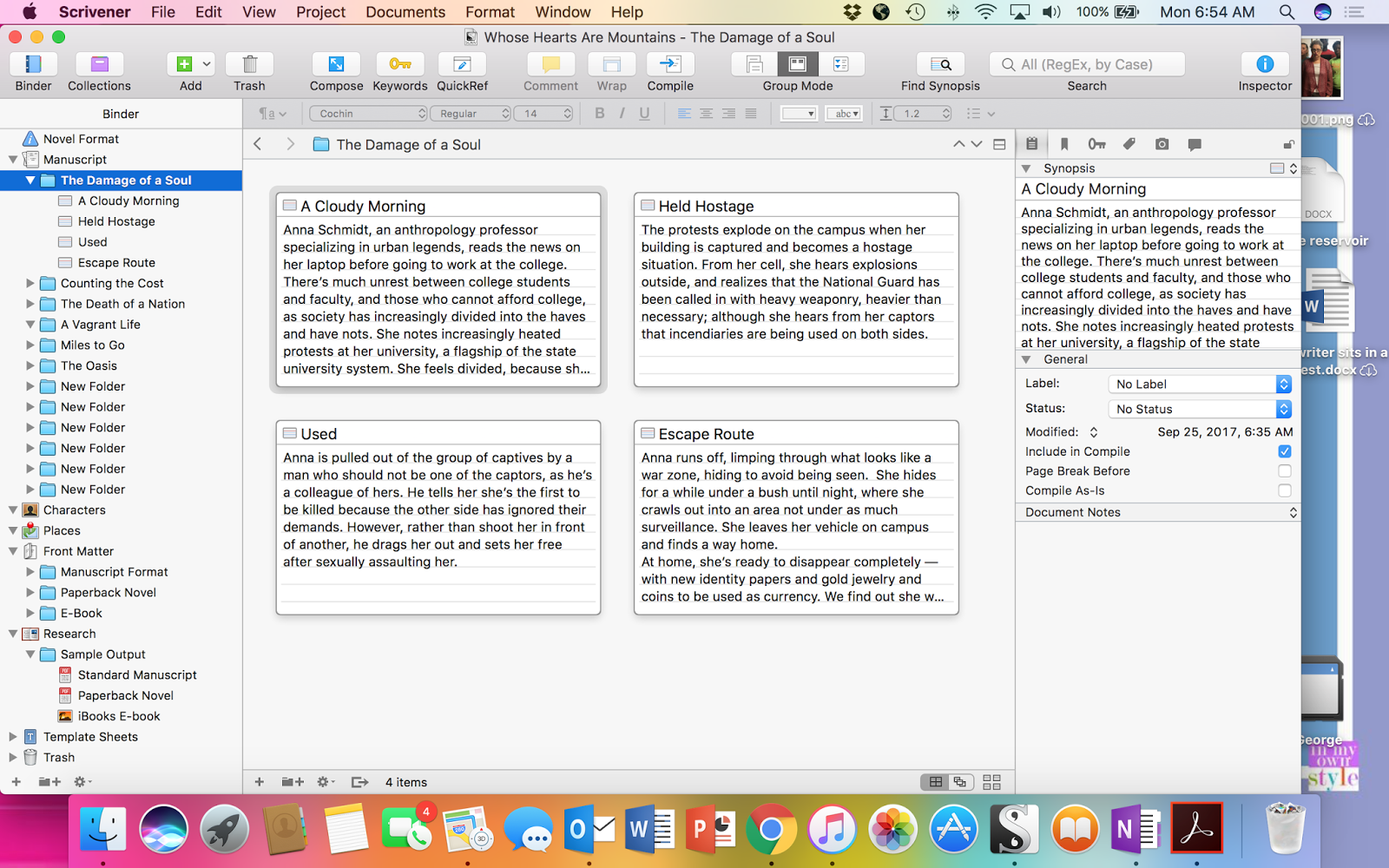
I’ve done this before — I start with a loose outline of major plot events, which looks like this:

On the left-hand side at the top is the outline for the book. I have the chapters added, with six titled, and the first chapter with its subchapters named and visible. The cards in the middle are the synopses for each section.  There are some commands at the right I will set up later.

That’s what I will be doing for the next couple of days, so that my book has some time to percolate in my mind in October after I edit another book.   Wheeeeeeee!