Note to readers: I’d like to call this Elegy, but only if it plants doubt rather than certainty that the subject is dead. Anyone want to weigh in?
I tell a story to the wind you’ll never hear.
Note to readers: I’d like to call this Elegy, but only if it plants doubt rather than certainty that the subject is dead. Anyone want to weigh in?
I tell a story to the wind you’ll never hear.
Writers have to provide a certain amount of solid grounding in their world, whether it be realism in an “ordinary world” or explaining the rules in a world of magic. But they have to do it carefully — not enough grounding and readers shake their heads at fancy words with no meaning; too much explanation and it comes off like sitting in a lecture in a stuffy classroom.
I wrote that “sitting in a lecture in a stuffy classroom” metaphor very deliberately, because grounding a reader in the rules of the world is, in effect, teaching. Doing this grounding not only helps the reader understand the world, but teaches them something new.
I remember a Jayne Ann Krentz book I once read (yes, I have read fantasy, and some of it is quite good) where the lead male owned a winery. At one point, he strides through the winery checking up on things. That’s about the only detail Krentz provided about the winery — he could have been touring an aircraft carrier for all we knew. This really stood out to me because I used to make wine at home and had considered starting a commercial winery at one point. My character would have stopped by the lab to discuss pH levels and brix — sugar levels — of grape must going into the process and the percentage alcohol and residual sugar of a batch waiting to go into oak barrels if it was red wine or bottling if it was white. He would tour the barrel stock and take a sample from a 55-gallon barrel with a wine thief and taste how it began to mellow under the influence of the oak. With these details, the reader understands more about wine — and the male protagonist is portrayed as having a keen eye on details, an understanding that winemaking is as much a craft as a business, and a rapport with his workers. That’s the beauty of teaching — done right, it develops the rest of the story — character, plot, theme, or all three — as well as teaching the reader about something new.
I do a certain amount of teaching in my own writings — I am, after all, a professor. I write what would be called magical realism if I wrote literary fiction instead of genre fiction (e.g. romance, science fiction, fantasy, Westerns, erotica). Sometimes what I write just has to be revealed rather than explained because there is no logical explanation — for example, the mystical aspects of my writing such as seeing visions and hearing the voices of the Gods (sounds epic, but the recipients of these preternatural events are a twenty-year-old college student and a fifty-year-old architect.)
Some extraordinary things need to be explained — such as the rules around time travel:
p.p1
And sometimes I teach the most prosaic things:
p.p1
When I pick up a book, sometimes I want it to broaden my world. Maybe it’s just me, because I teach college for a living. But if the book can explain something in a non-didactic (non-lecture-y) way, I’m all for it. I hope I’m doing a good job of it.
p.p1 {margin: 0.0px 0.0px 0.0px 0.0px; text-indent: 36.0px; font: 12.0px ‘Courier New’}
I’m currently editing my first novel, Gaia’s Hands, for perhaps the fourth time. Most writers would have delegated this to a drawer forever, but I’m going to use it as a learning tool. And, damn it, I’m stubborn.
The biggest thing I have had to do so far is remove two main characters, Annie and Eric. Not completely, mind you — they remain in the story, but not as main characters. I had read somewhere that more than two main characters distracts from the story, because we experience the story through the main characters. So we’re down to the seemingly mismatched couple I’ve mentioned before — Josh Young, the English major exploring his Asian American heritage and Jeanne Beaumont, the much older college professor who lives in the world of science.
Removing the first person POV for two characters resulted in removing two subplots, which I could do. But it also lost maybe 15,000 words, and publishers in SF/Fantasy now expect 75,000-110,000 words in their submissions. (Tea with the Black Dragon, which was nominated for the Hugo and Nebula the year it came out, would not pass in today’s market). Adding 15,000 words to an existing novel without it looking added on? Slapping two chapters in won’t do it. However, I’ve gotten the opportunity to look through the document with wiser — and older — eyes, identifying places where I erred in the following ways:
One of the best ways to keep your characters from becoming one big blur such that you can’t tell the difference is the character sheet. I have seen character sheets developed in a notebook in colored ink (What’re you up to these days, Ashley?), as templates for Word, or in software programs such as Scrivener.
At the very least, a character sheet for each main character will help you remember their traits and how they affect the story. Otherwise, it’s entirely possible to have one of your characters fall out of — well, character. For example, one of the themes in my writing is how pacifism has always been a minority position in the US. Therefore I have a lot of pacifistic characters living at the ecocollective that houses many of my novels, and other characters who are not pacifists but have agreed to non-violent rules to live in the collective. And then there’s Gideon, who was brought up by a Quaker mother, but couldn’t resist throwing a punch from time to time. I have to remember which ones are which to be consistent; thus, character sheets.
Character sheets also keep authors consistent from book to book. Case in point: One of my favorite books, one that makes me happy-weepy to read, is Tea with the Black Dragon, by R. A. MacAvoy. One of the protagonists is Oo Long, a mysterious Eurasian man who is more than he seems. Without giving away the plot, Oo Long, besides being the name of a tea, translates to “Black Dragon”. One of my least favorite books is Twisting the Rope, the sequel to Tea with the Black Dragon. My reason for disliking the latter book is because the character of Oo Long changes drastically with no explanation. In fact, his skin is described as “black” in the latter book. At the very least, the author needs to explain why a protagonist has changed color.
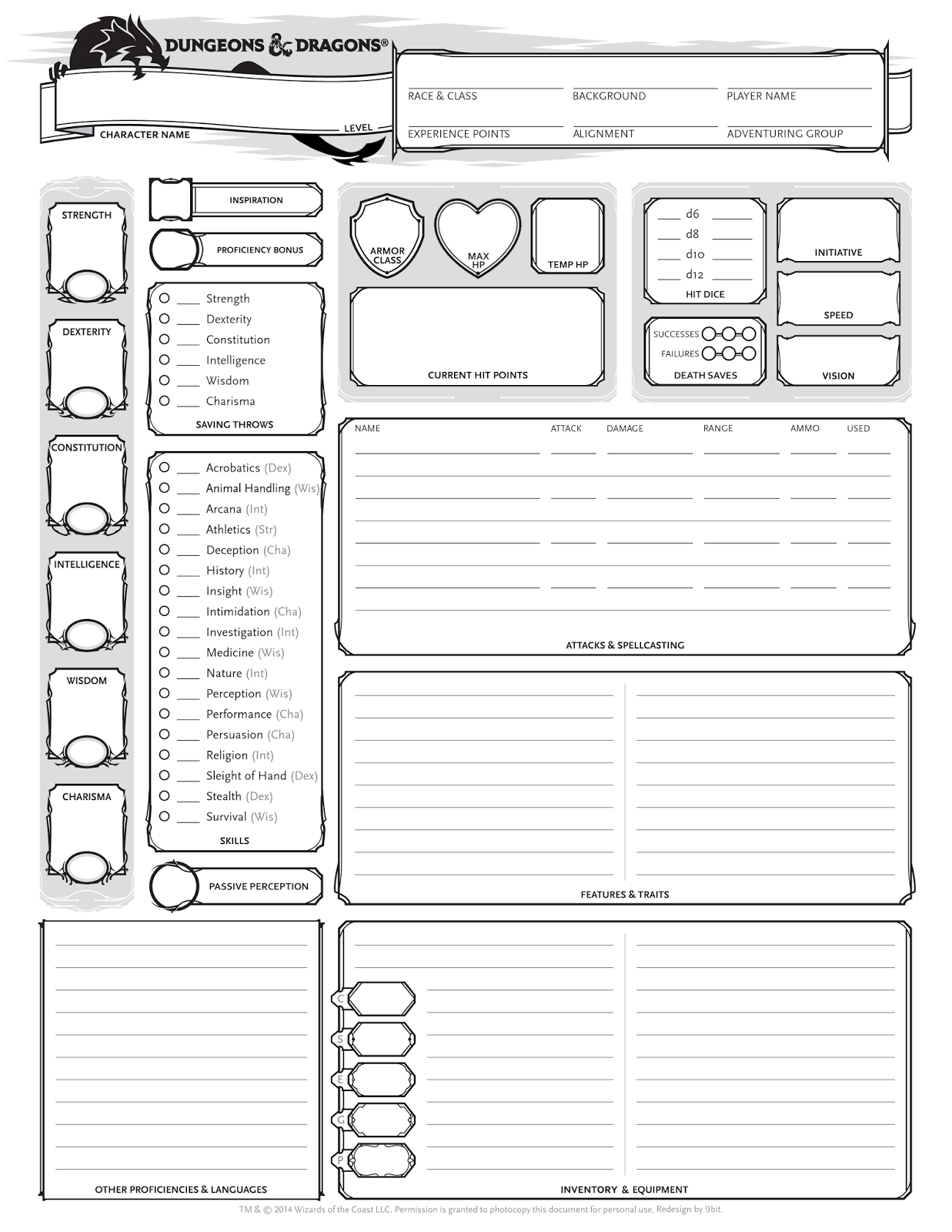
The first time I saw a character sheet was 30-some years ago, long before I started writing novels. It looked much like this: (Dungeons and Dragons, 2017).
Sorry for the mouse print. Anyone who has played an RPG recognizes this sheet, or something much like it. (My character was a female half-elf wizard with extreme beauty and maxed-out charisma. Hello, wish fulfillment!)
More pertinent to the discussion — this character sheet does a pretty good job for writers despite its obsession on quantifying character skills and its focus on fighting. I could see this working for sword and sorcery or even urban dystopia with fight scenes.
This next one I looked up on the Internet, a veritable treasure trove of character sheets. I love this sheet:
This sheet has so much detail, it would almost work as an intake assessment form in case management — all it’s missing is the mental status exam. I think I could use this form while discussing with my husband the fine points of a character over a three-hour coffee date. On the other hand, I have a novel with 65 characters, for which I have at least partial character sheets. Imagine filling this doc out for 65 characters!
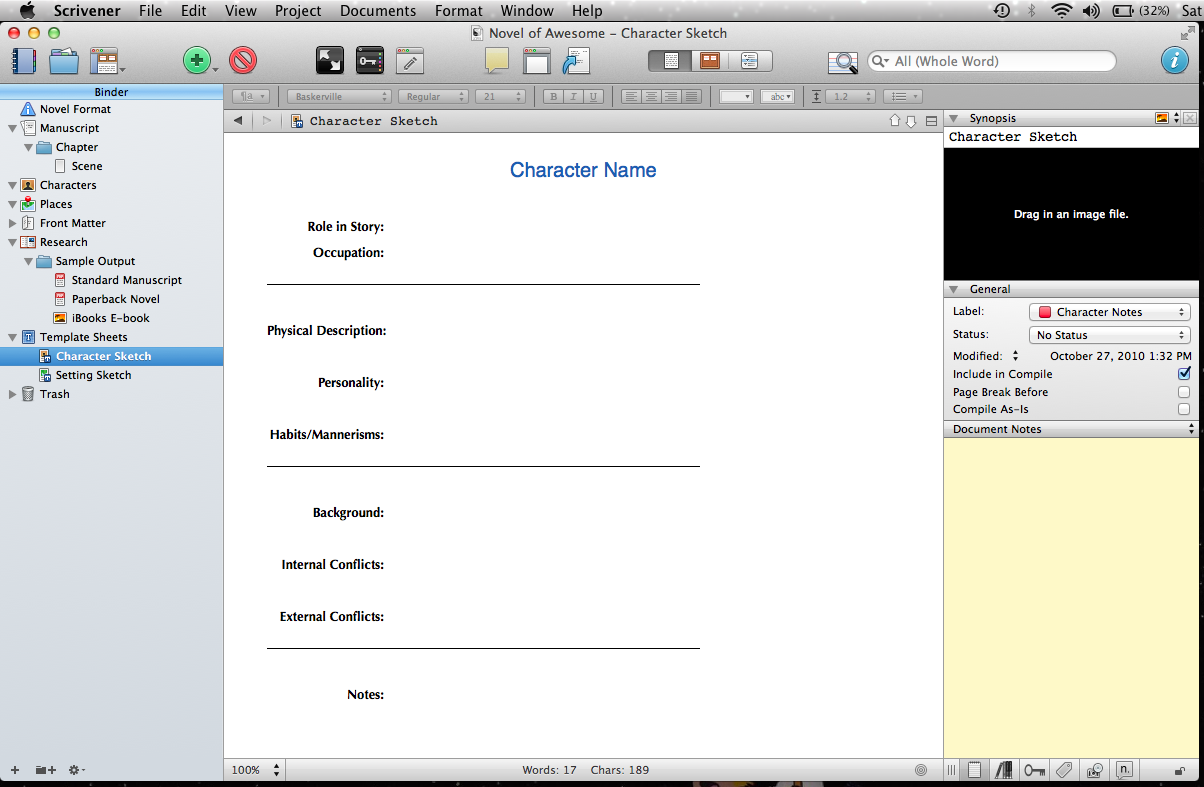
The third character sheet is what I use, because it’s electronic and because it’s bundled with my storywriting/formatting software, Scrivener:
I prefer the simplicity of this document — I can fill this out in 20 minutes or less and get back to writing. My favorite part of this document, however, is that I can drag and drop a picture to remind me of what the character looks like!
If you were to ask me, though, which character sheet/method is the best, I would not answer with Scrivener’s document, although it’s my favorite so far. As with many other things in life, the best character sheet is the one you’ll use.
As always, sources:
Dungeons and Dragons (2017). Character sheets. Available: http://dnd.wizards.com/articles/features/character_sheets [September 6, 2017].
Lerner, T. and Walker, K. (2017). The epiguide.com guide to character sheets. Available: http://www.epiguide.com/ep101/writing/charchart.html
Scrivener [Computer software]. (2017). Retrieved from https://www.literatureandlatte.com/scrivener.php.
I am a whirlwind, awhirlwind, doling out fire and storm.
Wretched, I hold my head as I type this.
I ask you the question, “Tell me your meaning.” I hold you to the answer.
You watch me stride across the classroom, my hands shaping a concept as I speak.
My dimples show when I smile over my glasses at you.
You can’t stop looking at me. You can’t stop wondering. You don’t know why.
In my office, there is a collection of stuffed toy Internet-famous cats.
I clutch the railing, lest my leg gives out.
Tell me your meaning. All of your meanings.
If you can, you can create three-dimensional characters.
(Trigger warning: Footnotes below)
The first stages of a novel — the writing — send my heart soaring. Discovering my characters’ quirks, finding their voice, finding MY voice, inserting moments of foreshadowing … it’s like a primitive ritual that spins into communion with Erato*.
Maybe I exaggerate. At any rate, creating a new world with new characters and new surroundings thrills me. I want to talk about writing with my husband, my friends, and anyone who will listen, all of whom react with “that’s nice” while they wonder if I’ve kept up with my lithium**.
Editing, on the other hand, feels like an exorcism. Looking through the draft for demons hiding between the sentences, suffering from boredom because there’s eighty thousand words to look through, and then finding something that doesn’t look like it should be there and wondering if it’s a demon or a cute cuddly spotted owl.
Or another extended metaphor with a side of simile: Editing feels like popping pimples — gross but necessary***. The great thing about this metaphor is that it has a happy ending: there is a certain satisfaction to popping pimples****. I’m not going to extend this metaphor any longer because — gross.
I’ve been editing for several days ***** and I can vouch that the extended metaphors are true to a point: I’ve read pages and pages the past several days with the following simultaneous charges: Make sure you take out that experimental technique the last agent who rejected you told you to take out. Make sure things still make sense from the previous changes. Make sure everyone’s still in character. Make sure the story captures people’s attention — how do I know what catches people’s attention? I’m weird. All of this while maintaining that people should be interested in agricultural back to earthers vs corrupt ag concern only with visions, Gaia-given powers, and a December-May love affair.******
But oh, when I fix something and I feel it’s right — which isn’t often — it’s so satisfying. Like popping — eww, gross!
* The ancient Greek muse of erotic poetry/lyric poetry. Why Erato? Because the ancient Greeks appeared not to write prose. None of the other muses worked — Urania, honestly?
** Lithium is the gold standard for treating bipolar disorder, particularly the manic/hypomanic stages. Currently, my lithium is trying to kill me with side effects mimicking acute toxicity, and I’m trying to get my shrink to see that my lithium is trying to kill me.
*** Dermatologists like Dr. Pimple Popper — not kidding! — would prefer you let them pop your pimples at exorbitant prices.
**** If you don’t believe this, Dr. Pimple Popper’s videos have almost 8 million views on YouTube.
***** when my lithium hasn’t been trying to kill me
******I meant “December-May”. She’s 50; he’s 20. I like making you uncomfortable with things like older women and younger men.
One of the big decisions a writer has to make when writing a novel is viewpoint. Viewpoint determines whose “voice” carries the novel or how much of the action is revealed. There are several viewpoints, courtesy of Orges (2011) that can be used.
I’m going to attempt to illustrate examples using things I’ve written (in a book or off the top of my head) because none of you have read the same books, and I tend to read genre fiction because Umberto Eco hurts my already aching head. The viewpoints below are proposed by Orges; the examples are mine.
I stood at the railing of the ship. The wind disturbed me, as there were no clouds in the sky or on the horizon to cause it. What the devil could it be?
I yelled to my Captain, who stood beside me scrutinizing the sky. “This looks to be a most unusual storm.
“I see that, ye idiot!” he yelled; I hardly heard him. “You’re the genius — what the hell do you think be causing it?”
I walked off, lest I lose patience. I peered at a corner of the sky where I spied a large, rather gaudy balloon.
“I see that, ye idiot,” the Captain bellowed back. “You’re the genius — what the hell do you think be causing it?”
Bob walked off, peering at a corner of the sky where he spied a large, rather gaudy balloon.
“Bob stood at the railing of the ship, looking toward the calm western horizon. “Captain,” he shouted to the man next to him, the wind swallowing his words. “This looks to be a most unnatural storm.”
“I see that, ye idiot,” the Captain bellowed back. “You’re the genius — what the hell do you think be causing it?”
Bob walked off, peering at a corner of the sky where he spied a large, rather gaudy balloon.
Bob stood at the railing of the ship, looking toward the calm western horizon. He was not the only one; the other men above deck peered and muttered in the wind that had suddenly blown up. Belowdeck, men bounced off walls as the ship began to list.
“Captain,” he shouted to the man next to him, the wind swallowing his words. “This looks to be a most unnatural storm.”
“I see that, ye idiot,” the Captain bellowed back. “You’re the genius — what the hell do you think be causing it?”
Bob strode off, peering at a corner of the sky where he spied a large, rather gaudy balloon.
Bob stood at the railing of the ship, looking toward the calm western horizon. The fact that the winds worked themselves to gale force without any clouds disturbed him. Was it magic? he wondered. He was not the only one; the other men above deck peered and muttered in the wind that had suddenly blown up. Belowdeck, men bounced off walls as the ship began to list.
“I see that, ye idiot,” the Captain bellowed back. “You’re the genius — what the hell do you think be causing it?”
Bob strode off, peering at a corner of the sky where he spied a large, rather gaudy balloon.
“I see that, ye idiot,” the Captain bellowed back. “You’re the genius — what the hell do you think be causing it?” On the other hand, our Captain seems almost stereotypically illiterate. Now’s a good time to pull out his grog and swig it, amirite?
Bob strode off, peering at a corner of the sky where he spied a large, rather gaudy balloon.
I peered at a corner of the sky where I spied a large, rather gaudy balloon…
Belowdeck, in the head, Cookie the cook prayed as he clutched his St. Christopher’s medal. He hated storms, had hated them since he was a wee child and his cradle had washed into the sea during a flood. He had been rescued by a stranger, a man who had brought him up.
As his guardian had told him, however, his days were numbered and the seas would have him back. And now it looked to come true …
I heard Bob talk to the Captain as if he’d been the first person to notice the wind picking up. He was far from the first — I felt the wind pick up first; I saw the mild sky. Nothing to see here, move along; except for Bob, who was bucking for Captain’s job.
You may wonder why I haven’t covered second person:
Bob, go talk to the Captain about that wind you felt. Make sure you tell him about the lack of clouds. And the water balloon. Then be sure to find a way to work around him given he’s an apathetic old sot.
See what that’s like to read? In small doses, maybe.
By the way, this is the hardest blog I’ve ever written!
Citation: Orges, S.M. (2011). The 7 narrator types: And you thought there were only two! Available: http://bekindrewrite.com/2011/09/09/the-7-narrator-types-and-you-thought-there-were-only-two/ [September 3, 2017]
I wear t-shirts and jeans for casual wear, classic-cut blazers and slacks and long skirts for work, and Bearcat Green sweats for football games. I wear a wedding band with Celtic knotwork and a Claddagh ring as an engagement ring. When I wear other jewelry, I wear vintage pieces that my mom left for me when she died. Currently, my nails are painted a color-changing green. In a back closet, I have period peasant wear to wear to the Renaissance festival.
What does that tell you about who I am? About who I’m not?
We are all Sherlock Holmes, deducing other people by their outsides. We look at hair — my short choppy hair makes people think I’m a lesbian — which can be very flattering. We look at accessories — a MAGA hat or black lipstick inform us on what category to put a stranger. We look at clothing — today, I’m wearing a Lil Bub t-shirt and jeans to work, and as I’m the professor, it will confuse a few of my new students who don’t realize Friday is my Jeans Day.
According to cognitive psychology, putting people in categories based on their clothing is a heuristic, or information-processing shortcut, called the representativeness heuristic. Does appearance tell us everything about a person? No! Marilyn Manson, grotesque goth that he is, is reportedly a very nice man. The woman in soccer-mom jeggings could be a clown on weekends. Therefore, the representativeness heuristic doesn’t tell us the whole truth, However, as people do dress to express their personality, we can use descriptions of clothing as a shorthand for personality.
I woke up this morning realizing that a book I wrote, Voyageurs, depends heavily on clothing as characterization. One character, Cat Pleskovich, wears leggings and tank tops to fit her dancer’s figure and daredevil tendencies. Another, Ian Akimoto, has very little clothing to his name because he lives in an impoverished, barren future. However, as a time traveler, Ian uses Method acting techniques, including dressing for character and time period, to fit in wherever he lands.
*****
Part of the intro of Voyageurs, made of clothing and impressions:
May 19, 1814 (Kat)
I stepped out of shadow and paid my entrance at the gate. I had dressed like a gentleman, and the suit set off my tall stature. I strode confidently through the gate of Vauxhall Gardens, as men do. From a grandstand, some musicians played something I didn’t recognize, something that sounded jaunty and Germanic.
A woman in widow’s weeds passed through the gate right behind me like a wraith. She would receive scorn not only because she walked in unaccompanied, but because she marred her period of mourning for frivolities. I admired her gall and wished I could accompany her to reduce some of the harsh judgments against her, but she slipped away before I could offer.
Besides, I had come here to solve a mystery. Someone had left a note in my (Twenty-First Century) mailbox that read, I know you are a Traveller. Meet me at Vauxhall Gardens at 8:00 PM on May 19, 1814. I will be on the first bench beyond the lights to your right.
One purpose of a pleasure garden, I had read, was to provide dark nooks for dalliance. An unintended consequence, however, was the presence of thieves. I walked with purpose, head up, smelling an elusive whiff of a cheroot on the breeze and hearing two gentlemen as they passed me, talking of an assignation.
I thought I knew of all the Travellers. A few of us had met up recently at the 1904 World’s Fair, Wanda and Harold and I, to see the wonders unveiled there. We had connected by email to set a rendezvous, as we lived in far-flung cities, and Wanda had to make her face look pale under her bonnet because St. Louis had been even more racist then. We all ate ice cream cones, of course.
As I walked toward the dark, I felt the note in my pocket as a talisman. My foray into meeting an unknown Traveller could endanger me. I carried a sword cane, standard for gentlemen of this era, as defense. I walked toward the first bench to the right, in the darkness, and I spied the widow there. She had pulled knitting from her bag and set to it. Through her veil, I thought she watched me.
I ventured into the deeper darkness, and her words, said in a husky voice, startled me. “You are not a man. You walk like a woman.”
I looked at the dark figure, and I noticed – “You sit like a man.”
“Katerina Pleskovich,” the other said in a voice slightly changed. “It’s good to see you in person.”
“Okay,” I said sternly, “You have the advantage on me, and that makes you look like a stalker.”
“Ian Akimoto,” he said, standing and pushing back his bonnet. In the moonlight, he was truly post-racial with glossy dark hair, wide-set Asian eyes, a long, thin nose, full lips. And an odd swirl of freckles on his high cheekbones. Not handsome, exactly, but perhaps appealing. Incongruously, I chuckled.
*****
p.p1 {margin: 0.0px 0.0px 0.0px 0.0px; font: 12.0px ‘Times New Roman’} p.p2 {margin: 0.0px 0.0px 0.0px 0.0px; font: 12.0px ‘Times New Roman’; min-height: 15.0px} p.p3 {margin: 0.0px 0.0px 0.0px 0.0px; text-indent: 20.2px; font: 12.0px ‘Times New Roman’} p.p4 {margin: 0.0px 0.0px 0.0px 0.0px; text-indent: 22.5px; font: 12.0px ‘Times New Roman’}
p.p1 {margin: 0.0px 0.0px 0.0px 0.0px; text-indent: 20.4px; font: 12.0px ‘Times New Roman’}
What do you know about Kat from her appearance? What do you know about Ian? Where were they wrong about each other, just from appearance? That’s the power of playing with clothing, appearance, and characterization.