Imagination

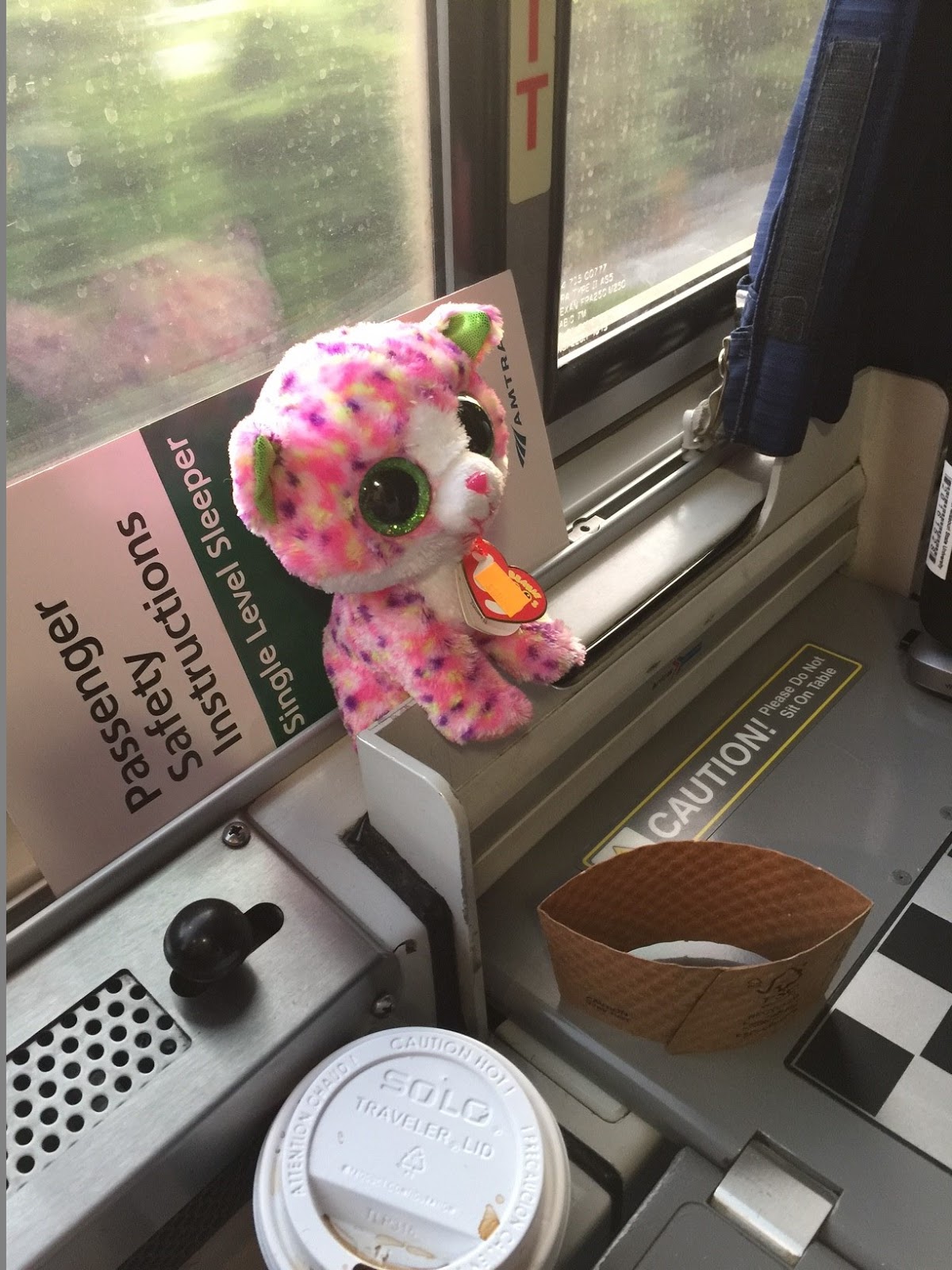
I type this while in a roomette car (tiny sleeper car) on the Lake Shore Limited barreling — no, creeping — toward Chicago. The train will arrive two hours late because last night we had a train robbery — NO, we did not have a train robbery, Marcie. We got delayed because of middle-of-the-night track repair…

I like Marcie’s version better. Marcie has a lot of imagination — and energy. A lot of you liked Marcie’s guest post yesterday. Someone from Portugal viewed it — what, four times?

I pull Marcie out of my imagination every time I need a boost — like the time she guest-lectured in my Resource Management class: “Aunt Laurie said I could talk to you about what she calls ‘satisfaction’ — or what I call happy. There are lots of types of happy…”

After twenty minutes or so, my class asked Marcie to step down and let me teach again. Why? Because as much as we desire imagination, we need it to be grounded by reality. Even high concept fantasy needs to have an internally consistent world. Otherwise, as Marcie will tell you, the bad guy could change the rules again and again and always win. None of us want the bad guy to win, much less win with a stacked deck.

But at the same time, we need our inner Marcie so we feel free to use our own imaginations. Marcie would like you to know she looks like this:

… what? You don’t think Marcie can be a big-eyed shape-shifting cat? It’s all about imagination.

Guest Blog from Marcie

(Note: this blog entry will be written by Marcie, my imaginary alter-ego. Marcie sees things differently than I do, and for good reason …)

Hi! My name is Marcie, and I’m seven years old. Aunt Laurie gave me permission to write her blog today, and I have so  much to say! Right now, we’re at a coffeehouse — it serves coffee, which is blech, and it’s a house. Aunt Laurie says most coffeehouses aren’t in houses. Then, why call them coffeehouses? Luckily she got me a hot chocolate because I hate coffee.

We just got out of summer camp. I didn’t go with the adults who ran around in all different colored vests and looked like they needed to poop more. I got to hang out with Aunt Laurie. She made me look really gross with wax and fake blood, and she told me this was for a game that would teach the people in vests  how to behave in plane crashes. I got to pretend I was hurt so that the people in the vests carried me back to lay on a cot. A person in an orange vest walked by and told me I died. It didn’t hurt to die, but I was still alive, so I guess I wasn’t really dead.

We’re in a place called New York, and it has these huge mountains all over the place. Aunt Laurie says they’re not mountains, they’re hills. I think she’s wrong, because we have hills in Missouri and these are much bigger. I mean they’re taller than houses — lots taller. The hills back home aren’t as pretty as the ones here.

I haven’t seen Bambi yet. Or a raccoon. I’m disappointed, as Aunt Laurie would say. But not often, because Aunt Laurie’s happy most of the time. She’s a lot like me, except she trips sometimes over nothing.  Aunt Laurie says she’s had too much coffee because her teeth are buzzing. I think that sounds kinda fun, even though coffee tastes like blech.

Tonight we’re going on a long train ride. We have to sleep on the train in a tiny room with bunk beds. There’s not enough room to play unless I sit in my bunk. We rode on the train on the way out and I bounced off the walls when I walked to the dining car.

I have to go now. Bye!

The Enforcer

WARNING: The story below contains swearing, attempted murder, murder, and lots of blood.

Sometimes I write short stories with little plots to help me develop characters. One of my favorite characters is the evil Archetype (immortal) who calls himself Boss Aingeal. This story is from his point of view as an enforcer in 14K, a Chinese street gang in Chicago, hence the warning above.

Two of the other characters — the lawyer Luke and the young man with the braid, Allan Chang, show up in later stories and novels. I love all of these characters.

*************

Boss Aingeal, as he called himself, glanced around his office on the second floor of an Asian grocery in Chinatown. Sleek and austere Chinese furniture in black and red accented the textured cream walls with cinnabar stripes. A series of swords – jian and dao, straight sword and saber, hung on the wall to make a point – this office belonged to an enforcer, a Red Pole. Although he usually negotiated rather than killed, Boss figured that the pole was represented as red for a reason.
It suited him well, the Chinese provenance of the furniture reminding him of the only woman he had ever loved.  He knew she was likely still alive – as an Archetype, she could have survived the damage he had done. As an Archetype, he could survive otherwise fatal damage as well – or had thought he could.
The evil he had done in his lifetime had caused him to crumble like the façade of an ancient building. The man in the mirror was a hideous parody of the proud Celt he had once been – pale whitish-pink hair that hung like hags’ hair, sagging cheeks, and bags under his eyes. The wages of sin, he thought, were truly death.
He heard a knock on his door, and he wondered if it was one of his compatriots in the Triumvirate. The Triumvirate didn’t transport to Chinatown often — when not in InterSpace, as Archetypes should be, the others in the Triumvirate played with power and influence in high places – in banking, in the courts, to skew the odds toward those already with money and power, who could be trusted to wield control. No blood on their hands, but no less evil. No less deadly. They, too, had aged for their evil.
He strolled over and opened the door; a tall, chubby liaison with shaved head and western business suit stood there. Boss recognized him as Nua Li, a lower ranked messenger for the gang. “Red Pole,” the man in the role of Straw Sandal said, and nodded.
“Sit, sit. Let us have tea,” Boss welcomed.
After the preparation of tea in the ornate Gong Fu style, which Boss had developed some skills in, the liaison said, “May I speak to you of business?”
“Of course,” Boss responded, steepling his fingers, “What business shall we speak of?”
“We have a loose cannon among the 49’s. Big mouth. Talking about our uh, — more shadowed business in the gambling den and how he’s so important in it.” The man, Boss noticed, fidgeted with his teacup.
“That could get us in trouble with the garda, no?”
“He brags that he deserves your job, especially as you are lao wai.” The liaison spoke in a hushed voice.
Boss chuckled, “But I am literally lao wai – I am old, and I am Caucasian, and I am most certainly an unusual hire in this business. He did not call me ‘lao wai’, most certainly?”
“He called you gao bizi, ‘high nose’.” Boss thought that the man’s words certainly weren’t too insulting, but only because Boss wasn’t one to get insulted easily. And the only way for the man in question to get the job of enforcer was to kill the current enforcer, which was Boss.
“Ah, a bendan, then? If he can kill me, he certainly deserves my job.” Boss sipped his tea thoughtfully. If it was the man Boss was thinking of, he certainly was a bendan, an idiot, for thinking he was a match for a killer like himself.
“It is not the bragging itself that we are worried about.” A long pause from the liaison.
“So, Straw Sandal, because you visit me, I assume there is a sanctioned hit on Chang Li. Does this come from the head of the gambling den or from Mountain Master himself?”
“You know these things do not trickle up from the foot of the mountain. I bring an official sanction by the Mountain Master himself.” The liaison took out a piece of thin paper, written in Cantonese and English, and placed it on the table.
“Really? For bragging?” Boss raised his eyebrows, and then read the paper before him. “Ah, the truth will out,” he murmured. “Screaming and beating people in the gambling den. That could lose us customers. He should take that to an alley.” Boss consulted the list once more – “Bragging about beating his wife. Has anyone told him about his culture’s belief in mianzi?” Mianzi, or ‘face’, was the key to Chinese character, meaning status, prestige, and the like.
“Chang Li wants to be a big shot, but other than that, buyao lian.” The words the liaison used, buyao lian, meant ‘does not want face’. Boss suspected that the hierarchy tested him with Cantonese words to see if he really understood the language or not – little did they know he spoke fluently the Cantonese he had learned 150 years before. Boss kept his little secret, and he learned much about 14K he perhaps wasn’t supposed to.
Boss could not ask the Straw Sandal why he fidgeted with his cup, or the man would lose mianzi. So he mused, “What’s the catch?”
“You must kill him by Monday, before the divorce becomes final.” Divorce? Ah, the Lis. How considerate to give the long-suffering wife a survivors’ package with the bank account and possible insurance policies.
Boss burned the contract in a candle flame, showing his acceptance. Inside, however, he felt his stomach had knotted.
Four and a half days to kill Chang Li, Boss considered as he walked the few blocks to the river. He could have transported to the river in another life, but now his energies needed to be conserved to give him more time. As he looked up the street, he saw a midsized man with straw-blond, almost white hair, wearing a pale-grey suit and looking as young as he had 5000 years ago. “I have four days to accomplish the impossible, and Luke Dunstan shows up,” Boss muttered.
“Need some legal help?” Luke inquired as he sized Boss up. Boss seethed – Luke Dunstan, the Saxon male Archetype, was his nemesis, as well as protector and probable father of the chaotic Lilith. Lilith who set off thousands of years of chaos and wantonness just by showing up at a ritual and getting Boss’s fool son to choose her over Eve.
He would settle that score soon. “Dunstan,” he said, peering down. “I’m working on a job.”
“I know. Li Chang.” Dunstan, Boss noted, used the American form of the name. “Your liaison Nua Li can be made to talk. Don’t fault him; he has a wife and kids, and I’m the only one he talks to. I’m his lawyer.”
Boss tried not to sputter, although he knew who had more face in this conversation, and he hated it. “Could you slow down the paperwork for Li Chang’s divorce? Or better, could you pull it?”
“Can’t do it. I put the papers in the pipeline, and it’s set to be settled first thing Monday.”
Boss realized that he didn’t have four days – he had three days. Two days to plan, and Sunday to execute. “Can’t you transport in and grab the papers for me to hold?”
“No can do, don’t want to break any rules.” This from the man on the side of chaos. Boss simmered as Dunstan strolled away, calling over his shoulder, “If you need me, just drop in.”
Boss stood there for a moment shaking as Dunstan strolled off. Then he took two deep breaths – it wasn’t good to lose one’s cool if one was the highest-ranking Caucasian in Chicago’s 14k Triad.
Boss decided to catch the water taxi at Ping Tom Memorial Park at the pagoda. It stood, a one-story open structure of wood, unpainted. It did not look like any of the pagodas he’d seen in China. Perhaps it was Japanese, or Vietnamese. Maybe someone made a joke at Chinatown’s expense. Maybe modern Chinese pagodas were minimalist, he considered.
The loop through Chinatown would allow him to survey the riverside for a good spot to kill Chang. He decided Chang’s demise had to look like an accident. It could not look like suicide, or Chang’s life insurance would not pay. It could not look like murder, or Mrs. Chang would be considered the prime suspect and the estate might get tied up.  And maybe attention would focus on him.
There, in the heart of Chinatown, not far from where he had started his excursion, he saw the perfect place – a metal sign pole six feet tall, holding a sign for boaters, advertising Lawrence’s Fish and Shrimp. It would be construed as an accident if Chang slipped, hit his head on the pole, and fell into the river. As long as Boss could time it such that the taxi would not be passing by at that moment, it would work fine.
His time on the boat now free, he considered how to attract Chang Li to the site. Chang wanted Red Pole, and the only way to become Red Pole was to kill the current one. All Boss had to do was pass a note to Chang insulting his manhood. It was an open secret Chang had sired no children, and that another man sired his wife’s son. The finishing touch would be suggesting that Chang would never beat Boss Aingeal in a duel to the death. That would work well, of course, unless Chang Li was a coward or a man of at least minimal intelligence. The former might be true, not so much the latter. At the same time, nobody ever died overestimating his foe.
Boss looked in the other direction to see a young man sitting, with long dark hair in a braid, bare dusting of facial hair in the shape of a goatee, almond-shaped eyes. He wore a black tank top and jeans with ripped-out knees. The man looked straight at him.
The man scrutinized him and said, “I think I saw you ‘round here years ago. You were younger then.” His voice spoke of years of drugs, years of vice – but he smelled clean, like a little babe.
“We were all younger then,” Boss grumbled at the man. “What is the point?”
“14K,” the other said. “You work for them.”
“Do you think a man like me would run around a dirty gambling den and break knuckles to facilitate collecting debts?” Boss asked, indicating his pristine black suit, subtly Asian in cut and expensive.
“You need to get out,” the man said. “That work’s gonna kill you.”
“You are correct, young man.” Boss turned to watch the riverfront.
The exit lay ahead at the pagoda. Boss climbed off the boat as it moored at the dock; the man with the braided hair climbed off ahead of him. He noticed a blackwork tattoo peeking out from under his sleeveless shirt. Brilliant work, but not Chinese, he noted. Especially not gang Chinese – no dragons. Boss wondered idly if his lack of gang tattoos set him up for potential challenges.
Boss walked up the walk to the sign he had identified as his crime scene. He noticed that the man with the braid and the tattoo walked ahead of him. As he got close, he saw that Chang Li stood at the post, examining it closely. The young man stopped to talk to Chang. He looked nothing like Chang, so the youngster with the braid wasn’t the son. His voice sounded flat and terse; Boss wasn’t close enough to hear the words. As he approached, Chang broke out in his legendary fury and tried to push the other man into the river.
“Good try, but I can swim now. You can’t do that twice to me,” the younger man said in a defiant tone that suited his gravel voice. He then walked off, dodging a grab from Chang. Chicken, Boss considered, using the common slang for a young male prostitute. The young man’s swagger looked right. Maybe Chang liked chicken.
Boss strolled up, his hand clamping hard on Chang’s shoulder, and hissed in his ear, “Sunday. Six AM. Be ready to die.”
“You be ready to die.” Chang hissed and tried to grab for Boss as he had the younger man. Boss dodged – for all his aging, he had lost none of his agility, speed, or strength.
As Boss walked back to his apartment, he considered that maybe the Chinese were correct about the stars aligning. He had done two days of preparation in one day.
Boss’s apartment was no less pricy than was his office, but the décor skewed toward the Celts he represented – handmade bobbin lace curtains, rough-hewn antique table from the 1700’s, tweed pillows on a new, but rustic green couch; ornate meerschaum pipes and Waterford crystal in a display case. It was a man’s apartment, despite the crystal and bobbin lace – it was an apartment for the man he had passed as before he started rapidly aging. The apartment depressed him now.
InterSpace, his true home, depressed him worse. He considered the uneven black-on-black pebbledash walls that should have comforted his Celtic roots but didn’t. His mind wandered, and reminded him that ‘pebbledash’ also meant diarrhea in Irish slang, which sounded about right. He thought of the white floors and the eerie lighting that showed only in the immediate vicinity of an Archetype. He thought about the lack of sound, the lack of Archetypes to visit, as they were solitary creatures. He thought of the lack of humans, who were at least amusing to watch.
Boss took a deep breath and thought of how he could refine Chang’s death. There were different types of death, he thought, the main ones being deaths that are not suspicious-looking, and deaths meant to send a message. Chang’s was one of the former, and although it would be tempting to give him a showy death, as he had declared himself a rival for Red Pole, it would cause problems for the widow and, thus, his assignment.  Innocuous deaths took no less time and effort to enact than did ornate ones.
It was fortunate that Boss had chosen six AM on a Sunday. That eliminated the interruption of passers-by and water taxis. He would prefer a foggy morning, which would be hard to come by in July. The site he had picked was far enough down from the park that he’d be unlikely to be disturbed by the Sunday morning tai chi crowd – not that he expected those ancient fellows to interrupt him.
All perfect, serendipitously. Ordained by the stars.
Still, he felt his stomach knot.
Sunday came, and Boss was ready. Archetypes did not need sleep, but he had meditated to calm the knot in his stomach. Then he reviewed the plan, over and over, until it became a pattern in his head. He wanted to do Chang’s death right, because he had the odd notion that Mountain Master tested him.
Boss arrived at the sign fifteen minutes early, to make sure that Chang did not have the same idea. No, Chang had not arrived. Boss reviewed his moves – clock Chang on the head, throw him in the river, first putting grease on the pavement and shoes to suggest he slipped on some grease. He even had the bottle of peanut oil to break at the scene to give it veracity. He would not bother with gloves – Archetypes had unrecognizable DNA.
Boss waited, his irritation growing. Chang Li, as always, was late — half an hour late. Typical for Chang.
Finally, Chang Li swaggered up, carrying a baseball bat. China had designed the most elegant martial sword arts Boss had seen, and Chang had brought a baseball bat like a street thug. Thugs did not become Red Pole.
Chang started the fight by brandishing the baseball bat as he charged Boss. Chang tripped and fell headfirst into the pole. Boss deftly removed the baseball bat from Chang, so that any question of another party was obliterated. Boss watched in amused horror as the blowhard with a possibly fatal head wound groaned and staggered backward into the river.
This did not just happen, Boss thought. This total oaf did not take my kill away from me.
As he stood shaking his head, he felt a presence beside him. He turned to find the young man from the boat ride, his dark eyes burning. “I’m sorry you didn’t get your kill, asshole, but my dad’s always been a bit of an idiot.”
“Your dad?” How did Boss miss that?
“Stepdad, actually.” Oh, yes, Boss remembered – the self-styled general fired blanks. Chang’s son was not really his, hence the wider eyes and the stronger nose. If Boss had missed that, what else had he missed?
Boss glanced up the river and spotted the elders fashioning the flowing movements of tai chi in ragged rows. Had they heard the commotion?
“Watch out,” Chang’s son yelled as he ran from the scene.
Boss looked up to see the liaison Li Niu walking up to him. He saw a glint of metal to Li’s right side. A Dao, short saber, was likely what he tried to conceal. “Cac”, Boss muttered in his native Gaelic. “Shit.” He sensed a betrayal here – did it go as far as Mountain Master himself?
Boss had no time to contemplate, and no weapon but a baseball bat. “Plá ar do theach!” he screamed, which played as well in Chinese as in Gaelic, as it cursed the man’s house.
Boss swung the bat to meet Li’s swing, and sword cut into bat. The sword stuck in the wood, and Boss wrenched it out of Li’s hands and threw it in the river, destroying his pristine accident scene. “Why?” he yelled at Li, all suavity gone.
“I’ll say it in English,” Li sneered. “Because you are old. Because you are white. Because you have no home, no mianzi. Because Mountain Master promised me Red Pole if I could kill you.”
“My friend, you do not understand. I am over 5000 years old. Don’t assume you’d be the first to try to kill
me, Nua Li, nor the last to fail.” Boss grabbed the other man by the shoulders and transported them to the Mountain Master’s office, which he had been to only once, leaving the peanut oil bottle behind.
This would be a splashy death, Boss decided as he teleported two swords from Mountain Master’s near-priceless collection, and threw one to Li.
As Boss battled the seriously outmatched man, he felt an unaccustomed twinge of pity. A waste of a good man, Boss thought, who had likely been talked into ambition by the Mountain Master. Li Nua might have lasted two weeks until the next contender for Red Pole challenged him – probably the Master’s plan as well. Finally, inevitably, Li Nua fell, killed by a slash to the abdomen followed to a mercy stroke to the neck.
As he hacked Li’s limbs and head off with the Master’s 600-year-old heirloom sword, painting the ornate room with blood, Boss remarked it was a shame that powerful men used good people like Li Nua as pawns. He considered the number of men like Li Nua he himself had used as pawns himself over the years.  
Boss carefully arranged the body parts into the rough outline of a body, with the exception of Li’s right hand. He ended his gesture with a resignation letter written in blood and in Cantonese. He weighted it to the desk with Li’s right hand, middle finger raised. He sensed this was over the top, childish even, but he was so weary.
He turned his back on his work and transported to InterSpace, there to go into exile.

Learn Everything

Everything a writer learns will help their writing.

First example: after twenty-something years of teaching college students, I’ve learned that classes get categorized in three groups: “I loved that class”, “It was okay”, and “Why did I have to take that class?” The number one class in the third category was Philosophy, otherwise known as “that class where you argue totally unimportant things”.  I sympathized with these students because I’d taken philosophy myself.  I had discovered the purpose of philosophy was to come up with a internally coherent argument about unseen and unknown things. There’s no way to objectively test if your argument is correct. (in the words of my mother, “What difference does it make if we have free will or not? We can’t change it!”)

When I took philosophy, I said what countless other students said — “what am I going to use this for?” Years later, I started writing novels, which required different skills than short stories and poetry. Because I wrote fantasy, I had to build talents and powers and magic and the like that were internally consistent. (Trust me, Harry Potter fans have convinced me that every single discrepancy in magic will be noted by the readers — Just look up “Elder Wand” and you’ll get an earful.) The jump from internally consistent arguments to internally consistent magic systems wasn’t that big. So now I finally get to use philosophy for something useful!

Another example: Moulage. According to my annual report last year, I am a nationally recognized moulage expert. (This means I’ve been moulage coordinator for two (going on three) of the disaster training exercises for the Consortium for Humanitarian Service and Education.) Moulage, by the way, is otherwise known as casualty simulation. Yes, that means I make ordinary people look like victims for emergency and disaster training. I taught myself how to do this after some lovely people mistook me for an expert, and I keep getting better as I go. But the reason I mention it here is because I have had to study many, many gory pictures to do my art — closed abdominal injury, disembowelments, burns, open and closed fractures, gunshots … If people get wounded or killed in my writing, I either know what the carnage looks like or I look it up.

In short, a writer can’t say “I’ll never use that”, because that most arcane or useless bit of information can, and will, come in handy.
********

If you’ve read this far: I will be taking the train out to upstate New York on Wednesday to serve as Moulage Coordinator for the third exercise in the CHSE series, New York Hope. I hope to have time to write, even on the train. I would post pictures of my handiwork, but it’s … gross.

A bonus — This Unseen Bird

This unseen bird (I think)
leaves me gifts every morning —
a feather heartachingly red,
a pristine moth coccoon.
Or I imagine things —
I’ve never seen the bird,
he may not even be red,
he never speaks to me.

I prefer to believe
this unseen bird
leaves me gifts every morning.

********

This is a rough draft and subject to change, as always. My goal was to write a poem using more everyday language. I read a lot of ee cummings when I was younger.

Writing for Change

Full disclosure here: I am female, cis/het, white (mostly), married, 53, educated, neurodiverse, middle class, and not beautiful according to Western standards. I tell you this not to present you with a set of labels to call me, but to hint at which social injustices I have faced in this society and which I have not.

I also am a member of the Religious Society of Friends (otherwise known as Quakers), and nowadays we’ve thrown off plain dress and plain speech (thee didn’t know that?) but have retained our sense of social justice as something important to work toward.

I carry this sense of social justice into my writing. I carry it imperfectly, given that I have not experienced life as a lesbian, as a black person, as a Moslem, a transgendered person, or a person with visible disabilities. Why would that matter? Because I am an outsider to others’ experiences. I do not experience the small insults others do every day — nobody suggests rape as a solution to my gender preference, nobody calls store security on me while I’m shopping, nobody tells me my religion is satanic, nobody calls me a cripple. Most of us miss these aggressions; others experience these and worse daily.

I want a socially just world. I imagine the world as a banquet, and I want to see everyone at the banquet. I want to feast on gravlax and fufu with palaver sauce, and oh-my-G-d Middle Eastern desserts. I want everyone to feast and to talk to each other and to share. And those who are uncomfortable with the other, I want there to be counselors nearby who will talk to their wounded inner child and their not-okayness and prepare them to sit at our table instead of taking it all away from us.

Full disclosure: I was harassed as a child because I was “different” (i.e. neurodiverse), and female, and fat, and gifted. The harassment accelerated into violence. This could by why I want a socially just world. I don’t want anyone else to suffer. It bothers me that I might not have noticed all the injustice if I had not experienced it.

I have to try the best I can to bring in the topic of social justice into my writing, hoping that I am doing so constructively rather than destructively. Here is what I have pledged myself to do:

1) Don’t be timid about putting people who are not necessarily “dominant culture” in my writing. Admittedly one of my favorite characters is Gideon, an avant-garde Jewish architect who designed exquisite bridges when manic but could not hold down a job when depressed. Less like me, however, is Arminder Kaur, a fourteen-year-old Sikh who dreams of being a “saint-soldier” defending the oppressed.

2) Avoid stereotypes, but thoughtfully include cultural norms for other cultures. One of the sensitive places in writing in this regard are accents. If the only people who have accents are foreigners and African-Americans, you’ve written stereotypes. I can point out that the downstate New York accents I ran into when I taught out there had many interesting pronounciations — “cawd”, “SHU-ah”, “Ant – AUCK – tica”. Remember these if you’re going to put in other accents.

3) Do not make white characters the “saviors” for people of other groups. People who are not white, straight, etc. will be allowed self-determination. Movies from Avatar to The Blind Side feature the “white savior” trope, and it’s really insulting.

4) Dominant culture will not be the standard by which other cultures are judged.  An overweight person will not be harassed into losing weight (as if that worked!),  Guardsmen will be allowed in a pacifist ecocollective if they lock up their guns while on site.

I will offend someone. I will fall short, because I’m human and because I walk around with privilege others don’t have. We all will offend each other at the banquet table because we’re different. But my responsibility is to write for the world I’d like to see.

My First Big Mistake, or How I Shot Myself with Chekhov’s Gun

In yesterday’s blog, I commented that I didn’t put great store in Chekhov’s Gun, or the principle that one should only include objects in a story that will come into play later in the plot.  I learned about the principle at about the time I wrote a novel for the first time (i.e. when my husband remarked that, if I was going to keep writing short stories around the dream I interrogated, I might as well write a novel).

I took Chekhov’s Gun to heart, writing extremely sparse descriptions of people and places, figuring that description would distract from the plot if they couldn’t drive it. Big mistake — I had written 300-some pages with almost nothing but dialogue driving the plot. Don’t get me wrong — I love writing dialogue; I think it’s one of my strong points. But the lack of description turned the book into something resembling cream of mushroom soup — bland, pale, lacking distinction.

And I, being too close to my work, saw nothing wrong with it and sent out a few queries to agents. Sixty-five to be exact. I got sixty-five rejections (I think; not all agents send rejections). I read my work again, and Richard read my work again, and he pointed out that I needed more description. I didn’t know what he meant at first. It took me a while to realize that I didn’t have to take Chekhov’s Gun quite that seriously, and I decided to examine the spirit, rather than the letter, of Chekhov’s Gun.

What I didn’t realize was that Chekhov’s Gun refers to objects that can be used, not all inanimate objects in a scene. The hideous 60’s wallpaper in the protagonist’s living room can set up a lot of information about the protagonist — it may reflect her “living in the past”, it could show that she can’t afford to redecorate her living room or that she hasn’t noticed the outdated decor. But even though she’s not going to USE the wallpaper in the future, it deserves to be described. People deserve to be described (although I get irked by the JD Robb version: “… although she didn’t like looking in mirrors, she looked in the mirror at her eyes the color of good whiskey; her choppy hair the color of deerhide…” This character who doesn’t like looking at mirrors is now sitting in front of one with a thesaurus.)

On the other hand, objects that can be used by the protagonists or others are subject to the Chekhov’s Gun rule.  If the writer points out the blender in that kitchen, or the gun in the canister of flour. or the TV remote in the living room, they should use it later in the story. If the character reads a book called “Starved Rock Murders”, the writer should take her to Starved Rock State Park later, preferably when there’s a murder. If the writer singles out a specific landmark, you should use that landmark later, but if it’s part of a large amount of landscape description, not so much.

It was a learning experience — describe, describe, describe; let important objects play in the background; don’t emphasize any old object that won’t be used later. And seek out readers before sending queries out!

Foreshadowing in the Forest

This was me at the library/coffee house at Northwest Missouri State University yesterday, soaking up ambience and writing on Prodigies (and not, as my husband suggested, pierogies.)

Grace has just been — liberated? abducted? by the prodigy Ichirou and his chaperone, Ayana. Not that Ichirou needs a chaperone, because the Ichirou that retrieves her from her dorm room has grown five inches and grown rather kawaii (cute) in the nine months since Grace last saw him. After officially withdrawing Grace from Interlochen Academy and helping her pack, the three embark on a tense van ride where Ayana refuses to discuss the reason they’re fleeing to a secluded cabin.

The three talk around the “elephant in the room” — or rather, van — which leads to discussions of cultural differences between Grace’s blunt questions and Ayana’s indirectness; discussions of how religion and death are perceived in Japan; and Grace’s revelation of how she lost her parents.

The most fun part to write was Ichirou’s brief speech about how men in Japan will not eat sweet desserts because they will be thought of as less masculine — while eating a plate of French toast swimming with butter, syrup, and whipped cream.

Obviously this took a lot of research on Google (best search of the day: Japanese death taboos). That’s not what I want to talk about today — instead, I want to talk about foreshadowing.

Foreshadowing is a storytelling technique where the writer hints about a later occurrence in the story. It’s best to do this with subtlety,  so the hint doesn’t tell the reader what to expect. Later, when the actual event happens, the astute reader will say, “Hey, wait a minute, didn’t I read earlier that — ?”

Chekhov’s Gun is a related principle of storytelling that advises the writer that any object introduced to the story that doesn’t have immediate purpose should be employed in the story later, and that things not important to the story should be trimmed away.  I’m not a strong proponent of this — if Tolkien took away any unnecessary scenery in The Lord of the Rings, the trilogy would be a brochure.

The reason I mentioned foreshadowing, though, is because what seems to be a conversation to develop characters further can also drop in bits of foreshadowing. In the section of my book I described briefly above, there were three bits of foreshadowing.  No, actually four. I know where those tidbits will blossom in the book, so I could foreshadow. (You may even remember reading about one earlier.) Wait a minute — that’s how foreshadowing works.

A Different Magic

Never have I had a harder time picking an adjective in my life. There are moments I’ve had in my life that were —  amazing? Overused. Magical? Cliche. Wonderful? — It seems we’ve taken the magic out of these adjectives. And in the moment I’m about to describe, I experienced magic, and I allowed it to change me. (Note: I know “Woodchuck” below to be a derogatory term, and I know that I’m showing classism, but I have to write this about the me I WAS rather than the me that I AM NOW. And I’m still learning about how I’m classist.)

******

This incident happened in upstate New York, a place full of thick woods, looming hills, shimmering lakes, and secrets. Washington Irving wrote The Legend of Sleepy Hollow and Rip Van Winkle, distinctly American fairytales, about those secrets. I lived in the Upper Catskill region, and the thunder in the hills did sound like giants bowling in hidden places. But at any rate, this was my brush with magic, and it wasn’t what you might think.

I had made friends with the manager of a beer and wine supply shop. I would visit him in the summer when I got bored because I lived alone and I couldn’t hang out at the coffee shop forever. Besides, I thought Scott was cute. I would never have dated Scott because our worlds were too dissimilar: I was a professor seeking tenure and wearing suits; he was what locals called a “Woodchuck” — an impoverished resident of the Catskills who typically lives off tourism in the summer, and welfare in the winter.

I walked into the store that day, greeted by the now-familiar setting — rough-hewn, dark wood; big squared barn windows; two-by-twelve shelves with boxes of rubber stoppers, gaskets, plastic airlocks, bottle caps and corks; a back room with the bigger merchandise like carboys and corkers and spargers. I wondered, not for the first time, if the space had been a stable or a work shed in an earlier life.

My friend Scott stood at the counter, ridiculously tall and skinny. His straight black hair fell past his shoulders in keeping with his Blackfoot heritage and set off pale skin befitting his German and Scottish heritage.  He squinted at me through his thick steel-frame glasses and grinned. “My friend’s coming over in a bit. He’s bringing some hopped sparkling mead over to taste. Should be good.”

I made wine and mead, which was how I’d found Scott’s shop in the first place. I knew that mead could be divided into “wine-like” and “beer-like”. I made the wine-type, of course — slightly sweet, not bubbly, sometimes herbal. I’d never had beer-like mead — bubbly, slightly bitter from hops. I decided to stay around, having nothing better to do.

Scott and I indulged ourselves in storytelling while waiting. Both sides of my family treated storytelling as a major ritual in getting to know people, and I honored the oral tradition by exchanging stories whenever I got the chance —

“… I woke up that morning, and my mother was gone. No, completely gone. All her belongings were gone, all the furniture was gone, and she had left me a note that said, ‘You’re responsible for the apartment now. I’ve moved in with my boyfriend.'”

Just as I had recovered from the ending, a stocky, sun-browned man with shoulder-length golden hair and goatee arrived with a bag, from which he pulled out two big brown bottles.

“Hey, Scott, do you have a bottle opener?” he growled, and I noted his leather biker’s cap, wondering how it would look on me. I was not going to ask.

“Ha ha,” Scott snorted and pulled out his bottle opener and three glass tumblers from behind the rough counter.

“Would you like some?” Greg asked, more gallantly than I had expected for a biker.

“Sure,” I replied, and he poured me a tumbler full.

I took a deep drink, and then another. Smoother than beer, scented with honey and fragrant hops, I knew I tasted something rare and rich. I felt a tingle, almost like a shimmer of gold, slide from my toes to my head —

I sat down abruptly, feeling tipsy yet not tipsy. I felt — not vague, but as if a golden mist had surrounded me, surrounded everything. Greg examined his mead against the light from the window, and it seemed that Arthur Pendragon, dressed in jeans and boots, drank of the Holy Grail. Scott limped across the room to look out a window, and I spied the Fisher King who had held the Grail before Arthur.

I excused myself, feeling small against such august personages, and stumbled into the sun, where I discovered that ordinary people had become mighty, and I, in turn, had become ordinary.

Themes — the implied content

How does a story’s plot differ from a story’s theme?
The plot describes the action of a story while the theme describes its soul.

Although themes aren’t the same as plots, plots incorporate themes. A theme of “Family is important”, for example, must feature a plot in which facing adversity makes the family stronger. A theme of “We make our own family” may have a plot in which four unrelated people experience adversity and develop close ties as a result. If the plot doesn’t carry the theme, the theme never escapes the writer’s brain.

Some themes are universal and archetypal. A professor named Joseph Campbell spoke on a universal theme called “The hero’s journey” in a book called The Hero of a Thousand Faces. (Women scholars have argued his Hero is inevitably masculine, and I agree). The hero’s journey consists of leaving home in a naive state, facing a danger, feeling insecure about meeting the danger, failing at meeting the danger,  discovering his strength, and overcoming the danger. In other words, growing up. Choosing good over evil is also a universal theme, and if you’ve read any of the Harry Potter books, you’re familiar with the theme. Fairy tales have great archetypal themes — reread them!

Some themes are shaped by our times. One of my common themes is “Acceptance of the Other,” whether they’re a different color, race, nationality, love preference, or species (there are non-human humanoids involved). This theme might not have been possible three hundred years ago. One theme of my current book is “We should choose our own destinies,” again not possible in the time of Calvinistic Determinism. Another is the previously mentioned “We make our own family” (or, in the movie Lilo and Stitch, “Ohana”) .

Some themes are shaped by our culture. The ancient Greeks viewed Eros, or passionate love, as a chaotic force that induced destructive behavior in its victims. How would they have reacted to the “happily ever after” of today’s romance novels?

One of the secrets of themes is that they should not be announced. Stories in which a character explicitly ties up the action by reviewing the theme with other characters  — I am reminded of one of the staples of my childhood, ABC After School Specials on TV.  “Johnnie, I told you not to open the door to strangers!” (Also, “Johnnie, I told you not to invite the drug dealer in for pizza!”) Your readers will find the themes, even subconsciously, when they feel themselves identify with them.

Themes, rather than plots, may be the way you perceive the world. If someone asks you what the book is about and you say, “It’s about a battle off the coast of Antarctica”, you’re a plot person. If you answer, “it’s about survival in the Antarctic during wartime,” you’re a theme person (see the difference?)

By the way, I’m a theme person. (My book is about a young person who discovers people who share her uncanny talent.  Plot people grumble at descriptions like this — but what HAPPENS?)