Notes on Life


Note 1: Stinky is still hanging in there. Every time we think she’s a goner, she does something like eats again. Right now she’s faceplanting in the couch cushions, but she’s alive and somewhat upright. 


Note 2: I am struggling with my work in progress — writing Gaia’s Hands without it being a total downer is hard. 

Note 3: I am still struggling with my future as a writer. I have not had any luck after several rewrites and several sets of queries on my (four now three) books. I am wondering if it’s time to self-publish, keep trying, or give up the writing thing entirely. Don’t worry; I’ve gone through this before. 

The COVID-19th Nervous Breakdown


There’s a COVID-19 hot spot in a summer camp in Branson, and I know they’ve been practicing social distancing and masking because I have a contact down there. Still, 85 people (kids and counselors) have COVID-19.


I have to teach this fall face-to-face (or F2F as we call it in education). I teach human services courses at a university 5 hours north of Branson. Although I will meet with only 1/3 of my students on any given day (Monday/Wednesday/Friday) in order to practice social distancing, and we will (hopefully) all wear masks, I’m still a bit wary. 

I’m not sure there’s much I can do about it. If the university says we’re face-to-face, we’re face-to-face. It’s a little nerve-wracking, especially as our plans don’t take into account the residence halls, the hallways, the food court … 

I have just about resigned myself to getting COVID this fall. It’s better, I think, than fretting about it for the rest of the summer.

Stinkerbelle is Dying

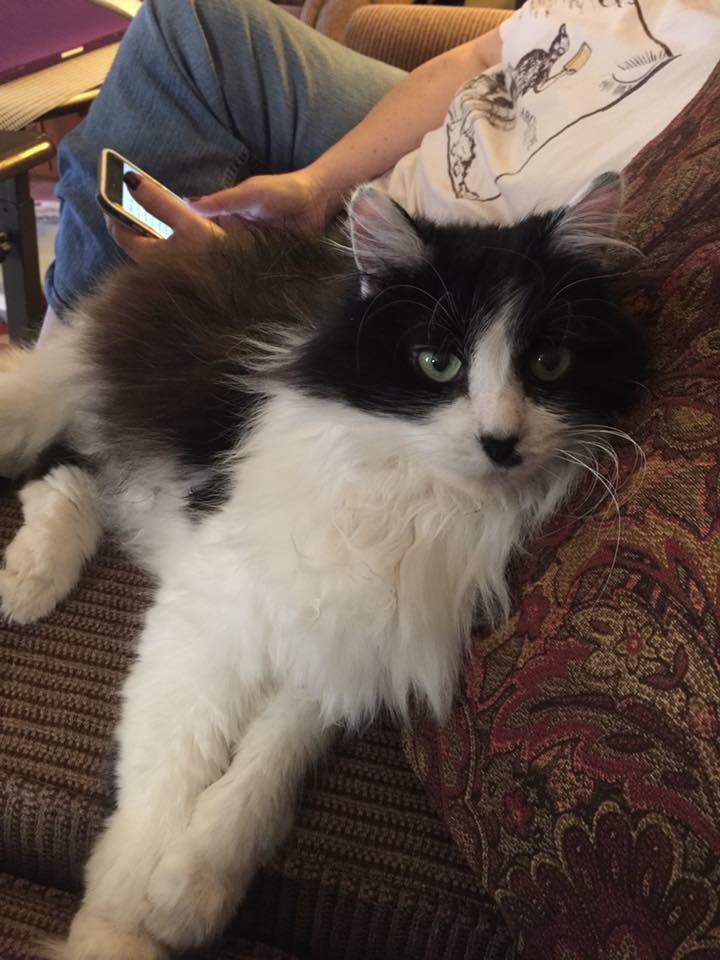
Stinkerbelle in better days. Note the evil gleam in her eyes.


I think my cat Stinky is dying. She’s fifteen years old, and she has taken a sudden slide into not eating much, not moving much, and not using the litterbox, instead deciding to go on the blanket where she lies. She is still eating, though, and purring, and she doesn’t seem to be in any pain, so I don’t know if it’s time to put her to sleep yet.


Stinkerbelle (her full name; she’s also been called Stinky, Stinkerbelly, Soccer Ball, Sockerbally, and Turnip Head) has always been a trial of a cat. I adopted her at four months out from under a friend’s porch, and she always has been a little bit feral. She earned her name from the time when she was a kitten and she crawled on top of me while I was semi-napping. She walked up to my face and looked at me sweetly, then punched me in the eye with a paw. 
Stinky then unleashed her reign on terror on the house. Fighting with the other cats, escaping the house, swatting at us — Stinky was our cross to bear. I loved her in the way I loved my bratty inner child — with a combination of exasperation and awe. 

Now Stinky stands only long enough to rearrange her old bones. Her head hangs down and she wobbles. She doesn’t have enough meat on her bones anymore. She lets my husband and I pick her up and hold her like a baby. She purrs instead of fighting us.

It will be time soon, I think. When she stops eating, when treats are not enough to entice her, when she has trouble breathing. But for now, she’s still on the couch waiting to get petted again.

Learning about my Characters: Jeanne and Josh

 I’m what’s known as a plantser — I start a bare outline and fill it in as I write. I’m finding out more about Josh and Jeanne as I write, and they’re turning out to be quite the couple.


Josh is afraid of an intimate relationship, but not for the usual reasons. He believes in another world, a world of spirits, hidden (as he puts it) in plain sight. He feels these spirits, sees visions, dances among the unseen in aikido. If he opens up, he reveals that world inside him.

Jeanne, meanwhile, is afraid of herself. She has been repressing her own relationship to the hidden world, because it wars with her adoption of the logical world of research. What happens, then, if she finds out — or remembers — her true connection to the world of the plants she nurtures?

I’ve gotten to the point where Josh has spoken of the hidden world as a theoretical, a source of poetry, and Jeanne begins to examine the imagination that she left behind in her chemistry labs. It’s exciting to see them launch into the second part of the book, the part of mysteries. 

Another excerpt from work in progress


Another excerpt from the work in progress:


Friday came, and Jeanne felt exhausted after a day in her laboratory, a day alone where she tried not to ruminate about the offer she had rejected or the threat to her chances for full professor. She sat on her couch and put on some U2, listening to the call to righteous action. Something blossomed in her, the memory of her childhood when she began studying the plants in her yard, when she felt something greater than herself. Her imagination, she thought, when she had used it. 

That evening, she almost didn’t go to the cafe to meet Josh. She knew he’d be disappointed if she wasn’t there. And maybe there would be comfort for her

She arrived early to find Josh already sitting at the table, head bent over what she learned was his always available notebook. He looked up as she sat down across from him and put away his notebook. His eyes searched hers; his smile upon greeting her shaded quickly to concern. 

“What’s up?” Jeanne asked.

“Not much. I was just writing. You look wiped out — the Growesta stuff?” asked Josh.

Jeanne nodded. “It’s not over yet. The dean tried to put a GMO plot next to my research plot; it would have destroyed the conditions of my research. He backed down on that. Then he berated me, berated my work, and doubled down on the threat to keep me from getting the promotion.

“The worst part of it for me is that I can’t do anything about it. No matter how hard I try, the body of my work will not be judged by its worth. I’m not used to being powerless over a situation.” Jeanne grimaced. “But the alternative is betraying Gaia.”

“Gaia. You’ve mentioned that before. You talk about Gaia as if it’s a being.” Josh glanced toward his notebook and pen and apparently decided against it. 

“Well, that’s the hypothesis,” Jeanne explained. “That the earth is a living organism, a whole organism based on systems. I believe that it’s more a metaphor than something to be taken literally; at any rate, I don’t want to be promoting Growesta’s need to extend its market share. I’ll allow that factory farming and the monoculture systems it creates are a necessary evil until alternative farming systems can be created or resurrected. But I need to work toward the alternative.”

“So what now?” Josh asked.

“What now? There’s nothing I can do.” 

“Yes, there is,” Josh insisted, taking her hand. “If you have no control over what happens, you have nothing to lose. What would you be doing if full professorship wasn’t in question?”
The warmth of his hand startled her; she didn’t want to pull away.  Jeanne paused. “Much the same as I have been doing, but … ” She thought. “I wouldn’t worry so much.”

“About what?” Josh inquired, and she found herself looking down from his penetrating gaze.

Jeanne considered. The wayward scents, the behemoth plant in her greenhouse. Gaia as a living thing rather than metaphor. There was a time when she would allow herself thoughts, fancies she didn’t have to prove. She ruthlessly pruned them away with scientific method. “About how I think. About Gaia. I used to have imagination. I used to be able to embrace fuzzy concepts like Gaia as an organism, even …” Jeanne paused. “Then there was college, and graduate school, and the scientific method. I began to let go of that part of me.”

“Why do you want that part of you back?”

Jeanne remembered a prior conversation, and how it put tendrils in her mind while she fought against Growesta, against her Dean, against the injustice of being denied credit for her work. “It was something you said the other day. About the unseen world? I used to believe in that. It fueled my desire to go into my field. But then …”  Jeanne faltered. The scent of spice viburnum wafted through Jeanne’s consciousness. It would be weeks before those flowers bloomed. 

“How can I help?” Josh asked. “I seem to have planted the seed.”

“Tell me about this unseen world.” The scent of flowers grew stronger.

Music and Memory


Sometimes I feel so old.


Usually it’s when I listen to music from the 1970’s. I was a child then, as I graduated high school in 1981. As a child, I didn’t go out of my way to listen to music; I absorbed it by osmosis from the AM station in our car and clutched my little brick AM radio with its mono earplug at night.

I knew all the songs, however. I knew them as narrative to a time of solitude, of lying in my room crying over the bullies at school, of words not being sufficient, of glimmers of light when someone extended a hand. Of scraps of poetry, words written in pencil on lined paper, fading as pencil often did over the years. 

I do not remember well. My memory is like a pile of Polaroids, instant photos, jumbled on a table, and I pull a random one out. I remember the snippet of memory in the photo and it evokes emotion. The story that goes with the words starts with “I remember when” but has very few words attached. The few stories I remember don’t have video with them, only words. 

The right song pulls the most obscure photo from the bottom of the pile, the one that’s faded, whose colors have reverted to greyish brown. All of the emotions, however are there, and I find myself weeping at something lost that I can’t really see. 

Right now I’m listening to a playlist on the stereo, with luscious rich tones that we didn’t know in the AM radio era, and I travel in the back of a station wagon in 1974, nine years old, trying to make sense of the world. 

Nagging fears in COVID

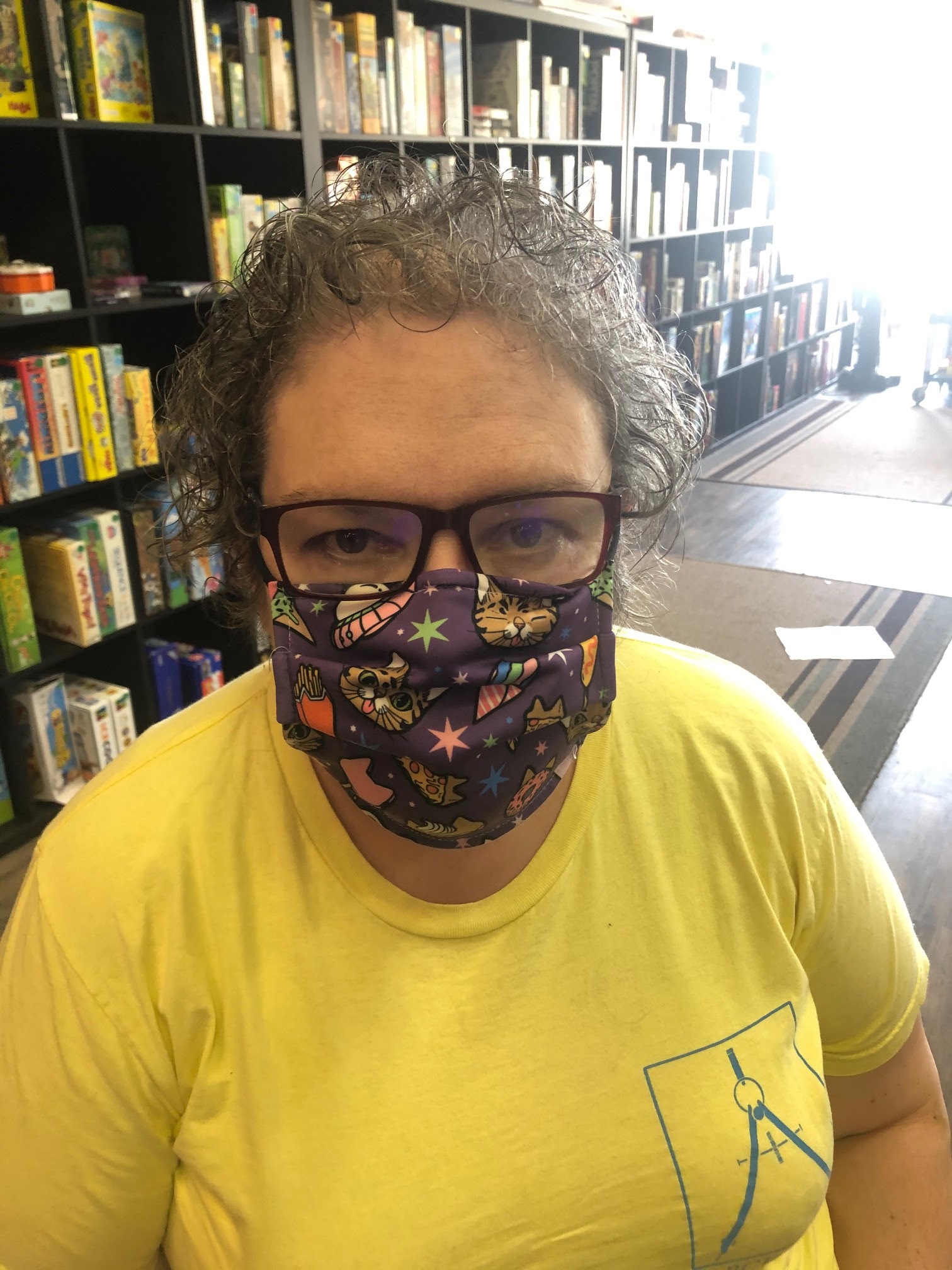
Here’s me, writing during the time of COVID-19. 

I’m scared of the future. I’m scared about the students coming back this fall, bringing their contagion from far-flung places. I’m afraid of what happens when they’re all congregated in their living spaces, in close proximity to each other. I’m afraid of their parties, their incaution, and their bravado. I’m scared that my university, who needs the revenue of on-campus students in residence halls to survive, will fail if students don’t show up and will fail if they have to refund students’ residence hall money if they have to leave.

I can’t be fearful of everything or else I won’t survive. So I put the fear in a box and go through my day-to-day activities. Sometimes it reappears when I read the news. 

There’s nothing I can do but adapt. 

First Draft

Now that I’ve done two hours for Camp NaNo (July edition), I can write today.


I’m starting to feel like a writer again. I don’t know what happened, except I put pen (fountain pen) to paper and came up with about a chapter’s worth of plot for Gaia’s Hands. It’s really rough — I don’t know if my characters are consistent or my atmosphere atmospheric or any of that, but this is all about a first draft


I’ve learned a lot about first drafts in my six years of writing novels, and this is what I’ve learned:

  • You just need to write. Edit later. 
  • When you’re new at writing, you will think your finished first draft is glorious. When you’re more seasoned, you will think your first draft is an abomination. In reality, it is somewhere between the two.
  • Let yourself get exhilarated by what happens in your first draft. Marvel at the characters, feel excited by the plot. Think of it (to use another metaphor) as planning and planting a garden. It will take a lot of weeding to get to its final result, but you’re not at that stage yet.
So right now I’m really excited about Jeanne’s experiment with the basil, where she learns that she has a green thumb, something she can’t ignore when the results are quantified in front of her. Later I’ll grimace at how my characters haven’t necessarily reacted to type. But that’s later. 

An Excerpt from Gaia’s Hands


This is early on in the novel — Chapter 3 or 4. In this chapter, Josh’s tendency to watch Jeanne from afar gets challenged.

****************

By Sunday, Josh’s migraine had luckily subsided with the help of a prescription a doctor had written him. But he hadn’t figured out the vision, of course. Or what to do about Jeanne. Josh threw on coat, hat, and gloves, and walked to his friend Eric’s house in the crisp cold of the afternoon.

“Who am I?” he queried himself. An introvert, an observer of human nature, a practitioner of aikido, a writer, an instructor, only son, half-Asian. He dug deeper: a dabbler in Shinto, a pacifist, a former problem child. He felt heart and gut, ai and ki. And now, something bigger than himself — a holder of a vision, a mystery. He would not tell that last part to Eric.

Josh arrived at Eric’s apartment and knocked on the door. At 1 PM on a weekend, Eric would be awake, unless he wasn’t. One never knew with Eric, who kept programmers’ hours and drank copious amounts of caffeinated drinks. 

After a plodding pause, Eric answered the door in black sweats and a t-shirt that read “No, I won’t fix your computer”. His sandy blond hair had been combed recently, by a real comb, and his deep-set blue eyes shone clear. A good sign.  

“Eric, I need to talk to you. Do you have time right now?” How do I even begin? Josh wondered. 

Eric opened the door to chaos. “Pull up a piece of couch –” he pointed to a decrepit beige couch covered in books and papers, one leg propped up by other books and papers. 

“Where do I put the papers?” Josh swiveled around for an obvious spot.

“Drop them on the floor,” Eric shrugged.

Josh dropped them on the floor. Eric moved a couple piles of books and folded his bearlike bulk onto a spot across from the couch. Josh paused, gathered his words. After a long silence he spoke. “This will sound insane, but there’s this woman, and I think I’m in love.” Josh studied his hands, felt Eric’s eyes on him.

“It’s about time. Do I know her?” Eric grimaced with his first sip of energy drink.

“I don’t know. You don’t hang out at the café much.” Josh closed his eyes and envisioned Jeanne on one of many Fridays, packing her computer away to listen to the music with an enigmatic smile. He caught himself smiling despite his moment of misery.

“Hate coffee, hate the music scene.” Eric pondered for a moment, then scowled. “You don’t mean Zoe with the dreadlocks who works there, do you? She has a boyfriend already.”

“No, and how do you know these things if you don’t go there?” Josh queried.

“Don’t ask me that.” Eric shook his head with a snort. 

“Okay, I won’t. Do you know Jeanne Beaumont?” Josh closed his eyes and sighed out a deep breath.

“Not personally.” Eric raised his brows.  “Isn’t she old enough to be your mother?”

Josh groaned inwardly. “Yes, and it strangely doesn’t matter to me. I really want to get to know her better.” He felt less sure of whether he meant Jeanne the woman or Jeanne the vision, which concerned him. “I’m also pretty sure it’s hopeless.”

“Does she know you exist?” Eric propped his legs on the seat cushion opposite Josh.

“I don’t know.” Josh sighed unhappily. “She looked right at me yesterday at the cafe, but that doesn’t mean anything.”

“You want me to tell you it’s hopeless, right?” Eric growled, but he often did, so it didn’t mean anything. 

“Right. Because it is.”

Eric looked over at Josh. “It’s absolutely illogical that Jeanne Beaumont would be interested in someone twenty-some years younger, but I hear these things don’t always follow logic. What’s the worst that happens? You suffer, and you have a lot of material to write poetry about. Sounds good to me.”

Josh felt the blues settle down on him like a blanket of snow. Rejection was a pretty bad ‘worst that could happen’. “Thanks. I guess.”

A touch of depression

Trying to wake up after 12 hours sleep. I feel like I could sleep more.

This is the sign that I’m in a bit of a depression, although whether biological or situational I don’t know. 


I’m convinced that I get into this state every end-of-semester, and that I can hold it off until then. My end of semester wasn’t until now because I had an intense summer class I just got over with. 

So what does depression look like? At this stage, it feels like sleeping all the time and wanting to sleep more, and avoiding email. Feeling a bit down about things and not wanting to engage. Taking things a bit harder than I normally do. 

The trick here is to not go in further. Get the things done I need to get done. Not take 2-hour afternoon naps (although that’s hard). Try not to think too negatively. Do cognitive exercises if I need to. Push myself to write.

If I don’t get this knocked down in a couple weeks, it’s time for me to see my psychiatrist for a medication adjustment. I hope it doesn’t come to that.