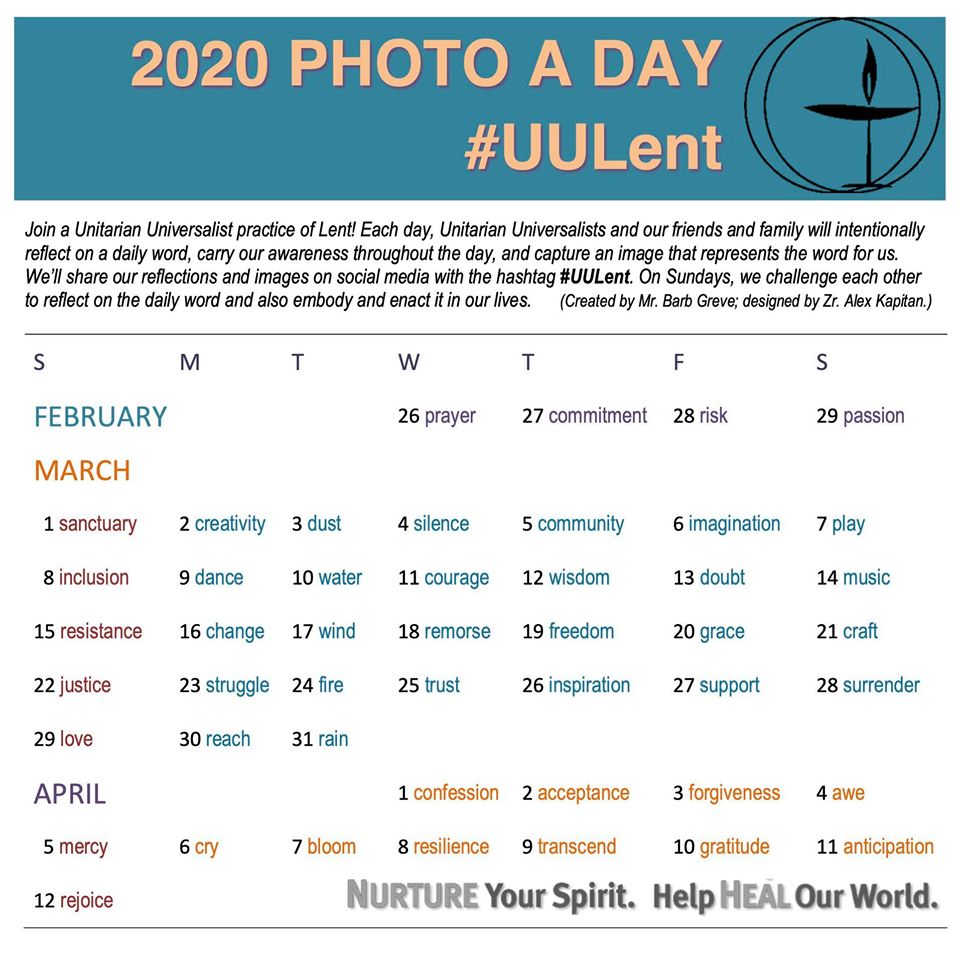
Day 5 Lenten Meditation: Sanctuary

We all need a place to feel safe. 

Whether safety means the need to get away from a hard day at work, a sense of loss from trauma, or an immediate threat to one’s well-being, sanctuary is necessary.

Some find sanctuary in a closed door, a meditation session, or a safe community. Some find sanctuary in writing, or art, or other engrossing activity. Some find sanctuary in family or friends, or in religion.

Inside each of us, no matter how old we are, is our memory of childhood, which was safe or not safe, That part of fears the unknown as something dangerous. That young self yearns for sanctuary. 


We can’t stay in sanctuary forever, because if we do, we are fugitives from live. Nobody needs to be safe forever. But it’s good that sanctuary is there when we feel threatened.
Day 4 Lenten Meditation: Passion


My idea of a creation story for this earth: The world was created in a burst of passion, with the raw materials for life combining in a great explosion of potentiality. 


Passion brings worlds into being.

When I write passionately, I create dystopias at times, but I plant the seeds for reclamation. 

Passion makes us reach out for justice.

When I see a kindred spirit, I feel passion for their presence.

Passion to live turns every day into love.

When I am most passionate, I come to know myself better.

Passion infuses us with becoming.


Day 3 Lenten Meditation: Risk


Without risk, there is no reward. There is only buckling in to the forces inside and outside of us.

Many examples of healthy, responsible risk-taking exist. Investing money for return on investment, dating, expressing one’s feelings, submitting creative works for publication, going up for a promotion. Confronting corruption and injustice, changing the status quo and being authentic also take risks.

Risk instills fear — of rejection, of failure, of loss, of negative consequences. Many people focus on the loss instead of the potential gain, and we call them risk-averse. Avoiding risk has its cost — lost opportunity, lack of progress, and a dearth of fulfillment. 

Choosing risk for its potential rewards may require changing one’s mindset with one or more of the following:

  • Examining the fear against the potential return
  • Believing that one will survive the worst case scenarios
  • Feeling the fear and taking the risk anyway 
Without risk, there is no reward. There is only buckling in to the forces inside and outside of us.

Day 2 Lenten Meditation: Commitment

This is a hard thing for me to write about, because I feel the guilt of all the times I broke my commitments because of depression.

My enthusiasm (and hypomania) would carry me into trying to do something but the depression would keep me from following up. I overcommitted, I underperformed.

It took the medication for me to see who I wanted to be. I don’t over-commit these days, knowing that the only thing that keeps me from mood swings is a precarious balance of medication. But I do commit — to my job, to my marriage, to the things I believe in.

Commitment defines me. I am not just what I embrace, but what I follow through on.  


Day 1 Lenten Meditation: Prayer


I’ll be honest — I don’t understand prayer anymore.

By “anymore”, I mean “not since I got put on medication for bipolar disorder. I have bipolar II, and my prayer life spun between being elated and feeling like I had a pipeline to our perception of God, and being depressed and praying in vain. Things are evened out, and my logical mind has taken over and made me question praying.

Does God grant our prayers? I wonder what happens when two football teams pray for a victory. Does God pick his favorite team? Does God bribe the referees? Choose the team that prayed the best?

If God grants our prayers, we rejoice that our prayers are granted. If God does not, we don’t say a thing. 

I’m not completely skeptical about prayer, though. I think prayer helps us find something within ourselves, strength or comfort or acceptance. I think that prayer fortifies us to help us face an unfair and unfriendly world. 

And prayer helps me find my keys in the mornin.

Lent: 40-some days of reflection

I will once again be doing #UULent reflections, even though I am not Unitarian Universalist and I’m not even sure I’m Christian these days given the bad name Evangelism/Fundamentalism are giving Christianity. I do like the concept of Lent as a period not of giving up but of growing up, and I feel like these prompts will help me focus on that outside of myself.  

These reflections will be on my blog for the next 47 days (whatever happened to 40 days of Lent?). Please join me in reading and reflecting, whatever your religious preference is. 

Novel in need of resuscitation.


I’m contemplating scrapping a novel.

Gaia’s Hands, my first book, needs so much help. I can’t even explain why, except that it just isn’t up to my standards. The B story (Jeanne and Josh’s relationship) doesn’t feel quite right. The A story needs a few adjustments. The magic seems intermittent and just wedged in.

All in all, I am frustrated with this story, even though I’ve rewritten it so many times it’s ridiculous.

It’s down to a short novel. Maybe if I cut enough, it can be a novella. I don’t see it getting larger again. 

Wish me luck.

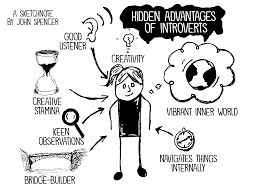
The Day I Became an Introvert. (Personal)

All my life I thought I was an extrovert. I loved hugging people, I loved being around big crowds of people, I loved to talk. But then, when I passed through one of my frequent depressions, I felt like crawling into a hole and not talking to anyone.

Fast forward over a diagnosis of bipolar II, and a life change with medication, sleep protocols, and other lifestyle changes (no alcohol), and my moods are stable. However, I’ve discovered what I thought was natural extroversion was actually my hypomanic moods, and my normal state was introversion.


Yesterday, my psychiatrist agreed that I am, indeed, an introvert.

This may be one of the hardest adjustments to make with my bipolar — that some of what I regarded as natural aspects of my personality were actually traits fueled by chemical imbalance. This adjustment is harder than it sounds — I find myself quoting a Myers-Briggs score from 20 years ago that is no longer valid, and it hits me with a small shock. 

What will it mean for me to be an introvert? 

Revisiting the Goals at the End of February (Goal-setting)

Here’s my writing goals list for the year as of today:

Goal Sheet:
Short-term:

  •  Develop a platform plan by March 1, 2020
  • Revise Whose Hearts are Mountains via developmental edit by March 1, 2020
  • Send 30 queries for Whose Hearts are Mountains by March 1, 2020
  •  Send 30 queries for Whose Hearts are Mountains by April 1, 2020
  • Send 30 queries for Whose Hearts are Mountains by May 1, 2020
  •  Send 50 queries for Gaia’s Hands by December 1, 2020
  • Write/submit 5 short stories/poems/flash fiction by December 31, 2020
    • Inner Child – January 30
    • Kel and Brother Coyote Make a Deal – February 15  

Long-Term:

  • Develop idea for next novel 
  • Get an agent 
  • Discuss with agent further books
  • Publish my first book 
  • Develop personal sales presence


I guess I’m not doing too badly. 

Short-term goals tend to build into longer-term goals, and long-term goals can build on each other. I’m currently working on the “getting an agent” part through queries, and if I get an agent to take me on, the queries section of the short-term goals will likely resolve itself. Publishing the book, on the other hand, will take years once I have a publisher, so it’s really long-term.
Personal sales presence is something I can’t really develop (other than developing a platform, which I am doing).

And I have ideas for a next novel. Almost too many, given that I’ve been advised to focus my efforts on shorter fiction. But I’ll pick one by NaNoWriMo (November), then start writing it.

I may have to come up with more goals at this rate.