Springtime and Struggles

Prodigies just got rejected by a small press — the usual “I don’t think this is a good fit for us”. Remember this is one of about twenty-plus rejections of the seriously revised version of Prodigies.

I’m currently rewriting Apocalypse (which in and of itself used to be two books) to add back some of what I lost in the combining. It’s hard to do right now because of the rejection. It’s very discouraging, and my mind isn’t wrapping around it very well.

Prodigies is still out at DAW, and the highest likelihood (given other evidence) is that they will reject it. Being accepted by DAW after being rejected by a small press would be like getting a Nobel Prize for something that failed to get a ribbon at the county fair. Yet my mind still fantasizes about the next step with DAW as if the next step isn’t a rejection letter.

I’m not sure I like optimism. I feel like I’m just setting myself up for disappointment.

What’s next? I rewrite Apocalypse, which I think will take longer than originally writing its two pieces took. (Writing is easy; doing it right is harder). I talk to my dev editor about what we can do with Prodigies to attract a little more attention to it. I go to that writers’ conference in St. Louis in June.

 Or I give up. I’ve talked about that before, but I don’t know how to quit.
Day 47 Reflection: Rejoice

I don’t feel too much like rejoicing today. I overindulged in Easter candy. I didn’t sleep well last night and now I feel hung over. 

But it’s a beautiful day, the perfect day for Easter. I will go outside today and set up some of my raised beds, for Spring is here and I do not need to wait any more.

I will eat breakfast, and go out, and clean my yard, and look at growing things. I will remember the lines from a poem by ee cummings:

I who was dead am alive again today, 
and today is the sun’s birthday

 — ee cummings, “I thank you God”

It is part of the human condition to rejoice.

Day 46 Reflection: Faith

I struggle with faith. This doesn’t mean that I don’t believe in a higher power or that I’m shopping for religion. It simply means that I question my notions of God.

For much of my life, I believed in God as a celestial Santa Claus. I would pray for something I wanted or needed, hoping God would grant me that. Nothing selfish, like a dollhouse or a bike, but things like praying for my mother not to have cancer or praying to win the spelling bee or, on a few really bad days, praying that I didn’t exist. God obviously didn’t grant all my wishes — I didn’t win the spelling bee and I still exist.

Some people told me that God knew what I needed better than I did. This logic worked when a bad relationship broke up and I only found out its fatal flaws in retrospect. I couldn’t accept that, however, when I reflected on the abuse I suffered in childhood. Did God want that to happen? Why didn’t He stop it when I prayed?

My friend Mariellen, a Quaker like me, opened my eyes to a healthier faith in God. She said that every night, she prayed for God to remove her burdens, and every morning she woke up with the same burdens, but with more strength to deal with them.

It makes sense. If people have a personal relationship with deity, then the way that deity acts in their lives will be personal. God doesn’t meddle; the potential of humankind can’t be realized with a meddling God. But I believe God lends strength and courage so we can be our most authentic, most powerful selves in the face of adversities large and small.

I can live with that God.

Day 45 Reflection: Loneliness

Society treats loneliness like a character flaw: “You’re lonely? What are you doing sitting around? Go out and meet people.” As if a birding club will remedy the ache in one’s heart.

Ironically, loneliness is inevitable in today’s society. Our jobs take us far from our families, and often cause us to move before we’ve settled us into a place. Unless we buy a home, and often we can’t afford buying a home, we live in apartments where our neighbors move in and out. We spend our free time online, where we measure our friendships by “likes” and seldom have deep conversations. We meet our potential partners by swiping right, judging them by a picture and a blurb.

We spend our quiet times nursing the ache in our hearts.

In our solitude, we attribute our loneliness to personal flaws. We come up with erroneous reasons for our loneliness, isolating us further: We are too much this, not enough that. We are strange. We are not worthy. Our isolation increases. 

We can ease our loneliness, perhaps even with the facile “go out and meet people” that society offers, but it will be hard work because we are swimming against the isolating currents of our society:

Sit in public places, even if you sit alone.  Turn your attention outward, again and again. Say hi to people who notice you. Ask to pet people’s dogs.

When the sting of loneliness eases a bit, find reasons to be around people. Volunteer. Find a group that’s exploring something you’re interested in. You will not like everyone you meet in these opportunities, and that’s okay.  The object is not to find one person who will keep you from being lonely, but to help you see that you are part of humanity. Friendship will come later as you find yourself in proximity with people you click with.

We were meant to be with people, even if our society makes that harder, even if our beliefs about ourselves and our loneliness make that harder. 

Day 44 Reflection: Pain

Pain has a way of blinding us to everything else. It screams at us to stop everything and tend to us. As it should; pain exists to alert us to damage. The damage can be physical, such as torn muscle or damaged cartilage or advanced cancer, or it can be emotional such as the death of a loved one or the predations of an abuser.

Sometimes pain lasts beyond the original insult.  Chronic physical pain such as arthritis lasts beyond the wear and tear that caused it. Chronic emotional pain in the form of post-traumatic stress disorder lasts far beyond the instigating factors. The time elapsed doesn’t lessen the pain in these instances.

We are taught to be stoic about our pain. We are told nobody wants to hear about our problems. We are told to tough it out, that no pain equals no gain. We ignore that very valuable alarm until we’ve lost sleep, damaged our bodies, break down, find ourselves with a gun in our hands pointed at ourselves.  

Pain is an alarm. We must heed it for our own survival.

Day 43: Ally

Who are the people around you who want to help you evolve your most authentic self rather than mold you into their image of you?

Who are the people who offer comfort, wise counsel, and effective challenges when needed?

Who are the people who will help you transform a piece of the world into health? 

These are your allies. Find them, connect with them, love them — for they need allies too.

Day 42 Reflection: Truth

Truth sets us free, but often in a way that feels like a wrecking ball. Or the silence just before the tornado hits, with its gut-crawling suspense. The silence after the crash, after the storm, shelters the whisper of two words: “What now?”

My truth: I have been struggling for seven years, ever since my diagnosis with bipolar and the loss of my original department. I have struggled with depression when my medications fail and when I face major setbacks. The tricks I’ve learned (cognitive journaling and meditation) bring me to zero but not above. Some days, I cycle through contradicting my negative talk and affirmations almost constantly. I believe that, because I make mistakes, that I am worthless.

My truth: I need to go back to counseling for a spell.

The silence left by the wrecking ball. I, a shell of a building, waiting for the materials to rebuild.

Day 41 Reflection: Travel

I don’t do tourism well. 

Sightseeing overloads me with buildings, paintings, terrain with no context. A whirlwind of “I have to see the Mona Lisa” and “You haven’t visited here until you’ve seen the mountains.” I see things without understanding their context, and I drift along from thing to thing.

When I travel, I want to engage with my destination. I want to learn, to make sense. I want to experience the destination with all my senses and make sense of it in my mind. 

I want my tour guide to take me to the mountains and point out the flora there, explaining to me what plants make good tea and honey. I want them to show me the restaurants where the locals eat so I can get a feel for their lives, to set me up in an artsy coffeehouse so I can observe people. Tour guides aren’t equipped to do that, so I have to do it myself. Travel becomes a research project, but that’s okay.

My biggest preparation as a traveler, however, is internal. I prepare myself for the cultural differences and adopt humility, because I am the outsider and will make mistakes. I open myself up to gratitude for the experience. 

Travel without gratitude, in my opinion, is hardly worth the time spent. 

Day 40: Sanctuary

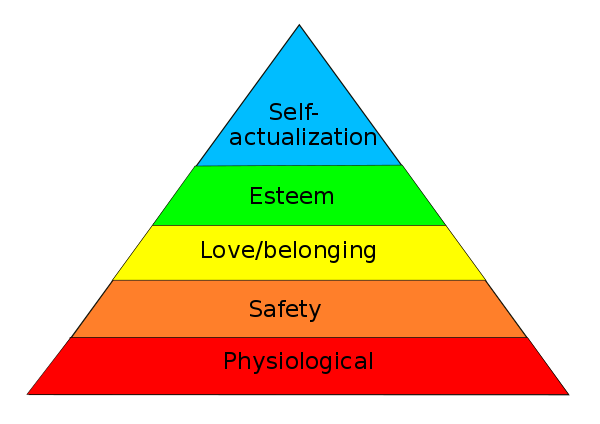
According to Abraham Maslow, psychologist, humans have a hierarchy of needs. The model (which everyone who has ever taken a psychology class will recognize) looks like this:

The hierarchy starts at the bottom, with physiological needs at the bedrock. Without food, clothing, and shelter, nothing in the upper levels matter.

Notice where safety is — right above physiological needs like food, clothing, and shelter. Safety is that fundamental, that we need it before we need love and esteem, and even when we having love and esteem, if that safety erodes at any time, we revert to needing that more than anything at any level above it.

To feel safe, we need spaces where harm cannot enter. We need a physical space secure from intrusion and hazard. We need a workspace free from threat and abuse. We need playspaces for children free from guns and bullying. We need a society free from scapegoating, discrimination, and hatred.

We can’t change the spaces out of our control, so we need ourselves or others to create protective spaces for us. We call these spaces our sanctuaries, our hideaways from the hazards of the outside, where we can be ourselves without danger.

Sanctuary cities have been in the news lately, with President Trump threatening to drop busloads of migrants off to these cities. The mayors of these cities do not see this as a threat, but an opportunity to provide sanctuary as a concrete action rather than as an ideal. These cities do sacred work in providing sanctuary to those who face an unsafe and insecure life.

Who is unsafe in our society? Name them, and then find a way to provide sanctuary. Eliminate white nationalism in your corner. Question the number of black males who get killed by the cops; question why whites get the benefit of the doubt. Stand up to bullies, including those in the administration of school districts. In Maslow’s hierarchy, people cannot thrive unless they’re safe. Help people to thrive.