That I should love you with my sullied heart.
When you realize that crushes, the crushes that started at an entirely too-young age, that persisted through your marriage to a very patient husband, are all ways of trying to break through the dichotomy that permeated your childhood:
I am innocent/I have been used sexually.
Now, as an adult in my fifties, that pattern of seeking someone’s attention as a mystical cure for a secret affliction continues. I learn more and more every time, and I hope to reach an escape velocity from it soon.
The world assumes that those who have been sexually abused as children have somehow invited it upon themselves, that they have somehow lacked the innocence that would have stopped an abuser otherwise. The child accepts this judgment and judges themselves as someone worthy of hurt, and if the child is female, the purity culture surrounding them proclaims them soiled.
I blocked my memories throughout my childhood, only remembering them in adulthood. So I felt sullied but didn’t know why, and when I hit adolescence, I needed that proof that I was still loveable. And all those other things I felt I was lacking — beauty, personality — got rolled up with the damage from my abuse.
Category: Uncategorized
Writing Reteat this Weekend
Wish me luck — I’m going on a writing (ok, editing) retreat at Mozingo Lake this weekend. It probably won’t snow much here this weekend. That’s where I need the luck.
Mozingo Lake is the park some seven miles from us, owned by the city, with RV and cabin camping and a big fishing lake. We’ve secured one of the cabins for the weekend because I needed to get away to some place with a fireplace, a view out the window, and a minimum of distractions (and wi-fi, so we’re not completely roughing it.) The cabins possess a rustic living room area opening to a less rustic-looking kitchen with modern appliances, with a bedroom and sleeping loft. Oh yes, and indoor plumbing.
We’re supposed to get no more than 1-2 inches of snow Saturday night, and I expect that to hold. We’re going to bail if the forecast changes by Saturday afternoon. The key here is “if the forecast changes”, because sometimes we get more snow than was forecast. With a bit more snow, the roads at Mozingo will be an impassible winter wonderland until they plow. Here’s hoping we get the whole weekend there, and here’s hoping we don’t get snowed in — then again, if we bring extra food, getting snowed in could be fun …
The Grass is Not Greener in my Yard
I want to get rid of all the grass in the front yard. Richard, my husband, does not agree with me.
![]() |
| My husband, Richard |
I don’t see the upside of grass lawns. Unless you are a ruminant (a cud-chewing animal), you can’t eat grass. It smells pleasant, but its scent is fleeting. Today’s lawn craze requires a monoculture of this pretty useless plant without the inclusion of co-planting in the form of white clovers that would supply nitrogen for the lawn. An attractive grass lawn demands babying — fertilizer, weed killer, mowing, reseeding.
I read somewhere that the desire for a green grass lawn is a throwback to early humans feeling more comfortable if there were no trees in their domain for predators to hide behind. I don’t buy this because landscaping incorporates plenty of bushes and trees for predators to hide behind. I myself think that the fanaticism for perfect green lawns, now with their perfect cross-hatching mowing patterns, has to do with what preeminent Victorian economist Thorstein Veblen called conspicuous consumption.
Conspicuous consumption refers to spending money in a way that shows that one has money. Perfect lawns are a perfect example of this — they require a lot of monetary outlay and a lot of time investment. It helps to be able to hire a groundskeeper to get that verdant sheen without any dandelions marring the perfection.
I could live without a typical grass lawn with all its high-maintenance needs. When the dandelions pop in our yard, I don’t think of digging them up unless I want to roast their roots for Beau Monde style coffee (aka chicory coffee, as dandelions are a close relative). I fantasize about a lawn full of clover with its little white blossoms or edible lawn daisies, or a slope of camomile and pavers surrounded with scented thymes. Or maybe just expanding my edible landscaping until there’s no lawn.
For which I’d have to hire a landscaper and participate in my own form of conspicuous consumption.
Author Mills and the Vulnerable
Last night I learned about author mills.
Author mills, sometimes known as vanity presses, are publishers that publish small runs of books for many, many authors. What do they look like? (Wikipedia, 2019)
- They go for quantity rather than quality of authors; they may have thousands of authors passing in and out of their presses.
- Almost no editorial gatekeeping (i.e. editing and other quality measures)
- They only publish small runs of high-cost copies
- They expect you to buy your own copies to sell
- Once you publish with them, they own your book and the rights to it.
The relationship, in other words, is non-reciprocal, and the author has paid, essentially, for services traditional publishers would supply themselves.
After getting all the rejections I’ve received, I’m scared that I’m vulnerable to such an approach. “Wow, someone wants to publish me!” is a powerful lure after a long, difficult, dry spell. And this is what the author mill counts on — the starstruck desire to see one’s name in print on a book cover.
Falling for an author mill because one hasn’t found an agent/publisher yet is like getting into a relationship with a narcissist because one has had a dry spell in dating. Both look like they fulfill dreams, yet drain the dreamer dry with nothing in return.
The ways to guard against this?
- Value yourself and your writing
- Know the signs of an author mill
- Research before you commit.
A great source with more information on author mills can be found here.
References
Strauss, V. (2010). The perils of author mills. Available: http://www.victoriastrauss.com/advice/author-mills/ [Feb. 20, 2019].
Wikipedia (2019). Author mills. Available: https://en.wikipedia.org/wiki/Author_mill [Feb. 20, 2019].
The Peaceable Kingdom
In my Archetype/Barn Swallows’ Dance stories, I write about the Peaceable Kingdom.
The Peaceable Kingdom originates with a passage in Isaiah 11:6-8, where the author writes about the animals, predator and prey, sitting peacefully together: “The wolf also shall dwell with the lamb, and the leopard shall lie down with the kid, and the calf and the young lion and fatling together; and a little child shall lead them.”
Edward Hicks, a Quaker painter, painted a series of paintings known as The Peaceable Kingdom in a somewhat primitive way, incorporating William Penn’s treaty with some Native American tribes in some of the paintings.
The Peaceable Kingdom is obviously a metaphor, because we can’t expect the lion to literally lie down with the lamb (as popular renditions of the Isaiah passage conflate), except perhaps in children’s play. Perhaps that’s why the passage evokes its sense of peace with such strength.
Barn Swallows’ Dance, my fictitious ecocollective in central Illinois, is my Peaceable Kingdom, or at least a noble experiment in such. Based on principles of right living, stewardship to the land, and pacifism, the collective has collected a variety of people who, like the wolf and the lamb, would not be expected to dwell together.
Imagine two National Guardsmen coexisting with a legendary draft resister. Or a real estate agent dwelling with an anarchist. A gay conservative rural Southerner living with himself. Barn Swallows’ Dance brings disparate sorts together to muddle their way through to the Peaceable Kingdom.
Because the Peaceable Kingdom is an ideal, the members of Barn Swallows’ Dance never quite make it there. They face conflict, they bicker, sometimes they fight. On rare occasions, someone commits evil out of their xenophobia. But the collective has pledged to create the Peaceable Kingdom, and they never quit trying.
.
Expectations
I’m down to twenty readers, but I am assured that all of you are real people instead of bots or that the CIA is no longer reading this for hidden messages — just kidding. I think. Thank you for following me.
I’m at a loss as to how to get more readers. This is my big worry about embarking in self-publishing as well. In a world where everything is screaming for attention, how does one actually get attention? Quality is not enough, as is evidenced by many industries — music, books, movies — where the hyped gets more interest than the small shining gem of a creation.
What’s enough? I’ve never stopped to consider this.
Expectations have a way of expanding. At the beginning of this journey, I didn’t know if I could write 50,000 words. Then, as I reached that point, I expected to be able to write whole novels which grew to 80,000 words or more. Then I expected to get published, which hasn’t happened yet but could happen if I self-published. Yet now I expect to have more than twenty people read my blog. And I expect them to comment occasionally.
Maybe I should scale my expectations down. Maybe twenty faithful readers are enough. Maybe self-publishing, with its potential of only a handful of readers, is enough.
Another round of killing my darlings
This morning, I’m editing a story for a short story contest. When I first wrote the story, I wrote it as an origin story for one of my characters and an exploration into cross-cultural relationships. For the contest, I knew I would have to edit out about 500 words to meet the word count.
But then, in the middle of editing words out, I realized several things. First, that the story could and should stand alone from its original purpose, so I edited out references to the magical realism world it came from. Next, embarrassingly, that there wasn’t enough tension in the story to make it memorable. I want to place the biggest part of the tension internally, not externally, even though there’s tension in the relationship between the two characters as well.
Writing is this process in which getting the ideas down on paper is only the first part. Refining the story into something that’s not just readable but skillful becomes the harder part. The hardest part is looking at what you’ve written with a critical eye, carving away parts of the story that do not serve their purpose, no matter how much one loved them when they were written. This is why the rule of editing is “Kill your darlings,” because in effect that is what the writer does in polishing.
I’m off now to kill my darlings.
My Sanctum
As I have mentioned before, one of the things that saves me from severe winter blahs (aka Seasonal Affective Disorder) is my planning for the spring garden.
I should explain that my garden has rules: everything I plant in it should be, at least in part, edible*. This means that I landscape with edible flowers, herbs, and plants that have been gathered and eaten in American or other cultures. Most of these can’t be found in nurseries or are rather expensive if bought as plants, so I grow them from seed myself in my grow room.**
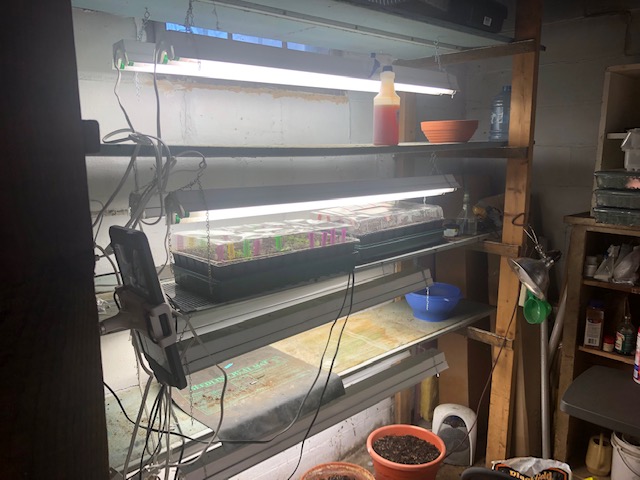
Here is a view of my grow room, which is a small basement room that used to be the coal room back when my 100-year-old house was a youngster:
![]() |
| Not very impressive, is it? |
The wires are for all the fluorescent fixtures and the heat pads — and the ancient iPad repurposed for record keeping that you see at your left. The wall that you can’t see is lined with reflective material that was meant to insulate a garage door. Peel and stick — excellent for increasing the light in this room.
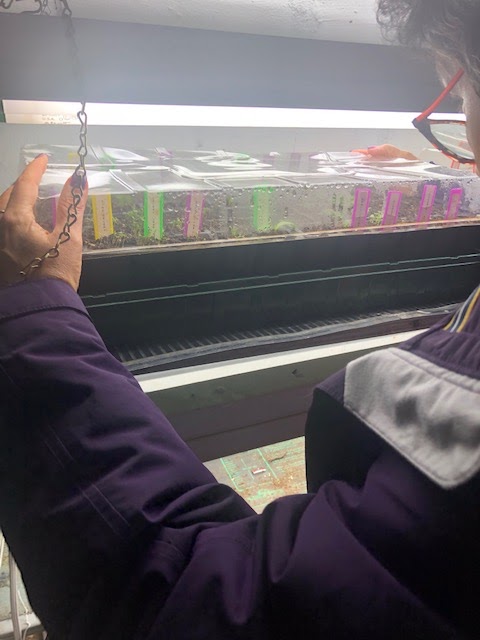
The flats you see are for two sets of items I’m growing — the edible nightshades (tomatoes, peppers, eggplant) and a handful of herbs (celery, lovage, yarrow, calamint, perilla, hyssop, alpine basil herb).
![]() |
| Closeup of my first herb flat |
I have more to plant — I’m waiting on seeds for my moon garden and more herbs and for some flowers (and for lots of things that will get planted directly in the garden. By the time I’m done, I will have six to eight flats of seedlings to nurture.
Not all of them will survive. Past seedlings have succumbed to damping off disease (which I fight heroically with cinnamon water spray) and watering malfunctions. Some seeds never come up. On the other hand, sometimes they grow faster than I expected, which is why I’m setting the top shelf (that you don’t see) for taller seedlings to reside. I will save the best of the plants that come up for planting come spring.***
Spring comes to me sooner than to most because of my grow room, with its ugly cement floor and worn shelves. Today I sat with my seedlings, thinning them out so that they could grow strong, and feeling, if not happy, a bit less out-of-sorts.
* This year’s exception is the moon garden, which is comprised of white, night-scented flowers, most of which are toxic to deadly if eaten.
** When I say “grow room”, people think I’ve got one of these high-tech setups advertised on eBay where people grow — well, plants that are illegal to possess or use in this state. Mine is not nearly so exciting.
*** This doesn’t count the direct-seeded vegetables. I have to admit that I’m not as good with these because it gets too hot to weed and there are so many weeds. I’m working on using more mulching and earlier morning weeding.
Light
This time of year depresses me — literally — with its dark mornings and uniform bleakness of the terrain. It’s not the deep despair of my bipolar depression, but a constant sense of flatness, of anhedonia, of just wanting to stay in bed. The festivities of Christmas that buoyed up my spirits have long passed; all now is grey.
My psychiatrist has prescribed 1 hour a day in my grow room for light therapy. There’s plenty of light in the small basement room, supplied by eight fluorescent light fixtures. And, although it’s a small room, there’s a table and chair where I can sit and even an old iPad I use to maintain my plant records.
And then there’s the plants. Right now, I have starts of herbs like hyssop and calamint, celery leaf and Asian celery, and my tomatoes and peppers popping out of the ground. For the most part, they’re tiny seedlings with their seed leaves no bigger than a baby mouse’s ear. But they’re alive, and I almost believe I can feel the light of their lives brightening my day.
In the gloom of this season, I will take all the light I can get.
Valentine’s Day according to economics
When I’m not writing, I am a family economist/behavioral economist. The philosophy behind both of those is that I study the use of time, money, and other resources — in household units and in a manner that accounts for psychology.
Running Valentine’s Day through the economics filter yields interesting results.
Take, for example, Valentine’s Day as a method of conspicuous consumption, and the role of social media in creating the conspicuous part. Today, people will post pictures of flowers, restaurant meals, and possibly engagement rings or jewelry. The gifts may be given from the heart; the need to post pictures on Facebook and Instagram comes from a desire for the world to know the value of the item.
Or for that matter, Valentine’s Day as an exploration of assortative mating. This is an economic concept borrowed from sociology that posits that people get sorted into couples based on complementary resources and similarity of levels of resources. Thus the stereotype that the rich man gets the trophy wife — there’s a little truth to the stereotype, according to the assortative mating theory. So, in effect, we don’t marry someone out of our league — we marry someone that complements us. And we marry as much for their resources combined with ours as we do love and romance.
And let’s not even mention that chocolate in a heart-shaped box costs much more coming up to Valentine’s Day than it does the day after. That’s pure supply and demand.
I take advantage of this last economic fact by celebrating Half Price Chocolate Day tomorrow.