Coffee in (not quite) Paradise

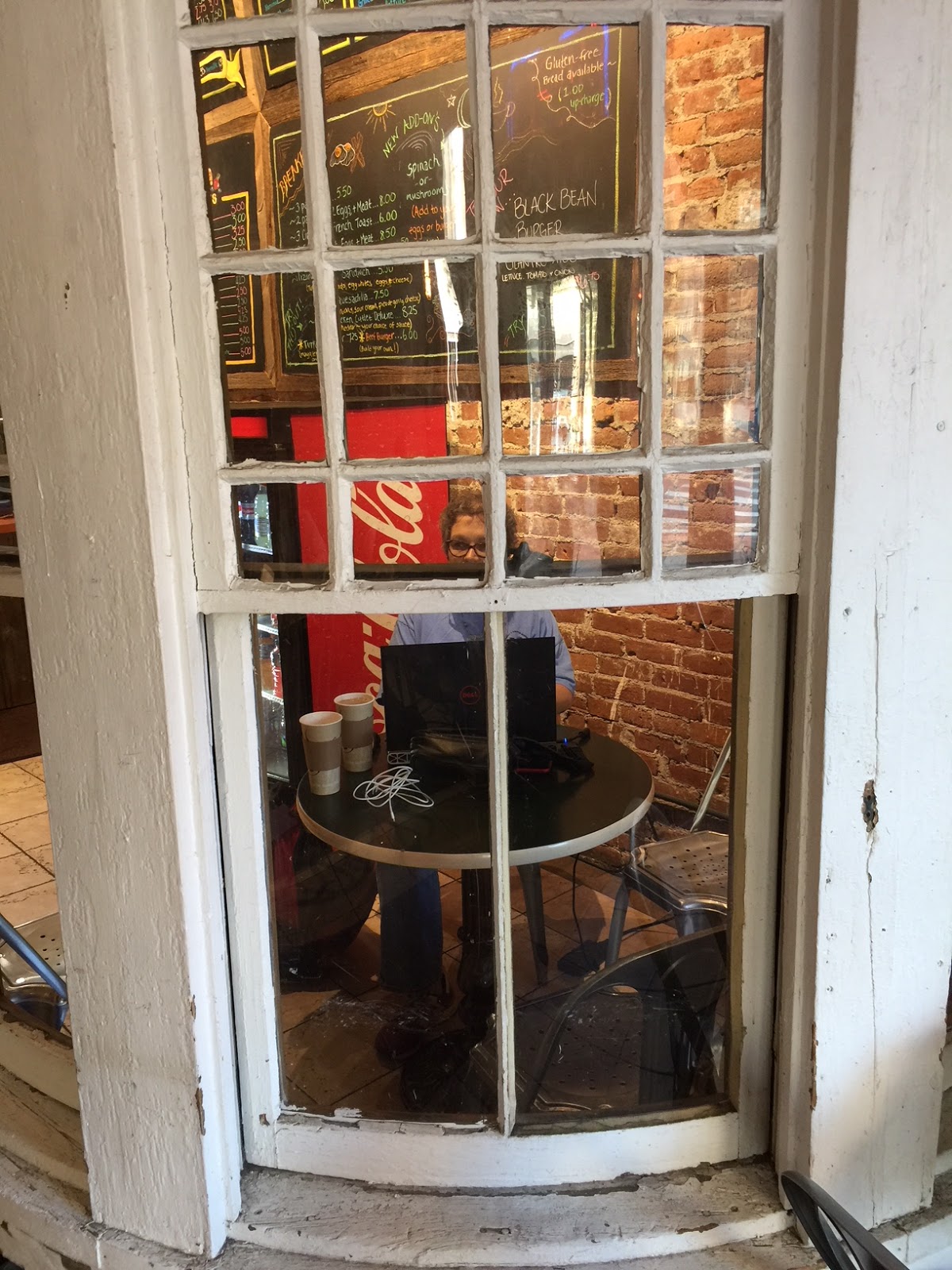
I’m sitting at Latte Lounge in Oneonta right now, sipping my husband’s caramel steamer and wishing we had a real (non-corporate) coffeehouse in Maryville. To be fair, we have close — the best Starbucks in the 50 states, attached to the campus library,

Yes, this is a bay window.

Oneonta still has a bit of a hippie vibe, with quirky coffeehouse spaces, the Autumn Cafe (a former food coop turned restaurant), and a head shop (the tacky price you pay for the health food stores and artisan delights). The summer traffic has gotten worse and the hotels get quickly packed due to the demand from club baseball tournaments, which Oneonta has capitalized on. The local artisan’s store features a writer who writes romantic suspense with a witch as the main character and publishes through Llewellyn Press (the leading pagan press). The attitude of New York State lends itself to diversity of opinion — “You have a right to live your life, and I have a right to live mine”. I suspect things still got heated during the last election.

There is a local Quaker meeting here, as there always has been, and I suspect that it (like most Quaker meetings) has very few attenders. But there is a Quaker meeting.

People are friendly here, whether from Upstate (the mostly rural majority of New York) or Downstate (NYC — or “The City” as it’s known here — and its suburbs). They can’t drive worth a damn, but they’re friendly.
You can learn a lot about a town by what it treasures. Maryville, MO treasures kids and church, which is great if you have kids and a church denomination to belong to. As a childless Democratic Socialist and pacifist, I don’t fit into any of the local churches. (The most liberal church in town will not take any constructive criticism, which is one of the things most apparent about Missouri — the attitude of “It’s ours, don’t question.” I was brought up to question everything.)
Oneonta treasures creativity. It has its own arts venue separate from the University. It has the aforementioned artisan booths, local writers, unique restaurant dishes, quirky coffeehouses and quirkier people. I would imagine that, with two colleges and a head shop, Quakers and witches and Unitarians, many families with children would find it a less than ideal place to raise a family. 
It will be hard to leave today, to get back to Syracuse and take the train back to the Heartland and then drive back to a place that reminds me too much of my hometown in Illinois, with its ugly secrets and its resistance to reflection and growth. But I have miles to go before I sleep, it seems, and that includes another year teaching at Northwest Missouri State University.
Which brings up a question:  How can I make my current home liveable? I’ve lost friends over simple requests to examine their use of words to be less derogatory of the neurodiverse. I have friends. and even though I worry they wouldn’t like me if they knew who I really was (the granddaughter of a witch, a Democratic Socialist, convinced that everyone will go to Heaven if there is a Heaven) but they accept my sense of humor and my bipolar disorder. It might help to find groups to connect to outside of town to make up for the lack of church affiliation and connections through children’s activities. I may have to drive 90 miles for the nearest Quaker meeting now and again.
But I will retire someday, and if we can find the money for a house (Oneonta has higher housing prices and older, bigger houses) we will settle down here.

They Say You Can Go Home Again …

I have a tendency not to look back. When I leave a place, I know it will change and the people I knew will leave. It is the nature of life in academia, where most of the people you know are students who graduate and faculty who find themselves elsewhere.

I went to college at a huge university, University of Illinois, with its 40,000 students. I knew very few fellow students, and it was only when I found a core of like-minded people — a couple faculty members, a few students, a few townies — that I felt an attachment to people for the first time.

When I left Urbana-Champaign for Oneonta New York, I was alarmed at how small the city and the college were. Soon, however, I grew to enjoy the artistic quirkiness of the town, and I got to know people through coffeehouse culture. I had a network of friends — not close friends, but friends I occasionally spent time with, and some who kept me sane when my marriage broke up (for reasons I don’t talk about, but it was much more dramatic than “we grew apart”)

I left Oneonta after five years for a guy. (Not the guy I’m married to). I have always been a “bloom where I am planted” sort of person until I moved to Maryville, MO. After twenty years there, I have not really bloomed. I have grown into a crabbed, stunted plant in hardscrabble soil with little nourishment. I don’t know why I feel this way — Maryville is a college town. It has activities at the university, and my colleagues are quirky. But I have not felt nurtured nor safe here.

Actually, I do know the reason why — Maryville was the town where two underage girls thought they were creeping out to meet a dreamy high school football player at a party. They were plied with alcohol and passed out. One was raped by the dreamy high school football player, who was the grandson of a state legislator. The charges were dropped by the prosecuting attorney. You might have heard of the girl — her name was Daisy Coleman, and she was 14 or 15 at the time.

The fact that some people could say “You didn’t know the whole story” when the girl was clearly underage makes me feel like living in Maryville is one lurking trigger, even years later. Bad things may happen everywhere, but the level of support the young man got, the fact that Daisy’s family was driven out of town, the condescending coverage the local newspaper gave the protestors — Maryville turned from a difficult town to find nurture in to a burg swarming with ugly shadows.

But now, finding myself back in Oneonta, I am looking back. The town has changed; it’s a little bigger and a lot busier and the signs on the businesses on Main Street could use a little beautification. The college has gotten so many new buildings I hardly recognized it. But my favorite restaurants — Brooks BBQ and the Autumn Cafe — are still here, and there’s lots of coffeehouses (I’ve already found my favorite).

I would love to move back to Oneonta someday. I may never find it; the cost of housing is somewhat higher and we’re a one-income household so we don’t have much set back in savings. Oneonta had become home to me, just like Urbana-Champaign had, but maybe I can’t go home again.

Dream House

Clapboards and fieldstone,

Perfect grey shingles —
a house as old as church bells,
as solid as a name.
A Volvo in the driveway,
a little rust on it, but still —
they say you can go home again
but it won’t be the same
I watch the story
through dime-store curtains
as you embrace your father,
take the Jeep and drive away. 
While in my kitchen,
dandelion wine
serves to remind me 
of the passage of these days.
CHORUS: (2x)
This is your dream house
you say this is your dream house,
this is your dream house,
I’m living in your dream house.
Once you told me,
you’d always lived there,
walked past the house I’m living in
and wondered what was inside.
Then you fell silent,
turned away quickly,
I thought I saw the hungry gaze
of a very quiet child.
CHORUS (2x)
And if you could
run up the stairs and down the hall,
look out the window
where the hayloft used to be,
would you still dream of it,
see how I’ve grown to love it,
would you then understand it,
understand me?
CHORUS (2x)
And in my kitchen,
dandelion wine
serves to remind me 
of the passage of these days.
******************
I wrote this song about 25 years ago when I lived in Oneonta New York in a carriage house dating from probably the late 1800’s. I loved that house, and at one point in my life swore I’d own it someday. 
I’m now back in Oneonta, and it’s different. It’s picked up more of the tourist trade by hosting baseball tournaments — I’m assuming this is farm league, as the Yankees have a farm team here. There are more coffeehouses than there were when I lived here, and more ethnic restaurants, but my favorite hangout still exists (and is owned by someone I used to know).
There’s lots of traffic out on New York 28, whizzing by the bed and breakfast. 
In a perfect world, the stars would align and I would find a way to afford the more expensive housing costs out here. I would retire early and find a job out here, and write in the local (independent) coffeehouse and eat once a week at the Autumn Cafe. I would make new friends at the coffeehouse like I used to, and I would have the carriage house as a writing retreat.
These are dreams, though, and I know reality has a way of exerting itself over dreams.

My weekend

Since Thursday, I have been in Oriskany (O-RIS-can-knee) New York, at the New York State Preparedness Training Center, doing moulage on willing victims for training purposes.

I’m in my usual post-event daze, made more intense by working under a professional moulage artist with twenty years experience. I learned how to make my injuries even better, how to work with plaster molds, latex and gelatin to make convincing wounds, and how to get wax wounds to stick (I work mostly in wax).

Hope exercises (Missouri Hope, New York Hope, Atlantic Hope and the new ones coming down the pike) are intense. The participants are assigned to teams, and the teams work to solve problems in search and rescue, triage and first aid, and incident command. They are placed in realistic scenarios and have to solve them on the spot. Complications thrown into the scenarios make the participants think on their feet.

There are at least as many staff members as participants — team controller/evaluators, who advise the participant teams, lane controller/evaluators, who run the scenario lanes, logistics personnel, subject matter experts, exercise director and staff, roleplayers —

And the moulage staff, who are looked at with a certain awe.

I’m bone-tired. It’s been an intense couple of days, which I wouldn’t trade for anything, because they’ve given me the opportunity to improve. I’m not sure if I’m making any sense here; I hope so. Thanks for reading.

I sit in the Metropolitan Lounge in Chicago’s Union Station waiting for my train, which should depart in about three hours. I’ve already been here for three hours, so it’s a long wait. I’ve drunk two lattes and three shots of espresso, and my teeth are beginning to hum. But there’s wi-fi, so I can indulge myself in some blogging.

It’s cold in here, and it’s raining outside. The Metropolitan Lounge is reserved for people in business class and those sleeping in sleeper cars (like we will be). It’s quiet with comfortable chairs with outlets nearby and a shower in the bathrooms — although I don’t know who actually showers in a train station shower.

I’m trying to coax some latte out of the machine and hope it warms me up. My teeth will be humming so much I’ll be picking up radio signals soon.

The Night Train

When I was a child, I lived a block from the Rock Island tracks, back at the end of the Golden Age of trains. I would wake up in the middle of the night to hear freight trains passing by on the tracks, or the 11 PM night Rocket, a passenger train, to Chicago. For a child who didn’t sleep well, the trains were a comfort, offering familiarity in the uncertainty of the night.

The Rock Island Line, like many railroads in the US, struggled to survive when the interstate system made it possible to travel at speeds previously unknown. The network of roads — interstates, US highways, and local roads — made the great elegant passenger trains obsolete. However, the Rock Island didn’t go without a fight when the government went to take it over, and they wooed people to  their side by offering family excursion trains to Chicago.

My family took one of those excursion trips to Chicago, ninety miles away, in 1970, when I was seven. I remember everything about that trip — the shiny exteriors of the Rock Island passenger cars and the worn interiors, the feeling of watching the industrial jungles and the brick stations pass by, bridges over sleepy water, and the noise, the glorious noise of the engine’s horn close up.

The thing I remember most was eating breakfast in the dining car. With its heavy silverware, its china with the Rock Island logo, and its white tablecloths, I felt like a princess. I don’t know if any dining experience will equal that one in my mind, because the waiter found me lemon and honey for my tea with a graciousness it’s hard to find nowadays.  That waiter would be in his eighties if he were still alive, but if I could find him, I would thank him for making my day memorable.

The Rock Island line is no longer, having been subsumed into Amtrak. Unlike the Rocket, the aging elegant Rock Island passenger train, Amtrak presents a train ride with little to be nostalgic about. The chairs in coach are not as comfortable, the meals on the Lake Shore Limited are now pre-made, many of the old railway stations are closed and the big stations made smaller due to security needs. Sometimes the toilets malfunction and things get — odorous.

But trains are still worth traveling on. The variety of people you encounter, from the Amish who see the train as a necessary evil, to itinerant musicians with backpack and guitar, and businessmen with their suit bags hanging in the luggage area. You can still sleep in a sleeper car, which is a miracle of getting two beds and a couch in a tiny space. The chugging of the engine and ringing of the bell as the train edges into the station, and the hiss of luggage wheels as the passengers hustle toward the station, waking up in the middle of the night in a sleeper car as the train travels through the Sandusky preserve on a narrow bridge of land surrounded by lake and marsh.

I dream of the trains coming back someday, when we have given up some of our control issues over travel, when we have given up our love affair with cars. Maybe it’s a futile dream, but it’s mine.

Happy 500

Wow. Yesterday was my 500th post!

Right now seems to be a time of musing and not much of writing. I’m done with my online class and prepping for a ten-day trip, half vacation and half volunteer work in moulage.  I’m going to upstate New York for New York Hope again, which is one of my three standing moulage gigs for the year — so more making ordinary people look like trauma victims.

The vacation part is how we will get there and back — by train, with a roomette both ways of the 15-hour trip. Richard and I are both train fanatics, and even though Amtrak pales compared to the golden age of train travel in the US, roomettes and business class still are novel enough for us to enjoy.

The second part of vacation will be going To Oneonta, where I used to teach college. It’s been about 20 years since I left, so I’m expecting things will be different and that I won’t know anyone there. It’s okay — I want to see Oneonta again because I still dream of it now and again; it was one of the most beautiful places I’ve ever lived.

I’ll write when I can, although not as often as I usually do while on vacation.

Love you all.

True Confession (or I doth profess too much)

I’m going over some old ground here.

I insisted that I didn’t want to get published for the recognition, but just to fulfill a goal.

I have to confess that I lied.

I have fantasies about getting published, about becoming well enough known that someone from my hometown contacts me, and I can snub them.

It’s horribly unbecoming of me to be like that. I don’t even like to admit I have that fantasy, but I do. Let me explain, and maybe you will understand me.

I grew up different. Intelligent, socially awkward, overweight — I lived in my own little world. I suffered from pica and ate glue and pencil erasers, as well as handfuls of sugar and Bisquick. I bit my nails. I laughed when nobody else laughed, I sang out loud for no apparent reason, not caring if someone else heard. I cried when people attacked me. I whined. All together, I was that unattractive kid that nobody liked. I don’t know if I would blame them.

Being that child, I was prone to bullying from my fellow classmates and adults. By the time I reached high school, I had been beaten up by classmates repeatedly, sexually abused by a few people, raped by classmates, threatened with desertion by my mother.

I made myself a coccoon from the outside world — from my parents, extended family, and classmates.  That coccoon was made of my fantasies, my behaviors, my wishes. In my coccoon, the monsters that everyone feared were my friends. The monsters would nurture me through the bullying, the attacks, the lack of safety I felt.  As I grew older, I fell in love in my fantasies — and when I told my best friend the name of who I had a crush on, she yelled it out the window, and every popular kid in the class shamed me in the hallways.

My childhood marred me. I have trouble making friends because I don’t want to impose myself on them. I have trouble loving my snot-nosed, eraser-eating inner child. (I tend to wish I had been Marcie as a child. Marcie is me without the snot nose and eraser eating.)

I entertain sadistic fantasies about my classmates from Marseilles. I entertain the thought that someday the tables could be turned and I could, if not bully them, reject them soundly. I feel guilty about that because it’s not a “pure” reason to want to be published.

I exorcise myself by writing. This blog post is no exception.