Tomorrow is the first day of my 25th fall semester as a professor.
Category: Uncategorized
Getting back into writing
I haven’t written much in the last few weeks, what with working with my dev editor, traveling for New York Hope and training in advanced moulage, prepping for work, and finishing my first semester of grad school. Now it’s two days before the beginning of the semester, I’ve got no prep to do, and no excuses to do nothing. (I don’t watch tv well, and there’s only so much looking at cats on Instagram I can do.)
So I’m taking the advice I’d give someone else — write something every day. This means in my case to get reacquinted with Whose Hearts are Mountains. I don’t know how I feel about that book at the moment. It’s in the Archetype universe, and I’ve had such trouble understanding how to improve the first book(s) in that universe, Mythos and Apocalypse (which I am thinking of putting together). I don’t know if it’s sellable, and I don’t know if I care.
It might be that I keep working on Whose Hearts are Mountains, send Mythos to my dev editor (Hi, Chelsea!) and figure out things from there.
But I need to write. Every day,
Siren
This poem is about the dark side of me I don’t indulge:
I would enthrall you with words
That fade into thickets green,
Tangle you in grasping vines.
Tease you with hints of heat
then saunter away.
The ugliest truths about the fairest of them all
Our fairy tales can destroy us.
If you think of it, fairy tales are usually not about fairies per se, but about magical thinking: “If only I were __________________ (for males, powerful, strong or rich; for females, beautiful — it’s pretty limiting, isn’t it?) then __________________ (happily ever after).
In other words, if we’re not happily ever after, it’s because we’re not (for males, powerful, strong, or rich; for females, beautiful) enough. We’re not enough.
The implications of fairy tales get uglier, though. Beautiful women get rescued from evil stepmothers, ravenous wolves, and wicked witches. By implication, if women are left in harmful and abusive situations, they’re not beautiful enough. And women who find their own ways out are not honored with stories. (To be fair, recent Disney fairy tales, among others, have found ways to honor strong heroines. But they’re still beautiful, and a guy is still involved in the picture.)
The most basic, ugliest implication of fairy tales is this: If you are beautiful, someone will love you. If you are not beautiful, you will not be loved. Obviously, in real life, people who are not beautiful find true love, and many beautiful people get stuck in superficial relationships whose narratives sell movies and other media. But we still stick to the fairy tales as informing human experience.
What if we didn’t have to be beautiful, strong, powerful, or rich to be loved? What if we didn’t have to do anything but be ourselves to be loved?
Why aren’t fairy tales like that?
Magic in the morning
Yesterday I made Richard stop at the Farmers’ Market while on our way to move my office things back into place for the school year. Little did I know it was to be a magic morning.
First, I should point out that I was wearing my writers’ shirt as I so often do — a t-shirt that says “I’m getting dangerously close to killing you off in my next novel”. That got attention from one woman in her thirties who self-publishes romance novels, a woman my age who dabbled in writing, and a young woman who writes for herself. So we stood around and talked about our experiences in writing, in what it means to be a writer, in dreams and realities.
Not the sort of conversation I expected in Maryville. Which is why it never happened before.
Later, as I walked around the ring of merchants, a little girl on her mother’s lap looked straight at me and said, “That bird over there is singing to you.”
I need no greater magic than this.
Making the Best
Despite the repeated dreams for years that I go back to teach at Oneonta, I am back in Maryville, MO, setting up for the new school year at Northwest Missouri State University. Unless I can find a way to afford the housing costs without having a mortgage in my retirement, I will likely retire here in Maryville.
In-Between
I gaze out the window at the Toledo train station, watching the rain bead off the windows. The train has been in the station for a while — a half hour, a day, forever — I’m too tired to figure it out.
This train ride will carry me from the joy of discovering home to the duty of another year teaching college. It will be my 21st year at Northwest. One of my first students is sending her kid to college. I still feel like I’m in my thirties despite my arthritis, and all my memories jumble into a timeless mist.
I will return to an abrupt transition to beginning of the school year meetings. But for now, I’m on the train, in-between everything.
Coffee in (not quite) Paradise
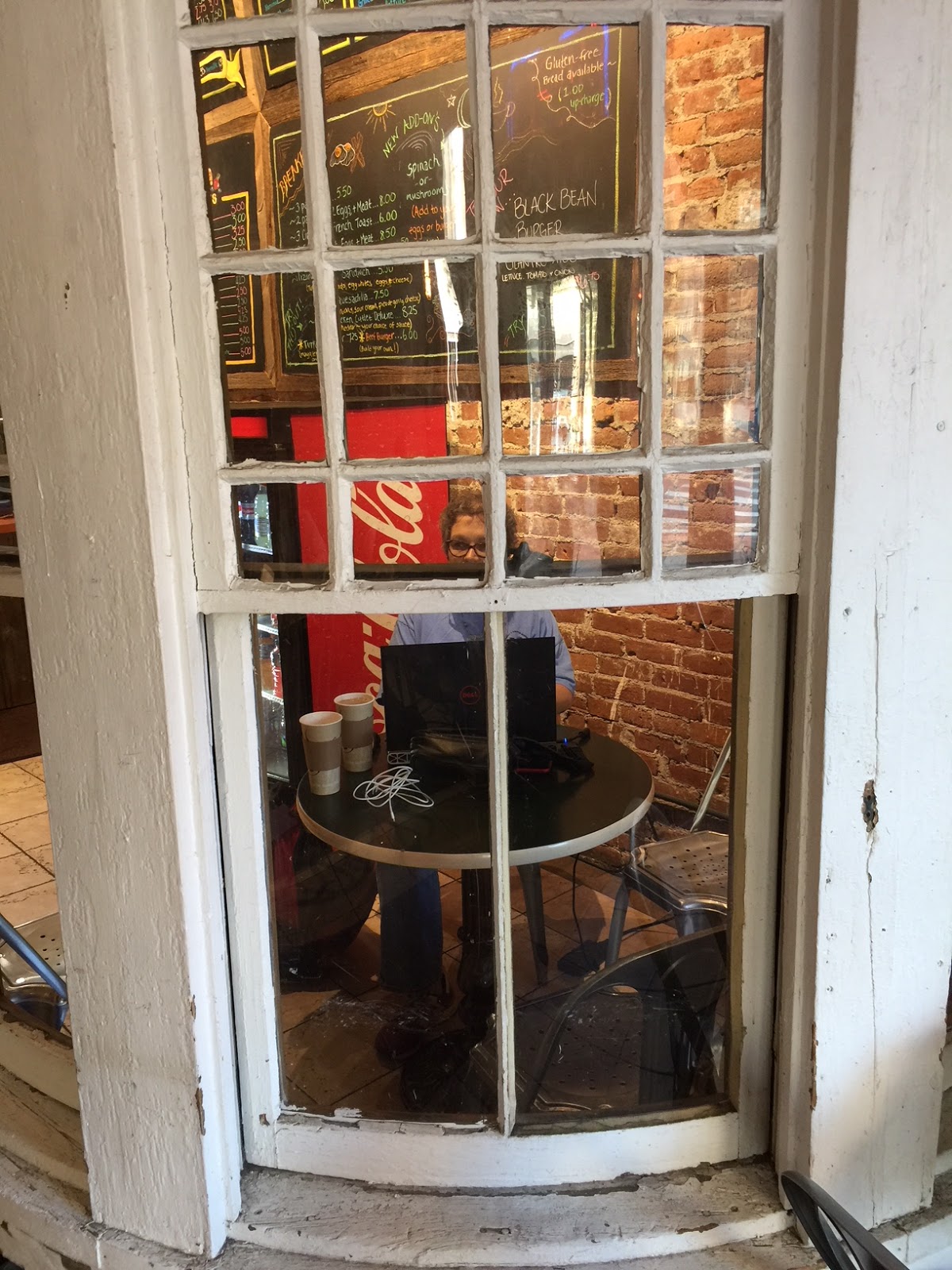
I’m sitting at Latte Lounge in Oneonta right now, sipping my husband’s caramel steamer and wishing we had a real (non-corporate) coffeehouse in Maryville. To be fair, we have close — the best Starbucks in the 50 states, attached to the campus library,
![]() |
| Yes, this is a bay window. |
Oneonta still has a bit of a hippie vibe, with quirky coffeehouse spaces, the Autumn Cafe (a former food coop turned restaurant), and a head shop (the tacky price you pay for the health food stores and artisan delights). The summer traffic has gotten worse and the hotels get quickly packed due to the demand from club baseball tournaments, which Oneonta has capitalized on. The local artisan’s store features a writer who writes romantic suspense with a witch as the main character and publishes through Llewellyn Press (the leading pagan press). The attitude of New York State lends itself to diversity of opinion — “You have a right to live your life, and I have a right to live mine”. I suspect things still got heated during the last election.
They Say You Can Go Home Again …
I have a tendency not to look back. When I leave a place, I know it will change and the people I knew will leave. It is the nature of life in academia, where most of the people you know are students who graduate and faculty who find themselves elsewhere.
I went to college at a huge university, University of Illinois, with its 40,000 students. I knew very few fellow students, and it was only when I found a core of like-minded people — a couple faculty members, a few students, a few townies — that I felt an attachment to people for the first time.
When I left Urbana-Champaign for Oneonta New York, I was alarmed at how small the city and the college were. Soon, however, I grew to enjoy the artistic quirkiness of the town, and I got to know people through coffeehouse culture. I had a network of friends — not close friends, but friends I occasionally spent time with, and some who kept me sane when my marriage broke up (for reasons I don’t talk about, but it was much more dramatic than “we grew apart”)
I left Oneonta after five years for a guy. (Not the guy I’m married to). I have always been a “bloom where I am planted” sort of person until I moved to Maryville, MO. After twenty years there, I have not really bloomed. I have grown into a crabbed, stunted plant in hardscrabble soil with little nourishment. I don’t know why I feel this way — Maryville is a college town. It has activities at the university, and my colleagues are quirky. But I have not felt nurtured nor safe here.
Actually, I do know the reason why — Maryville was the town where two underage girls thought they were creeping out to meet a dreamy high school football player at a party. They were plied with alcohol and passed out. One was raped by the dreamy high school football player, who was the grandson of a state legislator. The charges were dropped by the prosecuting attorney. You might have heard of the girl — her name was Daisy Coleman, and she was 14 or 15 at the time.
The fact that some people could say “You didn’t know the whole story” when the girl was clearly underage makes me feel like living in Maryville is one lurking trigger, even years later. Bad things may happen everywhere, but the level of support the young man got, the fact that Daisy’s family was driven out of town, the condescending coverage the local newspaper gave the protestors — Maryville turned from a difficult town to find nurture in to a burg swarming with ugly shadows.
But now, finding myself back in Oneonta, I am looking back. The town has changed; it’s a little bigger and a lot busier and the signs on the businesses on Main Street could use a little beautification. The college has gotten so many new buildings I hardly recognized it. But my favorite restaurants — Brooks BBQ and the Autumn Cafe — are still here, and there’s lots of coffeehouses (I’ve already found my favorite).
I would love to move back to Oneonta someday. I may never find it; the cost of housing is somewhat higher and we’re a one-income household so we don’t have much set back in savings. Oneonta had become home to me, just like Urbana-Champaign had, but maybe I can’t go home again.
Dream House
Clapboards and fieldstone,