The Curse

Atlantic Hope has wrapped up, and although doing moulage again was satisfying, med problems and stress have put me back into depression. Here’s a poem:

I am a mote of dust in a sunbeam,
a whisper lost in a hurricane gale,
a child fallen down a well in the woods,
an old woman freezing to death at a bus stop.
I am the scene on the cutting room floor,
the news that doesn’t fit the narrative,
the character edited out of the story.
I am a mote of dust in a sunbeam.

voiceless

To be a childhood abuse survivor is to exist without a voice.

Nobody hears when you tell them to stop. Nobody hears when you tell them why you’re crying.

The pain of being voiceless gets better, but the desire to be heard never goes away. It permeates one’s being like a curse that has settled into one’s DNA — “Until you get people to listen to you, you will never be whole.”

Sometimes you get people to listen to you, but it doesn’t break the spell. It never will, because it cannot erase the memory of adults saying, “Are you sure?” and shrugging off your story because you are a child and they are trusted more than you.

This is what mixes up with my feelings about getting published, and it has complicated my decisions about publishing. I want to be heard but I want to be true to my experience and ideals as well. The data from Kindle Scout doesn’t bode well for me. The last two days I’ve gotten less than 20 nominations a day; my writing doesn’t grab people. I have to accept this and go on.

My next step will be to self-publish this first work (despite the fact no one will likely not read it in the swamp of Kindle) and I’m probably going to quit querying. I then have to consider whether I will continue writing just for myself.  Writing takes lots of time and I don’t have a muse to energize my soul right now, so my writing is up in the air.

So I hope you’ll stick with me and keep supporting me:

Moulage day

He looked better before I beat him up.

This is what I came to do. This is moulage.

Second and third degree burns are done with unflavored gelatin and grease paints.
This is the most unalloyed creativity I get to do in my life. No worries about whether I’m doing well enough, whether anyone notices my work, whether I’m accomplishing anything — people tell me that me and my crew are freaking out everyone out there.
I’m an insecure person at times. I can ignore it when I try to get a novel published because I’m so excited about the creative process. But when the rejections come in, I wonder what I’m doing trying to get published in the first place.
With moulage, I will never be renowned. I will never work in Hollywood. I’m good enough and cheap enough (free) that people will need me to do the stuff I do. I have lost this in writing, where I keep saying “If I were good, I’d get an agent/get on Amazon Scout’s hot list/get published” because people CARE about successful authors.
In other words, moulage is a return to my childhood (in which I was a lot like Marcie). Writing has become the struggle of being heard as an adult.

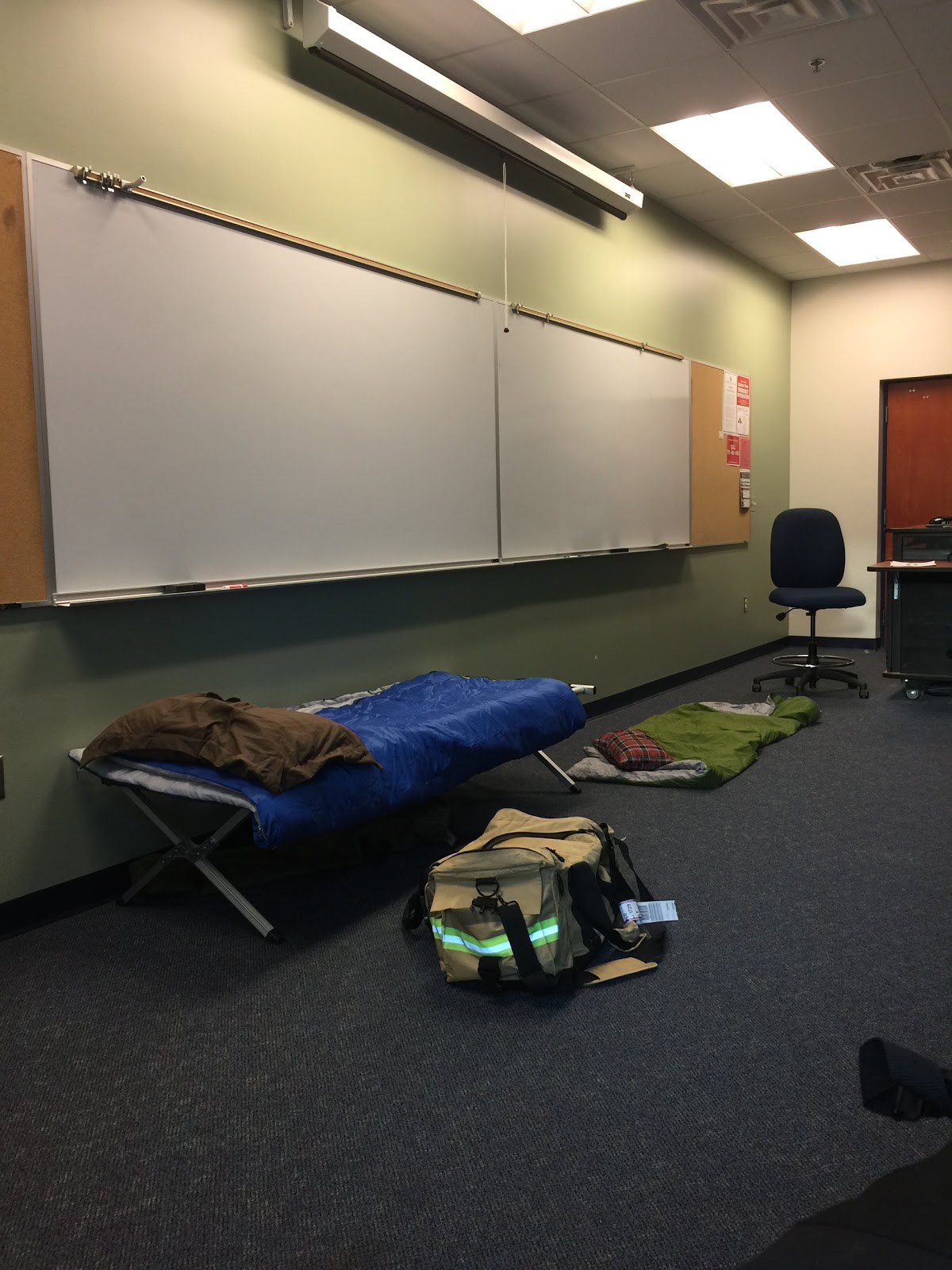
Welcome to the Hotel Atlantica. Cots optional.

Another day in Atlantica. We had our first round of beans and rice, supplemented by Cuban pork to weep for, with crackling skin and deep flavor. We will likely eat beans and rice without it tonight. Remember us as you drink your coffee — It’s 6 AM and there’s no coffee to be seen. And we have no way to get out of Atlantica.

No, Atlantic Hope is still some of the most fun I have all year. The people who volunteer to run the show are emergency personnel from various ares — one Brigadier General, a retired Navy Seal, nurses, humanitarian aid workers, firefighters, security personnel — and me, a pacifist who feels uneasy when people talk about their weapons like beloved racehorses. But they need us, because they don’t think they have the talent to do casualty simulation or, perhaps think it’s not as important as what they do. It is, after all, makeup, which is girly stuff.

I don’t really know if I have as much talent as they think I do. Richard and I get geeeted regularly during the exercise with “Really love your work!” We’re self-taught. Richard studied under me. I,d love to get more training but most of it is driven by the various companies who make Moulage products. We are not makeup artists.

But I’m here, and they need me, and when I’m in the flow of creativity, none of the above matters. I’m here doing something I love.

*******
Twenty-seven days left, and it already looks bleak for my campaign. Thank you if you’ve nominated me; 357 nominations is more than I thought, and less than I need. It seems a brutal way of getting discovered, though, and I know I may not be writing what people want to read, but thank you. https://kindlescout.amazon.com/p/250Q7OJ0R0F8W

Welcome to the glamorous life of a humanitarian aid worker.

Welcome to Atlantica! It’s 5:29 Atlantica time, and I almost froze themo death. Richard and I snagged a private room in the tactical building only to find out that 1) our sleeping bags stowed on site had disappeared, and 2) Hotel Atlantica (not the more amenable digs above) wasn’t heated. We found a hidden cache of blankets and survived the night.

I hope beyond hope the coffee is drinkable.

*****
Not much time or energy for writing here; but I’ll check in now and again.

Apparently my link to the Kindle Scout campaign for my book Gaia’s Hands was broken. Here’s a functional one:https://kindlescout.amazon.com/p/250Q7OJ0R0F8W/

Welcome to Atlantica

I’m typing this from the borders of Atlantica, the imaginary country
People from the Consortium for Humanitarian Service and Education will be creating for the training of some 50 individuals.

Atlantica is a troubled country. Freshly out of a war with a neighboring nation, Atlantica is riddled with corrupt officials, suspicious factions, and cholera. Then Atlantica gets hit by an earthquake, and our humanitarian aid teams navigate the red tape, vague threats from officials, and diseases rampant in the area to negotiate aid for the fragile country.

The idea behind CHSE’s exercises is to create a realistic exercise so that the participants can learn under pressure, make mistakes, and get advice from controller-evaluators so they can retry the encounter.

My job is to create realism. I’m the coordinator of the Moulage crew, and my crew supplies realism through simulated injuries and illnesses. We go for as much medical realism as we can produce with stage makeup and fake blood. None of our trainees have vomited yet, but we once sent someone to a hospital for a drill and he was seconds away from getting an IV.

Moulage is one of my favorite creative outlets. My husband and I have a little competition as to who’s grossing out people the most realistically. His specialty is degloving injuries, mine is deep burns. We learn from the nurses, medics, and zombie aficionados we encounter on our crews. And it’s worth sleeping on the floor and eating the Atlantican national dish, rice and beans, for four days.

I wish you could be here in sunny Atlantica.

***********
Just a reminder that my Kindle Scout campaign is live. If you want to nominate the book, go through the whole nomination process:

https://kindlescout.amazon.com/p/250Q7OJ0R0F8W

Soundtrack for Gaia’s Hands

Every time I write a book, I put together a playlist (or as us old-timers call it, a mixtape). I try to capture the book’s moods in a list of music that plays for between half and hour and an hour.

The style of the playlist varies by the moods and general tone of the book. Voyageurs, a time-travel mystery of sorts, goes from a late 1880’s German wind ensemble place to Indigo Girls and Hoobastank. The energy of Kat Pleskovich and Ian Akimoto’s Buddhist calm exchange importance on the mixtape.

Gaia’s Hands, on the other hand, is a mystical exploration of permaculture, love, and the greening of the earth. The soundtrack is funneled through Jeanne Beaumont’s experience of having been young in the 70’s and introduced to a wide range of music. Here’s that playlist:

Voices — Cheap Trick
Brass in Pocket — Pretenders
Big Yellow Taxi — Joni Mitchell
Doctor My Eyes — Jackson Brown
Ancient Forest — Clannad
The Host of Seraphim — Dead Can Dance
The Book I Read — Talking Heads
For What it’s Worth — Buffalo Springfield
Mother Earth (Provides for Me) — Nitty Gritty Dirt Band

I would love it if you could share playlists with me and the reason you use the playlists!

Today’s the beginning

It’s February 28, and my Kindle Scout campaign is up and running! I myself am at the National Preparedness Institute, which is not nearly as impressive as it sounds. I’m setting up for moulage as you read this, possibly. This link should be live now:

https://kindlescout.amazon.com/p/250Q7OJ0R0F8W

But here’s the story again according to Kindle Scout (2018):

  • A book is a new, never-before-published work of 50,000 words or more that you’d like to see published. In my case, the book is called Gaia’s Hands.
  • An author is the person who has written and submitted a book to Kindle Scout. That would be me, Lauren Leach-Steffens, also the author of this blog.
  • Readers (that means all of you) scout the site and nominate books they want to see published.
  • Nominations are how readers show support for a book. Readers can nominate up to three books at a time. This is what I’m asking you to do.
  • A campaign is a 30-day scouting period during which readers nominate books to be published. Mine is from February 28-March 30.
  • The Kindle Scout team makes the final call on which books are published by Kindle Press. This will depend largely on how many nominations. This is what scares me, because it sounds like a popularity contest and I’ve never been popular.
  • Kindle Press publishes the books discovered through Kindle Scout. This is my goal — not for the $1500 cash advance, or royalties. I want to be read and enjoyed and maybe make people think. (Although I could get a new computer with the royalties, one that can handle graphics so I can map my landscapes using SketchUp without bombing the computer)

Elegy for the Bookstop

To say that the Bookstop was a coffeehouse may be embellishing the place, for the Bookstop had started as a used bookstore owned by a retired English professor, and had lost most of its books and gained its antiques under new owners Mike and Sheila. But it retained its name.
This was the Bookstop in its heyday. The awning was designed by the owner’s son.
The Bookstop did sell coffee — decent coffee roasted by PT’s in Topeka. They sold espresso drinks, brought to an art form by dreadlocked Sharla, barista and cappuccino artist. They also sold homemade cookies and cinnamon rolls, and of a Saturday (as the old-timers say here), they sold a breakfast entreé.
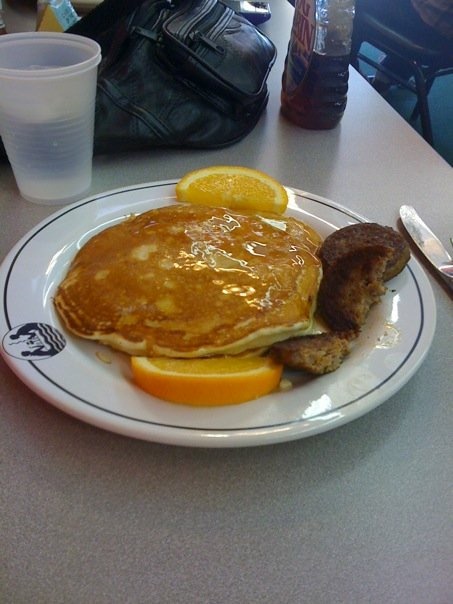
Saturday morning breakfast. Are you hungry yet?
I used to go to the Bookstop every morning at seven AM in the morning (as the old-timers say here) as I walked to work, walking poles in hand and a heavy computer backpack on my back. What kept me coming back every day was not the chaotic jumble of antique booths that took up two-thirds of the score, nor the shabby chic of the walls, not even the coffee (although it was very good). It was the people.
In the morning, I could count on an eclectic group of people — Spencer, a retired lawyer and Marine, sometimes with wife Jennifer; Rod, a cagey old man with a strange sense of humor; Mark, an economics professor I sometimes talked shop with; the retired SeaBee whose language hadn’t gotten any less salty after the war; the weathered cook with his crooked teeth; the Hagemans, enjoying their retirement; mild-mannered Tom; and of course, Mike and the baristas, who were usually witty as well as great at their jobs.
The regulars would talk. Spencer would drill me on my opinions on economics and politics; Mark would rarely interject from his perusal of Wall Street Journal. Sometimes Mike and Spencer would goad me into bawdy talk (which is one of my secret talents). Rod would laugh in that awkward bark of his, and Jennifer would mockingly scold Spencer. 
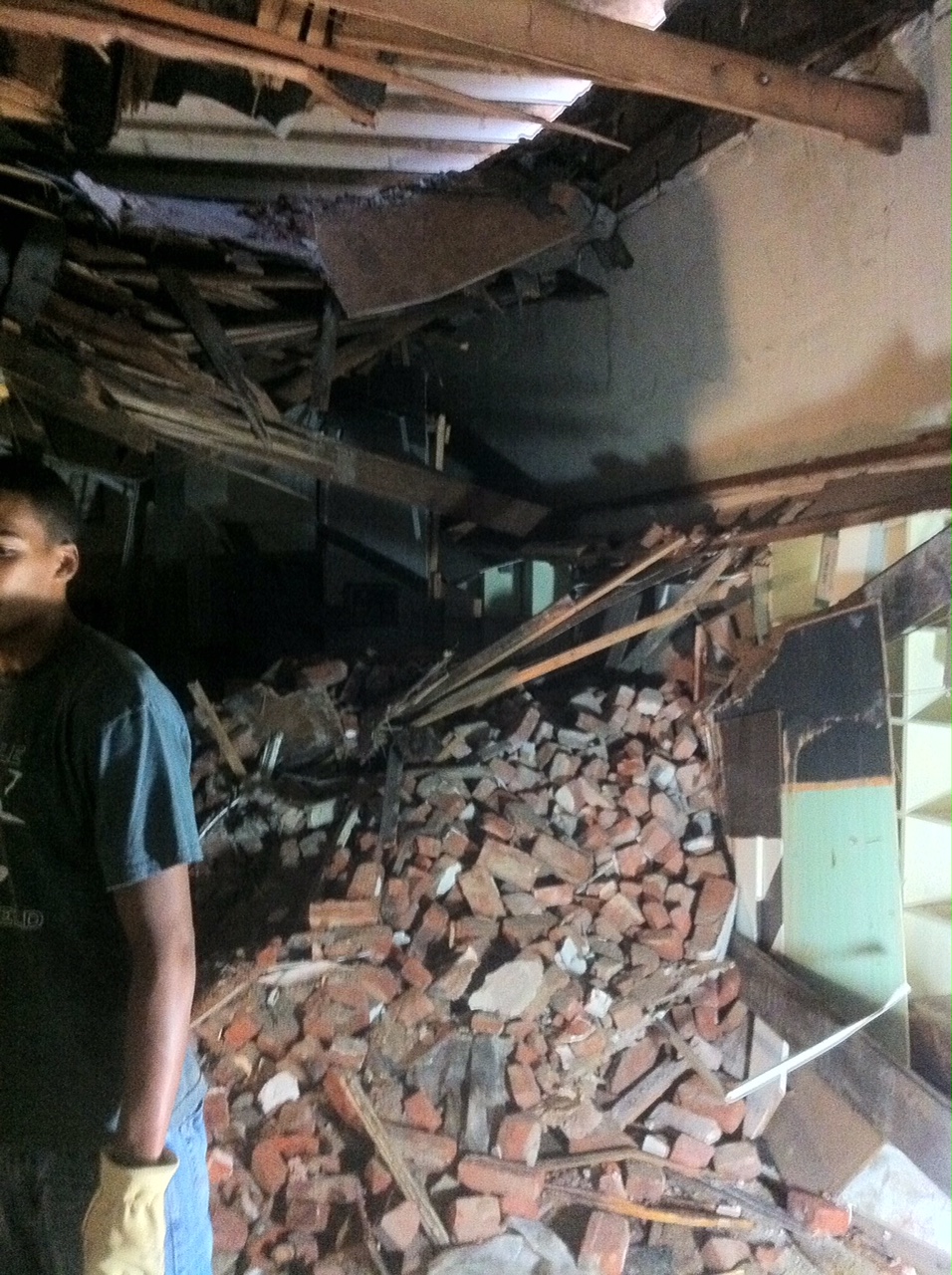
The Bookstop died after a protracted illness. It started by injuries from a fire in August 2011, when a tenant in the building next door set his apartment ablaze, and the rumor was that the fire resulted from his habit of relaxing with a joint or two. Although the Bookstop itself wasn’t affected by the fire, it suffered from some water damage. Just as Mike’s crews were starting to mop up the water, the demolition crew next door dropped a wrecking ball through the ceiling of the coffeehouse, and a torrential downpour caused much more water damage. The final insult was when the insurance companies — those of the building next door and of the demolition company — couldn’t settle with Mike in time to resurrect the business.
The fatal injury
For a while, a few of us regulars still drank coffee in the ruins of the Bookstop. This was a casual arrangement, word of mouth; Spencer unlocked the door in the morning, he and Jennifer kept the coffee flowing. We got the coffee for free. The back portion of the building was closed off with tarps to keep us from danger. The front area was cluttered with tools and coated with plaster dust. Sometimes Mike would show up. It was, in its own way, our wake, and it would not last for long. 
One morning, the door was locked. And it never opened again.
I heard that the Bookstop building, sad and weathered, without its distinctive awning, was finally closed. I don’t know what will be done with the building now, but it could never be as shabbily welcoming as the Bookstop was.
Rest in Peace, Bookstop. Thank you for being a faithful friend.

My Kindle Scout Campaign — asking a BIG favor

I have been accepted for a Kindle Scout campaign which will go live on February 28, while I’m off at Atlantic Hope doing moulage for a humanitarian exercise (“Atlantica — You’ll have a riot here”)

Just in case you didn’t know who Gaia is. 


This link will be available from February 28, 2018 12:00 AM EST through March 30, 2018 12:00 AM EDT:
Kindle Scout Campaign for Gaia’s Hands

The basics are:


Readers scout the site and nominate books they want to see published.

Nominations are how readers show support for a book. Readers can nominate up to three books at a time.

campaign is a 30-day scouting period during which readers nominate books to be published.

The Kindle Scout team makes the final call on which books are published by Kindle Press.

Kindle Press publishes the books discovered through Kindle Scout.
I hate begging my readers for nominations,  because it seems overly needy of me, but this is how Kindle Scout works. So I will not beg — I will only ask that you consider nominating me when this goes live!