An excerpt from what I’m editing today …

“The Triumvirate,” Luke stated, “expect us to be scared. Conversely, they expect us to be arrogant to cover our fear. We should communicate neither.”

“But wouldn’t fear cause them to under-prepare for the battle because they think we’re pushovers?” Stephanie Rogers, a member of the telepathic women’s rugby team, inquired.

“I suspect they will be underprepared no matter what,” Luke grinned savagely. “They believe themselves to have superior weapons — strength, transportation and teleportation abilities, near immortality and quick healing. The Nephilim have similar characteristics, but are less difficult to kill – or injure in this case. The Triumvirate expect us to conduct typical human warfare — with guns, which would fail us; with edged weapons, which they consider themselves better at, with martial arts, which some of them have mastered. They have not fought a battle against subterfuge.

“I fear, though, that if we send a cringing, cowering message, we ourselves will take it to heart and create our own fear, and they will win.”

“So, we send them the type of message we’re good at sending?” Ilsa asked. “Calm, strong, sure of our convictions?”

“I think that’s a good way to start,” Luke nodded. “How should we address them?”

“‘Dear assholes,’” Allan Chang intoned.

“Ah, no,” Alan Sutton replied.

“How about ’To our adversaries,’” Raina Prince suggested.

“Although I like that, we are not an adversarial people. In an ideal situation, we would seek to find unity with them.” Ilsa stood up. “How do we address them in that sense?”

“Dear Triumvirate,” Addie Majors stood up and answered. “We regret that you have chosen this action. We will be ready to face you on the appointed day.”

“We should be ready at any moment, though,” Luke said. “But we don’t tell them that, of course.”

“Frankly,” Dan Lance stated, “this sounds like a perfect message. Short, sweet, to the point. Not overly aggressive nor overly passive.”

Sarah Kinder jumped in. “I agree. That’s the message I would like to send.”

In the end, the collective entrusted Luke to send the simple message.
Write as if people want to read you.

I’m okay as a poet. I’m better than I used to be, but I still feel like there’s something I don’t quite understand, maybe how poetry distinguishes itself from lyrics (the latter of which I feel I do well at), or how to show what I want to say instead of telling. 

On the plus side, I write poems better than I used to.

The breakthrough was when I needed to write poetry in the voice of one of my characters in a novel. Josh turned out to be a much better poet than I was. This should not make sense, as Josh existed only in the novel and he couldn’t write any words I didn’t put in his pen. In other words, I was Josh. yet his style held mysteries mine didn’t. It held stylistic experiments I’d never tried.

The biggest thing, though, was that Josh wrote as if people wanted to read him. 

I put that into italics because that just occurred to me. Self-doubt puts limits on our motivation, our daring, even the effort we take to write. And it’s an uphill battle for many, even most of us. It keeps some from writing, and others from seeking publication.

Something I need to think about.

This paragraph may be the one that pushed me to write novels

And if you, the esteemed reader, should read to the story’s end, the spell contained within this book shall bestow upon you the powers of the heroine, and grant you your wish. For indeed the moment the page is turned, the story will become reality.
—The Universe of the Four Gods, Manga Chapter 1 
The above came from a manga/anime called “Fushigi Yuugi” or, in approximate English, “The Mysterious Game (or Play)”.* This classic anime series served up more than just the inevitable love triangle — with ancient prophecies, love beyond death, and shadow archetypes, it certainly hooked me in. 
Watching it now, FY hasn’t aged as well as I’ve liked, or perhaps it’s that I’m no longer a high school girl **. The female protagonist Miaka keeps making stupid mistakes, her male protector Tamahome gets sappy, and everyone falls in love with her despite her clumsiness***.

But that line of the legendary book that starts the adventure of Fushigi Yuugi! Don’t we all wish our writing will bestow powers upon all our readers, captivate them, become their reality while they’re reading, grant them the wish of going beyond what they feel are the confines of their lives?

 *Note: I do not speak Japanese (or any language other than English).
** I’m 52. No duh.
*** Twilight did NOT use this idea first.

An excerpt — just to tease you.

This is an excerpt from the story I’m currently editing:

The sun had barely peeked over the horizon when Luke Dunstan strode around the site of the coming Apocalypse.  He observed a brightening sky streaked with fuschia, an apple orchard etched in grey, squat houses surrounded by shadowed herbs and flowers. As an Archetype, Luke needed no sleep; because few of the humans were yet awake, he could walk alone.

He considered the plight of the collective against beings of his race and their vicious Nephilim fighting force, who fully intended to kill not only the humans of the collective, but the Archetype who held all women’s lives — his daughter Lilith.

Luke concealed his tears.

Wish Me Luck

After editing my many-times-edited first novel, I have submitted it to a digital imprint of a respectable American publishing house (for those curious, HarperLegend). I’m a little reluctant to do digital-only, but they do handle some of the marketing and sometimes bump someone up for paperback.

One of my difficulties in getting published, I think, is that I write a different sort of fantasy than people expect (at least I hope that’s it and not that I can’t write.)

Are there gods/goddesses/mythical creatures? Check.

Are there talents and abilities not found among the human population? Check.

Are there epic battles? Yes. But the good guys are pacifists and trying not to kill anyone. HUH????

What’s the main conflict of Reclaiming the Balance? Civil rights for half-human beings with superior strength. (And falling in love with an intersexed half-human being is the B plot)

Any epic gods? Well, Lilith (remember her?) forgot her identity for many years and became a psychology professor. Oh, yeah, the Garden of Eden was staged for legend’s sake.

And Lilith ran off with Adam. (OMG, that Adam?) Yes and he’s an incorrigible flirt.

You get the picture. Wish me luck — and drop me a comment! 

OMG Motivation

I’ve just finished with my spring semester grading and — I’m having trouble motivating on my editing.
I start a chapter of one of the books, and so many things seem much more interesting — Facebook. Instagram. My blog — oh, wait. I’m in my blog, aren’t I?
.
.
.
Oh, sorry. I just checked Facebook again. Nothing happened. Isn’t that always the case?

Why do people procrastinate? Sometimes they’re afraid they’re not up to the challenge. Sometimes they have very low attention spans. Sometimes they’re bored — ding ding ding!

Editing isn’t sexy like writing is. In writing, I meet (and fall in love with) my characters, they talk to me, their actions and beliefs and feelings flesh out the direction of my outlined plot, I get to know them. I create a world that’s more diverse (but perhaps no more tolerant) as the one I grew up in, one where a dying elderly woman can fall in love with a faun.
.
.
.
I’ve checked Instagram twice and Facebook once. Just saying.

How to do a boring task like editing and do it well? Break it up into little pieces. Start it and promise yourself you’ll quit if you haven’t warmed up to it in ten minutes. PUT AWAY THE iPHONE.

Or maybe I just need a break. Where’s my iPhone?

Ups and Downs of Writing

The first thing I’ll do here is break a taboo — I have a mood disorder. Specifically Bipolar 2 — half the mania, twice the depression. No, I’m not crazy — I have wonky biology. Just like you do.

Is there a link between bipolar and creativity? Collingwood (2017) reports that there have been many creative people known to be bipolar, but that this may be due to a third variable. She also points out that people with bipolar disorder are more productive and creative when they are managing their condition.

This has been my experience. I could not have written a novel without my medications, which is why I’m a late bloomer (I wasn’t diagnosed till five years ago). Self-maintenance activities such as regular sleep, eating regularly, not overworking myself, and avoiding alcohol supports my creativity as well. In other words, all those things creatives are reported not to do.

My imagination still functions with all of this — better, even. Thanks for reading.

I hope you find
at the end of the day
that the yammering words
chained and rechained in the switchyard
fade into a night of indigo
with the texture of a cotton eiderdown.

Collingsworth, J. (2017). The link between bipolar and creativity. Available: https://psychcentral.com/lib/the-link-between-bipolar-disorder-and-creativity/ [April 27, 2017].

Melancholy Pt: 2 — a poem about Limerance

Limerance
There’s a push to ask you for your name,
And a pull ‘cause I have no right to know,
As I stand in the corner of the venue
With nothing in my mind except the color of your eyes.
There’s a push to sift through every word
And a pull to flee from disappointment
Still I remember and I polish all your words
And call myself the author of the author of their shine.
There’s a push from my husband and he’s laughing,
And a pull from my husband ‘cause he’s scared
And I’m standing on one foot while juggling cats
And I don’t want what I want,
And I don’t want what I want.
NOTE: No husbands were harmed in the writing of this poem. Said husband says he’s merely bemused, not scared. 
NOTE2: This may not be the finished work.

Melancholy makes for good poetry.

When someone paints a portrait of a poet in their mind, they picture the poet as brooding, head resting in hand or fingers steepled, drinking coffee absentmindedly in a cafe with walls the color of storms.* The word “Byronesque” comes to mind, appropriately.

There’s a very good reason — melancholy makes for good poetry.

Why? Because poets bear the feelings of their society. Not just the positive feelings — all the feels.  The feelings we don’t want to deal with, the feelings we’re afraid to deal with, the feelings we wished others understood. Poets even imbue poems about stealing plums from the refrigerator with interpretable, moody meaning.

Poets have a solid qualification to write about society’s moods — poets are moody.  They ponder in ways that bring feelings to the surface. They flirt with limerance and relive heartbreak. Their words bleed on the paper as they write with fountain pens in cafes with walls the color of storms.

But you need our melancholy, because you need to visit your own.

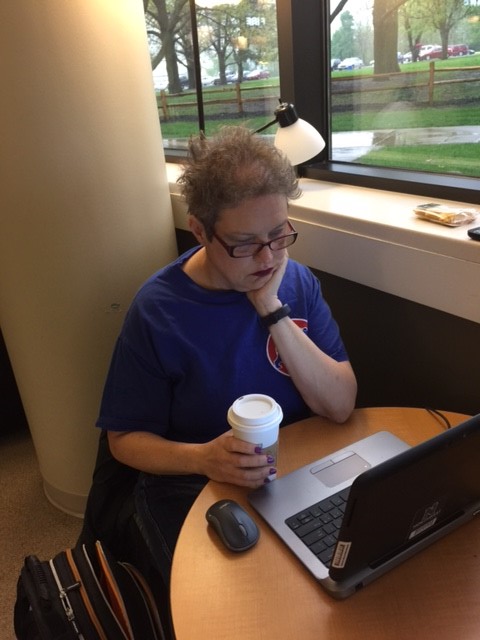
Portrait of the author on a blah day.

* Correction: only the male poets. The female poets always look perky, even though some of the moodiest work ever was by women like Maya Angelou and Gwendolyn Brooks.  And Emily Dickinson. And Sylvia Plath. And …

Editing as a form of Revisiting

I have been participating in Camp NaNoWriMo this April, pledging 60 hours to editing a book (which turns out to be all five) by the end of the month. I can only edit as much as my writing knowledge and my fallibility let me, and my husband and co-pilot looks at them afterward (more slowly than I do). I MAY HAVE TO PAY SOMEONE TO EDIT.

The fun part, though, is that I get to revisit some of my favorite people — the thoroughly modern psychologist Lilith (yes, that Lilith) and her consort, the fey Adam (yes, that Adam); Lilith’s father Luke, a 6000-year-old supporter of humanity and suspected Serpent in the Garden; Adam and Lilith’s daughter Angel, the iconoclastic creator of immortal cats; the practical botanist Jeanne and her younger and mystical lover Josh and their relationship with Gaia; Amarel, who was born on the point between human and Archetype, old and young, and male and female.

If you’ve read the previous paragraph, you will catch some of the issues that may prevent me from getting published — subverting the Garden of Eden to find a different message; a young transgender individual (who will fall in love); an exploration of No One True Religion; an older plump woman in a relationship with a much younger man.

Other issues stay hidden: a battle plan without bloodshed; corporate plots to bury opposition; liberals that act in opposition to their morals; no vampires, werewolves, or over-the-top sex scenes.

I worry that this isn’t “marketable”, because it’s not urban fantasy, romance, or sword and sorcery. It’s not what the Sad/Rabid/Dead Puppies want to see. I write about the Peaceable Kingdom and our failures in getting there. If you know of someone who will publish this (not self-publishing yet) let me know.