Day 36 Lenten Meditation: Acceptance


At the risk of sounding cliche, I don’t think I can start this better than using the Serenity Prayer:

Lord, help me to accept the things I cannot change,
the courage to change the things I can,
and the wisdom to know the difference.

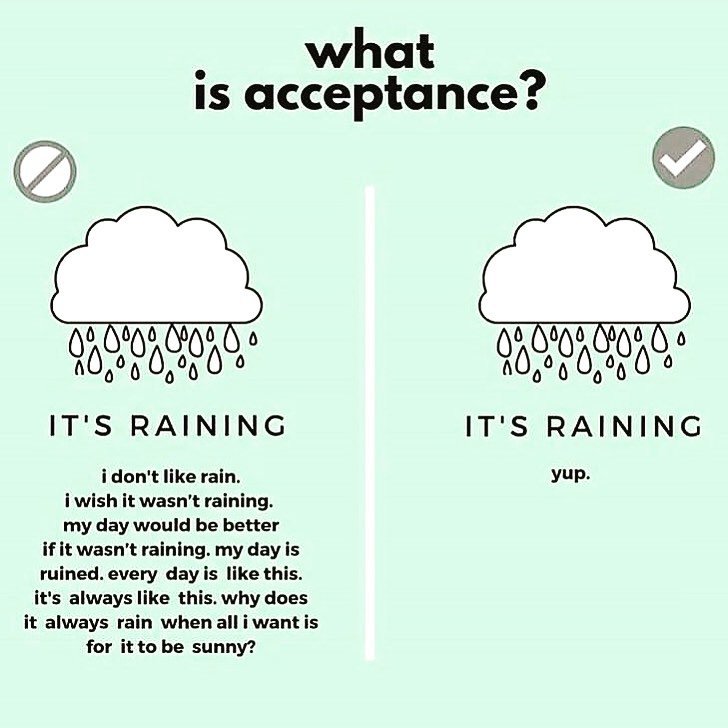
In the time of pandemic, we have a lot we cannot change. We cannot change the fact that the virus is out there or how virulent it is. We can’t change that we’ve been put under a shelter-in-place ordinance. We can’t change the shortages in the stores.  All we can do is accept.

But we can change some things. We can plan our shopping to minimize our exposure to others. We can keep our hands clean and wear masks to keep from getting the contagion. We can take care of ourselves physically and mentally. We can spread love through social media. 

How do we know the difference? After all, there are people out there breaking social distancing rules, some of whom now have COVID-19 and are regretting their actions. Their bravado didn’t change the contagion. Some people are raging at the situation, which is the opposite of acceptance. Knowing the difference requires self-examination and the question “How?” How can my actions change the situation? How can my influence create a new path? If there’s nothing you can do, then it’s time to accept.

Day 3 Lenten Meditation: Risk


Without risk, there is no reward. There is only buckling in to the forces inside and outside of us.

Many examples of healthy, responsible risk-taking exist. Investing money for return on investment, dating, expressing one’s feelings, submitting creative works for publication, going up for a promotion. Confronting corruption and injustice, changing the status quo and being authentic also take risks.

Risk instills fear — of rejection, of failure, of loss, of negative consequences. Many people focus on the loss instead of the potential gain, and we call them risk-averse. Avoiding risk has its cost — lost opportunity, lack of progress, and a dearth of fulfillment. 

Choosing risk for its potential rewards may require changing one’s mindset with one or more of the following:

  • Examining the fear against the potential return
  • Believing that one will survive the worst case scenarios
  • Feeling the fear and taking the risk anyway 
Without risk, there is no reward. There is only buckling in to the forces inside and outside of us.

What I’ve learned by using Submittable

When I went to Archon, a conference for writers in St. Louis, a few people advised me to start submitting shorter items, poetry and short stories, as the novel market has been so capricious. One person tipped me off to Submittable, a web page/app which helps writers identify potential publishers (literary journals, writers’ web pages, etc.) and streamlines the submission process.


What I’ve discovered from using Submittable:

1) Many journals have submission fees, so submitting in bulk can cost some money. The lowest fee I’ve seen is $5.00, the highest fee I’ve seen is $30. The more “literary” or exclusive the journal, the higher that fee.

2) There are a lot of themed calls for submissions — fantasy, horror, romance, cross-genre and more.  Some of these offer a prompt — one of the ones I entered had the prompt “Catch up”. 

3) I have a ten percent success rate, which has kept me from the despair about not finding an agent/publisher for my novels. 

I get a lot of rejections for my work, but because there’s always more contests, and more hope, I feel better about trying.

The Daily Submission

Strangely, the daily rejection submission gives me more hope than might be expected.


To those who haven’t been following my log, I have started submitting flash fiction/poetry and short stories I’ve written on a daily basis, one per day, using Submittable. This means that, given the odds of being published with all the submissions coming in, I have been receiving a rejection a day.

I don’t focus on the rejections, strangely. I focus on the fact that I, at the moment, have six submissions (counting Prodigies at DAW, a manuscript for a novel) out. 

I don’t know how much longer I can continue this exercise, because there are little readers fees nickeling and diming me — four dollars here, six dollars elsewhere. But so far, it’s given me hope. 

A Rejection a Day

I think I’m becoming more sanguine about rejection. 

I’ll never like rejection, although one woman I met at Gateway Con said that she loved rejection because it meant another person read her stuff and knew her name. 

I’ve been practicing my rejections. I’ve got Submittable (a submissions software) bookmarked on my computer and I try every day to submit a little something — a short story, flash fiction, a poem — to see if anything gets accepted. I’m hoping for acceptance. So far, I’ve been getting tiny rejections, and that’s not bad.

Of course, I know myself — I’ll be good about rejections till I get a major rejection. Like the one I’ll probably possibly get for Prodigies. 

But even then, I know that a rejection doesn’t mean that my writing is bad, but could mean that my writing was in the wrong place at the wrong time. It means that it’s time to examine the piece and try, try again.

Day 19 Reflection: Hospitality

My friend Celia has been dead for ten years, but I still miss her. The thing I miss the most about her is how I felt when I visited her — I felt perfectly accepted despite my quirks (my need for an afternoon nap, my chattiness, my occasional giddiness). 

To me, accepting the other is the key to hospitality.

Too many places I’ve been have professed hospitality and shown otherwise, many of them Christian in focus. I stayed at a bed and breakfast that posted the “As for me and my house, we will worship the Lord” quote in a guest room. This seemed almost hostile to me, even though I’m a Christian — as if the host had said “Leave this part of you that’s not Christian behind if you’re going to stay here.” I attended a church once that prided itself on its inclusiveness yet employed an uncomfortable silence when I mentioned I had just been diagnosed with bipolar disorder, just when I needed reassurance. I did not feel accepted there.

To me, the whole message of the New Testament. the key book of Christianity, is that the other is our brother or sister. Many other religions hold the same message. How can we be hospitable when we shut the door to travelers and seekers who are not like us?

To give hospitality is to say, “Please sit with me. I will assume the best of you. Spend this moment with me. Come as you are.”


Day 9 Reflection: Acceptance

“It is what it is.” This phrase has always bugged me, because I want to fix things. I want to make things happen. I want to be in charge of my destiny. All I need are some affirmations and I can —

Sometimes, it turns out, I can’t.  

Sometimes I don’t have the energy to put more effort into something to influence the outcome. I give what I can, and then I accept that I’ve done the best I can, and I take my needed rest. I find this with my writing career, which thus far has not taken off. Because I have a full time job which supports my family, I cannot devote myself to full-time writing, so I write as much as I can and then accept my time and energy limitations.

Sometimes I don’t have the power to change reality, and I have to accept it. I cannot bring a loved one back to life. I can’t reverse a layoff. All I can do is accept and mourn and adapt.

Sometimes, though, it’s dangerous to accept things as they are. Injustices may be too large for me alone to solve, but that doesn’t mean I should dismiss them with “It is what it is”. I have limited power to change others’ minds or to change society, but I must address what I can rather than accept. I accept that I can’t change the world, but I try, and I listen to those who face the injustice so my energies go in a helpful direction and are not wasted. 

At the end of the day, “it is what it is” … for now.

Rethinking why I write

Once upon a time, I wrote because I desperately needed to be heard.

I don’t feel that pressure so much anymore. I think that it took working with a developmental editor to let that go, because I realized that I could act like a professional and take writing seriously without someone bestowing a first-place ribbon on my work. In other words, I don’t need to be published to prove anything.

But now that the immediate, inner child’s need to be heard is no longer applicable, I’m wondering if it’s truly worth it to get published.

I have heard from agents that they’re getting 500 queries a day. This means all they can do is skim them and pick what “jumps out” at them. I could be an excellent writer, but because I’m not prone to sensationalism, what I write may not “jump out”. I think I need to accept that.

I may never get published. I say this dispassionately — the odds are very poor, no matter how good a writer I am, no matter how much I publish. If I get a foot in the door, I may get more published because I will be a recognizable commodity. But right now, Prodigies (my most polished/edited piece) has gotten four rejections and I just sent it out.

I don’t know where that leaves me relative to writing or publishing. I currently have almost no free time because when I’m not working, I’m writing. I’m feeling uninspired.

I may need to rethink whether this is my calling.

"I wrote a love song to a sparrow"

I didn’t tell the story I thought I’d tell.

No stories about hardship, no stories about resilience. Somehow, the Dear World storytelling process got to my inner core in less than twenty minutes.

I told a story about love, creativity, and sparrows.

When I was a child, I talked to sparrows. And trees. And squirrels. Mr. Shady Tree lived down the street from me. He had been trimmed to look like a child’s lollipop tree. Now and again I would stop by to visit him. I would offer him invisible TV Dinners and banana splits. He never spoke to me but I felt a sense of comfort talking to him. I talked to the birds in his branches, too. I remember the sparrows best — they were flighty sorts, hopping in small groups from branch to branch, then scattering when cars drove by.

I quickly gathered a reputation from my classmates for being “weird”, and this led to a lot of harassment on their part and a lot of shame on mine. I cared less and less about their “normal”. I isolated myself rather than face the shame.

When I hit adolescence, I discovered more beauty in my world — boys. I felt as if I could study every inch of their faces — their skin, translucent or spotty, their eyes, the truth behind their cryptic scribbles in their notebooks. I could never draw them, never even remember their faces. So I wrote poems. In junior high, I showed the poems to my best friend, and she raised the window sash and announced my crush to everyone outside during lunch. I would spend the time between classes being admonished by the other girls that So-and-So wouldn’t possibly like me back.

The two lived together in shame in my mind — birds and crushes.

One day in college, I wrote a love song about a sparrow. I confess, it wasn’t really about a sparrow — it was about a young man on a bus. He had long, honey-brown hair and round glasses and a faint dusting of freckles and a strong, curved nose. His build was delicate, bird-boned. The rain had drenched him as it had me, but he looked at home in a misty forest, and out-of-place on that grimy bus.

So I wrote the song. Looking back, I had a revelation about this song —  no, two: I had found a way to both talk about my strange reality where birds and trees could understand human speech and maybe even take one on a journey, and I had found a way to talk about crushes without revealing them. I also found acceptance for myself as the child who others found “weird”.

Oh, the song? Here it is:

CHORUS:
Pretty, pretty –
I would not take your feathers,
I would not steal your flight,
I only want to watch you
Spin stars into the night
I’d love to hear your stories,
I wonder where you’ve been,
I wonder where you’re going to
Pretty, pretty.
Who am I to seek you out –
A child who talks to birds.
I’d love to tell you something,
But I stumble on the words.
The poetry of birdsong,
The music of your voice
I wonder where you’re going to
CHORUS
And where am I to look for you?
I’ve squinted at the trees
To watch the flutter of your wings
Float past me on the breeze
The poetry of birdsong,
The music of your voice
I wonder where you’re going to
CHORUS
And who am I to seek you out –
A child who talks to birds.
I’d love to tell you something,

But I stumble on the words.