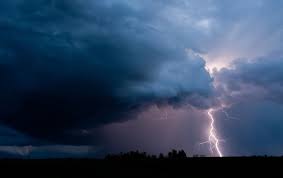
I was hoping for a thunderstorm today.
I love thunderstorms, with their gushing rain and big booming thunder. If I weren’t so aware of my mortality, I would stand in the thunderstorm and scream with the lightning.
Thunderstorms are cathartic, clearing the air of heat and dust, clearing my mind of stagnation. Changing the topic from waiting to doing.
The color of the dewy grass after the storm cheers my heart. It makes me feel like rebirth is possible.
I will have to wait till tomorrow, apparently, and even then the forecast might be gentle rain or misty drizzle. I’ll accept those, even knowing I will miss the more dramatic storm.
Tag: amwriting
Heaven and a Cup of Coffee
“I feel like I’ve died and gone to Heaven.”
I thought about the phrase this morning while drinking the best cup of coffee my husband’s ever made, and I wondered what that would actually be like. I know that different people’s notions of heaven differ, but many of them seem to look like life on Earth except, maybe, with less material goods, more leisure, and more happiness*.
If this is Heaven, I can’t help but think I will have feelings other than joy and a deep contentment. I’ll have left all these people I know and a life I’ve stated as “pretty darn good”. Won’t I mourn my lost life? Won’t that perfect cup of coffee make a poignant reminder of my mornings on Earth?
Wouldn’t I get tired of my perfect coffee every day? Part of what I love about our coffee in the morning is the fact that my husband and I order the varieties we want to try, Richard (husband) roasts the beans, and we critique the resulting brew. Wouldn’t we lose something if the coffee wasn’t of our production?
So I think of Heaven, and I worry a bit. Because if Heaven is that perfect cup of coffee, I’m afraid I would be bored before long.
***************
* Less materialism seems to be a predictor of happiness on Earth as well, so there might be something to this vision.
**My notion of Heaven is that I will become a traveling soul with consciousness that can zip across Heaven and Earth at the speed of a thought. As I travel, I will quickly lose more and more memory of the material of Earth, and I will only be a force for good.
A Pretty Good Life
So today is my one day of summer break. My online class (the one I’m taking) starts tomorrow while the internship I’m teaching starts Tuesday. But those classes will still give me plenty of time for writing because I’m stuck here anyhow.
So what am I doing for summer break? Baking some bread. Editing some writing. Making my own personal recipe of thousand-year-sauce chicken. Planting some lamb’s ear and garlic chives. Drinking more coffee. Petting the cats. In other words, business as usual because, frankly, I have a pretty good life.
![]() |
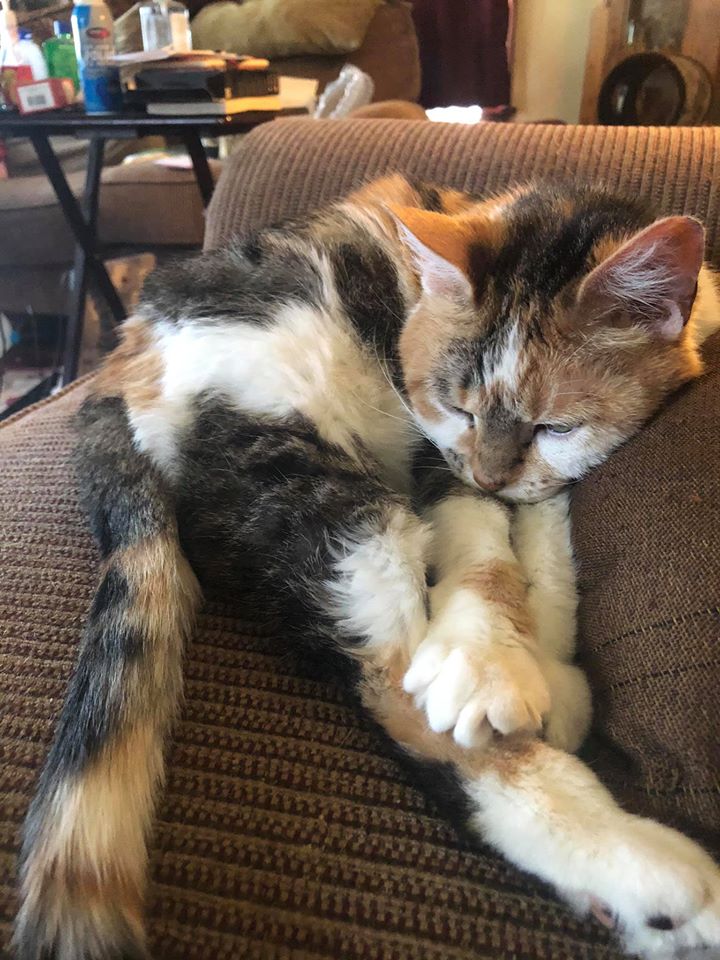
| Girlie-Girl working hard on a Sunday. |
Richard is making more coffee while I type this. The cats are lounging in various areas of the house. Eric Satie’s Gnossiene No. 2 is playing on the stereo. It’s chilly outside, but it will warm up by the time I’m ready to plant new plants.
There’s a new, beat-up spider plant in the window. I’m going to try to give it a good life, too. I mean it’s really beat up to the point where I think I need to remove most of the biggest leaves. But it will survive and so will we.
Daydreaming a Summer Break
Sorry to keep you all waiting, but I had to finish grading final exams for my last class. I’m officially done with my semester, which if you read yesterday’s post, doesn’t feel like an ending at all. I’m wondering if going tent camping in my backyard would feel like a vacation. At my age, it would probably feel like torture.
Honestly, if I could afford a travel trailer, I’d park it out at the nearby park for the summer just to feel like I’d gotten away from people. I like that idea — it would make a perfect writing retreat. Home away from home, and even wifi (not excellent wifi, but passable).
A cabin out in the woods would be nice. If it had wifi. I need to have my internet to monitor students and the like.
I’m just not ready to break the shelter-in-place and be in space with lots of people. I’m certainly not going to take the face mask off the few times I’m anywhere near people.
It just doesn’t feel like summer without my little writing retreat.
The Seasonless Year under COVID-19
I can’t tell what season it is.
In academia, we have a defined year with three seasons. It starts in fall with the first day of classes, and fall semester ends with Christmas. In January, the spring semester rolls around, and it’s of slightly different character than fall semester, lacking the tinsel and greens of December and adding the bacchanalia of Spring Break. The school year ends at the beginning of May, and even though I supervise internships and take an online course for my Disaster Mental Health certification, the change in routines — no faculty meetings, flexible schedule, time to take a vacation — marks that a season has passed. Until the end of summer, when we start preparing our classes for the school year.
I have no such thing this year.
We started online classes in March, which made the school year feel like an endless prep period, typing on our computers and missing the face-to-face interaction. I’m answering emails from students at 9 PM and at 5 AM, so I feel like I’m always working. We’re going from that to summer — but the freedom of travel has evaporated with COVID-19’s sequestering. So I’ll spend the summer working with my interns online using Zoom, and the flexibility of my time will not matter. Days are melting into a sameness, and that sameness is work without any defined boundaries.
I admit that I’m getting a decent amount of writing done because I have to do something with the time I’m not working on student stuff. And I’m grateful that I can shelter in place, as my age and weight makes me at risk for a more severe infection. But I find my rejoicing at summer terribly muted, because there is no summer. I wonder when there will be a summer again.
A reading that seems to corroborate my current feelings:
https://theconversation.com/will-covid-19-be-the-death-of-summer-vacation-135776
An interview with … me!
Here is an interview with me that a fellow writer, C.A. Campbell, posted on her blog today.
It’s right here!
Reattempt at first chapter of Apocalypse
This is a potential first chapter to Apocalypse to set up a feel for the characters and the setting — the “before”. One of the big problems is that I’m not a big description writer — I try to do those things as concisely as possible and I’m not sure they’re enough. Sigh.
******
At Barn Swallows Dance, the sky was still deep indigo and the air slightly damp when life began to stir. The early risers made coffee in their homes’ small kitchens; the late risers slept blissfully unaware of the small commotions of the dawn.
Micah Inhofer, as farm manager, showed up to the farm half an hour before his staff, checking his phone in his makeshift “office” just inside the sheep barn, surrounded by friendly bleats from the Welsh Mountain flock. He ran a long hand through a shock of black hair and consulted his notebook. The cows would be milked, and the milk pasteurized for the collective to drink and make yogurt from. The eggs would have to be gathered, all the animals fed, the produce picked.
In the commercial kitchen that served the whole sixty-odd members of Barn Swallows’ Dance, Mary Rogers, dark and slender in white chef’s gear, poured beaten eggs into the line pans of old bread drizzled with cinnamon syrup to make french toast casserole.
Nearby, Shelby with her blue spiked hair cut up a large bowl of strawberries and added sugar to them. Early breakfast was more than just breakfast; it was the ritual that not only started the day, but cemented the residents’ sense of belongingness.
“How are the raspberries doing? Have the birds gotten to them yet?”
“They’re doing fine, and we should have some in a couple weeks. They’re in the Garden. They’re protected from the birds there.”
Mary nodded. The Garden took care of its residents.
Outside, Jeanne Beaumont-Young, stocky and grey-haired, pulled coffee out of the solar roaster, taking a whiff of its richness, and brought the bowl inside to be ground and drunk. The early morning was like church to her, and coffee was its sacrament, which meant she was its priest. She smiled at her metaphor and put it away, feeling more comfortable with the science of roasting coffee beans.
Her husband, Josh, meditated in the Garden as he did every morning, a slight young man in the orchard entwined with vines and surrounded by herbs and berry brambles. A practitioner of Shinto, he focused on the spirits of the garden that Jeanne had designed and the collective had planted. The spirits, he believed, tended the two acres of orchard and food plants from the moment it had begun to grow. Now it was the Garden, and one could hear the capital G in the way people spoke of it.
He heard a rustling of leaves and smiled, knowing he was welcome in this clearing in the orchard, which he considered the heart of the collective.
Gideon Stein strode back from the shower house he had built next to the small collection of tents that housed summer residents, feeling the chill against his bare torso and legs and a twinge in his back he attributed to middle age. He entered his own ger, a white conical tent with blue markings he had painted himself. He changed out of his shorts into jeans and t-shirt, then braided his long brown hair into a plait that hung down his back. He reminded himself that he needed to look at the latch to the pasture the sheep and goats shared at the moment, because the goats had managed to almost break the latch in their attempts to break out of pasture. He couldn’t help but admire the goats’ chutzpah.
He thought about his former life as an architect and his most renowned work, the Frazier Dream Bridge in Vancouver. He couldn’t live that high life anymore, because the costs of stress were frenetic energy alternating with crippling, deadly depression.
He had come to Barn Swallows’ Dance to recuperate, perhaps even to hide from the press that had named him a dangerous visionary.
Sometimes he wondered what he was called to do.
In a house at the other edge of the collective, Rita Yilmaz looked down in fond exasperation at her oldest, Ty, who sprawled across every inch of his bed, still asleep. The twins, silent as always, stood behind her; she knew they smirked at their unruly brother. Her children’s hair, flaming red unlike her own black curls, reminded her of her long-gone love and the message he had just sent her, to meet him that night behind the Commons. Perhaps there would be another child. Perhaps he would leave again in the night. Zoi was a force of nature, and an enigma, she thought.
“Ty!” she shouted. She prodded Ty’s shoulder and Ty, tall and slender like a sapling, grimaced and opened his eyes.
Ilsa Morganstern, general director of Barn Swallows’ Dance, downed her morning medications as she sat on her bed. There seemed to be more medications every year; by her early eighties, that meant a lot of pills to swallow.
She thought about her morning announcements to the collective for early breakfast. Nothing too pressing: a pothole had opened on the north exit, there would be make-your-own sundae for dessert that night, the women’s rugby team from the university would arrive the next day for their summer session; Gideon and Larry had pitched their tents in the tent camp.
No crises, Ilsa noted with satisfaction. No fires, no tornadoes, no crop failures thus far.
She knocked on wood.
Laurel Smith hadn’t slept. Like every morning, she put on her coveralls and checked the pockets to make sure she had the keys to her small house in the collective. She would milk the cows before early breakfast; after breakfast she would muck out barns. She regarded her deceptively petite build; she could shovel manure faster than the men in the barns; her strength had always been her most employable trait.
She could remember nothing of her other skills and education before the attack that left her without memories, without a past, without an identity. She would skip early breakfast, to avoid revealing these secrets about her life.
Elsewhere, in a place where daylight and night had no meaning, Adam sat in a vast expanse of a room barely lit by a glow that emanated from Adam himself. The walls were uneven banks of tiny black crystal, the floor a flawless sheet of milky white that seemed almost a molten blue in the shadows.
Adam himself looked human, if genetically blessed; his long black hair flowed like water across his shoulders, and his fine-boned Asian features possessed uncommon beauty. He wore black jeans and a t-shirt, clothes that mimicked the humanity that he watched over, and perhaps envied.
This was InterSpace, the place where Archetypes lived, maybe barely existed, in the space between atoms, as beings of energy who could shape their space with their will. Adam’s world, at that moment, consisted of the walls and floor and the comfortable leather chair he recreated from a memory of Earthside, out of the stuff of InterSpace.
In his hands, Adam held a lock of hair braided into a circlet — golden blonde, the pure tones of an Archetype like himself. A contrast to his own jet-black hair. A memory of love, however brief; something that Archetypes were not supposed to experience.
A memory from six thousand years before in a life left waiting for something.
Waiting for the legend to come full circle, when he could reveal himself again.
Luke Dunstan, an Archetype, rued giving in to the Triumvirate.
He sat down heavily, appearing as a man of average human height, with flaxen-blond hair and a weathered face. He stared at the perpetually burning bonfire outside the vast cave his consort Su had constructed from the matter of InterSpace. The limitless space held the appearance of stars in a night sky. However, no artifice would make the formlessness of InterSpace more like the warmth of Earthside.
The fear that usually lay quiescent in him burned cold like the bonfire — a fear for humanity, the humanity that the Archetypes had been created to protect from their harsh tribal history. He buried his head in his hands, feeling every minute of his six thousand years of existence.
Luke remembered the discussion, thousands of years before, with the three fellow Archetypes who called themselves the Triumvirate. The four sat in a room with a long marble table traced with gold, conjured up in InterSpace from a memory of Earth. The walls stood as black crystalline arrays and the floor as milk-white glass, the natural state of InterSpace.
“You tricked us. We meant to steer humans’ destiny,” the pre-Etruscan, with his waves of chestnut hair and pale skin, stated flatly, pounding a fist on the gilded table. Light emanated from his fist, from all the men, leaving the rest of the room in shadow.
“Humans are meant to lead, not be steered,” Luke, new to his life as an Archetype, countered, heedless of the chasm opening up before him.
“So you believe,” the Ubaidian debated, materializing a goblet in his hand. He drank of it deeply. “I disagree. They quarrel with each other and strike each other down. They do not learn. They need to be led, and you have destroyed our chance to lead them.”
“They should be allowed to find their own destiny,” Luke argued. “You cannot do it for them.”
“I think you will find that we can and we will ultimately guide humans’ destiny, and that the Council of the Oldest, whoever they are, will not interfere.” The pre-Etruscan smiled. “It’s only a matter of time.” He leaned forward. “You may play games, but we do not. There are three of us, and only one of you. Three against one — we could end you … “
Luke capitulated out of weakness, the weakness of a newly born, unworldly Archetype. He made the bargain to save what he treasured most, without seeing the loophole that put all of humanity in danger.
Luke remembered, and spent his long life ever vigilant for signs the Triumvirate would gain control.
And nobody, not those who slept in nor those who worked before dawn, nor those who lived in a world without sunrise, knew how rapidly their lives would change in the subsequent days.
Feeling discouraged about my writing
I’m feeling a bit discouraged about my writing this morning.
All I’ve been doing is editing, and editing more than one work’s beginning. This gives me a pretty myopic view in many ways, as I’m focused on the first moments of the work, trying to give my readers a setting to react to.
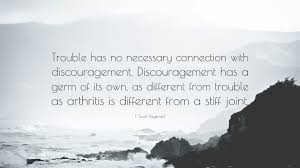
I’m feeling very discouraged. I’ve been doing this for, what, seven years? And I’m still fixing mistakes. And I don’t know, through all this, if I’m getting any better, if my work is getting any better. I don’t know if it’s worth it, because I don’t know if I’ll ever get published. Or, if I self-publish, if I’m good enough to get published. I don’t want to be published until my stuff is good, really good, and I don’t know if I’ve got what it takes to get there.
I need a breakthrough, not a breakdown. And I don’t know if I can find my way to it.
Monday Morning
Photo by Nathan Lemon on Unsplash
Monday morning, which seems a lot like every other day in this pandemic — I have two cats at my workstation (the corner of the loveseat in the living room), and I’m drinking coffee.
Today is work (the ordinary type where I have to grade final exams for classes) and work (the writing type where I look at what I’ve written and what it needs). I’ve done fixes on Whose Hearts are Mountains and Prodigies, and it’s time to apply it to Apocalypse.
You see, now I know what my problem is. I started right into the action and didn’t give the story its moments to develop characters and scene. I hope I’m doing it right this time.
First Chapter from Prodigies (rewritten)
After classes for the day, I stepped out of the music building at Lakeview Academy, a private residential school for the arts. I walked quickly down the paths, through manicured lawns, past buildings dedicated to teaching written, visual, and performing arts. I walked under trees that would show their fall colors in a few weeks, past the banks of mums that gave the campus an air of nostalgia. I could walk this path with my eyes shut, as I had walked it for seven years, ever since I was a junior high student nervously clutching my viola. Instead of the scrawny, frizzy-haired biracial child I had arrived as, I had grown tall and slender, and my hair tamed and pulled behind me in glossy tight curls. I still saw both my mother and father in my looks — brown skin, deep brown eyes, a thin and fine-boned nose.
My mother and father, however, had died when I was fifteen, in a plane crash attributed to unknown causes. I found out when Dr. Estelle DeWinter, my mentor, found me in art history class and walked me back to the office to break the bad news to me. Although I felt like I would crumble into nothing, I cried very little through it all; I sat through bewildering appointments with my parents’ lawyers and suffered two years of a guardian who threatened to pull me out of Lakeview. Only the surprising effort of Dr. DeWinter kept me in Lakeview until I became an emancipated minor at 17.
I think I missed what could have been with my parents more than what we actually had; I spent my life in residential schools from age seven, to develop a musical talent my parents recognized as extraordinary. If I inherited anything from my parents, it was my ambition, and from my grandmama I received humility to temper it. What I claim as my own is discipline and my own inexplicable talent, a freak accident of birth.
I walked quickly toward my weekly meeting with Dr. DeWinter. I was lucky to have a mentor at Lakeview that I could identify with as one of the few black students at the arts academy. I entered the Administration Building, an austere Neoclassical Revival building from the beginning days of the academy. Inside, dark wood paneling and white walls lent a gracious, if institutional air. I went to the front office where Mary Kravitz, the secretary, stood guard behind a low partition. “I’m here for Dr. DeWinter, if she’s ready for me.”
“I’ll ring her.” I was punctual, as Dr. DeWinter had taught me. This, she said, was the most basic courtesy of a professional, no matter what accounts of divas in the news would have one believe.
I didn’t look forward to the meeting, because I knew that I would disappoint Dr. DeWinter again. I had not applied for any colleges yet, and it was my senior year of high school. I couldn’t explain to her or to myself why I dragged my feet except that I didn’t want to leave the familiarity of Lakeview. I didn’t know what I wanted to do with myself — anything but music was out of the question, but I didn’t know if I wanted to go into music performance, which was what was expected of me, or fall back on music education. Therefore, I hung back, feeling guilty in my school uniform.
“You can go back, Grace,” Mrs. Kravitz said behind her counter. She hung up the phone and stared back at her computer screen.
I turned the corner and walked down a corridor of shut office doors with their shaded glass windows showing light inside. I reached Dr. DeWinter’s office, with its hand-lettered name on the door, and knocked.
“Come in, Grace,” she announced in her voice, warm and dry like a plucked viola string. I tried to read her mood from her voice and failed. I opened the door and slipped through it, into the familiar office with its jungle of plants in the window. I sat on the wooden chair that looked like it had seen generations of students before me — even Dr. DeWinter herself — and had survived them all.
“Grace,” she said, turning to me from her wooden swivel chair. “How have you been?”
I looked at her, her straightened grey hair swept back into a bun, her oval steel-framed glasses accentuating her nearly black eyes. She was my mentor, she was the mother I had never really had in a lifetime of residential music schools, and we walked through our ritual of the past seven years. “I’m fine, Dr. DeWinter. I haven’t gotten that cold that’s going around yet.”
“Good. How are your lessons going?”
That I could smile about. “I’m currently butting heads against Paganini’s 24 Caprices. What kind of demented genius could write those?”
“Paganini did. And played them, too. What does the music say to you?”
“Impish. I mean, technically very challenging. But the feel of it is that of a little imp, darling and devilish, taunting other violinists.”
“Do you still prefer your viola to violin?” Dr. DeWinter smiled.
“I know I have to give equal time to both instruments, because there’s so little written expressly for viola, and you keep telling me I have a career ahead of me. But my viola — “ Here, I sighed. “My viola is almost like a part of me. It’s like my voice.”
“And of course you’re still getting voice lessons on the side.”
“Yes, but I think my voice will always be for me, not for the public. I have a good voice, I know, with good musicality — but I’m not Norah Jones, and that’s who I’d want to be.”
“I would agree with you there,” Dr. DeWinter said — and paused. Here came the question I didn’t want to answer. “Speaking of careers — “
I would never get away with anything with Dr. DeWinter. “I know, I know. College applications. They’re due November 1st.” I felt my stomach sink as I realized I had disappointed my mentor. “I’ve been looking on the internet, but —”
“But?” asked Dr. DeWinter, eyes boring into mine.
“I don’t know what I want. I know you’re expecting me to go into music performance, because you believe I have great potential — and I know I do. I could probably get myself into some program like Berklee or USC, but I don’t know …” Here I dithered, revealing my indecision and my discomfort at anticipating the future. I had no idea how to be an adult — not even how to budget my money, as I spent money for nothing but tuition, room and board, and the occasional concert dress. I had few clothes that were not uniforms; little contact with the outside world other than field trips to operas and plays and concerts and art exhibits, not to mention performances. I suspected real life was more complicated than that.
“I think we’ve sheltered you too much here,” Dr. DeWinter said after a long pause. “You’re almost eighteen, and you’ve been in residential schools since you were seven.” It was true; my parents had placed me in an enriched boarding school called Renaissance School for the Arts when it was clear that I was a music prodigy, and from there straight to Lakeview.
I felt a flutter of uncertainty in my stomach as I tried to explain to Dr. DeWinter: “I want to stay here another year. Explore my options. Learn — “ I hated to admit the next part — “learn how to live on my own.”
“Most people learn how to live on their own by living on their own,” she said wryly. “I want you to try to fill out a few of those applications, at least one, within the next week. You can ask Ms. Hollis in the school counselor’s office to help you with those, you know.”
“I know,” I sighed. “I just —”
“You really can ask for help if you need it. Being on your own doesn’t mean going it alone. Take it one step at a time.”
If only I knew what that first step was.
Later, after dinner and a string quartet rehearsal, I was back in my room. I had a room to myself, which had been part of the original arrangements for me at Lakeview. I had few belongings, as I needed few. The posters on my walls, something which would surprise most people, were superhero movie posters — Captain America, Wonder Woman, Black Panther. On a shelf were the glass menorah my father’s mother had given me, a tiara I had purchased as a joke, a stuffed-toy Siamese cat, as close to a real cat as I’d ever been able to keep, and trophies I had earned in competitions. The items that declared me a princess, a reputation I had built myself in self-defense from the microaggressions, as Dr. DeWinter called the sidelong stares and condescending conversations I often faced in the classical music world.
I lay on my bed, surfing Facebook on my phone. Various chatters from my classmates, people I knew but didn’t really know. It was as if we lived in parallel universes. In their universes they went home for Christmas, they paired up in the halls and broke up just as quickly, and some of them risked expulsion by sneaking out to the ropes course or behind the gymnasium to have sex. I had not gone there; first, for a protective instinct I’ve always had, and second, because I was saving myself. Not for marriage, but for that career I knew I should have.
Suddenly tears started to flow, blurring my screen. There was nobody I could talk to about this — Dr. DeWinter didn’t relate to me on this level and I didn’t want to talk to the school psychologist about it out of that same sense of self-preservation in my core. So I thought about the Paganini piece and felt ready to tackle it again.