
A glimpse out the window
at blasted apple blossoms
and snowfall blotting out
the first green of spring
and the doors barred
to keep contagion out —
the world could end
with an ellipse
at the end of a message
as
all
traffic
ceases.
Tag: amwriting
The beginning of a novel

I got an agent rejection for Prodigies the other day (that’s been out for a while; I guess it got backlogged) with a difference: The agent explained what she found wrong with the book.
She loved the setting and the beginning descriptions, but she couldn’t get into the characters.
I looked at the novel and realized the reason she couldn’t get into the characters was that I never gave her a chance to.
The beginning of a book, according to Save the Cat methodology, should accomplish a few things: The character in her original setting before the action begins. A theme to the book. The debate where she goes on her path — but perhaps it’s the wrong path.
My book starts with the action — no chance of getting to understand Grace, no way to see Grace in her original setting, In other words, no way to identify with Grace.
My beta reader didn’t tell me about this, which is worrisome. On the other hand, I am learning enough about the structure of novels that I can fix this (I’m fixing this right now) and hopefully I will be able to incorporate this into new novels.
A Sunday Morning in the Age of COVID
(There was to be a picture here, but for some reason I can’t get my pictures to mail to me.)
Sunday mornings in my house:
This much hasn’t changed: Classical music in the background — today it’s an album of violin concertos.
Coffee — currently we’re drinking a store-bought coffee; usually we drink beans that Richard roasts himself.
Cats — there are four, although one seldom comes upstairs. One of them, Girlie (the patched tabby with the attitude) is sitting next to me. She helps me get my work done.
Now, in the time of COVID: Breakfast is usually cereal, but in the quarantine I’ve discovered that I like playing with sourdough starter, and so sourdough bread as french toast is the featured meal of the day. I will make more sourdough bread later. I’ve named my starters: Marcy is a Polish whole wheat starter, Horatio is a home-captured wild yeast, and MarcyxHenrietta is an accidental batch that got spiked by the yeast water known as Henrietta.
My computer — I work on my writing on Sundays. Normally, I would be on my way to the cafe to write for a while. Now I write in a corner of the living room, burgundy and gold. I hate to be far from the action, which is part of why I used to write at the coffee shop. I miss the coffee shop.
The view through the window — all the snow from the freakish snowstorm has melted, and the sky is a blue-grey. I need to get out, even if it’s just a trip in the car to the local park.
Today, for some reason, feels like Easter (which it is for the Orthodox faiths) and I have hope that we will rise from this pandemic a more thoughtful people.
Lost Rituals
It’s Saturday, and most of the snow has melted. The apple blossoms, however, are not coming back, so there will be no apples this year. It’s symbolic, I think, for all the rituals of American life which will be put on hold this year because of the coronavirus — graduation ceremonies, weddings, birthday parties. Burials go on, but funerals do not.

I worry about not having these rituals, especially the rituals of transition like college and high school graduations. Without these types of rituals, we feel rudderless, out of sorts. We need a recognition of what we’ve accomplished and where we’re going.
At the college, our students won’t go through graduation until fall, if we are even out of shelter-in-place by then. Our retiring faculty and staff will get no parties.
I suspect that our changed situation will be temporary, but that temporary could be as long as a year and a half. A cohort of people will not have their rituals to cling to, will feel rudderless, bereft. And although it is a small pain compared to the real possibilities of losing a family member, I will still mourn it with you.
A poem for COVID-19 and ten inches of snow
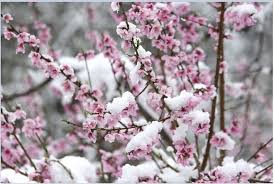
I don’t write poems as much as I used to, mostly because I’ve gotten to an impasse with poetry. I know from experience submitting poems that my poems don’t quite have what it means to be great, and I don’t seem to be able to figure out what they are missing. I also think they’re too short compared to modern poetry. But here’s a depressing poem for today:
A glimpse out the window
at blasted apple blossoms
and snowfall blotting out
the first green of spring
and the doors barred
to keep contagion out —
the world could end
with an ellipse
at the end of a message
as
all
traffic
ceases.
Collecting Kindness
Today, one of my favorite Internet Cats, Maya, is #collectingkindness. Toward this end, she is asking people (I love the imagery of this) for pictures, poems, essays, etc about what they consider kindness to be.
To me, kindness is giving without calculating a return, without regarding how the other compares to you relative to color, race, ability, socioeconomic status, sexual orientation, or religion. Just giving, whether that be a smile, a favor, a conversation, recognition, love. No strings attached.

My Problem Child

My first novel has always been my problem child. I wrote Gaia’s Hands based on a dream/fantasy I had of a May-December relationship, only the female was the older one. Because I didn’t want to write a romance novel (plus I couldn’t see an audience for this one), I developed a quirky fantasy line involving the most high-powered version of a green thumb you can imagine. There’s always seemed to be something missing, or something awkward about it, and I’ve tried many ways (usually cutting things) to see if that helps. It didn’t. There was still something lacking.
The other day, a book coach with a romance background looked at it, and she said there were two faults — 1) not enough emotion; 2) It should actually be a romance. to be honest (and I apologize to the romance writers who read this) I have read a lot of romances I don’t identify with, with tropes that annoy my feminist sensibilities: the heroine who doesn’t think she’s attractive but she’s drop-dead gorgeous, the male who’s the strong silent type. I don’t want to write those tropes, and I’m afraid I’ll be an unreadable romance writer if I write the truth about Josh and Jeanne — she’s twenty years older and a Rubenesque professor; he’s built like a lightweight wrestler and the most macho thing he does is practice aikido (and has achieved the equivalent of first level black belt). He writes poetry and stories; she designs permaculture gardens. He is intense and hungry; she’s a bit preoccupied with his research. They both think what they want is impossible.
The trouble is, I have to believe in their romance to write it, and right now I’m like Jeanne, who thinks it’s a biological impossibility that a twenty-year-old guy would fall in love with a 45-year-old woman. I know the other way around is possible sort of — I have gotten crushes on 20-somethings with small builds. But, again, like Jeanne, I don’t know how that could be reciprocated. If I want this book, I have to find a way to believe in that.
A Time to Write
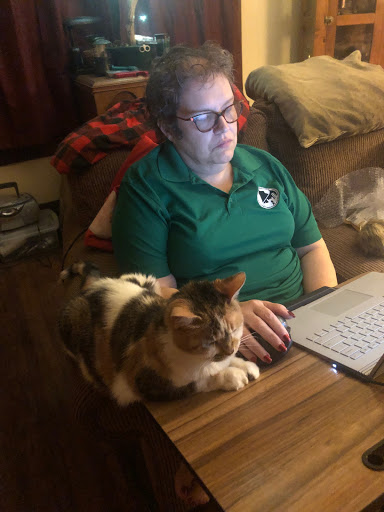 |
| Me during the Pandemic |
During the pandemic, I teach at home, and I have plenty of time when I have no emails to answer, to projects to grade, and no meetings to attend. And no distractions from the outside.
So I write.
I just got done doing another edit of Whose Hearts are Mountains, which had suffered in the querying process. I mainly edited for plotting, using the Save the Cat protocol. I now have that out to my friend Ken (Hi, Ken!) who will be as brutal on it as any developmental editor. Then I’ll tweak and go to my final 30 queries.
Now, I’m working on Gaia’s Hands again, the problem child of my lifetime. I’ve decided, through consult with a writing coach and reading over Save the Cat Writes a Novel, that I’ve been going about it all wrong. First of all, the story is an unusual romance in addition to being a fantasy, which makes me grit my teeth a bit because it’s never going to be marketable as a fantasy. Second, its timing is all off. What this basically means is that I am going to have to rewrite the whole thing. I know I could put it in a drawer and forget it, but it’s foundational to another series. And now that I’m beginning to understand the story, it is compelling.
When I mean “unusual romance”, I mean this: Josh Young has a thing for Dr. Jeanne Beaumont, even though he’s twenty-five years too young and she’s out of his league, what with that Ph.D. and that plant patent of hers. Jeanne Beaumont wishes she were younger and prettier, because she’s become intrigued by the graceful Josh Young.
There’s more to the story, because I have to juggle in the fantasy element. But you get the idea.
I like the fact that I’ve decided to try harder, even if I never get published. I think at this point that learning is more important than getting published.
I still have my fingers crossed for publication.
Lenten Meditation Day 46: Rejoice

Today is Easter, the day in which (in the Christian calendar Jesus Christ rose from the dead. This year, it’s also Passover, when in the Jewish calendar the Jews triumphed over the Pharaoh who subjugated them. If we go back into myriad European pagan beliefs, Eostre is when the year is released from the captivity of winter.
And we rejoice.
There seems to be a common theme here, that of being released from an adversity. I think that’s important. So many good stories begin with overcoming barriers, and there’s a reason. We don’t want to think that we’re going to be shackled forever, so we fight against the captors. In all three of these, divine assistance yielded the victory.
I personally think God works differently than in the stories. I don’t think God sends plagues to our enemies or picks winners in football games. That is not to say that God doesn’t intercede. I think God sustains us until we achieve our victory. I think God gives us the strength to persevere, comforts us in our difficult times, clears our minds so that we can find victory.
But in the end we find victory — not always the victory we wanted, but we find the victory anyhow.
I leave you a poem by ee cummings that I think captures the essence of Easter:
“i thank You God for most this amazingday: for the leaping greenly spirits of treesand a blue true dream of sky; and for everythingwhich is natural which is infinite which is yes(i who have died am alive again today,and this is the sun’s birthday; this is the birthday of life and of love and wings: and of the gaygreat happening illimitably earth)how should tasting touching hearing seeingbreathing any—lifted from the noof all nothing—human merely beingdoubt unimaginably You?(now the ears of my ears awake andnow the eyes of my eyes are opened)”
Day 45 Lenten Meditation: Anticipation
Sometimes when we anticipate, we wait for good things to happen. Sometimes it’s a matter of what we’ve earned through hard work, what we will be gifted with through tradition, or what we’ve been promised. We know something good is coming, although we may not know exactly what. This kind of anticipation feels like an invitation to a sumptuous feast.
Sometimes when we anticipate, we prepare for bad things to happen. We make emergency plans and emergency funds, we make contingency plans. We buy life insurance and make wills. By anticipating, we can protect ourselves and our families.
Anticipation requires us to look into the future, for good or bad.
 Words Like Me