The human race owes its survival to resilience.
“Bloom where you are planted”. All fine and good, but currently I’m planted in my living room, wearing sweats, in day N (where N = I’ve lost count) of shelter in place during COVID-19.
Yet I’m still finding ways to bloom. I still write this blog daily. I work on writing in-between my classes. I experiment with sourdough starter. I name my sourdough starters. I wear lipstick with my sweats. I have long literary discussions with my cat Girlie-Girl, who remains unimpressed.
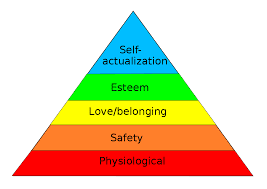
It’s easy for me to bloom, however. When I look at Maslow’s Hierarchy of Needs:
I’m relatively high on the pyramid. My most basic physiological needs are met (food, clothing, shelter); I am safe in my house; I have a loving relationship and feel I belong in my community; I derive esteem from being a professor and writer; and I have enough of these items to feel I can give back to the community (self-actualization). I have plenty of energy with which to bloom, in other words.
Expecting someone to “bloom” when they’re hungry is cruel, as is expecting someone who doesn’t feel safe to express themselves freely. Even I, when I’m in a state of depression or mania, don’t bloom. Sometimes we just manage, and that’s good enough.
We should strive to bloom. We should not make it an expectation, however, because so many people struggle in their lives. Do not judge them if they don’t bloom.
I don’t cry often. I don’t know whether it’s because I’m a basically strong person, or because my bipolar medications keep me calm. But I feel the tears lurk, looking at the world’s situation under COVID-19.
Highly contagious with about a 2% death rate. That seems small — 98% will survive it — until you look at the number of people in the world. As of this morning, there have been 9100 deaths in the US, half in New York City. And there’s no end in sight despite sheltering in place.
I’m feeling discouraged, and I normally have faith in our ability to surmount nearly everything. I feel tears come to my eyes as I read the news. I don’t read the news much, because of this feeling of despair, the reality of the numbers which still conceal the human cost.
I can’t quite cry. If I could, I think the sadness would pass for a while, because crying is healing. Crying is like a good thunderstorm, giving us release from the sadness. A good loud cry is what I need right now. I’m not there yet.
The first dictionary definition of mercy is “showing compassion or forgiveness toward someone we have the power to punish”. This makes me wonder about the Mercy Hospital in the college town where I used to live, as punishment doesn’t seem to be the purview of hospitals as far as I know.
But that’s okay, because the third definition, and the one most used today is “something performed out of a desire to relieve suffering; motivated by compassion.” I want to focus on the first definition, however, to make the point that mercy is not simple compassion or simple forgiveness.
People talk about a merciful God, and that makes sense if their notion of God is one who forgives all. But when they turn around and gloatingly remark about how the “sinners” (i.e. people not like them) will spend eternity in Hell, they have declared their God without mercy.
If God is a merciful God, She must weigh the good in everyone as the bad falls away at the end of our days. If God is not a merciful God, I do not want anything to do with him.
I looked at today’s topic with frustration. How does one put words to awe without sounding pedantic? Yet we writers do this all the time:
I’m not going to accept the common wisdom of this concept, which says that you should readily and automatically forgive those who have wronged you. That advice is simplistic and does hot honor the situation of those who have been wronged.
Forgiving means to stop being angry for some harm or fault. For everyday mistakes and small infractions, forgiveness is merited because the need is to move on with life.
However, for victims of aggression, anger is a powerful emotion that can give power to the powerless. It can motivate toward justice for the wronged. Automatic forgiveness relinquishes power to the wrongdoer. Anger, and thus lack of forgiveness, becomes healing.
For the victim of great injustice, of abuse, of violence, they need only forgive when they feel their lives are held back by their anger, when they no longer see themselves as victims but as survivors. They should wait until the point where they feel they have personal power without the anger. Until then, they need anger’s power.
I’m not sure anyone has the right to tell someone else when to forgive. Forgiveness is very personal, and our entreaties to “forgive and forget” often come out of our fear of anger and our desire to smooth over conflict.
Forgiveness is powerful, but only if the forgiver finds that forgiveness lightens, rather than diminishes, the soul.
At the risk of sounding cliche, I don’t think I can start this better than using the Serenity Prayer:
Lord, help me to accept the things I cannot change,
the courage to change the things I can,
and the wisdom to know the difference.
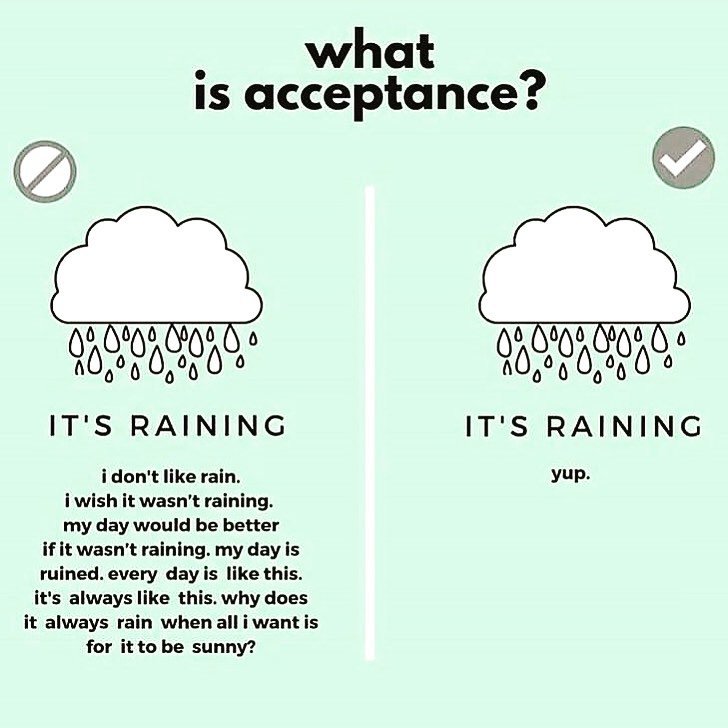
In the time of pandemic, we have a lot we cannot change. We cannot change the fact that the virus is out there or how virulent it is. We can’t change that we’ve been put under a shelter-in-place ordinance. We can’t change the shortages in the stores. All we can do is accept.
But we can change some things. We can plan our shopping to minimize our exposure to others. We can keep our hands clean and wear masks to keep from getting the contagion. We can take care of ourselves physically and mentally. We can spread love through social media.
How do we know the difference? After all, there are people out there breaking social distancing rules, some of whom now have COVID-19 and are regretting their actions. Their bravado didn’t change the contagion. Some people are raging at the situation, which is the opposite of acceptance. Knowing the difference requires self-examination and the question “How?” How can my actions change the situation? How can my influence create a new path? If there’s nothing you can do, then it’s time to accept.
I consider myself a mystic, but I don’t know whether I believe in the God I’ve been been presented with.
I could use a good spring rain right now. A real gullywasher, where there’s no question of going out in it unless one wants to get drenched. And then I would go out into that rain and feel it drench me to my skin.
There is something purifying about standing in a torrential shower. From the skin to the soul, rain washes away all the dirt of the day. It chills my skin, reminding me that I am alive.
What can I say that hasn’t already been said about love?