
I manifest resilience in my life, and I find it’s one of my most enduring characteristics.
There are many ways in which my life has been privileged — I was born into a white middle class family, I have been gifted with a good deal of analytical and verbal intelligence — but I have had to overcome a childhood of bullying, unstable parenting, sexual abuse, and the beginnings of what was later diagnosed as Bipolar 2. I have made it to 55 years old with a reasonably well-balanced life.
As I wrote that, I realized that I (as I suspect many do) began to conflate resilience with accomplishment and judging my resilience by the degree of my accomplishment. This transmogrifies an ordinary, developable skill into an attribute of the rarefied few. This is the script of what I referred to yesterday as inspiration porn: ” … overcame a difficult childhood/debilitating disease/life-shattering accident to become a lawyer/doctor/marathon runner/fill in the blank with an accomplishment most of us reading the story couldn’t manage. If I look at what I’ve accomplished (a modest career at a small Masters I university where I’ve made few waves, six novels that I can’t get an agent for/published) I don’t feel very resilient. But if I look at what I’ve survived, and the current quality of my life, I feel very resilient indeed.
If we want people to be resilient, we have to believe that resilience is ordinary, is learnable, is measurable by one’s quality of life and not their level of achievement.
Tag: balance
Writing and the Balance
Yesterday I felt unbalanced.
It’s been a busy work week, just as it promises to be a busy semester. I have three research projects I’ll be working on, plus recreating a new class or two, plus the usual teaching and student work. I spent all of yesterday creating a new syllabus for a class, something that should have taken me a week or so.
(I promise you I’m not hypomanic, just busy.)
In addition, I got three rejections yesterday. That brings me up to 1/4 of my queries coming back as rejections in four days. At least they rejected me quickly.
After it all, I felt unbalanced, like I always do when there’s too much work and not enough pleasurable things in my life. I used to think what I needed was recognition — to get noticed, to get published, to get an award or something. In other words, to get what I would call a “cookie”.
Yesterday I realized that I don’t need cookies. I need, instead, to get rid of feeling bad.
In other words, I need to get back into balance. And I’m coming to realize that writing, in and of itself, helps me feel balanced. (So do good smells, reading, tub soaks, and surprising new discoveries).
So I will persevere and keep writing.
No, not ‘happily ever after’!
A question I asked the other day in my Positive Psychology class: If there was a machine you could hook up to that would give you a medication that would keep you happy all the time, would you?
Almost all my students answered no. When I asked why, they said things like “Would you know you were happy if you were never sad?” “Would you be able to detect a threat?” “Wouldn’t you get bored?” One student said, “I think what you’re describing is called ‘heroin’.”
All good points. The type of happiness we can seek on demand, the type of happiness the machine dispenses, is called “hedonic happiness”. It makes us happy in bursts, much like heroin sends the taker into short-term bliss. Hedonic happiness is short-term and can become addictive. Things like compulsive shopping and other addictions (including the aforementioned heroin) result from a perfect storm of complications in life, including the compulsion to self-medicate with happiness. Who wouldn’t be tempted if their life started to spiral out of control?
I have two characters in two different books, Allan Chang and Ichirou Shimizu, who both fight the lure of perpetual hedonic happiness. Is it a coincidence that both are Asian? That might be just because I think Asian men are underrepresented in literature and demoted as sidekicks or comic relief. It could also be because I think Asian men are cute, as evidenced bythis photo:
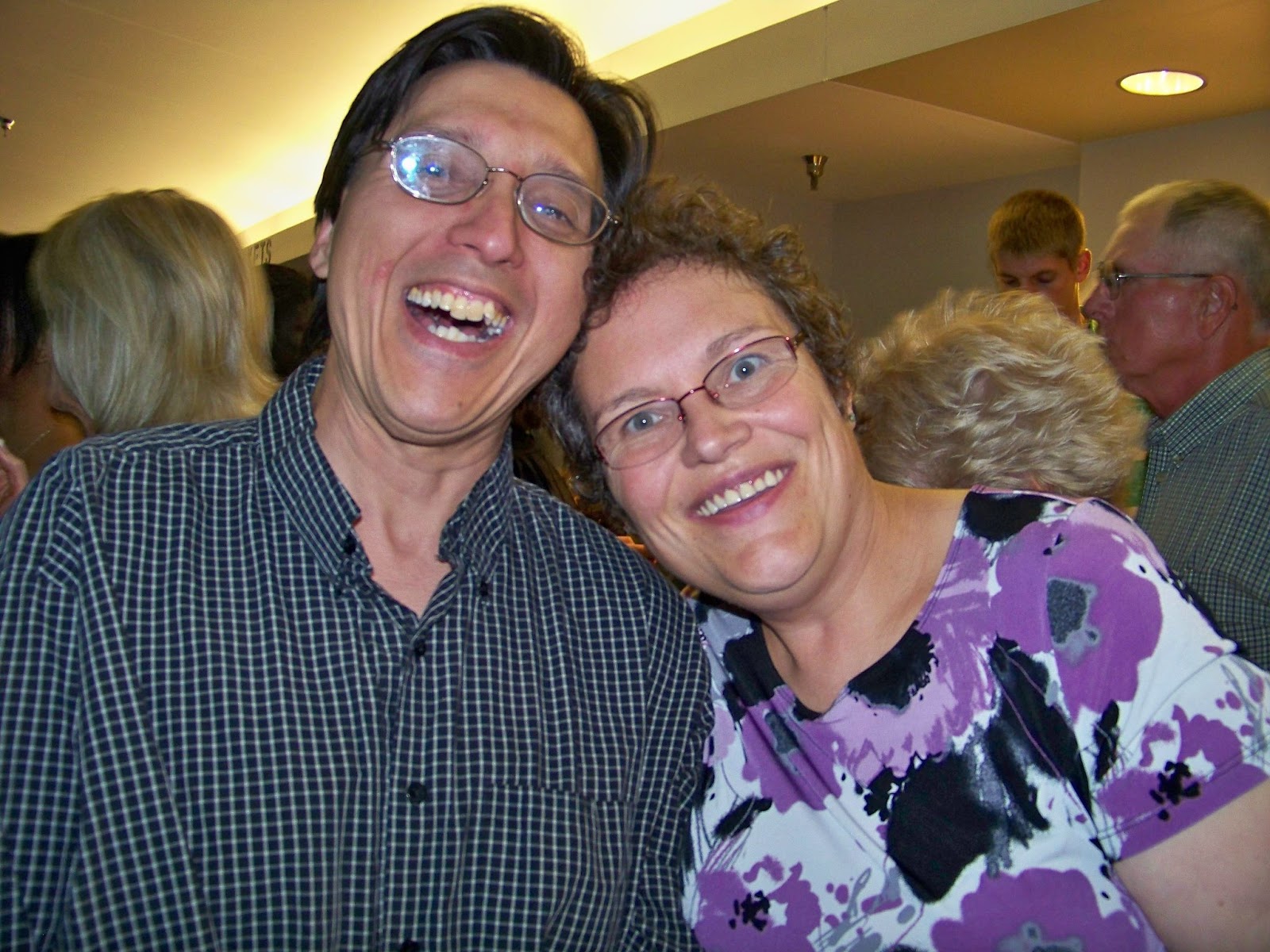 |
| This is my husband, Richard Leach-Steffens, and I. He’s your typical Asian-German mix, brought to you by living in the USA. |
It’s interesting, however, that Asian cultures emphasize balance and harmony, because the hedonic treadmill (represented by heroin for Allan and by a fantasy world for Ichirou) is counter to the values of an Asian society. Yet that harmony is broken for both — Ichirou by a hidden talent and the pressures of being young in contemporary Japan (see hikikomori), Allan by an abusive family situation. I set up the balance/imbalance dichotomy accidentally, but I love the results.
This is the kind of stuff I mean when I say I put the things I know into my books. I don’t want someone well-balanced with no difficulties to be the addict, because research shows that happy rats don’t do smack, but the stressed-out ones do. And people don’t escape if where they’re at is just fine. (I’m not talking about the later stages of addiction, when the behavior becomes the life — just why some people can take drugs and quit, and others can’t.)
By the way, I wouldn’t hook up to the happy machine either. Being at the same level of happiness all the time doesn’t make for good writing.
 Words Like Me