Day 43: Ally

Who are the people around you who want to help you evolve your most authentic self rather than mold you into their image of you?

Who are the people who offer comfort, wise counsel, and effective challenges when needed?

Who are the people who will help you transform a piece of the world into health? 

These are your allies. Find them, connect with them, love them — for they need allies too.

Life without writing

About querying time, I wonder what it would be like to quit writing and quit pursuing representation and publication. Querying is brutal — you prepare excerpts of your prized manuscripts to people who will go by their first impressions, and nobody will tell why they rejected you except “It’s not you, it’s me” or “I’m very picky about who I represent”. I would love some real feedback like: “Could you rewrite your query letter and tell me more about x”.

What would my life be like without writing? I think it would feel like having a lobotomy — I would know something important was missing, but have no idea what. It would be like waking up and finding out a loved one was gone — not dead, just gone. In other words, there would be a hole and I can’t imagine filling it up. No other hobbies I’ve had have been this fulfilling, and for my gardening to be close to this fulfilling I would need a working greenhouse with enough room to actually handle my plants. (We do not have the space or money for that.) My moulage (casualty simulation) might become more fulfilling if I could go professional with it, but the outfits that need moulage for training purposes can’t afford a professional.

As for giving up dreams of being published, that’s a little more complex. There are certain things built into my psyche for better or worse. I love to accomplish new things, and everything else in my life lately has been things I’ve done for the last N years, where N is probably around 30. I’ve hit a stagnation point in my job with 8 years until retirement (I’ve tried hard, coworkers, but I’m chronically burnt out and in need of a break). I need challenge, and I need recognition. I need people liking my work, and to do so they have to see it. Esteem and accomplishment are nothing to be afraid of.

What would it feel like to give up trying to get published? I’d be exactly where I am now, except that the challenge would be gone and I would feel like I had given up on an adventure to stay in my stagnation. I don’t know if I can find another opportunity to break the stagnation.

So I do the same thing I’ve been doing every four months for the past two years, wondering if I will ever make escape velocity.

If anyone has ideas of challenges I could try (I’ve already lost 70 lbs, I have some health problems that keep me from running, I don’t want to run for public office, and I have profound hand-eye coordination problems), let me know.

Tightrope walking

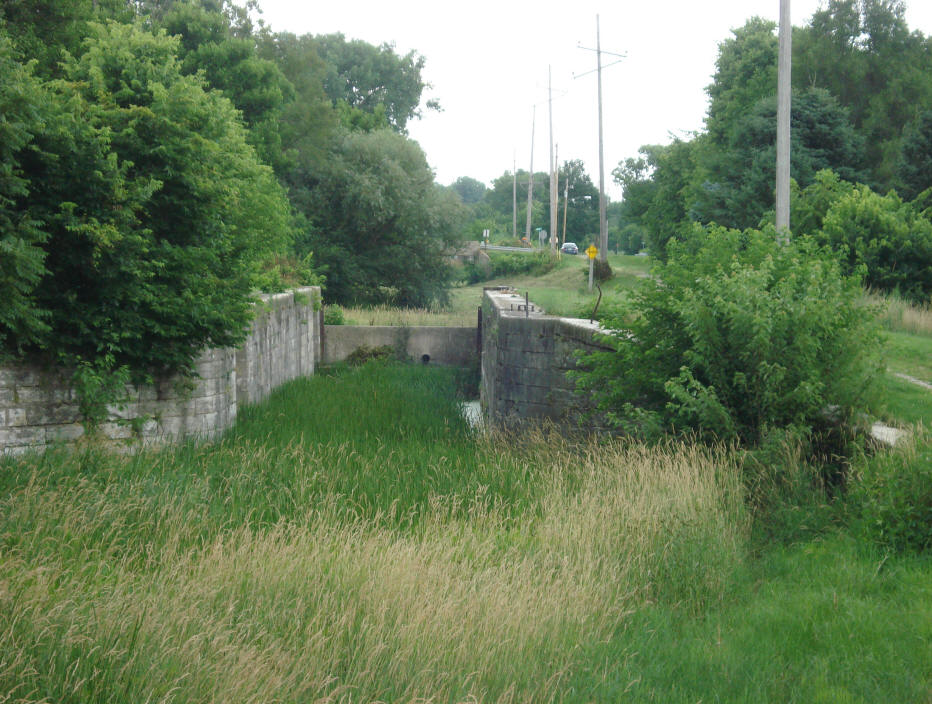
When I was in junior high school (middle school for you youngsters), I was walking home from school with my sister and a couple friends, and we came across a familiar piece of abandoned infrastructure from the old Illinois-Michigan canal: the remains of a lock that helped boats navigate the changing heights of the channel. It looked like this:

If you look closely between the massive retaining walls, you can see a concrete wall going from left to right. On the side closest to you, you see what is about a seven or maybe ten-foot drop into damp reeds. (This picture was taken too early for you to see the full-grown invasive Phragmites reeds dead and broken on the green side. Trust me, that’s the green you see.) On the side you can’t see is a shorter drop into what is brackish water most of the year. The wall itself is no more than a foot wide, and to access it you must sit on the retaining wall with your feet dangling and slip downward, landing on the retaining wall.

This is important, because my sister’s two friends decided we would take this route instead of the perfectly safe footbridge a half-block west. I expected Juli (not her real name) to navigate the treacherous path relatively well, because she was pretty slim and a tomboy, but then Bobbie (also not her real name) managed it despite her plump, awkward build.

Because these were my sister’s friends, they called out for my sister to try the path. I didn’t even exist to them, being younger and awkwardly embarrassing to be around. Lisa, who has a fear of heights, passed. I, seizing the chance to prove myself to them, shimmied down to the five foot jump onto the wall. Walking it was easy, if I didn’t think of the scummy green water on one side or the sharp canes on the other. And if I didn’t consider how immensely uncoordinated I was. I didn’t think about them, because I was working hard to walk fast across a balance beam when every other time I’d been on a balance beam I fell over. And trying not to pass out.

Somehow I made it, only to find the real challenge: trying to climb up that five-foot retaining wall with only a sharp, rusty bracket to hold onto. I withheld the desire to cry. Or barf. Luckily, Juli and Bobbie helped pull me up, after waiting a suitable time to make me suffer.

Why did I tell this story? To use it as an analogy for writing. Writing to be read is like walking a narrow beam where there’s a brackish pool of familiarity on one side, and a deep fall with sharp sticks on the other.

What do I mean?

Most people need some familiarity in what they need — whether topics, themes, plots, characters, or setting. For example, I’ve been told by a psychologist (of course!) that Jungian archetypes — Persona, Shadow, Great Mother, Wise Old Man — are necessary to sell a book. Genre fiction has its own tropes — where would science fiction be without the amusing alien (porgs in The Last Jedi), the ancient conspiracy (also in The Last Jedi), and the balance between Good and Evil (also in the Last Jedi)? Familiar topics help us place ourselves into the action, and familiar plots help us feel that an age-old myth unfolds before our eyes.

At the same time, people need their minds to be challenged, but not so challenged that they can’t identify. There’s a whole range of challenge from what we call “beach-blanket books” — light romance and slice-of-life books that are a vacation in a paperback — to Umberto Eco, whose books are so dense that one had to make a concerted effort to read.

In other words, people read things that affirm them, but at the same time they like some unfamiliarity. Danger, even — if not danger of being impaled on reeds, the danger of having their minds changed, their hearts broken, their lives expanded.

*********
Writing this blog also compares to that tightrope I walked as a child. My most read topics are the more personal ones: No Coffee, Marcie, Graduation, Bipolar disorder, Richard’s aunt dying. The creative pieces get a moderate number of visitors, thank goodness. The technical ones perhaps the least, but they’re not sparsely subscribed to, either.

I want to pick topics that appeal to everyone, but I don’t want to lose the writing/writer aspect of it. I want to share my creative writing, of course, and walk through the joys and sorrows of being a writer. I want to teach techniques in case I have writers out there. (Notice I don’t say “aspiring writers” — if you’re thinking about it, you’re a writer.)

So unless you object to the mix, horribly, I’m going to keep walking that tightrope.

I didn’t write yesterday.

I didn’t write yesterday.

I guess sometimes I need a break. Although I spent a few hours doing the following searches:

permaculture greenhouses
permaculture greenhouse plants
honey bees
honey bees Elko NV
Africanized honeybees
honey bees greenhouse
lizards eastern NV
venomous reptiles eastern NV

And I’m still looking. I have six greenhouses to fill with herbs, greens, and the like — well, five, because one dome is a production greenhouse for seedlings and the like.

Wish me luck today — I’d like to get 2000 words in!

Procrastination

We procrastinate for several reasons:

  1. Because the tasks lack challenge (Housework, for example)
  2. Because the tasks are too challenging (Getting up in the morning?)
  3. Because the tasks are monotonous (Housework, for example)
  4. Because of fear of failure (Why I have five manuscripts that I haven’t marketed aggressively)
  5. Because of fear of success (Honestly. Success changes lives)
  6. Because we just dislike the task (Housework, for example)

In other words, we want to perform tasks that are challenging but not too challenging, have enough novelty to engage us but utilizes our skills, and offer reasonable success that doesn’t fall outside our comfort zone. If we don’t perceive that the task will grant us all that, we procrastinate.

Many factors inside and outside ourselves can create an atmosphere ripe for procrastination. Illness and worry can ramp up our belief that tasks are too challenging. Depression can enhance our feelings of failure. Jarring background music may burden us with more challenge, while bland or crowded surroundings may increase our perception of monotony.

The process of writing yields all sorts of procrastination pitfalls.  Some tasks — proofreading, for example — can be boring. Revising a novel or poem can challenge writers to the point of stress. Search and replace on a document can be monotonous (Scrivener, which is what I use to compose my writing, has no automatic replace). The difficulty in breaking into the market with one’s writing can enhance fear of failure, and daydreaming can enhance fear of success. Some parts of writing, such as writing a synopsis, can be annoying.

We can trick ourselves out of procrastination. Some tricks I use are:

  1. Breaking the task into smaller pieces. For example, I lay out the outlines for my books in quarter-chapters. Instead of feeling that sense of accomplishment only after finishing a chapter, I feel it with every quarter-chapter. (Small, frequent doses of accomplish reduce the fear of failure and the monotony).
  2. Switching up where I write (this is why writing retreats are so popular)
  3. Skipping forward to a more rewarding part of the book (more challenge, more motivation)
  4. Skipping forward to a less challenging part of the book (in my current book, that means writing in the Michigan hideout part of the story — less challenging than piecing together the malls in Gdynia (which is pronounced Goo-DOON-ya for you English speakers)
  5. Starting my writing day by promising myself I can quit writing after 10 minutes (I’m dealing with minor depression today — this is my best strategy for writing with depression).
Procrastination is not our friend, but we can negotiate a cease-fire with it.
Thanks for reading. I love you all.