Getting inside Josh

Because I can’t draw my character. Because I can’t post a male nude. Use your imagination here.


I’m still working on Gaia’s Hands, because I don’t have much else to do right now. 


I’m trying to get into Josh Beaumont’s (male lead) head so I can develop and write him more fully. This is a challenge for me, because I’m not 1) male, 2) twenty years old, and 3) a mystic. No, scratch 3); I’ve had some nonstandard experiences in my life. 

I want to be authentic with the character, especially with his sexuality, which is an important part of what is basically a romance novel at its heart. Josh is pretty normal in that category, except for the fact that the object of his affections is 25 years older. And he’s a virgin. As an older woman, I want to make sure this is realistic (other than the age thing, which happens sometimes) and not personal wish fulfillment.

This isn’t a total problem, because Josh is mature for his age (about 25 emotionally) and I think that comes from his being a mystic. Josh has visions that change the course of his life, and Jeanne has been the star of his visions lately. 

So I want to paint Josh as a gentle soul, but with drive. Someone who sublimates drive into poetry. Someone who’s going to finally ask for what he wants when he can’t hold it back anymore. 

He’s my project for today. Let’s see where I can go.

Meet Sunshine Walton

As I peered into my computer screen, a low and modulated voice broke into my reverie. “May I sit down?”

I look up, and the cafe became solid again. A tall, slender woman with brown skin and fine black braids pulled into a sleek bun stood with her hand on the back of the chair facing me. She is dressed in a red skirt suit with sensible black heels. Her air of calm competence left me feeling a bit awkward.

“Sure,” I said, nodding to the chair.

She reached down to shake my hand. “My name is Sunshine Walton. You asked to see me?”

Oh, I thought. Oh. Of course I had asked to see her. I had thought I needed to see my characters for my latest book more clearly. I hadn’t guessed … “Yes — yes. I did ask to see you. I just didn’t expect you so — quickly.”

Sunshine smiled bemusedly. “Did you want to ask me some questions?” She sat straight, almost primly, in her chair.

“Yes. What is your background?”

“I’m a military brat.” She sobered. “I think we moved five times by the time I finished high school — no, six. ” She chuckled, a low pleasant sound. “I got to see the world. It was a strange childhood. It was hard to get to know anyone outside my family, because then they’d leave, or we’d leave. It was a vivid and lonely childhood.”

“Any romances in your life?” I wasn’t sure that was a good question to ask, but I asked it anyhow.

“Oh, I had a grand romance in high school — that was ages ago …” Sunshine chuckled. “I was convinced he was the love of my life, and then — “

“Then what?” I asked impatiently.

“We moved again. Apparently it couldn’t last long-distance. He never wrote. Since then, I’ve been too busy to have a relationship — college, finding a job in my field …” Sunshine gazed in the distance, then shrugged.

“What is your field?”

“Accounting. But I also have some management skills. I think I have an innate talent for management, but I thought accounting was safer.”

“Safer?” I queried.

“More likely to get a job. I don’t like the thought of starving.” Sunshine raised her eyebrows. “That’s why my dad ended up in the military, I guess.”

“One more question,” I stated. “How do you feel about Santa Claus?”

Sunshine laughed. “I haven’t believed in Santa since I was seven. I guess he’s a good thing for the children. I suppose if I have kids, I’ll do the Santa thing with them, but …” Her voice trailed off as she gazed into the distance, then she shook herself.  She checked her watch. “I have to go — I have an appointment across town in fifteen minutes.”  She stood in an efficient motion, nodded to me, and strode out the door.

I smiled. Sunshine’s studied calm was about to be upended by a bit of Christmas magic.

Character Sheets and Why You Need Them

One of the best ways to keep your characters from becoming one big blur such that you can’t tell the difference is the character sheet. I have seen character sheets developed in a notebook in colored ink (What’re you up to these days, Ashley?), as templates for Word, or in software programs such as Scrivener.

At the very least, a character sheet for each main character will help you remember their traits and how they affect the story. Otherwise, it’s entirely possible to have one of your characters fall out of — well, character. For example, one of the themes in my writing is how pacifism has always been a minority position in the US. Therefore I have a lot of pacifistic characters living at the ecocollective that houses many of my novels, and other characters who are not pacifists but have agreed to non-violent rules to live in the collective. And then there’s Gideon, who was brought up by a Quaker mother, but couldn’t resist throwing a punch from time to time. I have to remember which ones are which to be consistent; thus, character sheets.

Character sheets also keep authors consistent from book to book. Case in point: One of my favorite books, one that makes me happy-weepy to read, is Tea with the Black Dragon, by R. A. MacAvoy. One of the protagonists is Oo Long, a mysterious Eurasian man who is more than he seems. Without giving away the plot, Oo Long, besides being the name of a tea, translates to “Black Dragon”.  One of my least favorite books is Twisting the Rope, the sequel to Tea with the Black Dragon. My reason for disliking the latter book is because the character of Oo Long changes drastically with no explanation. In fact, his skin is described as “black” in the latter book. At the very least, the author needs to explain why a protagonist has changed color.

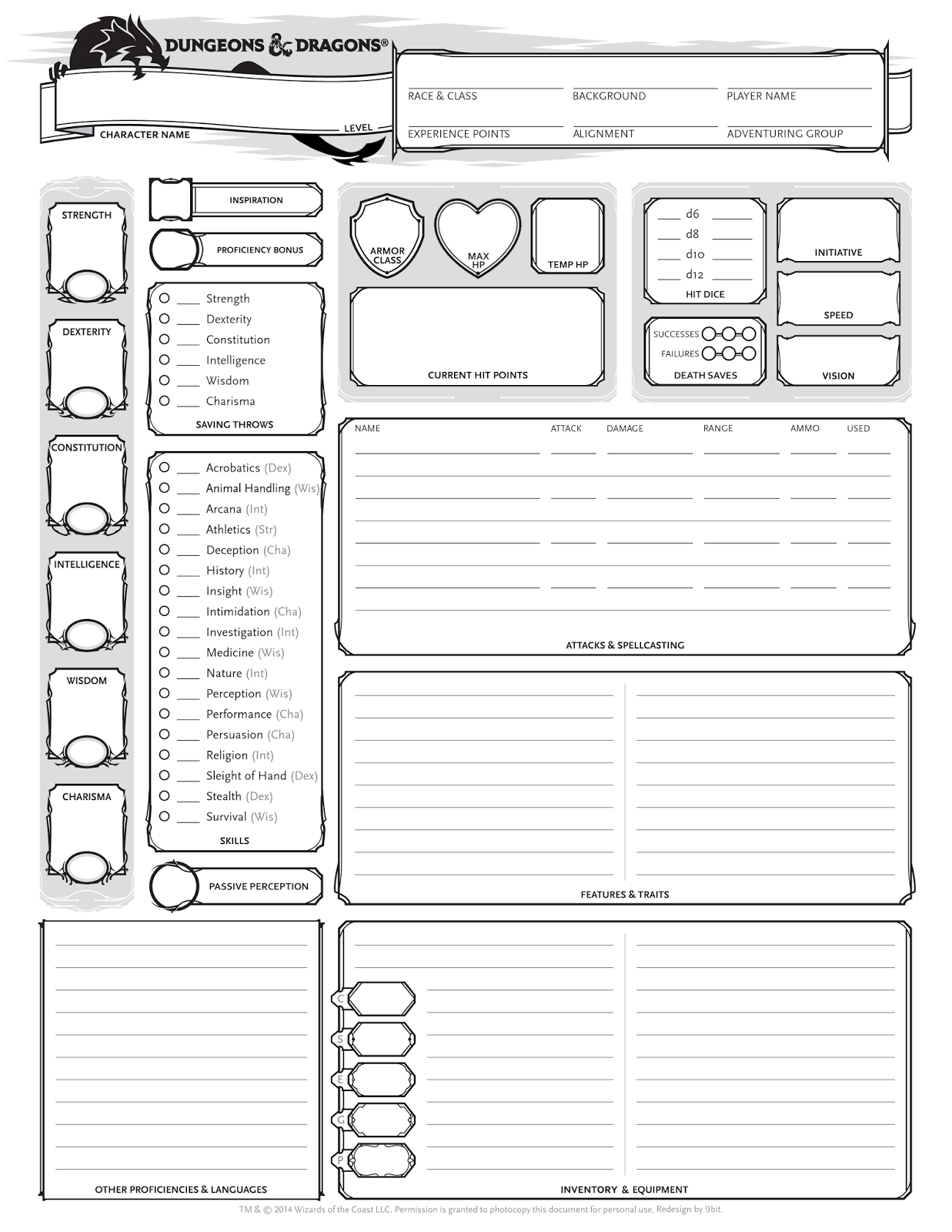
The first time I saw a character sheet was 30-some years ago, long before I started writing novels. It looked much like this: (Dungeons and Dragons, 2017).

Sorry for the mouse print. Anyone who has played an RPG recognizes this sheet, or something much like it.  (My character was a female half-elf wizard with extreme beauty and maxed-out charisma. Hello, wish fulfillment!)

More pertinent to the discussion — this character sheet does a pretty good job for writers despite its obsession on quantifying character skills and its focus on fighting. I could see this working for sword and sorcery or even urban dystopia with fight scenes.

This next one I looked up on the Internet, a veritable treasure trove of character sheets. I love this sheet:

This sheet has so much detail, it would almost work as an intake assessment form in case management — all it’s missing is the mental status exam. I think I could use this form while discussing with my husband the fine points of a character over a three-hour coffee date. On the other hand, I have a novel with 65 characters, for which I have at least partial character sheets. Imagine filling this doc out for 65 characters!

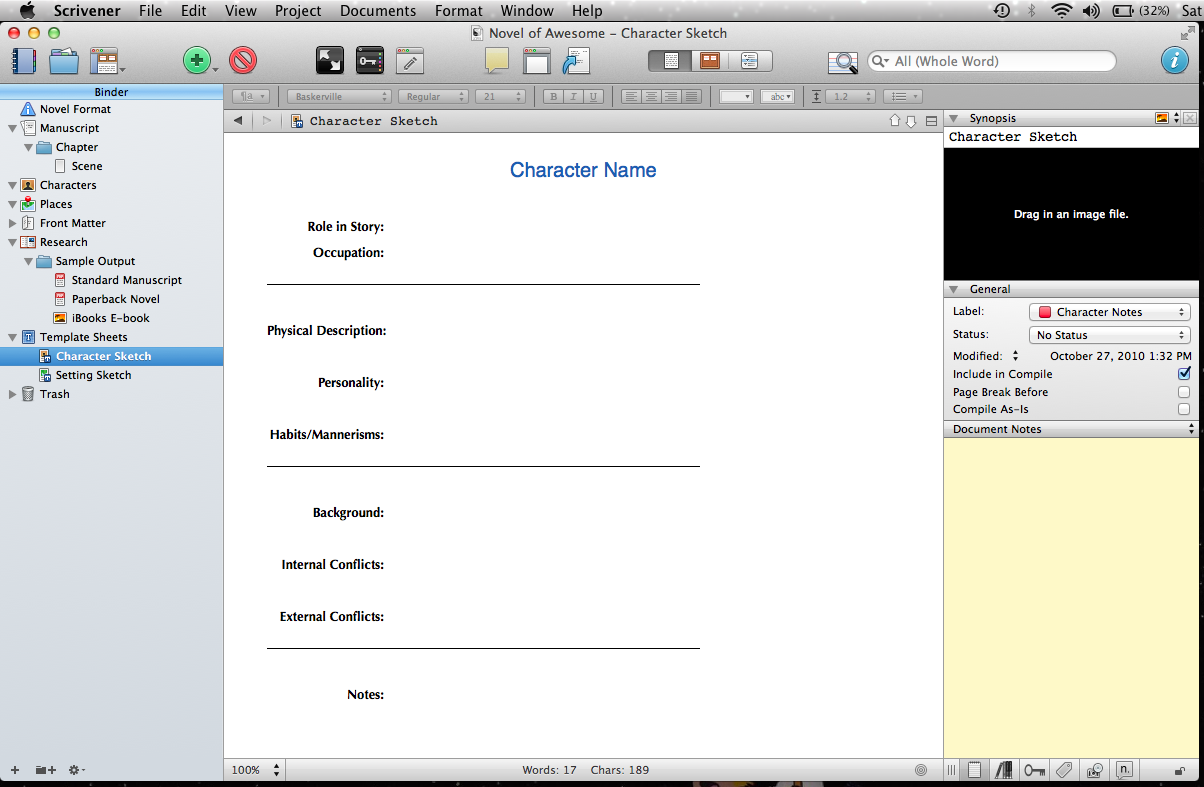
The third character sheet is what I use, because it’s electronic and because it’s bundled with my storywriting/formatting software, Scrivener:

I prefer the simplicity of this document — I can fill this out in 20 minutes or less and get back to writing. My favorite part of this document, however, is that I can drag and drop a picture to remind me of what the character looks like!

If you were to ask me, though, which character sheet/method is the best, I would not answer with Scrivener’s document, although it’s my favorite so far. As with many other things in life, the best character sheet is the one you’ll use.

As always, sources:

Dungeons and Dragons (2017). Character sheets. Available: http://dnd.wizards.com/articles/features/character_sheets [September 6, 2017].

Lerner, T. and Walker, K.  (2017). The epiguide.com guide to character sheets. Available: http://www.epiguide.com/ep101/writing/charchart.html

Scrivener [Computer software]. (2017). Retrieved from https://www.literatureandlatte.com/scrivener.php.