Open Questions and Characters Again: Conflict

My character sheets — the ones from Scrivener — have two categories on them that I’m not happy with: Character’s internal conflicts, and Character’s external conflicts. I fill them with short, telegraphic statements:

William’s conflicts: Internally — because he deserted his lover, who was killed 18 years later; Externally — With his employer, Free White State; with Jude, who he feels is hiding something.

Jude’s conflicts: Internally — For not fitting in with other Archetypes/Folk; Externally: With his Archetype parents, for deserting him; With the Commune, for sheltering humans and Nephilim; With Free White State, for moving slowly with their plan.

One of these is a flawed good guy; the other is a sympathetic bad guy. How can you tell?

Conflicts can cause anger, fear, fury, hopelessness; sadness; and many other emotions. Can you tell what emotions come up with each conflict? You can assume, and you might be wrong, even if they’re your characters.

Conflicts can stir up desires for reconciliation, revenge, murder, wallowing in self-pity, petty bickering and passive-aggressive snapping — and more. Do any of the segments above give this impression? No!

I want to feel my characters — their loves, their dislikes, their conflicts — so I’m about to take another approach: Open-ended questions.

*****

Me: Jude, tell me about your conflict with your parents.

Jude: I understand that in InterSpace, engendered children seldom have contact with their parents after engendering. But they’re quickly apprised of their purpose — or were, until the Council of the Oldest gave the humans their cultural memories back. Archetypes engendered Earthside — that is, from the renegades — have contact with their parents and other Archetypes, at least occasionally. I was left in a privy, the abandoned result of unauthorized intercourse between two Archetypes. There I was, a freak who served no purpose and who was born fully adult. I would kill my father if he hadn’t already died saving the humans. I don’t know why they deserved more than I did.

Now, for a similar situation with William:

Me: Tell me about your conflict with your parents.

William: My situation was interesting. Six thousand years ago. the Archetypes calling themselves the Triumvirate staged the Garden of Eden in order to control society’s women, and thus the entire society, through religion. The Triumvirate engendered a male Archetype called Adam and a female Nephilim — half-human — called Eve. You may know the story.  What you probably don’t know is that a couple Archetypes — Su and her apprentice Luke — engendered a female Archetype named after an older legend than Adam and Eve, called Lilith. Adam chose Lilith, not Eve, as his consort, and the Triumvirate tried to get Lilith, but not Adam, killed. Adam and Lilith went into hiding Earthside.

At that point, my parents, the female Norwegian Archetype and the male Bering Strait Archetype, decided to subtly go rogue, vowing to stand against the Triumvirate just as Luke and Su had. They had me in defiance, and placed me among the Aleut. What I discovered was that parentage among Archetypes was as nothing, the humans held parentage in great esteem. Not only did I not know my parents, but I couldn’t speak of them because Archetypes were not open to the humans.

Someday I will demand an explanation from my parents.

****

So different, huh? It’s a lot of work, but I’m getting a good idea of the characters, their conflicts, and how they intend to deal with things. I may not do this for all the characters, but the main ones: Anna, Daniel, Jude (listed above), MariJo, and William. Especially Daniel, because all he is right now is aLove Interest. (Although it would be a nice way to counter all those useless female love interests endemic in fantasy, comics, and damn near everything else written, I will not put Daniel into that spot.)

I have my work cut out for me today, and what I really need is to hole up in a coffee shop and start talking to my characters.
Character Sheets and Why You Need Them

One of the best ways to keep your characters from becoming one big blur such that you can’t tell the difference is the character sheet. I have seen character sheets developed in a notebook in colored ink (What’re you up to these days, Ashley?), as templates for Word, or in software programs such as Scrivener.

At the very least, a character sheet for each main character will help you remember their traits and how they affect the story. Otherwise, it’s entirely possible to have one of your characters fall out of — well, character. For example, one of the themes in my writing is how pacifism has always been a minority position in the US. Therefore I have a lot of pacifistic characters living at the ecocollective that houses many of my novels, and other characters who are not pacifists but have agreed to non-violent rules to live in the collective. And then there’s Gideon, who was brought up by a Quaker mother, but couldn’t resist throwing a punch from time to time. I have to remember which ones are which to be consistent; thus, character sheets.

Character sheets also keep authors consistent from book to book. Case in point: One of my favorite books, one that makes me happy-weepy to read, is Tea with the Black Dragon, by R. A. MacAvoy. One of the protagonists is Oo Long, a mysterious Eurasian man who is more than he seems. Without giving away the plot, Oo Long, besides being the name of a tea, translates to “Black Dragon”.  One of my least favorite books is Twisting the Rope, the sequel to Tea with the Black Dragon. My reason for disliking the latter book is because the character of Oo Long changes drastically with no explanation. In fact, his skin is described as “black” in the latter book. At the very least, the author needs to explain why a protagonist has changed color.

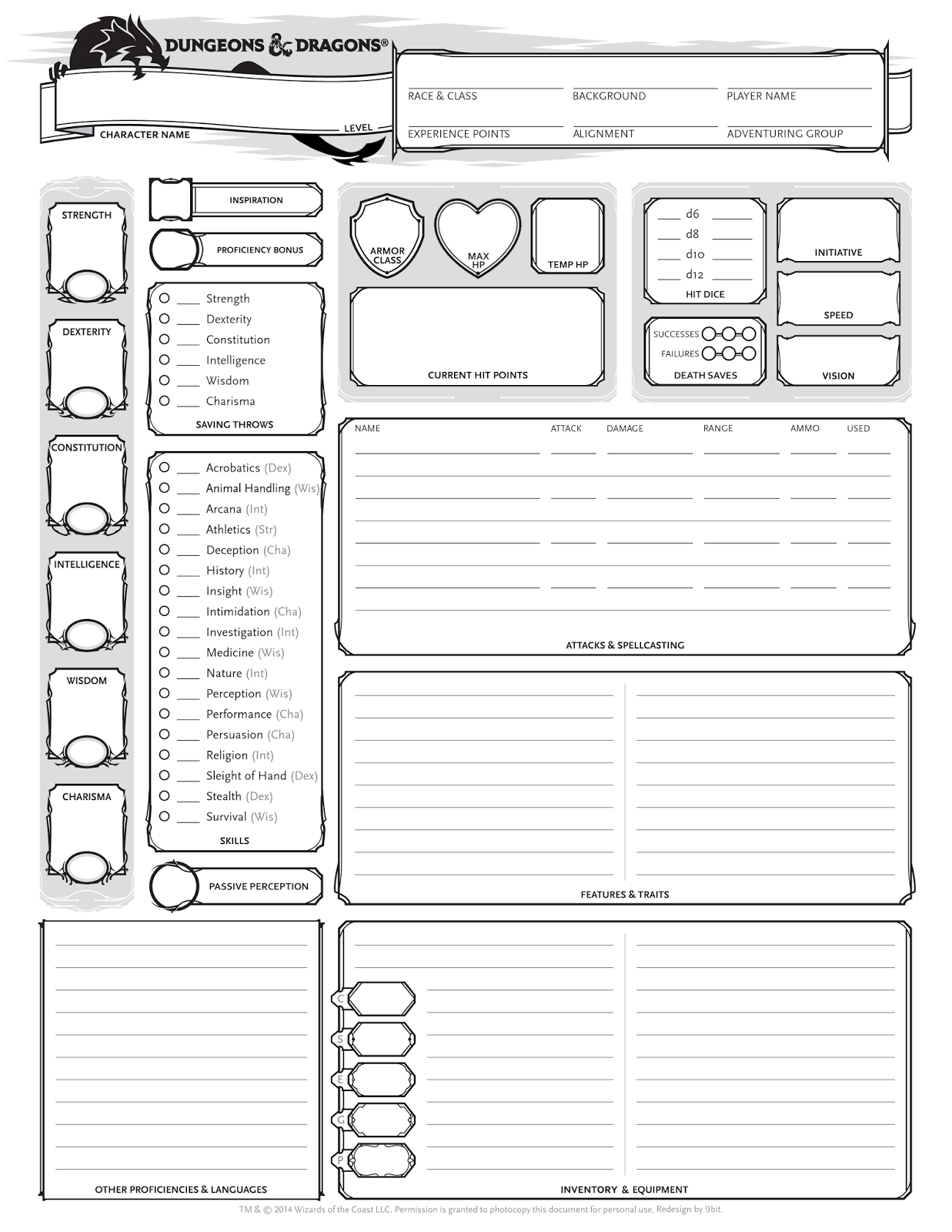
The first time I saw a character sheet was 30-some years ago, long before I started writing novels. It looked much like this: (Dungeons and Dragons, 2017).

Sorry for the mouse print. Anyone who has played an RPG recognizes this sheet, or something much like it.  (My character was a female half-elf wizard with extreme beauty and maxed-out charisma. Hello, wish fulfillment!)

More pertinent to the discussion — this character sheet does a pretty good job for writers despite its obsession on quantifying character skills and its focus on fighting. I could see this working for sword and sorcery or even urban dystopia with fight scenes.

This next one I looked up on the Internet, a veritable treasure trove of character sheets. I love this sheet:

This sheet has so much detail, it would almost work as an intake assessment form in case management — all it’s missing is the mental status exam. I think I could use this form while discussing with my husband the fine points of a character over a three-hour coffee date. On the other hand, I have a novel with 65 characters, for which I have at least partial character sheets. Imagine filling this doc out for 65 characters!

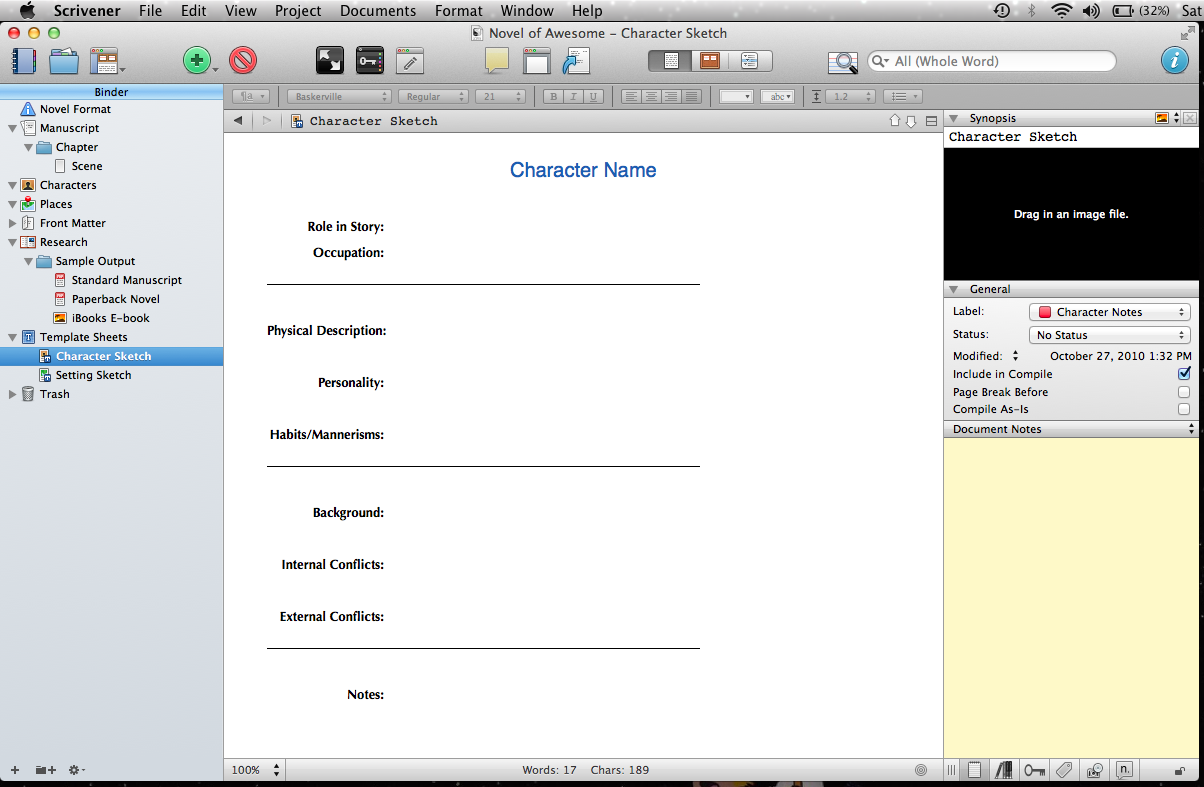
The third character sheet is what I use, because it’s electronic and because it’s bundled with my storywriting/formatting software, Scrivener:

I prefer the simplicity of this document — I can fill this out in 20 minutes or less and get back to writing. My favorite part of this document, however, is that I can drag and drop a picture to remind me of what the character looks like!

If you were to ask me, though, which character sheet/method is the best, I would not answer with Scrivener’s document, although it’s my favorite so far. As with many other things in life, the best character sheet is the one you’ll use.

As always, sources:

Dungeons and Dragons (2017). Character sheets. Available: http://dnd.wizards.com/articles/features/character_sheets [September 6, 2017].

Lerner, T. and Walker, K.  (2017). The epiguide.com guide to character sheets. Available: http://www.epiguide.com/ep101/writing/charchart.html

Scrivener [Computer software]. (2017). Retrieved from https://www.literatureandlatte.com/scrivener.php.