Going back and editing early

My final total for NaNoWriMo is 74,171 words — but the novel, Whose Hearts are Mountains, is not yet done. I’m actually going back to what I’ve written already and editing before I write the last section — in this case not subtracting, but adding foreshadowing, correcting details and making the earlier parts consistent with what I learn about the character later.

Why am I doing this instead of plowing ahead and going back later? Because the things I want to correct are bugging me. Like what signs do we have that Anna has the push-pull of a human side (wanting touch and contact) and Archetype sign (reserved, not emotive)? Not too much. Do we know about her stepfather’s past? No, but hoo boy, I discovered it yesterday and it’s big. Do we know why her natural father is so broken? No, I need to put that in. Do I have the chronology right? I hope so, because I’m really bad with time.

I hope this busts my writers’ block. I hope this makes me feel better about this novel. I need coffee now — today’s coffee is Costa Rican Tarrazu, roasted last night.

This morning: Reluctance to write

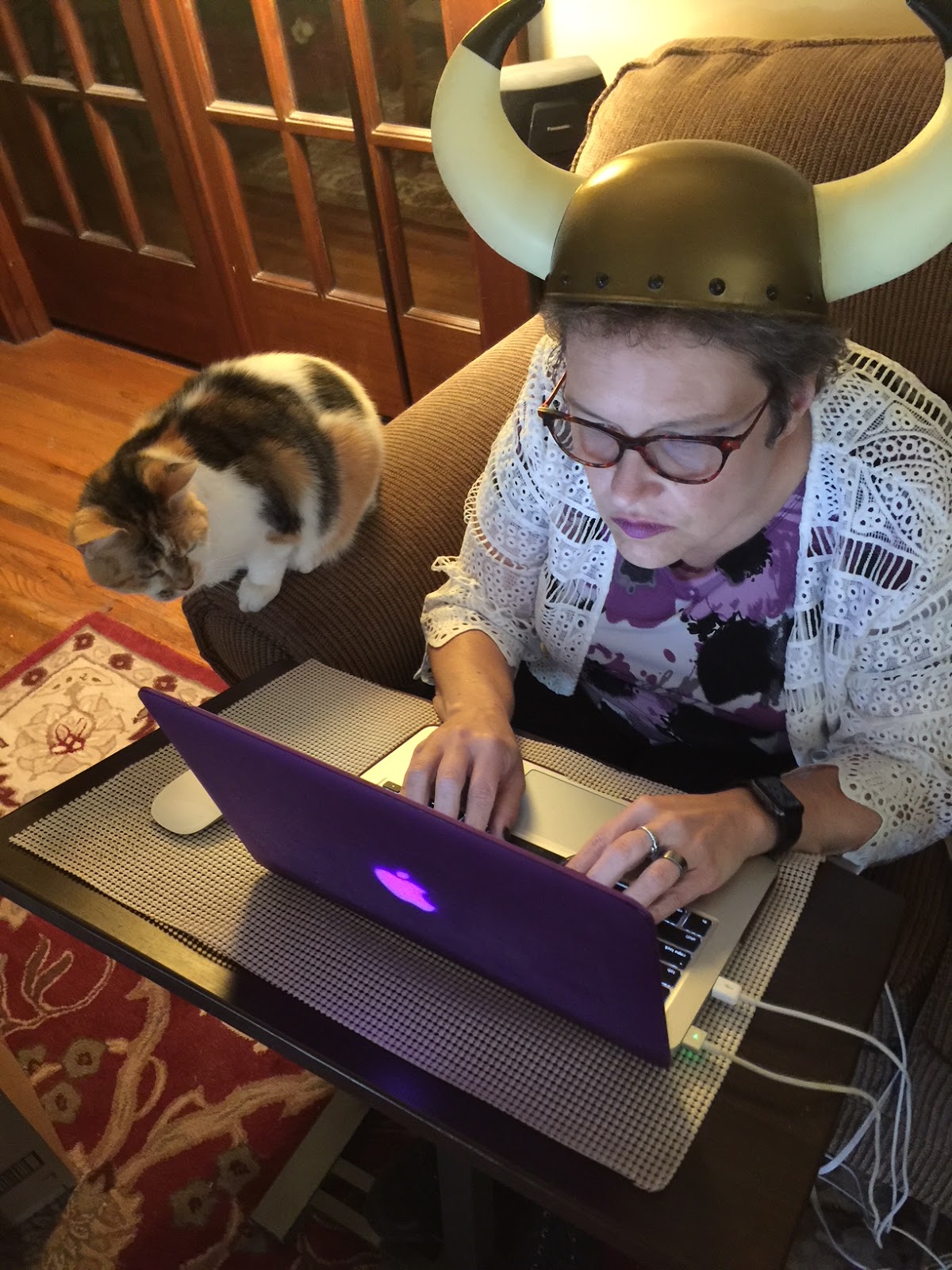
I’m not sure why I’m not motivated this morning. It’s bright and early (or at least early) in Maryville, MO; Girly-girl the deadpan calico cat sits next to me and purrs —

If a picture’s worth a thousand words, why do I write?

It’s a perfect day for writing: warm inside, rainy and misty outside. There Will Be Coffee Soon. I have all day to write —

At 5 AM, 4000 words (my weekend goal) is much too daunting.

How shall I deal with this?

1) Break the goal down into a couple parts — four blocks of 1000 seem workable.

2) Start writing for fifteen minutes and let myself quit if I’m still not into it.

3) Drink. The. Coffee. First. It’s Kenya Nyeri, home roasted, and sure to taste somewhere between a good solid cup of coffee and heaven in a cup.

4) Write a more fun part first. Actually, this beginning part is a good, dramatic part — it begins with the protagonist reading a journal left by the last survivor of a plague — but is the plague still contagious?

5) Alternatively, tackle the hardest part first. Right after this segment is a part I haven’t really conceived of first, and it’s kind of a transitional part. These are hard to write without sounding like a voiceover in a movie script: “As a matter of fact, my adventures were just beginning …”

6) Forgive myself if I don’t make the goal. I’m way ahead, as is expected from someone who loves personal challenges.

Talk to you later!

To My Readers — a virtual cup of coffee

All of us have excellent stories to tell.

The shortest story I’ve ever been told: “I was going to do my banking today. So I went to the bank, and it’s on fire.” 
The short story best relying on imagination: “Remember when there was a bounty on coyotes in Missouri? My mom hit one and threw it in the trunk to take to the sheriff. Too bad it wasn’t dead.” 
The best short story I played a role in: “I had a dream last night we were all late for the bank robbery. That was alright, though, because we were all zombies.”
I collect other people’s stories — the one about a friend playing war games in a park, who runs into some woods to take a leak at the edge of a cliff, only to look down and find himself exposed above a two-lane highway. The one about the hunter attacked by a rabid deer and the one about the woman who shot a deer while sitting on the toilet. My grandmother Iverson’s malapropisms and my great-great grandmother who could stop bleeding by the laying on of hands. Silly and clever and maladroit and mournful — I hold stories for people. And holding stories makes me happier than almost anything (except coffee).
I know all of you have stories of all kinds. I would love to sit with each and every one of you (assuming none of you are slashers or stalkers) over a cup of coffee (or beverage of your choice) and find out who you are from your stories. 
I know this vision is against all the rules of the Internet, where we all read each others’ Facebook posts without remarking, and half the posts are reposts anyhow. 
So, again, I’d like to hear your comments, and more importantly, hear your stories. (We’ll have to imagine the coffee.)
Here’s to you, readers!

More on Retreats and Mini-retreats

Every morning, I participate in my writing ritual —  I write this blog and try to get my writing goal done for the day (somewhere between 1000 and 2000 words unless I get to a difficult part). Early mornings are my time — it’s 6:20 AM Central Daylight Time and I’ve been up for an hour.

You also know that, every now and then, I need a writing retreat — somewhere with a unique atmosphere, someplace that’s a Place. Someplace that’s preferably a short drive so that precious writing time isn’t eaten away by driving time.

My favorite retreat: Starved Rock Lodge. Admittedly, one of its draws is that I grew up near there. However, being a national-park level log and shingle lodge hidden in a state park doesn’t hurt, either. The Great Hall, with its varnished logs and towering ceilings and comfortable chairs and eclectic visitors, stimulates the imagination like little else. I will not be going home this Christmas, to my heartbreak, because in my opinion, Starved Rock Lodge is the epitome of Christmas — for locals as well as for travelers, including the Jewish families from Chicagoland who have reunions there.

One of my other favorite retreats: The Elms Hotel and Spa in Excelsior Springs, MO. A massive stone-and-wood building in a neo-Tudor style on the outside, the inside harks back to the 1920’s with parquetry floors and dark wood. It’s not hard to imagine that it was the stopping place of gangsters and their molls from Kansas City. One time there, I happened to mention to our waitress that I was on a writers’ retreat and she let Richard and I use an unused part of the restaurant, complete with a couch and a sleek black fireplace for ambiance. She also kept us supplied with coffee (thank you, Laura Sanders!) The bonus: Using the spa, for a massage and an afternoon in the Grotto, which features comfortable lounge chairs, a sauna, a steam room, a whirlpool, a steam shower, and an icy shower. Even if you can’t afford the massage, the Grotto alone — $25 a day — works to help clear a writer’s mind.

Sometimes my husband and I can’t afford (timewise, money-wise, or both) a weekend retreat, so we take a day retreat rather than go to a cookie cutter corporate coffeehouse. One exception on corporate coffeehouses — our local Starbucks is located in the campus library, a spacious and warm space which only needs a fireplace to be perfect in its atmosphere. “Meet me at Starbucks” may be the most welcoming phrase you’d hear on campus, and I hold my Friday office hours there. But because it’s so familiar, I don’t use it for a serious “get in the writing mood” space.

Today, we’re travelling 45 miles to a writing space in St. Joe, Missouri. There are two coffeehouses in St. Joe, and although neither of them are Starbucks, one of them works better as a writing space than the other. Hazel’s, the one I don’t take writing mini-retreats at, has good coffee, but has the ambiance of the gift shop at a Cracker Barrel — lots of gifts for sale scattered across shelves and surfaces — lots of visual stimulation I can do without. The other coffeehouse — Mokaska — is closer to downtown, and has a spacious and old-building look to it: high punched-tin ceilings, exposed ductwork and scaffolding for lights, and old woodwork at the counter. We’re going to Mokaska.

Would it be cheaper to have a writing retreat in the home? Yes, but we don’t really have a good room for it. There’s the dining room, which has the ambiance of the Christmas tree we never took down, but the 20’s era dining table proves to be awkward to use a laptop on. There’s the spare bedroom of our circa 1919 home, but it’s long and narrow and full of bookshelves and Richard’s Star Trek ship collection, so the ambiance it provides could best be called “claustrophobic”. My normal writing place is on the couch in the living room with my laptop and a computer desk. All fine and good, unless I need a change of scenery, and then I retreat.

Have a happy Saturday (Friday? Sunday?) all!

For the Love of Coffee

On Facebook, coffee is a sacrament. Have you noticed this? Coffee jokes, coffee witticisms, coffee mugs. If you subscribe to writing-related pages on Facebook, you’ll quickly become convinced that coffee is the fount of all inspiration. For many of us, it is. (Those of you in the United Kingdom don’t understand this because your coffee usually is Nescafe instant and some boiling water. That is not coffee.)

Some of you reading this don’t fancy coffee and prefer your caffeine another way. For example, tea — sweet, unsweet, green, oolong, Earl Grey. Most of the people I’ve met who drink Earl Grey were English majors or Star Trek: Next Gen fans. Or Mountain Dew — all the people I’ve met who prefer Mountain Dew are computer programmers. Read on, because it may help you understand us coffee drinkers.

Why do so many writers prefer coffee? It could be because of the allure of coffeehouses* as places to write. Perhaps it’s knowing the mystique of the coffee’s journey from coffee cherry to processing method to grinding to brewing. Maybe it’s just that coffee is a socially sanctioned form of stimulants.

Coffee drinkers, like writers, appreciate the history of coffee. The apocryphal story of the discovery of coffee goes like this: An Arabic shepherd, feeling weary, sat under a bush to rest after making a fire to boil water. After he let the water cool, he notices one of his goats take a drink and then bound around the pasture with leaps and hops. The shepherd witnessed this, took a drink of the water, and no longer felt tired.**

Can you write without coffee? Yes — any ritual will help you get in the mindset, and writers have plenty of rituals — Using a fountain pen to write, writing in a dedicated Moleskine book, writing in a blog as a warmup, listening to music … Coffee is just another ritual. With caffeine added.***

*****

*  You will find the best ambience in indie coffeehouses. Consider yourself lucky if you have access to these. Chain “stores” that sell nationally recogized brands, not so much. Only one Starbucks in the US, in my opinion, has true coffeehouse ambiance, and it’s the Starbucks at Northwest Missouri State University, in the library. I work at that university and hold some of my office hours here.

**  I question this account for a couple reasons: 1) I’ve seen goats. They dance like they’re overcaffeinated ALL THE TIME. (Meet the crazy goats at Goats Gone Grazing Acres for an example.) 2) The herder boiled his water to be sanitary, only to drink it after a goat slurped it up? I prefer the story without the dancing goat.

*** Full disclosure: I am a coffee snob. In this household, we buy small lot green coffee beans and roast them at home in a small-batch drum roaster. We brew in a French press. We check for flavor notes. It’s really quite obnoxious. Really.

Melancholy makes for good poetry.

When someone paints a portrait of a poet in their mind, they picture the poet as brooding, head resting in hand or fingers steepled, drinking coffee absentmindedly in a cafe with walls the color of storms.* The word “Byronesque” comes to mind, appropriately.

There’s a very good reason — melancholy makes for good poetry.

Why? Because poets bear the feelings of their society. Not just the positive feelings — all the feels.  The feelings we don’t want to deal with, the feelings we’re afraid to deal with, the feelings we wished others understood. Poets even imbue poems about stealing plums from the refrigerator with interpretable, moody meaning.

Poets have a solid qualification to write about society’s moods — poets are moody.  They ponder in ways that bring feelings to the surface. They flirt with limerance and relive heartbreak. Their words bleed on the paper as they write with fountain pens in cafes with walls the color of storms.

But you need our melancholy, because you need to visit your own.

Portrait of the author on a blah day.

* Correction: only the male poets. The female poets always look perky, even though some of the moodiest work ever was by women like Maya Angelou and Gwendolyn Brooks.  And Emily Dickinson. And Sylvia Plath. And …