Coffee in (not quite) Paradise

I’m sitting at Latte Lounge in Oneonta right now, sipping my husband’s caramel steamer and wishing we had a real (non-corporate) coffeehouse in Maryville. To be fair, we have close — the best Starbucks in the 50 states, attached to the campus library,
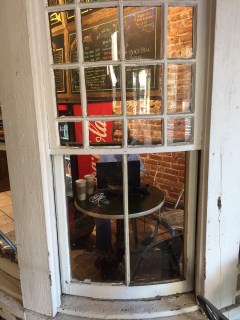
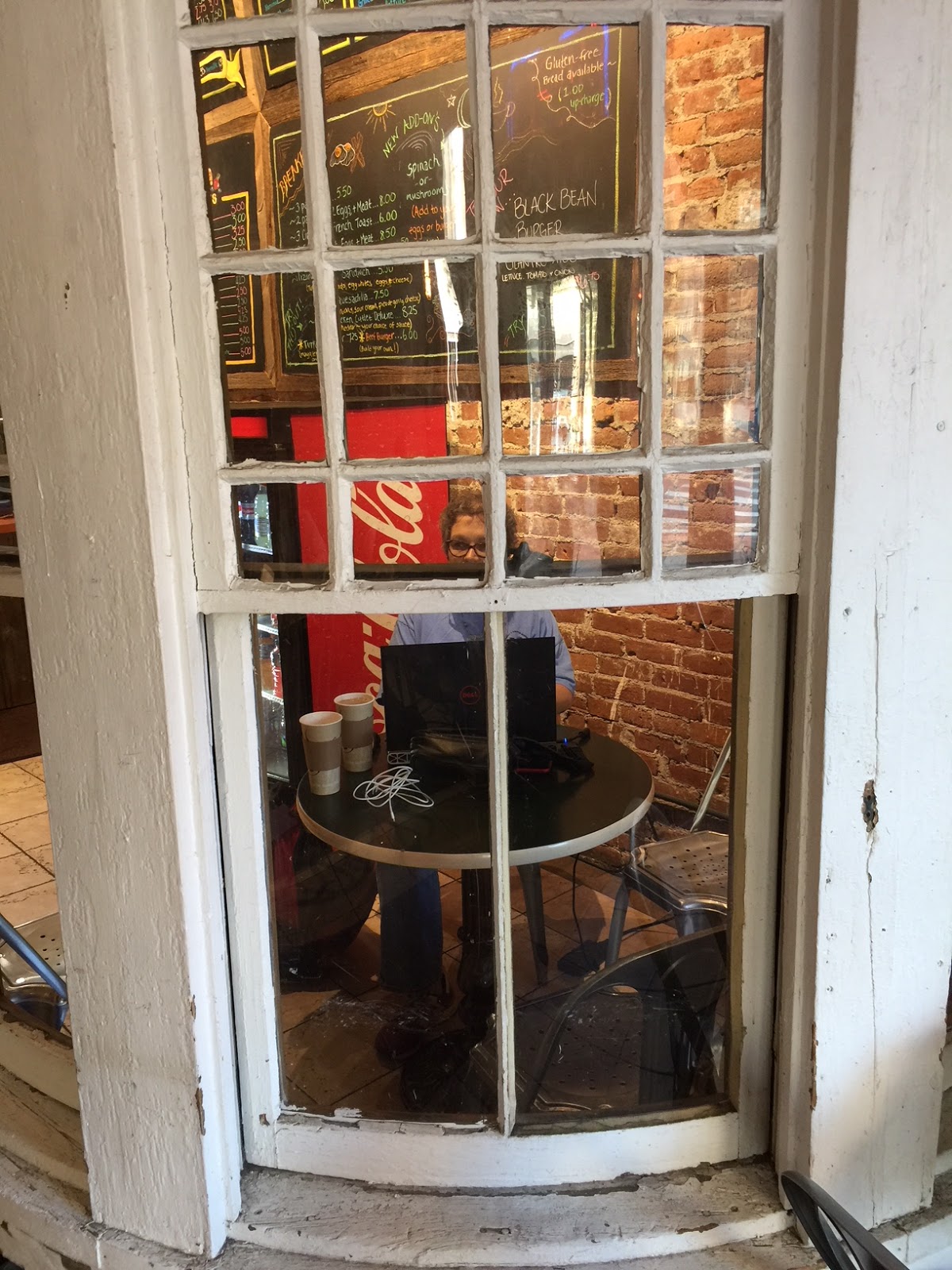
Yes, this is a bay window.

Oneonta still has a bit of a hippie vibe, with quirky coffeehouse spaces, the Autumn Cafe (a former food coop turned restaurant), and a head shop (the tacky price you pay for the health food stores and artisan delights). The summer traffic has gotten worse and the hotels get quickly packed due to the demand from club baseball tournaments, which Oneonta has capitalized on. The local artisan’s store features a writer who writes romantic suspense with a witch as the main character and publishes through Llewellyn Press (the leading pagan press). The attitude of New York State lends itself to diversity of opinion — “You have a right to live your life, and I have a right to live mine”. I suspect things still got heated during the last election.

There is a local Quaker meeting here, as there always has been, and I suspect that it (like most Quaker meetings) has very few attenders. But there is a Quaker meeting.

People are friendly here, whether from Upstate (the mostly rural majority of New York) or Downstate (NYC — or “The City” as it’s known here — and its suburbs). They can’t drive worth a damn, but they’re friendly.
You can learn a lot about a town by what it treasures. Maryville, MO treasures kids and church, which is great if you have kids and a church denomination to belong to. As a childless Democratic Socialist and pacifist, I don’t fit into any of the local churches. (The most liberal church in town will not take any constructive criticism, which is one of the things most apparent about Missouri — the attitude of “It’s ours, don’t question.” I was brought up to question everything.)
Oneonta treasures creativity. It has its own arts venue separate from the University. It has the aforementioned artisan booths, local writers, unique restaurant dishes, quirky coffeehouses and quirkier people. I would imagine that, with two colleges and a head shop, Quakers and witches and Unitarians, many families with children would find it a less than ideal place to raise a family. 
It will be hard to leave today, to get back to Syracuse and take the train back to the Heartland and then drive back to a place that reminds me too much of my hometown in Illinois, with its ugly secrets and its resistance to reflection and growth. But I have miles to go before I sleep, it seems, and that includes another year teaching at Northwest Missouri State University.
Which brings up a question:  How can I make my current home liveable? I’ve lost friends over simple requests to examine their use of words to be less derogatory of the neurodiverse. I have friends. and even though I worry they wouldn’t like me if they knew who I really was (the granddaughter of a witch, a Democratic Socialist, convinced that everyone will go to Heaven if there is a Heaven) but they accept my sense of humor and my bipolar disorder. It might help to find groups to connect to outside of town to make up for the lack of church affiliation and connections through children’s activities. I may have to drive 90 miles for the nearest Quaker meeting now and again.
But I will retire someday, and if we can find the money for a house (Oneonta has higher housing prices and older, bigger houses) we will settle down here.

A happy note about bad things

Sometimes the things I need are not the things I thought I needed.

I needed the bad yearly evaluation, because without it, I would not have been able to talk honestly with my boss about what I had been going through for the last two years illness-wise. I would not have gotten the kick in the butt to do better, nor would I have realized that my boss cared about how I was doing.

I needed to have my writing rejected, because I would never have been pushed to get beta-readers on the job. Not only do they help me improve, but they are reading my stuff and that feels good.

I needed to feel like I was the most uninteresting person on earth (isn’t depression grand?) so I would see the places where I am geekily interesting — edible plants and herb garden, persistence in fishing even though I catch nothing, wanting to learn everything, moulage, the ability to talk to anyone about anything, addiction to coffee, dedication to writing …

I needed to have that terrible school year — two terrible school years filled with depression and illness. Even though I have a lot of work (writing, disaster mental health class, redesigning a class) this summer I feel relaxed because I can take a day to go off to St. Joseph and drink at a quirky old coffeehouse.

I needed to break my heart on that crush, because it showed me how understanding my husband is about my periodic idiosyncracies in looking for the muse, a person who subtly infuses my creative soul with energy. (Crushes would lose their power if one did anything about them, so they’re supposed to go nowhere. Dear muse, if you are reading this, thank you.)

I needed to feel alone, because if I hadn’t, I wouldn’t have realized how much it means to me that I have readers. I love you all!

Elegy for the Bookstop

To say that the Bookstop was a coffeehouse may be embellishing the place, for the Bookstop had started as a used bookstore owned by a retired English professor, and had lost most of its books and gained its antiques under new owners Mike and Sheila. But it retained its name.
This was the Bookstop in its heyday. The awning was designed by the owner’s son.
The Bookstop did sell coffee — decent coffee roasted by PT’s in Topeka. They sold espresso drinks, brought to an art form by dreadlocked Sharla, barista and cappuccino artist. They also sold homemade cookies and cinnamon rolls, and of a Saturday (as the old-timers say here), they sold a breakfast entreé.
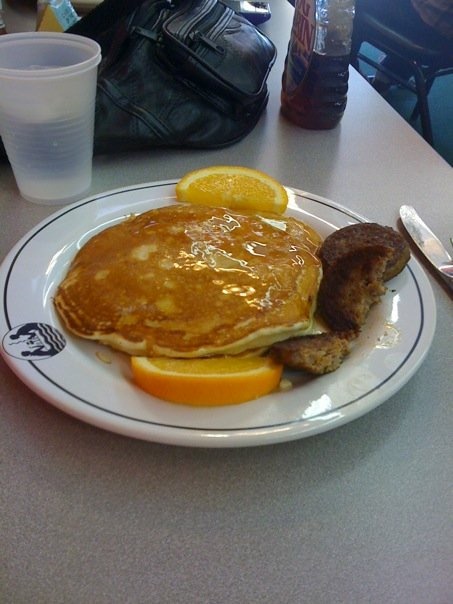
Saturday morning breakfast. Are you hungry yet?
I used to go to the Bookstop every morning at seven AM in the morning (as the old-timers say here) as I walked to work, walking poles in hand and a heavy computer backpack on my back. What kept me coming back every day was not the chaotic jumble of antique booths that took up two-thirds of the score, nor the shabby chic of the walls, not even the coffee (although it was very good). It was the people.
In the morning, I could count on an eclectic group of people — Spencer, a retired lawyer and Marine, sometimes with wife Jennifer; Rod, a cagey old man with a strange sense of humor; Mark, an economics professor I sometimes talked shop with; the retired SeaBee whose language hadn’t gotten any less salty after the war; the weathered cook with his crooked teeth; the Hagemans, enjoying their retirement; mild-mannered Tom; and of course, Mike and the baristas, who were usually witty as well as great at their jobs.
The regulars would talk. Spencer would drill me on my opinions on economics and politics; Mark would rarely interject from his perusal of Wall Street Journal. Sometimes Mike and Spencer would goad me into bawdy talk (which is one of my secret talents). Rod would laugh in that awkward bark of his, and Jennifer would mockingly scold Spencer. 
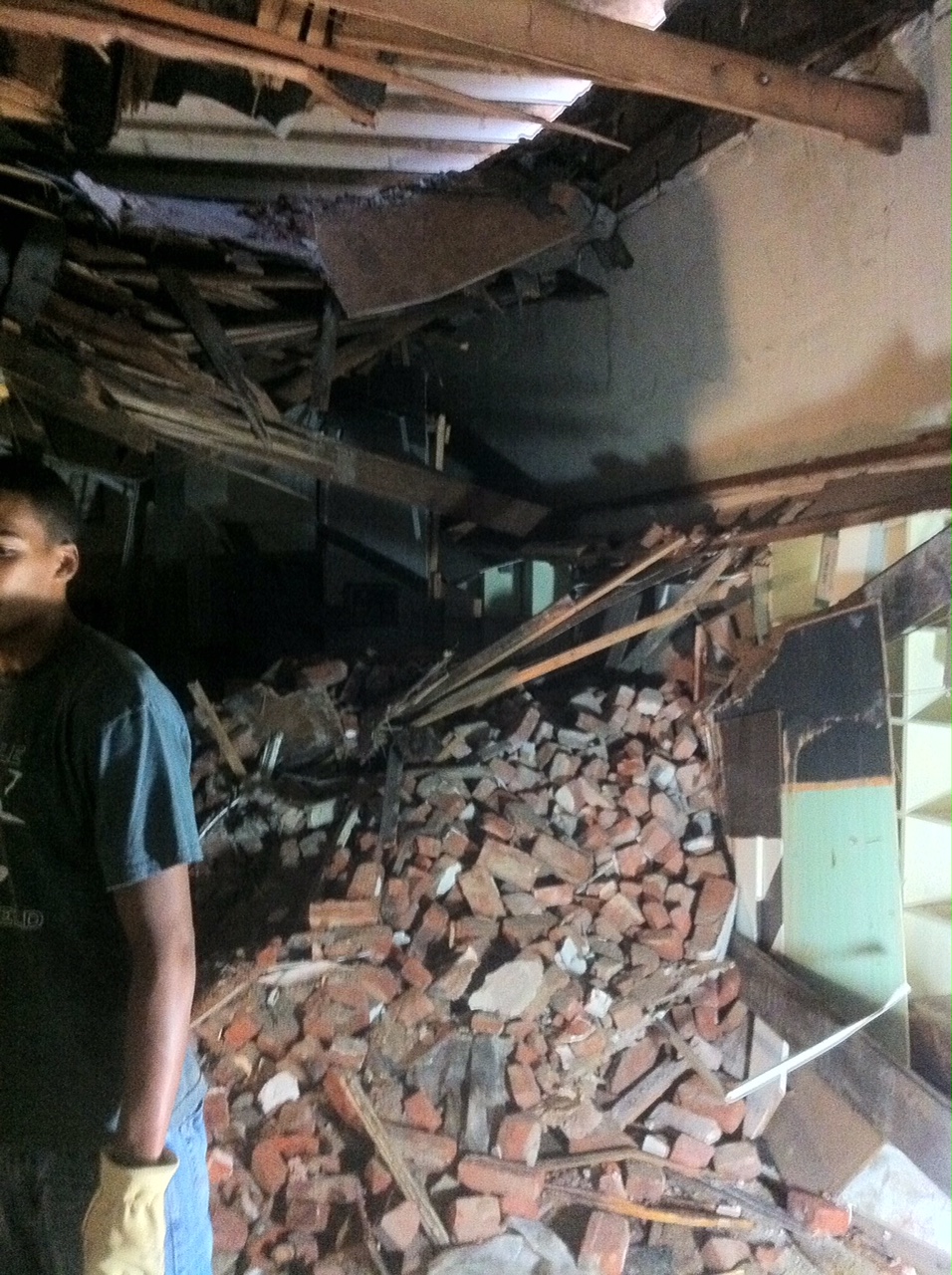
The Bookstop died after a protracted illness. It started by injuries from a fire in August 2011, when a tenant in the building next door set his apartment ablaze, and the rumor was that the fire resulted from his habit of relaxing with a joint or two. Although the Bookstop itself wasn’t affected by the fire, it suffered from some water damage. Just as Mike’s crews were starting to mop up the water, the demolition crew next door dropped a wrecking ball through the ceiling of the coffeehouse, and a torrential downpour caused much more water damage. The final insult was when the insurance companies — those of the building next door and of the demolition company — couldn’t settle with Mike in time to resurrect the business.
The fatal injury
For a while, a few of us regulars still drank coffee in the ruins of the Bookstop. This was a casual arrangement, word of mouth; Spencer unlocked the door in the morning, he and Jennifer kept the coffee flowing. We got the coffee for free. The back portion of the building was closed off with tarps to keep us from danger. The front area was cluttered with tools and coated with plaster dust. Sometimes Mike would show up. It was, in its own way, our wake, and it would not last for long. 
One morning, the door was locked. And it never opened again.
I heard that the Bookstop building, sad and weathered, without its distinctive awning, was finally closed. I don’t know what will be done with the building now, but it could never be as shabbily welcoming as the Bookstop was.
Rest in Peace, Bookstop. Thank you for being a faithful friend.