Insecurity as part of life

I am close to the end of Prodigies, so close that I can see — the headlights of an oncoming train.

That’s how writing feels like if you’re insecure — the feeling that you’re going to finish the work only to find it a piece of crap. And realizing you’re the least objective person reading your work, but still accepting your own judgment that it’s a piece of crap. That’s what insecurity is — the lurking voice that whispers “you’re not good enough, you’ll never get published, nobody cares about what you write.”

I’m insecure. Isn’t every writer? Isn’t every creative person out there?

What do I do about it?

At this point, it’s hard, because many of my creative friends say, “Hey, I did a thing! Look at this thing I did!” and post it on Instagram or Facebook. I think that’s why I have a blog here, but I get comments very few and very far between, so I don’t have the response of “Hey, what a cool thing you did!” Come to think of it, my friends who say “Hey, I did a thing!” don’t get responses on Facebook or Instagram either, and they have more friends than I do.  I should comment more on their things they did. Maybe it’ll come back to me.

My beta readers (two of them; the third hasn’t gotten back to me) have been complimentary of my work even through pointing out some necessary changes. I actually feel less insecure when people point out errors and problems becausef they care enough to read and it’s only in the worst writings that someone can’t make constructive comments.

Insecure people seek out reassurance, and sometimes it has the opposite effect if they ask for too much. “Look at this thing I did!” seems more positive and effective than wailing “I’ll never be published”. I’ve done both.

I can own it, my entree into the world of creatives — I’m insecure.

Another (Moulage) Gig in my Future

When I talk about “gigs”, I’m not talking about music (I play Irish bodhran, but not well), comedy (my comedy career is restricted to teaching), or acting (my theatre career began and ended in high school). I’m talking about my other creative outlet, moulage.

Moulage is, as I may have said before, casualty simulation — or as I like to say it, gorifying people. Injuries are rendered by a combination of theatre makeup materials, homemade makeup, props, fake glass, sticks and pipes for impalements, and lots of skill and imagination.

This is done for the benefit of training community emergency response team (CERT) members, first responders, nurses, and humanitarian aid workers. I also provide my skills to high school safety docudramas, active shooter training, and creating zombies (although I’m not nearly as good at the latter as is my friend Rod Zirkle.)

I am entirely self-taught. I was recruited for moulage crew as an assistant in Missouri Hope (one of the CHSE exercises below) in 2013. I dithered around a lot, and the next year I was recruited as the moulage coordinator for Missouri Hope. With absolutely no real training, I studied injury pictures and makeup and that DVD from Simulaids where they practice all the techniques on a straight-faced student.

This gig is a big one — a major humanitarian service training program in Florida. You can learn a little about Atlantic Hope and the Consortium for Humanitarian Service and Education (CHSE) here.  I will spend three days sleeping on the floor, eating beans and rice and bad coffee, and modeling burns for free (but I love it!) I will be trying to report from the field Wednesday-Monday.

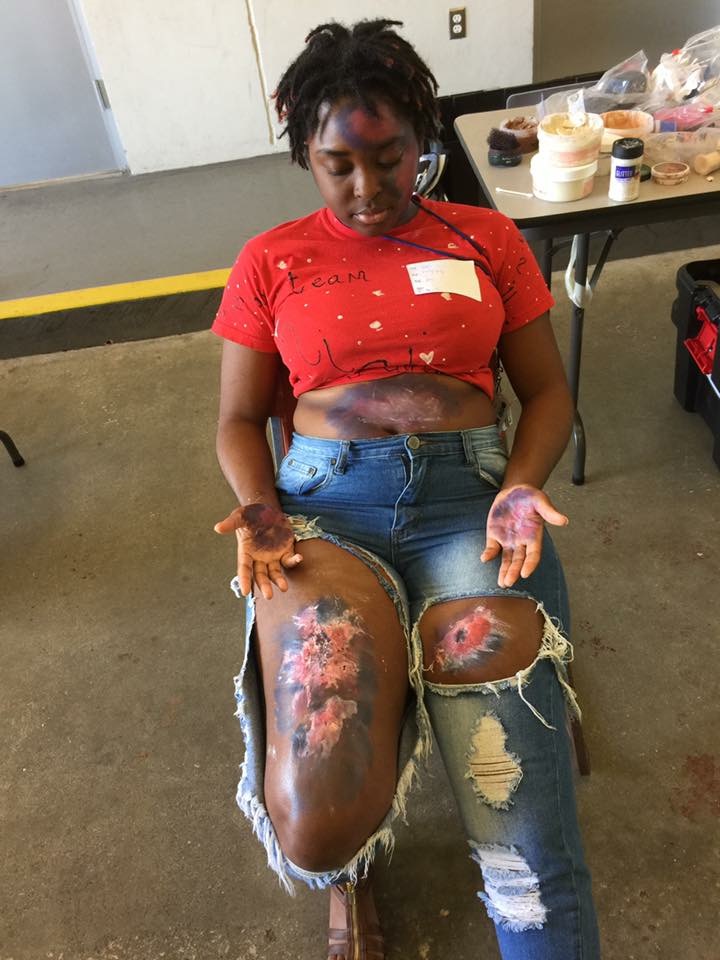
Here’s an example of my work from last year’s Atlantic Hope:

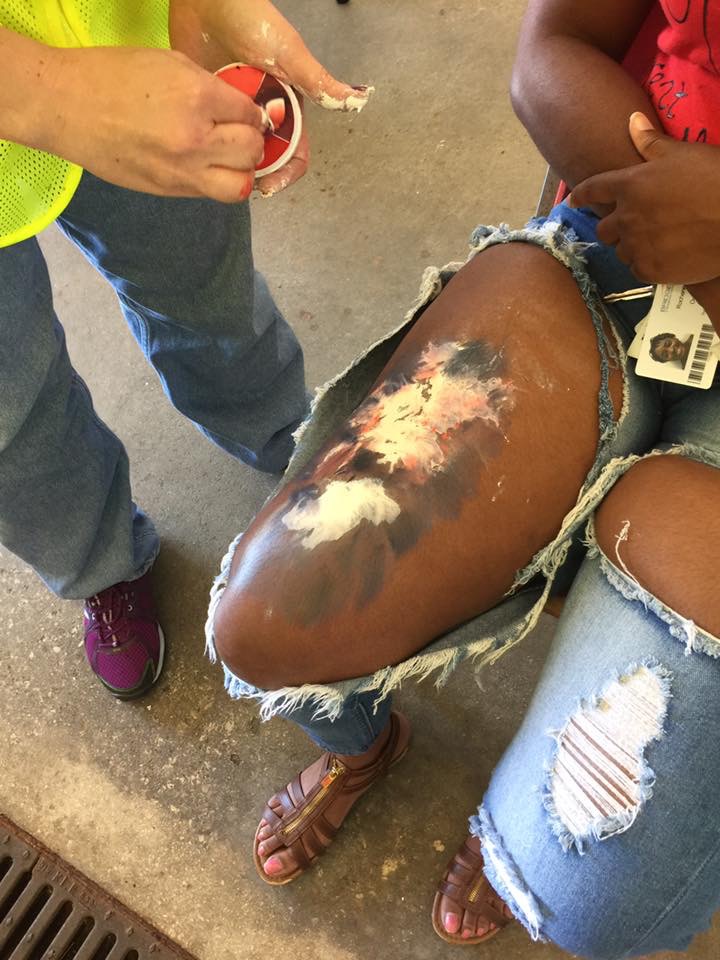
Building up a burn. 
Finished product. Beneath the skin, we’re all pinkish. This is not meant to be a profound statement.
I’m a perfectionist. If I had to do this again, I would not put the black at the outside, because it doesn’t look like soot, but third-degree burn (which it isn’t if it’s at the outer edge. I would slather it in thick gelatin around the edges and over the pink parts to give it a more three-dimensional look and maybe build up some blisters with gelatin. 
I’ll be honest — I think I keep getting gigs because nobody’s found anyone else locally who claims to do moulage. I think I have about six gigs a year. Let’s see: Missouri Hope, New York Hope, Atlantic Hope, CERT training in the spring, the prison simulation and night training for the Emergency and Disaster Management students, and the high school docudrama. I guess that’s seven. I sometimes also do moulage for the Emergency Medical Responder testing, nurses’ training, and the active shooter training on campus.
It’s a lot of fun and I feel appreciated when I do this. I lead a crew of about 4-6 people (including my husband), I create better and better works through learning and studying moulage, and my time goes toward the greater good. It’s a largely anonymous job — you’ll never see pictures of me in any of the CHSE promotionals, and I’m subsumed as a member of the “moulage crew”. But when people compliment the moulage, I know that I’ve contributed my skills in moulage and teaching to the rest of the crew.

Depression and Creativity

There’s nothing that crushes creativity quite as thoroughly as depression. Depression crushes everything in its path, but creativity is its most obvious casualty.

I stare at the page; no ideas come to mind. My mind is filled with fog, like that of caffeine withdrawal, but coffee doesn’t touch it. If I write about the love of my five cats — yes, they love me unconditionally, even when they avoid me — I get weepy because I doubt I deserve their love.

If I write about death, I fear that someone will put me in the inpatient ward, where they strip you of all the autonomy of adulthood — no phones or computer to stay connected, no shoestrings, mandatory group sessions, the position of having to ask for everything you need. I don’t understand how depersonalizing the patient helps them heal, but that’s the process.

If I write about anything else — I draw a blank. I cannot find the words, and when I do, they demand to be dragged out of my mind one. word. at. a. time.

Depression is not sadness — sadness is draped in dignity, and writing about sadness evokes a broad, snowy plain where the air is so still the trees might shatter. It’s not anger — anger burns clean and hot like a flaming sword, and in some cases the angel’s righteousness flows through the anger.

Finding yourself wandering at the edge of the woods after a forest fire, smelling damp, burnt woods and finding the carcasses of birds and small animals of the ground. You have no home anymore; you have no phone, nor anyone nearby.

That’s depression.

Ups and Downs — Bipolar, Academia, and Creativity

Now, Shelly and Lanetta, I’m not saying that I WILL write this book, and I’m not saying that I WON’T, but here’s the introduction:

*******

If you look around the walls of the main library at University of Illinois at Urbana-Champaign, you may find the name Lauren Leach on a Bronze Tablet dated 1981. This denotes I graduated in the top three percent of my graduating class. It doesn’t tell the story of breaking down in my last semester of college with moods that could fluctuate from destitution to a mild euphoria in a matter of hours.

If you were to look at the faculty roster at a moderately selective regional university, you would be able to find me under my current name, Lauren Leach-Steffens, as an associate professor in Behavioral Sciences. You would not find the story that my prior department, Family and Consumer Sciences, had been disbanded, nor that the impending news of its demise caused a shockwave of stress that led to swings of terror and agitation, racing thoughts, and a month of less than two hours of sleep a night. I finally received a diagnosis for that episode and the myriad episodes I had experienced for most of my life — bipolar 2.

I could have kept my diagnosis a secret, as many people have throughout the ages, but then the only bipolar stories people would identify are those of addiction, disturbing behavior, suicide.  The celebrities people vicariously watch and judge, the co-worker whose wake includes hushed voices behind the hand — yes, these people exist, but we assume that they will invariably break down in the middle of the street or die with a needle in their arm. We may even push them into those dark scenarios with our generation of stigma.

I’ve chosen to embrace the stigma. I can afford to — I am white, highly educated, a recipient of lifelong white privilege.  I will not be shot in the street by cops, as has happened so many times with people of color. I’m not likely to lose my job unless I violate ethical standards or fail to do the essential responsibilities of the job. I think being open is a great way to use privilege for good. I would like to show people a story that doesn’t look like a sensationalistic biopic (which, truly, nobody with my condition truly resembles.)

This is why I tell stories.

****************

When I’m not being a professor — and even sometimes when I am, I tell stories. Many of the stories aren’t mine — for example, humorous typos from my students, an illustrative example in class, other people’s funny stories. 

Some stories become writings. I write short stories based on my fantasies and dreams, I write novels based on my nightmares and my periodic feeling of hope, I write poetry when I want to get the most of my feelings into the tiniest number of words, I write songs because they’re contagious and a great way to spread ideas that need to be heard. 

I write when I experience a transcendental moment and when I feel despair. I write when I look at someone and that moment tells me they’re so beautiful that I have to unburden that beauty onto paper. I write when I know that I will never know them. I write when climate change looks unstoppable.

p.p1 {margin: 0.0px 0.0px 0.0px 0.0px; text-indent: 18.0px; font: 13.0px Palatino} p.p2 {margin: 0.0px 0.0px 0.0px 0.0px; text-indent: 18.0px; font: 13.0px Palatino; min-height: 18.0px}

I think there’s always a little bipolar in my life even with the daily medication that causes me a handful of physical woes — manageable, a touch of moodiness here and there. You wouldn’t know it to talk to me, because I’ve been able to function through it all my life. But I tell stories through my ups and downs, small and big, because in the end, that’s the only way we will know each other’s stories, get to know each other — and ourselves.

First Snow — postscript

We received four inches of snow here in Maryville, Missouri to give us a white Christmas. Because it didn’t fall until after 10 PM, we could not celebrate First Snow last night, and so we celebrated it this afternoon with a big festive bowl of snow in the living room and a small mug of mighty Irish coffee to share.

It was Richard’s first First Snow, and as he’s the first one I’ve initiated into the mysteries of First Snow in over 20 years, it was fun to hear his toasts. His toasts addressed very concrete realities of our political and social environment, which is not surprising, given his Master’s degree in History. My toasts addressed more creative/mystical/connectedness themes (those of you who have ever known me, your ears should be burning!) 
While Richard poured the last sip of the Irish coffee out into the snow, I followed him out with a snowball in my hands and pelted him with it. I guess we have a new part to the tradition 🙂
********
Merry Christmas, Joyous Yule, Happy Hanukkah (late, right?), Happy Kwanzaa, Happy Birthday to all you Christmas babies. Can you say “Happy Festivus”, or is that a contradiction of terms? Happy Holidays to all. 
As always, I invite you to write back. If you want to do so by Twitter, I’m lleachie on Twitter. I’m also lleachie on Instagram. 
Let there be peace on Earth. 

Part 3: Writing a song: the words person and the music person

Yesterday afternoon, Mary Shepherd and I sat in a music practice room with a slightly off-tune piano, my lyrics, and her notes. In a small room with cinderblock painted glossy beige,  I sat down with her as she explained how she had gone about writing the lyrics. She also explained that she hadn’t played piano since eighth grade nor did she play guitar, but as a music major in her undergrad years, she did understand a bit about writing music.

“You said it was a folk song, and it was definitely a folk song. I decided to go with ballad style instead of rhythmic,” she explained as she pulled out her composition book.

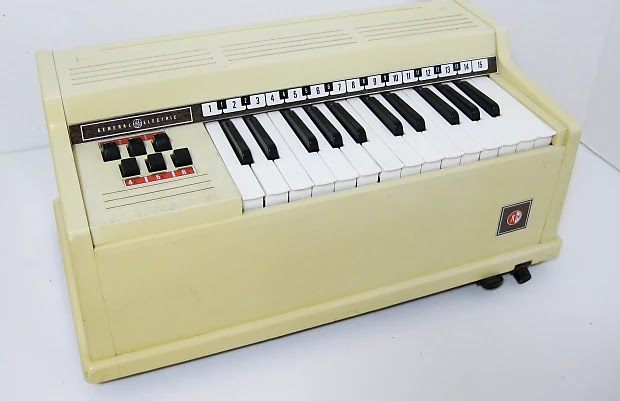
“You understand it then,” I chirped, “because that’s the spirit I wrote it in.” Folk music was a subversive part of my childhood, a gift by my Aunt Peggy, who would play and sing folksongs on a ’70s small boxy white keyboard sort of thing which looked like this:

So, we set to work, and — she captured it. Folk ballad style, with musical emphasis at the right places. I was happy weepy by the end of the session.  It’s now with her to note the slightly different rhythms in the verses because it’s folk music and that means that my rhythm is not necessarily straight iambic tetramater (four feet/measures per line, four accented beats per line, second syllable accented as in duh DUH duh DUH duh DUH duh DUH) .  Folk music tends to get its interest by being mathematically loose; I tend to not care about the number of feet/measures as much as I care about four accents per line.

Perhaps the most valuable part of the session is that I learned about mathematics and creativity after we’d corroborated on the song. I had not seen mathematics as creative at all, thinking it was just analytical left-brain stuff. Not at all, Mary assured me — she used mathematics to create quilt block patterns, find problems that needed to be solved, and even understand music. Music is very mathematical, Mary tells me — John Cage’s compositions come to mind, as does traditional Balinese Gamelan music and even the basic concepts of measures, beats, and chords. Certain mathematic progressions sound better than others.Mathematics and music composition live in a different world than I do, but it was a fascinating world to visit.

Now, on the whole left brain/right brain thing, I’m supposedly equally proficient in both (left brain – math/analytical; right brain — creative) but I prefer to live in my right brain because the scenery’s prettier to me, and I wander to the other side when needed (like editing and my job). I think Mary’s the same way — balanced in the right brain/left brain processing, but she lives in both hemispheres at once. What a wonderful place to be!

Feedback and Creativity

This is a quick entry before I go off to make volunteers look like victims:

Last night at the Missouri Hope (disaster exercise) training, we discussed the model of learning we use in the exercise: Put the team into an unique and overwhelming situation, step aside to see how they handle it, and advise when they get stuck.

The key, however, is that how you give the feedback is vitally important, because insensitive feedback can create problems in the disaster scenario and, worse, hinder learning and the willingness to develop further.

For example, “You could do better” is content-free, offering a judgement without supplying any advice.

Obviously, “That was a stupid thing to do” merely insults the learner and suggests they may as well not try again.

“That was good, but …” People ignore everything before the word “but”, so it sounds much like #1 above.

“Don’t do that?” Just don’t do that.

Good critiques inform the client factually of corrective actions. “It would work better here if you would …” or “Think about …”

The training session had me reminiscing to that moment in my college poetry class where I quit being creative for many years: The time my poetry professor called one of my poems “greeting-card trash”.  Now that I’m older, I realize that not even professors are infallible, and many are just plain mean and ugly. But at age 20, I took it so hard that I didn’t let anyone read my work for years.

I still wrote, but in hiding, only lsharin my stuff in that brief stint as singer-songwriter (until I divorced my guitarist). I had lost the joy of creating, and I started my career as a professor with very little balance. I had become half of myself.

It took marrying Richard, I think, to bring me back to my creative self. The strange thing is that Richard is an aspiring writer, but doesn’t think he’s creative. He is; just not as flamboyant as I am. He loves being silly, and I think he should write children’s chapbooks with illustrations for the rest of his life. In that atmosphere, my creativity came back, because I could try new things in a safe atmosphere and use feedback to hone my skills.

The Dance

I have a friend I’ve never met. I suspect he has been involved in creative/artistic pursuits — acting, modeling, beatboxing, probably singing — since he was born. (If you’re reading this, you know who you are). I suspect he grew up in a family that supported creativity. One of the things I’ve observed about him is how easily he can gather support to help him develop his craft further, to counter the annoying people who would prefer he do something practical.

Watching him and his friend jam on Facebook night before last, I realized that I felt like I literally sat in that jam session, even though I didn’t speak a word of Polish. It wasn’t just watching my friend twiddle with electronic equipment while his friend strummed; it wasn’t just hearing how the sound coalesced into a mood, into a journey — although that was part of it. It was about feeling the joy that emanated from those two musicians, and returning the joy back.

That feeling is what creatives live for — creating for oneself is okay, but creating for community far surpasses that.

This symbiotic relationship of artist and audience has existed since the beginning of time. The Balinese gamelan, an orchestra of bells and gongs, has cultural rules as to how the orchestra is set up — in the village square, on the ground, at the same level as the audience. This reflects that relationship between musician and audience, and the belief that creativity doesn’t happen without audience involvement.

Writers have some disadvantage in finding that support system. We write secretively, and when we tell our friends about what we’re writing, it comes off as “I’m writing — uhh, THINGIE…” Most locales have writers’ groups, but a newcomer walks into the group’s already established relationships and often feels lost in the outskirts. Writers depend on getting published to be heard, and publishing a book is nothing like standing in the town square and playing. Some authors excel at Twitter exchanges, some blogs (I would recommend John Scalzi). Some, like me, are just beginning to explore this.

The exchange between creator and audience, at its best, feels like a dance. The creator invites us to the dance, making us feel welcome to shed a little of our stiffness. Then we dance, not always in a physical sense, but we feel a part of what’s being created.  It feels a little like this —

I shed my clothes to dance in light
again, spinning wildly into sky —
my hand reaches out to touch your face
and touches heat, and touches light —
almost close enough to touch,
almost close enough to feel —
my hand reaches out to touch your face —
I touch your hand, and we are close enough.

Thanks for listening to me. Let’s dance.

What Makes You Passionate? (No, not about sex)

This question is for my readers — writers or non-writers: what makes you passionate?

No, this is not about sex — or it could be, I guess; I just don’t want to hear about it. This is about what fires you up, inspires you, drives you to create, or to dance, or play with your kids, or even to sell Mary Kay (if you’re out there and reading, Cassandra!)

Passion is not the act itself; it’s the thoughts and feelings about the act — for example, “I feel passionate when I read my girlfriend’s texts and I want -” (No, that’s sexy, whoever of you thought that. We’re skipping that today.)

Let’s try this again:  “I feel passionate about trains — it’s the history, it’s the very size of the engines, the glamor of the old lines in the Golden Age of trains. I love building my own elaborate layouts for HO gauge and building scenery and picking out my rolling stock …” (Note: I had to research this section to write it. I do not have elaborate layouts in my house.)

Not everyone describes their passions in such glowing terms. Introverts tend to keep their passions to themselves. Some people are afraid to describe their passions at all, because they think their passions are too strange– there are a few that fit that category, I’ll admit; Ed Gein’s* sewing projects, for example.

We need to know what makes us passionate, because that’s what makes our lives magical, what motivates us to create, to excel, to grow.

What makes you passionate? Feel free to jump in!

* If you don’t know who Ed Gein is, look him up. He inspired both Leatherface in Texas Chainsaw Massacre and Norman Bates in Psycho.

Flow, happiness, and writing

Caution: My day job is a Human Services professor, and I teach a positive psychology course.  Classroom lectures come out of my mouth (figuratively and literally) at the most unusual times.

 According to the psychologist Mihaly Csikszentmihalyi (1990),

“The best moments in our lives are not the passive, receptive, relaxing
times… The best moments usually occur if a person’s body or mind is
stretched to its limits in a voluntary effort to accomplish something
difficult and worthwhile.” (Csikszentmihalyi, M., 1990)

The quote above refers to a concept called flow. In flow, sense of time is lost and all that remains is oneself and one’s skill and the challenge. Flow becomes a source of well-being.

If you have a creative life, you have probably experienced flow. The night on the stage where you become the character; the dance where you merge with the music, the rhythm of your feet on the floor, the movement of your partner; the writing session where time passes without your notice and you’ve captured the moment you’re writing about. 

(I do not mean to imply that flow only comes from creative endeavor — people with noncreative talent experience flow as well — repairing a car engine, cross-stitching a sampler, or teaching a class.)

I think creatives, having experienced flow in our creative lives, crave it over and over — and do not always find it. Dancers have days where they miss their landings, where every movement is effort without reward. Actors have days where they’re handed a new script and they can’t encompass the character even if they’re Method and have literally put themselves in the character’s shoes. 

Writers have those days when they can’t motivate to write, because we look at what we’ve written and the characters don’t shine or threaten, because we’ve lost the thread in the side plots, because the plot that looked iron-clad has a hole the size of a small house, because we had to go back to doing research (that pierogi place in Krakow haunts me in my dreams). Trust me, I know, because I’ve dealt with all these lately.

These will pass. Because we’ve paid our dues and found a level of proficiency that allows us flow, we will find it again when we hone our abilities, regain our focus, and pursue excellence.

Oh gosh — I discovered a new wrinkle for the world I’m writing in, and it’s about flow:

So I have prodigies with “normal” talents who also have talents in less normal categories, talents that can be “weaponized” — emotional manipulation, perfect recall, fire-starting, etc. These shadow talents are not always available — could it be because the shadow-talents are fueled by flow?