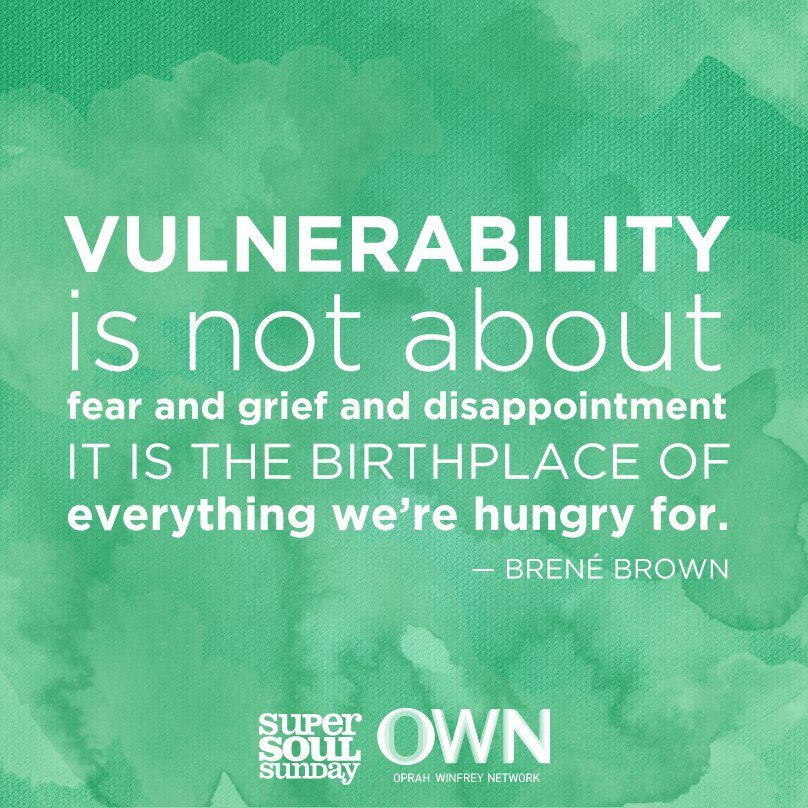
Day 2 Reflection: Vulnerability

 For the #UULent reflection list, look here.

If I make myself vulnerable, I could get hurt. People could laugh at me. I might fall in love and get my heart broken. People will think I’m stupid. I could make a fool of myself.

We fear being vulnerable. The fear likely comes from our most primal selves, where vulnerability meant a life prematurely ended by animal attack or fights with other tribes. Our bodies have evolved to make fear an experience we run away from, ensuring our survival. The experience of this fear makes our shoulders shrink into ourselves, makes our skin crawl, our stomach hollow, our heart pound. Most of us want to avoid that feeling, or at least control the feeling by riding on a roller coaster where we know the risks are limited by the design of the ride.

Focusing on our fear of hurt — and vulnerability to hurt — paints all the potential hurts with a big red brush. Being laughed at is equated to death. Worse, the focus isolates us from the risks we need to take to grow and evolve and flourish.

If I make myself vulnerable, I could get hurt. People could laugh at me. I might fall in love and get my heart broken. People will think I’m stupid. I could make a fool of myself. But if I don’t, I will be lonely. I will not experience love. I will not grow. I will not strive for new goals. I will not embrace my humanity. I will not truly live. 

*****
If you want to learn more about the importance of being vulnerable in one’s life, look for Brene Brown’s material on vulnerability.  Here is a good start.

Poem and Origin

You break me in this place
Of aborted dreams, this ice
Wrapped around age seventeen,
My missing innocence,
The fear, the blinding fear
That I should love you with this sullied heart.

You remind me of what I haven’t known —
Beam of light in the dark,
Holding pure secrets,
Embracing my dichotomy
And fear, this blinding fear

That I should love you with my sullied heart.


When you realize that crushes, the crushes that started at an entirely too-young age, that persisted through your marriage to a very patient husband, are all ways of trying to break through the dichotomy that permeated your childhood:


I am innocent/I have been used sexually.


Now, as an adult in my fifties, that pattern of seeking someone’s attention as a mystical cure for a secret affliction continues. I learn more and more every time, and I hope to reach an escape velocity from it soon.


The world assumes that those who have been sexually abused as children have somehow invited it upon themselves, that they have somehow lacked the innocence that would have stopped an abuser otherwise. The child accepts this judgment and judges themselves as someone worthy of hurt, and if the child is female, the purity culture surrounding them proclaims them soiled.

I blocked my memories throughout my childhood, only remembering them in adulthood. So I felt sullied but didn’t know  why, and when I hit adolescence, I needed that proof that I was still loveable. And all those other things I felt I was lacking — beauty, personality — got rolled up with the damage from my abuse.

Facing my fears (writing related)

My worst fear about writing is that, after developmental editors and publishing coaches, I will be left with this choice: Write what I love or get published.

I have gotten several rejections by agents. I don’t know if anyone will read me if I self-publish, because I’ve never been good at self-promotion.

There, I said it.

This has been my fear all along, that I will hit a dead end in my writing career — and yes, I think of it as a career, or at least the start of a career.

If that’s the worst thing that can happen, what are the possibilities?

  • I keep trying to find an agent, with the great possibility that revising my query materials will not attract an agent.
  • I self-publish, trying to get a readership on my own, which scares me to bits, because I hate self-promotion. I am convinced there’s a psychological disorder called “Midwestern Female Syndrome” in which sufferers display inward perfection while at the same time striving to look mediocre to others
  • I give up writing novels, because it’s really a waste of time to write novels that nobody reads.

I don’t have more than three possibilities in my mind. My mentor Les says that’s a bad thing, because there are always more than two options. I, however, cannot quit until I’ve exhausted all avenues.

On the flip side, how would I measure success?

  • An agent, and eventually a publisher if going the traditional route
  • At least 1000 copies sold of a self-published book, without having to resort to buying the books myself and reselling them
  • In the short run, at least breaking even on the investments I put into coaching, editing, and other items.
My vision, or where I would like to be:
  • Money to supplement my retirement in 10 or so years
  • A devoted readership
  • A book signing tour 
  • The confidence to say I’m an author
I think my goals are realistic — perhaps too modest, but realistic. 
This is where I am, world.
If you could send encouragement (non-anonymous preferred), prayers, wishes, or advice I’d greatly appreciate it. 

A little of what I’ve been writing today from Prodigies.

After what seemed to be a dozen iterations of the plan and all our roles — Ayana and Weissrogue as the elderly couple, Ichirou and I as the starstruck lovers, Greg infiltrating the sound system — it was time to sleep and reconvene early in the morning. I talked everyone into letting me use the hide-a-way couch in the living room, given that I didn’t think I would sleep much. This left Ayana with Greg (another of my motives) and Ichirou with Weissrogue.

As I had predicted, I didn’t sleep. Every significant event of my journey to this moment unfolded in my mind: The invitation to Poland. Finding Ichirou, looking helplessly young in the darkened room as he spun the most comforting moment I’d had in my life. The uneasy dinner with Second World Renewal; our escape down the fire escape and into the old city of Krakow. The waiter, who ended up being Greg, and our journey with Ayana from Poland to Denmark, chased by Second World’s men. After a hiatus, Ayana returning with a much more mature Ichirou, and our confrontation with someone’s — someone’s men. My death —

That was what bothered me, what kept me from sleeping. I was not afraid to die because I had died already.

I had died already, and I knew what to expect. My death was a comforting place, deep indigo and silver, and a place I yearned to go back to. I didn’t want to die again, really; I just wanted to go back there. Especially tonight, with all the times we fled going through my mind like a video montage.
I thought about the place, the silver-laced grass and the rabbit, my parents walking past me. My death.

No, I wasn’t scared.

I fell asleep and dreamed of that place, deep purple with silvery leaves that ruffled in the breeze. I lay down in the grass, and the rabbit nestled next to me. My parents did not cross the hill, nor did Ichirou come, and a touch of loneliness marred my meditative state.

Then the rabbit hopped up to my face and chided me. “Do you think you can live here forever?”
“I could, rabbit,” I breathed. “Here I would never have to deal with being rejected. Death won’t reject me.”

“Death won’t nurture you, either. If you stay for long enough here, you will never grow any more than you have now. You will never develop your talent, and you will never be loved or nurtured again.”

“I’ve never been nurtured, and I’m not sure I’ve been loved. My parents farmed me out to music schools, and I don’t know if they were in league with the Renaissance movement. And I never will know.” I sat up, not questioning that a bunny spoke to me, because this was my dream.

“What about Przymeslaw? What about your traveling companions? What about Ichirou? And Dr. DeWinter?” The rabbit washed his face with his paws.

“I don’t know who’s side DeWinter is on. For all I know, she’s part of Renaissance. I don’t trust anyone from Interlochen now.”

“Trust somebody. You need something to pull you out from this place or else you’ll be always in danger, like Ichirou. I’d point out, though, that he’s less in danger than you are, because he’s reached a hand out from his place. Have you reached a hand out from yours?” And with that, the rabbit wandered off, sniffing the silvery grass as he bounced away.

I woke up to find Ichirou standing over me grinning ruefully. “May I come in? I can’t get to sleep.”
I held my hand out to him and we cuddled until we created space for each other.