On January 2nd, I made a vision board — or rather, a vision book, as I didn’t have any place in my room to post poster board.
What is a vision board?
A vision board is a motivational tool using pictures and sometimes text to render what’s most important to a person into visual form. This can be done in poster or book form or online, and could utilize photos, clip art, or other visual symbols.
How does it work?
Many proponents of a vision board believe in the Law of Attraction — that we can attract good fortune. I do not, largely because it seems selfish to me. I tend to believe that it helps me to focus on my goals and, thus, helps me to motivate toward what I think is most important.
What does my vision book look like?
It takes up six pages of a larger book that I should be documenting my success in. The pages are: Writing, getting published, marriage, teaching, research, and time management.
Does it motivate me?
When I first made it, it greatly motivated me. It felt like a ritual, and I’m a great fan of rituals. Now, a month out, I feel I need to look at them again, maybe on a daily basis.
Do I need to make a ritual to look at it daily?
Most certainly yes. Or make an actual board to hang on the back of the door.
Tag: goals
Stretch Goals (Personal development)
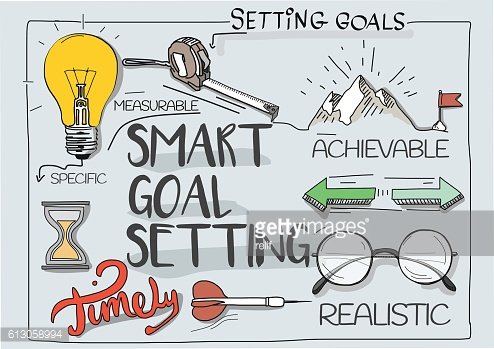
I know I’ve talked about SMART goals — all our goals should be Specific, Measurable, Action oriented, Realistic, and Time-bound. It’s good to write these down to have something to refer to and direct your energy.
- I am nearing 1000 followers on Twitter. Now I would like to see 2k. I now plan I will acquire 2000 followers by June 1 through a combination of getting my name out there by making and following and liking posts, and following others.
- I have just finished the developmental edit stage of my WIP. My next stage is to find beta readers, then collect their comments and edit some more. (This goal has not reached SMART goal status; notice I haven’t developed it enough to make it SMART)
Wishes are the first step
I’ve been thinking about wishes, largely because I tend to look down on them as impractical. The truth of the matter is, the impetus for goals comes from wishes.
What are wishes?
This is easy. Wishes are thoughts about what we want to happen. They are the expression of fantasy. Fantasy is a video clip of our desires, wishes are the sound bite.
Fantasy, as well as the resulting wishes, come from our values, which in turn come from our emotional and cognitive responses to formative experiences, some of which are transmitted to us by our childhood interactions with caretakers.
I grew up in a creative family — my mother took photographs and designed multimedia projects and my dad did woodworking. Thus I learned that creativity was valued in my family, I learned from my teachers that I had a skill for writing. These developed my value that getting recognition for creativity was important.
I fantasize about getting a book contract. It’s a movie in my head. From it I extrapolate the wish to get published.
Wishes are translated into goals
We have limited resources and abundant wishes, so we have to prioritize which ones we act upon. When we decide to process a wish into steps we can act upon, it becomes a goal. So my raw goal is to get published.
Goals are then clarified
We can’t act upon goals until we’ve clarified two things:
- what resources (time, money, etc.) we can allocate to fulfill the goal
- actions to take to fulfill the goal
- Specific: Yes, I covered the query questions above
- Measurable: “book traditionally published” is measurable
- Relevant: I think so
- Time-bound: Yes
- Achievable: here’s the big problem. This goal has nothing to do with what I can do, but a result that’s out of my control. I need to rewrite this goal into one or more goals that will be things I can take action on, which I have articulated here.
The goal becomes the plan
Because I have done the prior steps, I can act upon those specific goals. The goals inform the plan, which is the series of actions that it will take to fulfill the plan.
Then it’s time to act.
You have a trajectory, a time limit, and the steps toward winning. Now it’s up to you.
Without goals, our wishes flounder. But without wishes, we have nothing to make goals from.
Practicing my query synopsis for Whose Hearts are Mountains
Anna Schmidt, a shell-shocked anthropologist, searches cross-country for the origin of an elusive folk tale in the wilds of the former United States. She holds her own secrets as the daughter of the premier cryptologist of the era, on the run by her deceased stepfather’s urging. She finds tantalizing hints of the tale, threats to her life, and unlikely connections — and a threat against humanity that only she, with her knowledge of cryptology, can solve.
Better get over this burnout quick.
My brain needs a rest.
I think I burned myself out doing 50 hours of editing Gaia’s Hands in ten days. My brain definitely needed a break. Then I’m in the busy part of my semester, and have graded 45 final projects and 25 papers in the last two weeks. And put together my classes for next semester.
I think maybe I’m a little burned out on everything. I tend to want to sleep a lot, even though I’m not depressed. It’s a good thing that I have a week off for Thanksgiving next week, then a week of finals, and then Christmas.
I’m not going to let the burnout last long. I need to think of a project — maybe editing Whose Hearts are Mountains before a dev edit. Maybe editing a story or two for submission, or even writing a new story. Someone suggested I turn the short story Hands into a novel, but I think that would require a research trip to Poland, where I don’t know the language nor what I’m looking for.
I’m trying to find my direction forward, and it’s harder now that I’ve calmed down about getting published. I should go back to my goals and see if I need to revise or add or just get cracking on them.
Dreams vs goals
I’ve been pretty mellow lately about my writing, getting my enjoyment from editors telling me how to improve. This is my most noble self, but my sanguinity even in the face of rejections doesn’t motivate me to push myself — for example, I haven’t sent queries lately. I haven’t finished editing Whose Hearts are Mountains (although that may need a developmental editor).
- Write/submit 5 short stories/poems/flash fiction by December 31, 2020
- Get Whose Hearts are Mountains into developmental edit by March 1, 2020
- Send 50 queries for Gaia’s Hands by February 1, 2020
- Send 50 queries for Apocalypse by August 1, 2020
Day 18 Reflection: Focus
I’m beating my head against the keyboard facing this topic, wondering how I can write about this without stating the obvious: We need focus to fulfill our goals.
We have valorized focus, declaring it a quality that leads to greatness. However, too many things disrupt focus: background noise, mental distractions and worries, a cheesecake staring one in the face, too much challenge in the task, even the amount of sleep one has gotten the night before.
It is not always possible to be focused. It’s often the case that people are too scattered, or too worried, or too overwhelmed to focus. It’s time to ask for help, take a break, get a good night’s sleep, put away the cheesecake, and try again.
Fantasies, Aspirations, and Goals
The average self-publisher sells about 250 copies of their work.
Hearing this statistic floored me. I have no doubt that it’s accurate. It’s just that — that’s not a lot of copies. I thought I was being conservative when I set a goal of 400 copies if I self-published.
I thought I was being realistic when I ruled out thousands upon thousands of copies and the New York Times bestselling list. It turns out that my scaled back fantasies — even the 400 copies if I self-published — are too unrealistic. Without realistic grounding, our aspirations are set by our fantasies, and our aspirations in turn set our goals.
It’s time for me to figure out how to pare back my goals, fueled by fantasy. My fantasy was that I would have an agent and would find a publisher of size (say, one of the Big 5) and go on a book tour where someone else made the arrangements for me and I didn’t have to buy my own copies to sign and sell.
In a way, this is freeing. This makes me realize that having 20 readers of my blog is perhaps normal, and that the agents who reject me need to so they don’t starve, given the odds of someone picking up a book and reading it.
It also means that I will never get external validation of my work if I gauge success by my fantasies. How many readers is “enough” if the average self-published book gets 250 reads? What does a rejection mean if the object is not quality but saleability?
My goals will stay the same:
- Get picked up by an agent or publisher, avoiding vanity presses and publishing mills
- If the above doesn’t work, research and develop an effective self-publishing strategy, avoiding self-publishing scams
What changes are the standards for success. I’m still working on scaling down my expectations. This will be difficult.
Getting from goals to accomplishments
Sometimes I write in this blog when I don’t seem to have a lot to say. It’s not because I love to hear the sound of my “voice”, although some would argue I do. Rather, it’s to keep a routine going so I don’t lose a good habit.
Routine is what helps us develop good habits. That, and a reward for doing them, since in the short run doing what we’ve always done feels better. Habits, as unglamorous as they are, are what turn long term goals into accomplishments.
As a professor teaching positive psychology and behavioral economics, I have an interest in the whole idea of how to change habits. The behavioral economics idea behind behavior is that we’re naturally going to choose the immediate reward over the long-term benefit. There’s proof behind this; behavioral economists (including my favorite, Dr. Dan Ariely) do research to support their hypotheses, like any good professor.
I am trying out a program called Fabulous, which helps people develop good habits. It is based on behavioral economics, and Dan Ariely is one of its driving forces. The program uses environmental cues (such as putting your sneakers by the door if you’re training yourself to exercise), social cues (reminders on the app and encouragement), repetition, and rewards (praise and leveling up). I’m not necessarily going to recommend it, because membership costs $50 a year, but I think the reasoning behind it is sound, having read some of the research myself.
To go back to my blogging habit — I have writing on my daily to-do list, along with one hour of writing activities daily. I set aside some time each morning to write; my computer is my environmental cue.
And my reward? Reading the stats on my Blogger page to see people from many different countries reading this blog.
Facing my fears (writing related)
My worst fear about writing is that, after developmental editors and publishing coaches, I will be left with this choice: Write what I love or get published.
I have gotten several rejections by agents. I don’t know if anyone will read me if I self-publish, because I’ve never been good at self-promotion.
There, I said it.
This has been my fear all along, that I will hit a dead end in my writing career — and yes, I think of it as a career, or at least the start of a career.
If that’s the worst thing that can happen, what are the possibilities?
- I keep trying to find an agent, with the great possibility that revising my query materials will not attract an agent.
- I self-publish, trying to get a readership on my own, which scares me to bits, because I hate self-promotion. I am convinced there’s a psychological disorder called “Midwestern Female Syndrome” in which sufferers display inward perfection while at the same time striving to look mediocre to others
- I give up writing novels, because it’s really a waste of time to write novels that nobody reads.
I don’t have more than three possibilities in my mind. My mentor Les says that’s a bad thing, because there are always more than two options. I, however, cannot quit until I’ve exhausted all avenues.
On the flip side, how would I measure success?
- An agent, and eventually a publisher if going the traditional route
- At least 1000 copies sold of a self-published book, without having to resort to buying the books myself and reselling them
- In the short run, at least breaking even on the investments I put into coaching, editing, and other items.
- Money to supplement my retirement in 10 or so years
- A devoted readership
- A book signing tour
- The confidence to say I’m an author