I dream of the first emerging sprouts speaking to me.
The stretch of the first seedling breaking through the soil with the tiniest pop assures me that change is possible. And each seedling, each plant, has purpose. The lowliest weed has purpose — dandelion makes a wine whose pale nectar will break your heart. The scrubby lamb’s quarters tastes better than spinach, and purslane is rich in Vitamin A and Omega-3 fatty acids. What is toxic to man may treat your illnesses — the toxic foxglove can be processed into digitalis, a heart medicine that you might have heard of. Even the otherwise useless Cannabis sativa* is a bioaccumulator, pulling heavy metals from the ground and sequestering it in its leaves.
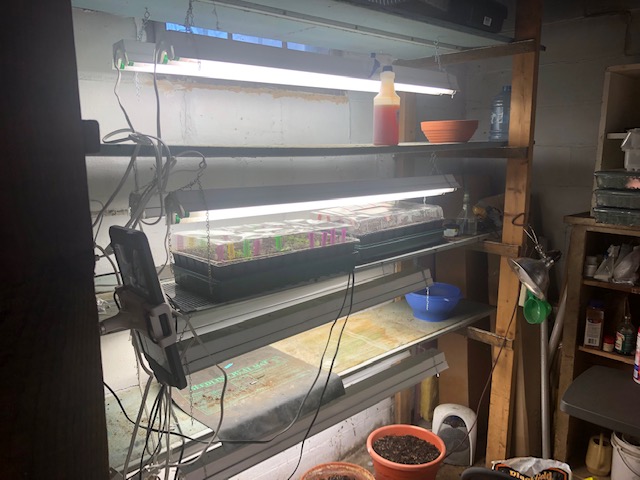
My basement is full of seedlings to go into my summer garden. They live in the former coal room, now a room of grow lights and reflective insulation material on the far wall, with a window that the law enforcement officials can look at and make sure I’m growing tomatoes. This may not be enough.**
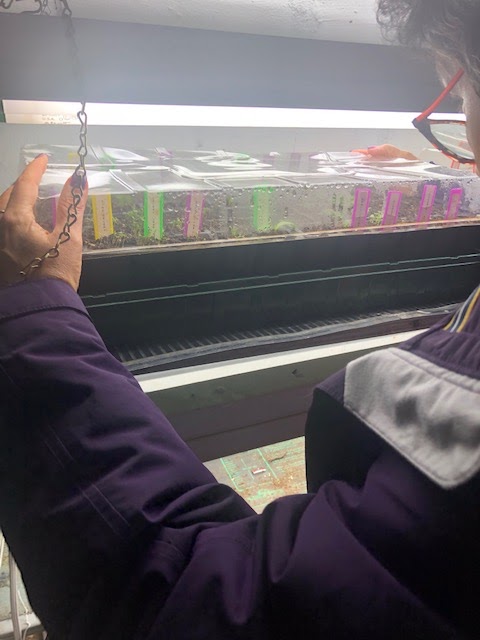
Right now, the tomato/eggplant/pepper plants are partying on the top shelf with the cardoon which I thought I wouldn’t get to grow. The perilla seedlings are numerous and vigorous. Hablitzia, yarrow, pinks, and savory are popping up a little more leisurely, and I still can’t get sea kale to grow from seed. The basil — I’m a basil fanatic, but I still may have to give some away. That’s not all the seed flats — I am nearly out of room on my plant shelves, and there’s a dwarf lemon tree I hope gives me lemons for lemonade someday.
At night, when I go to bed, I imagine I hear the plants sighing in their sleep. When I feel down, I contemplate sneaking down to the basement and joining them in the dark. But I am human, and cannot sleep in a garden bed, so I wish them a silent goodnight.
***********
I’ve gardened since I was about five years old, when my second cousin Dale Hollenbeck gave me a plant of his that was dying to see if I could nurse it back to health. I did, and I did the next one he gave me. I had a lot of failures, largely because of my lack of understanding about soils — it turned out that Illinois’ hardpan soil wasn’t a great planting medium for cacti — or much else. It was at that point that I wanted to learn anything I could about plants.
My neighbor Johnny Belletini, who was somewhat of an adopted grandparent (I adopted him), taught me one day that weeds weren’t nameless and had uses people didn’t know about anymore. I was fifteen; he taught my his recipes for dandelion greens and dandelion wine that day, and I made my parents leave the lawn unmowed until I picked all the flowers to make dandelion wine***. We did everything wrong, but the result (don’t ask me how I know) was a sacrament, sunshine in a glass.
When I was seventeen, my second cousin Francis Koenig**** worked in a state park for a while and had an encyclopedic knowledge of those previously nameless weeds. At the time, I had begun my lifelong interest in edible plants. He would visit me at my parents’ house, and my family would sit mystified as he and I talked about plants — their genus and species names, appearance, habitat, and uses.
Nowadays, I have an odd quest, and that is to landscape my entire yard with edibles. I have raised beds for annual vegetables and for perennials, I will add edible weeds (tastes like spinach) like quinoa and orach and giant lamb’s quarters, and I will add herbs to the rubble-and-dirt hill by the stairs to the backyard.
Many of the edible plants I’ve never eaten before. The moringa thicket in a pot in the basement apparently has excellent nutrition for a green tree, and the scarlet runner beans are a favorite in Britain. But I’m fascinated by vegetables and fruit that can’t be found in a grocery store, just as I am interested in people and places you couldn’t find near a shopping mall.
Later this spring, I’ll give you a virtual tour of my garden (if I can get my SketchUp software running on a four-year-old Mac with no graphics capability to speak of. If you want pictures, let me know.
Thanks for keeping me company.
******************
* I do recognize that C. sativa is not useless; I was just having a little fun. The plant has proven useful for wasting syndrome PTSD, chronic pain, muscle pain, glaucoma, and mental health issues. (Grinspoon, 2018). In addition, it is used as a sacrament in the Rastafari religion.
** There is also a window where any curious law enforcement officer can look into to assure themselves that there is no Cannabis grow operation here. I still feel a certain sense of unease about having a grow room in my basement. I’m not kidding. Not Marijuana
*** I made my first batch of wine at age 15. I did my research first — although there was a law against drinking until age 21, there was no law against making wine at any age unless you made over 200 gallons a year and/or sold it.
**** Francis Koenig died of drowning in 2009. I point this out where I otherwise would have because 1) he was family and 2) he lived lonely because of his neurodiversity. I believe he was on the autism spectrum, as he worked at a sheltered workshop until he retired. I want you all to see that the neurodiverse have lives and feelings and deserve to be members of society to the extent they feel they can. Thank you, Francis, for telling me that hawkweed had edible roots — I look for it often, and I think of you.
************
Grinspoon, P. (2018). Medical marijuana. Available: https://www.health.harvard.edu/blog/medical-marijuana-2018011513085. [March 13. 2018].

 Words Like Me