Getting back into writing

I haven’t written much in the last few weeks, what with working with my dev editor, traveling for New York Hope and training in advanced moulage, prepping for work, and finishing my first semester of grad school. Now it’s two days before the beginning of the semester, I’ve got no prep to do, and no excuses to do nothing. (I don’t watch tv well, and there’s only so much looking at cats on Instagram I can do.)

So I’m taking the advice I’d give someone else — write something every day. This means in my case to get reacquinted with Whose Hearts are Mountains. I don’t know how I feel about that book at the moment. It’s in the Archetype universe, and I’ve had such trouble understanding how to improve the first book(s) in that universe, Mythos and Apocalypse (which I am thinking of putting together). I don’t know if it’s sellable, and I don’t know if I care.

It might be that I keep working on Whose Hearts are Mountains, send Mythos to my dev editor (Hi, Chelsea!) and figure out things from there.

But I need to write. Every day,

Hope Part 2

My mantra:

“You may find a sweeter outcome than you’ve imagined.”

I don’t know what I think about this mantra that has popped into my head. On one hand, I fully expect another round of rejections like the one I got yesterday, less than 24 hours after I sent it. On the other hand, I have a pretty vivid imagination. I imagine a multi-book deal and a book-signing tour for which I would have to get book-signing clothes, and friends who want to read this book.

Realistically, I don’t think that’s going to happen. As a friend of mine said, publishing is a punishing business. It’s true. I need the hope to get through another round of queries, hoping that an agent will bite. Which is the first step to getting published, because there’s no guarantee that a agent will take you on after they’ve asked for more material.

The other piece that gives me hope is that I’m already an artist, already a writer. I don’t have to get published to be one. I write, I get feedback, I improve my work, I try to get it published. I am serious about what I do. I am a writer, and all the publication route does is make my work available to other people, and gives it some sort of seal of approval so others take it seriously.

I have a friend (as much as one can be when the entire friendship is me commenting on his Instagram posts) who has been busting his butt to get recognition for what he does, and he finally says he’s broken a goal. He hasn’t announced it yet, but I’m sure it’s good because he was almost speechless in his Instagram post.

I’m proud of him.

I hope I will be able to make that kind of announcement someday.

Hope

What do I write about when I feel I’ve written to you about everything?

How about hope?

Hope, depsite what most people think, is not a wish that someone makes that something will happen. It is not a belief that something specific will happen. But it is a belief that something positive will happen.

There is a big difference between those items. A wish is a petition to an external grantor — God, the wee folk, Fate, the Goddess of one’s choice. The wisher washes their hands of agency and often blames the external grantor if the wish is not fulfilled. For example, “I wish I would get published” gives the responsibility for my getting published to The Powers That Be, who so far have failed me. Bribery — “I’ve been good, God, where’s my cookie?” — is also a danger to wishes (and very specific prayers) and ends in disappointment.

Believing that something specific will happen takes the onus off a god figure, but provides only one narrow possibility for fulfillment. This time the fulfillment is in the hands of a worldly grantor: “I wish Tor/Forge would publish my book.” There’s only one way for this to be fulfilled, and how good my book is doesn’t enter into it, nor does whether it’s something that fits their imprint. Worse, if I receive this, I will never believe my worth if it happens. (Ok, maybe I would.)

For the final part, I’d like to share an old joke with you:

Sven prays every Sunday in church that he will win the big lottery. Week after week he prays, and week after week he fails to win. One day, he prays: “Lord God, I have prayed in church every week to win the big lotto, and I don’t win. Have you forsaken me?”

A big booming voice rocks the whole church building: “Sven, buy a lottery ticket.”

This joke has a lot to do with hope as it really exists. Hope is, first and foremost, a sense of positivity around the situation. It doesn’t provide a script for what should happen, but opens our eyes to what could happen.

For example, if I hope for the way to open (Old Quaker speak) toward getting published, then that can be fulfilled in many ways — through finding beta-readers after a year of searching, finding a developmental editor in my Camp NaNo cabin, finding my way through a knotty plot problem, getting an aha about a query letter, getting an agent, etc. I might not have seen any of these developments as progress if I saw hope as granting a wish or demanding the universe deliver.

Hope is thinking, “This could happen” every time I send a batch of query letters, hooking up with a developmental editor despite my fears that she’ll feel my manuscript is crap, looking at the latest message from one of my betas and thinking about how to improve something.

If you’ve been reading this, you know that sometimes I feel hopeless (and sometimes I am hopeless). But then I rise again, and hug hope to my chest for another round.

Keeping the Dream, Fortifying the Dreamer

I am in love with the world “potentiality”. According to Merriam-Webster (2017), the word means “a chance or possibility that something will happen or exist in the future.” When a writer puts something out there, whether it be sending a manuscript to an agent or posting on Wattpad (shameless plug: I have a short story collection developing at https://www.wattpad.com/user/lleachie), they are activating potentiality. The possibilities for getting noticed or getting published in a crowded field of manuscripts are small, but the dream is great. 
And then the agent rejects the piece with the common “It’s not you, it’s me. Keep writing”, or the story moulders on Wattpad …
It’s easy to become dejected, call yourself a failure, believe you’ll never be published, want to give up. But if you’re a writer, you can’t. You just can’t.
Writer, do not give up the dream. Do not buy into the belief that your only hope to be noticed is wishful thinking and a SEO guru. Don’t focus on fame (although wouldn’t that be nice?), but focus on the experience of getting further than you have before and having new experiences and learning. Create your own goals and stretch yourself to make them. Fortify yourself with what your writing means, that it’s important, and that the world doesn’t always honor what’s important, focusing instead on what is loud and flashy.
Maybe the goal in letting your writing out into the world is to release it and see what happens. Does it change a person’s mind? Does it get you on the stage at an open mic? Does it turn you into a blogger? Where does it lead you? 

Dusting myself off and trying again

It looks like I’m going to subject myself to another round of the Kindle Scout campaign process.

I’m just finishing one more edit of the book Voyageurs for a possible Kindle Scout campaign. It, like Gaia’s Hands (which, with fewer than 15 days left, will not make the cut for publication), is a standalone book for the moment. Voyageurs doesn’t happen in the same space as the Archetype series, so it wouldn’t break up a series (which would make it unattractive to an agent).

Voyageurs is very different than Gaia’s Hands. Where Gaia’s Hands is a delicate, pastoral slice of magical realism, Voyageurs features the sardonic daredevil Kat Pleskovich and the bookish Ian Akimoto from the disastrous ecological future called The Chaos. What begins as a string of suspicious deaths among the Travellers, or time-jumpers, becomes the uncovering of a plot to destroy the world.

Although it would be easy to dismiss this book as a time traveller romance, I’ve skewed things a little too much to use that label comfortably. Present-day Kat’s streetwise manner and her prickliness make her anything but the girl who needs a big man to protect her. Ian from the future, frail and bookish, has more empathy but a tendency to try to ingratiate himself to Kat. Their mentor, Berkeley, is a frustratingly droll time historian who revels in the Socratic Method. The bad guys? You’ll have to read the book.

I would call this book a crossover — soft SF with a touch of mystery and a relationship that helps pull things together.

If you have any ideas about the timing of the book campaign, please let me know.

Thank you for sticking with me!

Hope Springs Eternal: Querying again

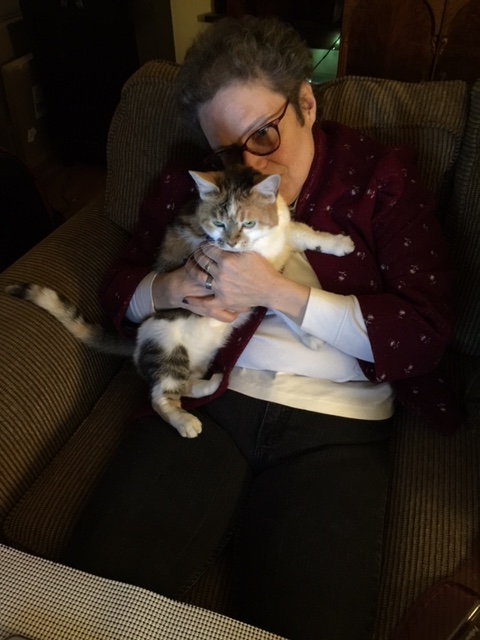
Spring must be coming. My cat Girlie-Girl is standing on my chest while I write, some of my seedlings are coming up for summer, I’m dreaming frisky dreams that are too graphic to write about, and I’m querying again.

Girlie LOVES being held, doesn’t she?

I’ve sent four or five out yesterday, and I felt good about it. This is the stage of querying agents that is fun — the part where I get to brag about my novel. This time, it’s Mythos, which starts with a woman’s missing memory and ends with the upcoming Apocalypse.

Here’s the beginning:

In the waning light of a Chicago summer evening, a male rested his back against a light pole and gazed at the indigo horizon over the lake. The breeze from the lake caught a strand of his dark hair and blew it across his face. He gazed up at the concrete horizon to see a form falling, falling from a good height. He squinted, and then raced down greasy streets to its impact, his nerves on edge, his heart barely pounding. 
He arrived at a dead end where a woman lay sprawled, her head pillowed by a cat that had been crushed by the impact. Just behind her stood a rusty dumpster in front of a wall, which amplified the smell of dying. 
He knelt in one flowing movement. He checked her breathing – she breathed still, steadily, as if she slept. He, of anyone on Earth, knew she did not sleep. 
The man leaned closer, and his face brushed against curly blonde hair. He could smell the sharpness of blood. “Can you hear me? Let me know if you can hear my voice.” No response.
 He did not touch her so as not to injure her further. He did touch the cat, black with a white locket, whose labored breath indicated certain death. He whispered to it, “Well done, brave cat. You have saved this woman’s life.” The cat purred.
He leaned again to whisper in the woman’s ear, his hair falling in his face: “Please do not die. We have just met, but I suspect you are the most important being in my life, my love.” He stroked her hair and murmured words of comfort. Tears ran down his cheeks. 

p.p1 {margin: 0.0px 0.0px 8.0px 0.0px; font: 12.0px ‘Times New Roman’}
When the sirens approached, he froze for a second. 

Then he dissolved into nothing.

**************

The less fun part of querying, of course, is getting rejections. I’ve never not gotten one. Every time I go through a round of rejections, I swear I will quit querying. But I keep writing, and I keep querying. And spring keeps arriving.