Day 45 Reflection: Loneliness

Society treats loneliness like a character flaw: “You’re lonely? What are you doing sitting around? Go out and meet people.” As if a birding club will remedy the ache in one’s heart.

Ironically, loneliness is inevitable in today’s society. Our jobs take us far from our families, and often cause us to move before we’ve settled us into a place. Unless we buy a home, and often we can’t afford buying a home, we live in apartments where our neighbors move in and out. We spend our free time online, where we measure our friendships by “likes” and seldom have deep conversations. We meet our potential partners by swiping right, judging them by a picture and a blurb.

We spend our quiet times nursing the ache in our hearts.

In our solitude, we attribute our loneliness to personal flaws. We come up with erroneous reasons for our loneliness, isolating us further: We are too much this, not enough that. We are strange. We are not worthy. Our isolation increases. 

We can ease our loneliness, perhaps even with the facile “go out and meet people” that society offers, but it will be hard work because we are swimming against the isolating currents of our society:

Sit in public places, even if you sit alone.  Turn your attention outward, again and again. Say hi to people who notice you. Ask to pet people’s dogs.

When the sting of loneliness eases a bit, find reasons to be around people. Volunteer. Find a group that’s exploring something you’re interested in. You will not like everyone you meet in these opportunities, and that’s okay.  The object is not to find one person who will keep you from being lonely, but to help you see that you are part of humanity. Friendship will come later as you find yourself in proximity with people you click with.

We were meant to be with people, even if our society makes that harder, even if our beliefs about ourselves and our loneliness make that harder. 

Day 2 Reflection: Vulnerability

 For the #UULent reflection list, look here.

If I make myself vulnerable, I could get hurt. People could laugh at me. I might fall in love and get my heart broken. People will think I’m stupid. I could make a fool of myself.

We fear being vulnerable. The fear likely comes from our most primal selves, where vulnerability meant a life prematurely ended by animal attack or fights with other tribes. Our bodies have evolved to make fear an experience we run away from, ensuring our survival. The experience of this fear makes our shoulders shrink into ourselves, makes our skin crawl, our stomach hollow, our heart pound. Most of us want to avoid that feeling, or at least control the feeling by riding on a roller coaster where we know the risks are limited by the design of the ride.

Focusing on our fear of hurt — and vulnerability to hurt — paints all the potential hurts with a big red brush. Being laughed at is equated to death. Worse, the focus isolates us from the risks we need to take to grow and evolve and flourish.

If I make myself vulnerable, I could get hurt. People could laugh at me. I might fall in love and get my heart broken. People will think I’m stupid. I could make a fool of myself. But if I don’t, I will be lonely. I will not experience love. I will not grow. I will not strive for new goals. I will not embrace my humanity. I will not truly live. 

*****
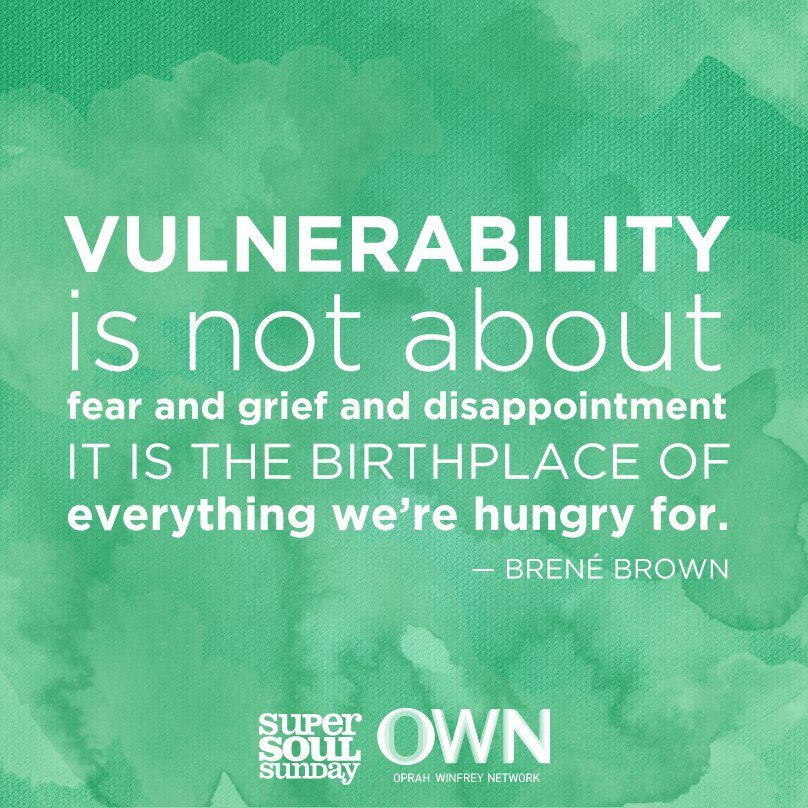
If you want to learn more about the importance of being vulnerable in one’s life, look for Brene Brown’s material on vulnerability.  Here is a good start.

A Place I’ve Never Written About

I’ve been reading a lot about “incels” — men who call themselves involuntary celibates, but who have such a repulsive worldview of women that it’s understandable why they’re not finding partners. They look at unattainable women as bitches and women who enjoy sex as sluts and women who are involuntarily celibate as cows. In other words, they’ve dehumanized every possible woman they could have bedded. Naturally, they’ve taken to valorizing men who kill as many as these women as possible.

When I was younger and single, I had a lot of what would be called dry spells. I was appealing only to a select group of people, many of which were interested because “fat girls are easy”. (Note: we’re not.) I once even called myself celibate, until a sassy friend said, “There’s a difference between being celibate and not getting any.” So, as you see, I was in the same boat our incels were in.

I didn’t become a man-hater, although I’ve always been too much of a feminist to give in to “fat girls are easy” and too proud to gush over any guy who looked at me. So I took matters into my own hands.

I fantasized about a place of solace.

I named it the Brigadoon Sparrowhouse, “Sparrowhouse” for a place where free spirits, which I had nicknamed “sparrows”, lived, and “Brigadoon” for the play about a mysterious village that appeared only every seven years.  In my mind, the Brigadoon Sparrowhouse popped up somewhere in the west central part of Urbana, the funky area where college professors and the occasional house full of poor, progressive students lived. I didn’t know where it would be, but it would appear when the light filtered just so through the trees as they shook droplets from their limbs. In my mind, in the moments I was most in need of human contact.

The door to Brigadoon Sparrowhouse was always open to me. I would walk in, and find myself standing in the middle of the living room, a slightly chaotic place with couches and chairs, all with their newness worn down by use. The living room wore dark paneling, an artifact of the era in which the room had first been remodeled. Pillows and an afghan brightened the room, and a woven wall hanging completed the look.

I would sit on the couch and cry, soaked from the rain and feeling like I would never get warm again. I would grab the afghan and curl up in it. I was alone; it was always a chance I took going there.

Soon, someone would show up, someone who was free and not currently connected with someone. Usually, it was Mark, who looked gloriously unlike the people I knew. He was tall and thin, with waves of auburn hair pulled back in a short ponytail. His face was narrow and pale and Irish; his eyes nearly the same color as his hair.

“You’re freezing,” he would say and wrap his arm around me, hugging me close.

“I got caught in the rain while I went walking,” I would stammer. “I didn’t know where I was going.” Often, I would think, I didn’t know where I was going.

“Something’s up, then,” Mark would say. “Tell me what’s up.”

I would tell him what was up — I felt like I was wrapped in a bubble and unable to talk to other people; I looked at the shining beauty of a friend and couldn’t reach them; I believed that nobody would ever love me.

“We love you,” Mark would say with his arm around me. We. The Sparrowhouse.

Sometimes Mark the sparrow and I would make love, up in his bedroom, a chaotic room with white walls, a mattress on the floor and a chest of drawers with sacred objects on its top — a stone with a hole, a cowrie shell, a bowl made of stone and a feather. Our union would grow out of a discussion, and tears, and solace. I felt the poignancy, because the sex was borne of agape, not eros or ludus — it was a gift, a reassurance that isolation would not be forever. It was not charity, but humanity answering humanity.

I did not fall in love with Mark, knowing that he was a figment of my imagination, just like the Sparrowhouse, which would disappear when I stepped out of it.

Depression and how it feels

I stare out the window at a bleak landscape of snow and dead trees. I can’t go outside; the doors have drifted shut. The walls of the house whisper to me that I will always be trapped in this house and the others will leave me to die. Time passes; I can’t tell how much time, but now the walls tell me that when I die, I will have left nothing behind me. I will disappear as if I have never existed.
Nothing will change; nothing will ever change.
*****
Note: I’m not REALLY hearing the walls talk to me. This is figurative, damn it.
*****
I’ve been struggling with depression. It happens sometimes; if it persists or gets worse, I will have to see my doctor.  I don’t usually struggle with my neurodiversity  — i.e. not being wired like everyone else, which refers to a variety of mental differences one could have such as bipolar, autism spectrum and other mental health issues. However, when my moods go too far above or below the imaginary line of normal, I struggle.

You may have heard that depression is not just a “bad mood”, an accurate description. I can present to my students an enthusiastic facade. I can even be that enthusiastic, chipper person while I’m teaching. I can even “catch a mood” and feel chipper for a while afterward. But in depression, that state doesn’t last long, and I fall back to a feeling of hopelessness.

I’m ok; I’m doing what I need to do. My husband is keeping an eye on me.
Still, pop in and say hi if you’d like.

*****
It looks like I’ll still write — although I may not go the novel route for a while. I’ve never cared about getting anything else — like my poetry and essays — published, so I won’t deal with the rejection.  I’m here because I think I have things worth saying.