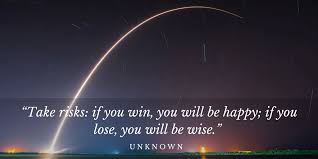
Day 3 Lenten Meditation: Risk


Without risk, there is no reward. There is only buckling in to the forces inside and outside of us.

Many examples of healthy, responsible risk-taking exist. Investing money for return on investment, dating, expressing one’s feelings, submitting creative works for publication, going up for a promotion. Confronting corruption and injustice, changing the status quo and being authentic also take risks.

Risk instills fear — of rejection, of failure, of loss, of negative consequences. Many people focus on the loss instead of the potential gain, and we call them risk-averse. Avoiding risk has its cost — lost opportunity, lack of progress, and a dearth of fulfillment. 

Choosing risk for its potential rewards may require changing one’s mindset with one or more of the following:

  • Examining the fear against the potential return
  • Believing that one will survive the worst case scenarios
  • Feeling the fear and taking the risk anyway 
Without risk, there is no reward. There is only buckling in to the forces inside and outside of us.

Day 37 Reflection: Recovery

Life passes peacefully, and then something bad happens. A town floods, a loved one dies, one’s dignity is violated. We feel lost, betrayed, angry that we have suffered this loss. 

Then comes the slow process of recovery. Recovery doesn’t come quickly; we must go through the feelings that come with loss, the anger and the sadness and the fear. There’s no going through this quickly. We can’t recover from someone else’s timetable.
 
When we recover from a catastrophic event, we do not return to normal. That place is gone, destroyed by the event. We journey to a new normal, a normal where the event fades into memory and its changes to our lives are reconciled with the past.


Day 34 Reflection: Grace

“There but for the grace of God go I.”

I hate this phrase with a white-hot passion. First of all, it paints God’s grace as favoritism that preserves some from trials and tribulations while smiting others. Or perhaps it hints at some virtue the speaker possesses that keeps a retributive God from smiting them. Or judges someone for handling their tribulations in a way that makes their life worse.

No matter, the phrase paints a deity that plays favorites in handing out grace and a world of the holy haves and have-nots. 

This is not how grace works at all. The Wikipedia entry for divine grace defines it as:

[…] the divine influence which operates in humans to regenerate and sanctify, to inspire virtuous impulses, and to impart strength to endure trial and resist temptation; and as an individual virtue or excellence of divine origin. (Wikipedia, 2015).

In this context, grace gives us resilience in life. This makes sense, because one of the purposes of religion is to give people meaning in life, particularly helping to make sense of life when bad things happen. 

So divine grace is something all of us have, whether or not we would call it that. It is the sense of greater-than-ourselves that we rely on in the face of loss. Grace plays no favorites; it does not reward some and neglect others. 

“There but for the grace of God go I” is a very comforting construct, because it suggests that God protects the believer from harm or loss. None of us, however, are immune; God does not arrange the lives of Her followers.  It’s a good thing that real divine grace exists to help us through the bad times.

More to think about.

In the last 24 hours, I got one nomination in my Kindle Scout campaign. It’s not your fault, friends; there are only 40-some of you.

Like my lack of response from agents, this is not proof that I’m a bad writer; just that I don’t interest readers.

I can’t write to the public. I feel that fiction has too many sexy couples, military maneuvers, dudebro heroes, near-invisible women, and irresistible vampires. I want to see male characters run the gamut from delicate to nerdy to comical, and not always powerful, Rich, or ruggedly handsome. I want my female characters to be strong, competent, professional, essential to the plot, and not necessarily  beautiful or sexy. I want my backgrounds to be unfamiliar yet familiar scapes — college towns, ecocollectives, vast darkness. I want pacifism against war to be my battle in a world where war vs war is the default.

The cost of this is that people in dominant culture will not be able to insert themselves into the story, and the background contains little familiarity. The status quo will not be supported. I want to open hearts, not offer up Same Shit, Differenr Day.

This gives me more to think about — am I an author if nobody reads me? If it worth the time I spend? Do I like my fantasy worlds enough to live in then without giving tours?

And what happens to this blog?

OMG, a close close call!

I organized my computer today. It’s running out of storage, and I hate iCloud and am moving my cloud storage back to Dropbox, which works more like a backup system.

The reason I hate iCloud is because it has a tendency to take forever to sync. I cannot reliably get to it as a storage medium. It’s not a backup medium. And, sometimes, I wonder if it loses my files in the ether.

Like today, when I’m moving files back to Dropbox, zipping photo files and getting rid of the originals, because I have almost no storage space left on my 5-year-old Mac. I have a really good filing system for the most part — I always keep photos away from everywhere else, and I always keep Scrivener (writing software) files in either my Scrivener folder or my writing file. But then this happened …

One of my Scrivener files went missing. This is how I learned iCloud’s uselessness as a backup.

I checked everywhere — on Dropbox, on my Mac, on iCloud, on every possible place it could have been. All I found was a 3-chapter sample, while the document I remembered was eight chapters long. Prodigies, one of my works in progress, had vanished. (Mr. Borowiec, this is the one I asked you to provide me with some Polish dialogue for. No, don’t feel guilty.)

So I panicked. Richard, my husband, did not. While I was getting weepy, he looked through his Dropbox account to see if he’d read a draft in progress. Sure enough, he had the full eight chapters. I went from anguished cry to happy cry (just as drippy but not as red-eyed miserable).

Thank you, Richard. You’re the MVP today.