Valentine’s Day — a whole lotta love (Personal)

Yesterday, I taught my personal adjustment students about love. No, not the deeper, profound experience of love. But I taught them that Valentine’s Day celebrates only one type of the seven types of love that the ancient Greeks celebrated.

So, those types of love:

  • Agape – love of humanity.
  • Storge – love of family
  • Philia — love of friends
  • Pragma – love which endures.
  • Philautia – self love
  • Ludus – flirtatious/playful love
  • Eros – romantic and erotic love.
Valentine’s Day only seems to celebrate eros, and it does so in a big, splashy, commercialized way. 
 
I want people to reclaim the other types of love for Valentine’s Day and go out and celebrate them. Galentine’s Day is a good start, for those female friends who want to celebrate each other. But we should be celebrating our families, our friends, our flirtations, the world. Wouldn’t the world be better for that?
 
If you liked this blog post, please drop me a note at lleachie@gmail.com or @lleachsteffens on Twitter.

Back from my journey

I’m back to Maryville, and back to my routine, changed. 

The things I forgot while living out here, far away from home: 

  • There are people who love me unconditionally, who don’t seem to care that I have and have always had bipolar disorder. 
  • I know how to hug and I, as a matter of fact, love hugs
  • Time passes, but what matters endures.
I don’t have too many words yet, because I am very tired still from the journey. 

I love you all.

Eulogy for a Good Man

I guess it’s okay to writer about this now — the obituary is now up; it has been posted on social media. 

My friend and mentor, Les Savage, died at 92 last Saturday. 

Les looked like a garden gnome — short, with wild white hair, chubby cheeks, and a beard. He had twinkling blue eyes, and yes, at least one person I know called him Santa Claus. Like Santa Claus, he gave the most wonderful hugs.


He’d led a fuller life than most; his reminiscences were peppered with phrases like “when I had my pilot’s licence”, “when I was in the navy,” and “when I worked in a lab in Glasgow”.  I didn’t learn until his obituary that he also could have included “when I consulted for the Apollo missions.” He was a combustion expert with a PhD in mechanical engineering who led a side business blowing up coal mines (in a controlled manner) to get rid of mine gases. He did carpentry in his basement and had wired up a house-wide stereo system long before Bluetooth made that easy. He appreciated good coffee, good wine, and good whiskey and taught me a little about each.

He also friended a motley crew of folks who needed a father figure and some emotional support. I was one of those folks, having a contentious relationship with my mother, undiagnosed bipolar disorder, and an unlucky love life that absolutely obsessed me. The group I hung out with Les called themselves Saturday Night Group because of their tendency to meet on that night to occasionally cook dinner, watch Star Trek: Next Generation, and talk. Membership rippled in an organic manner — new people showed up, some stayed, and we developed close bonds. I am still friends with many of those people, and I will see many of them at the wake.

He gave. This is what strikes me. He gave to his religious community as a communion bearer, he gave his support to the local LGBTQIA community, he gave to his “kidlings” as he called us. He did not judge us — we who were gay or pagan or atheist or struggling with mental illness or nonwhite or multiracial.  If ever there was a good example of a Christian man, it was my friend Les.

I loved the man. I still do.

Of weak coffee and wistful waiting

My coffee tastes a little weak this morning.

My husband usually makes the coffee, and he has learned to make it to the strength I prefer. He’s in Kansas at a funeral, however, and I made my own coffee this morning.

My morning routine has been broken — we usually get up around 5 AM (me bright-eyed and bushy-tailed, him not so much) and sit together for breakfast and coffee and sharing cat memes on the Internet. Now I’m on my own and it’s 6 AM and very quiet in here. I’m trying to share cat memes with Buddy the Cat, but he remains disinterested.

It’s been less than 24 hours since he left, and I miss Richard. It’s been over ten years married, and I still miss Richard.  Not in a huge heart-rending way, but in the little things. I imagine this would be a hard thing, maybe the hardest thing to bear, if he died before I did — the low-key, everyday presence. 

He’ll be home about 7, 34 hours after I last saw him. No big deal. Just … when you’re older, love is less about passion and more about sharing cat memes.

Day 39 Reflection: Love

My best lesson on love (and massage) I learned from a man named Patch Adams.

Patch, a doctor, clown, and force for delightful subversion, used to visit the university I attended, University of Illinois, where he would lead workshops as an Artist-in-Residence. I didn’t know who Patch was at the time, although all my juggler friends did, so I didn’t know what to expect when I ended up at a massage workshop led by him.

I remember being one of many students sprawled around a dimly lit community room in Allen Hall, where Patch had not arrived yet. All of a sudden, this tall, wiry guy with baggy pants and high-top shoes and a handlebar mustache bounds in ranting “You’re not touching! How can you give a massage when you’re not even touching!” 

As you can tell, I was about to go through a transformative experience.

In this workshop, we did not learn technique. We learned love, with instructions like this:

“Don’t give massage if you want to get into someone’s pants. If you want to get into someone’s pants, say to them, ‘I want to get into your pants.'”

“People need touch, and you need practice. Offer to rub someone’s back. Or even their hand.”

And the most important message: “Whenever you massage someone, think ‘I love you.'” 

This workshop happened some thirty years ago, and I still remember these things vividly. When I’m not too preoccupied with my own woes, I walk down the street thinking “I love you” to the world around me. 

This is what I remember when I think about love.


Conversation with Leah and Baird

I sit at a front table at the coffeehouse. I look out the plate glass window — outside, the incessant rain punctuates my gloomy mood. I watch two people rush inside, looking wet and miserable. The tall man shakes droplets out of his black curls and the woman, long blonde hair tangled from the storm, playfully swats the man in the shoulder. He laughs at her. “You’ll need to get a lot stronger for that to even begin to hurt, Leah.”

They look young, she just out of high school and he in his early 20’s.  They lean close to each other as they speak, not quite touching. I can feel the tension of their not quite touching, and understand their plight more than they themselves: they are young and in love, and they do not want to be.

Then the woman glances around and spies me. She taps the man’s shoulder and draws his attention toward me. They make a beeline toward my table. “May we sit down?” the woman asks. “We need to talk to you.”

It’s then I realize who they are. “Leah Inhofer,” I noted as the two sat down. “And Baird Wilkens, right?”

“Of course you know us,” Leah acknowledges as she sat down. “You’re the writer.” 

Baird brushes a lock of wet curly hair out of his eyes. “You wanted to talk to us.”

“Yes, I did,” I admit. “It’s time to write about the two of you, and I need to get a better feel for you.” I pause. “You first, Baird. You’re a Nephilim and you were born not that long ago. Who are you?”

“True on both counts,” Baird notes. “It’s been about a year, but luckily, being a Nephilim, I became very quickly. I fell into the agricultural concern at the Dance, sensing that farming was where I could serve best. I found myself gravitating to the Maker mythos of the Archetypes rather than Leah’s Christianity — “

“Not my Christianity,” Leah corrects. “I don’t know what I believe, I don’t judge like my parents’ God does.” Leah shifts in her seat. “My parents don’t approve of me hanging out with Baird, because he’s a Nephilim. They can’t handle that he’s not fully human, because it calls into question all they believe as Christians. His father’s an Archetype — too much like an angel and not enough like one for Dad’s liking.”

Baird shrugs. “I don’t like that at all. I have to work with him, and he’s cordial enough to me, but he doesn’t like Leah spending time with me.”

I suspect there is more to Mr. Inhofer’s discomfort than Baird’s parentage, but I keep quiet. 

“Leah,” I ask. “What are you doing now that you’re out of high school?”

“I’m waiting. My goal is to get to college and then vet med school, or at least vet tech training. We need a vet at Barn Swallows’ Dance. I’m trying to get in at the University.” 

Baird looks at Leah pensively. “Baird?” I ask. “Are you going to stay at the Dance?”

He shakes his head as if clearing it. “Oh, sorry,” he murmured. “My mind wandered.” 

 “Earth calling Baird,” Leah teased. “Come in, Baird.” Baird’s pale cheeks took on a rosy tone as he looked down his nose at Leah. 

Baird smiles, and I see something in his smile that Leah doesn’t, a longing. It’s not my business to tell, I realize. Only to write.

Day 13 Reflection: Search

Humanity searches.

The poorest search for sustenance and shelter. The disenfranchised search for justice. The lonely search for love and belongingness. 

We all search for meaning in a harsh, capricious world.

It’s hard to live in such a random world, where one’s life can be turned upside down by a natural disaster or a crash of the economy. It’s harder to live in a world where the wicked game the system and come out on top, where structures that disadvantage people by race and social class keep people down.

We all search for something beyond ourselves, for comfort, for meaning. Some find it in a Supreme Being, others find it in nature or music, still others find it in service to higher ideals. Sometimes our attempts to order our world yield injustice, as when we decide that those who are advantaged deserve their status by order of a deity. Sometimes, when we realize that what we thought was natural order are actually the structures of injustice, we make meaning of the need to right wrongs. 

We define ourselves as the seekers of the Mystery — followers of the Book, calling ourselves Christian, Jew, or Moslem; Hindu or Buddhist or Zoroastrian; seekers of Truth. No matter how far we travel on our path, the Mystery of life will always be just beyond us, hiding in a random world.

Day 12 Reflection: Heal

I have been in a state of healing for most of my life. 

I grew up with childhood trauma — sexual abuse and rape, bullying, an unstable parent. I will talk about resiliency later in this series, because today I want to talk about healing.

This is hard to write, because society tends to tell survivors to ‘get over it already’. The heart and mind don’t work that way. Childhood trauma changes one’s whole trajectory — how one sees oneself, what one believes is possible, how abnormal one feels compared to the children around them who haven’t faced the trauma and who blithely live their lives without picking around the traumatic experience.

I didn’t start healing until I left my hometown for college. Before that, I was still immersed in the toxic culture of the town and could not see my life as anything but pain. In my new life, however, I met people who loved me for myself, wreckage and all.

It was only then that I began to heal. I think love is an integral part of healing, because it shows us that we are more than the sum of our damage. It’s hard to let love in as an abuse survivor, but I had friends who persisted in loving me, and I became the person I had been denied.

 I’m still healing, many many years later. It’s much better; the nightmares come rarely, and the memories have faded to neutral-toned snapshots, devoid of the pain. Sometimes I wonder how I would have turned out if I hadn’t had the childhood I had. But my life has turned out so much better than I had dreamed as a child, which I credit to healing.

I will likely heal for the rest of my life, as do many (if not all) of us. But healing is possible.


I’

For my cat Stinkerbelle

Stinky bit me in the nose last night.

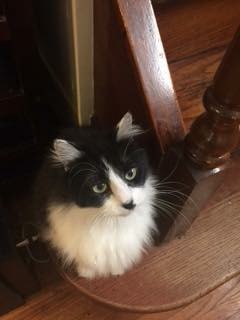
Stinky — Stinkerbelle in full —  earned her name as a kitten by crawling up my chest and sweetly punching me in the eye. Adopted as a feral kitten out from under a friend’s porch, she hasn’t mellowed in her fourteen years on earth.

Stinky has not come a long way since we adopted her. She chooses to stay upstairs, mingling only with our other five cats when wet food is served. She hogs the food and now rather resembles a soccer ball — black and white and round. She hisses at the other cats, at us, at inanimate objects. She likes to have her back scritched — until, suddenly, she doesn’t, hence the bitten nose. All in all a disagreeable cat.

But Stinky will sit on the bed sometimes, close to my head, purring just out of the happiness of being near me. She will rub up against my hand ecstatically when I pet her and eventually bliss out into a cross-eyed state. She doesn’t hate — she just doesn’t know what to do with herself. 

So we love Stinky in the way one loves their problem children. Awkward, unbeautiful, cranky, at times lashing out. She reminds me of me as a child — roly poly and uncoordinated, unaware of how my intelligence put off people. I did not believe myself lovable, and told the school psychologist only the monsters were my friends.

I study Stinky and find my inner child, runny-nosed and crying, yet still worthy of love.