
As you noticed from the title, today’s post is called “A NaNo Success Story”. But it’s not my story, which you’ve already heard — more than once.
This is my husband’s story.
For those of you who don’t know my husband, his name is Richard Leach-Steffens, and he looks like this (the person who isn’t me):
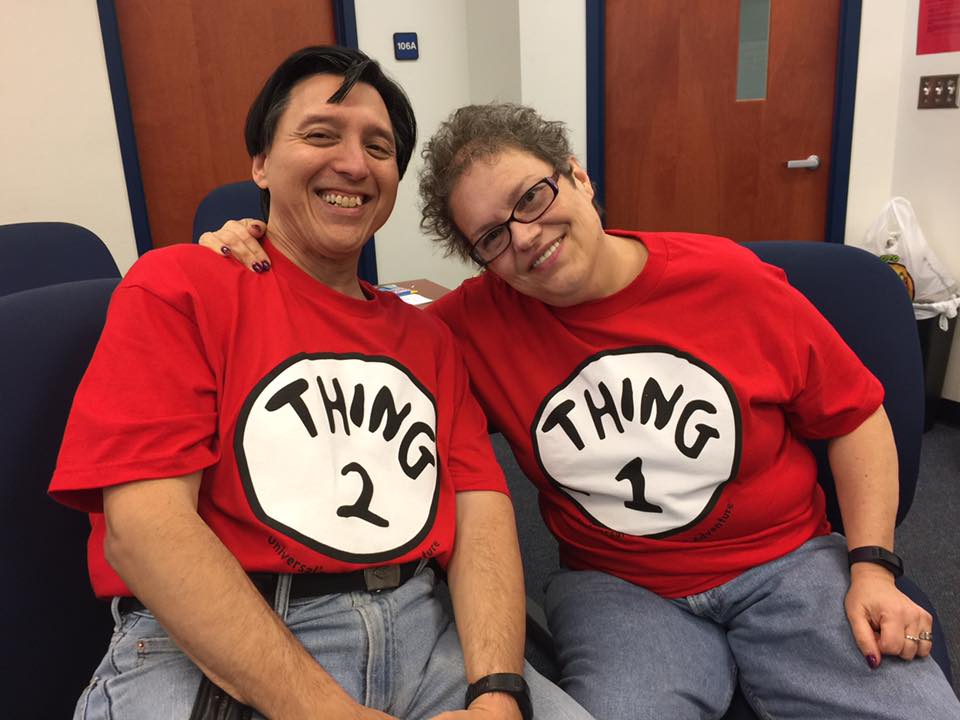 |
| We were both a bit chubbier then. |
He is universally regarded as the sweetest guy in the universe. He has a couple quirks, but so do we all. One of his more obvious quirks is that he has trouble finding words, and instead of a stammer, he uses grand arm gestures to try to coax the word out of hiding. (In the fashion of married people, I have picked up this habit, except I also say “uh … thingie” while trying to remember).
Richard has always wanted to write. When I asked him what job he dreamed of when he was younger, he said, “I wanted to be a traveling restaurant critic, but I have writer’s block.” I thought he had the perfect job idea, by the way: travel, eat, write, get paid. I’m still wondering why I didn’t come up with this.
When I started participating in NaNoWriMo, I invited Richard to participate with me. “But I don’t have ideas!” I knew that Richard had ideas, because he helped me with ideas all the time. Many a car ride and coffee hour has been spent bouncing ideas off him, and him bouncing ideas off me.
Richard, like many, dipped his toes in writing through Camp NaNo, a less strenuous version of NaNo, where one could set their own goal. Richard’s first project was part 1 of a novel based on one of the characters in my series of novels, Arnie Majors, the D.B. Cooper of draft resistors. His second Camp project was part 2 of the same book. He felt comfortable writing in an established world, because although he’d gotten comfortable with his writing, he didn’t feel comfortable with his imagination.
Last year, Richard started (and completed) his first NaNo book. Again, it was based on my Archetype world, but he took a character mentioned once in passing and created a book around her story. It’s clearly his book and not mine — yet it’s true to the universe. He made his word count goal in time, so he won.
This year, Richard wrote a book with his ideas, his imagination, start to finish. It’s soft Science Fiction, very conceptual — in other words, his kind of book. (His Master’s is in history, specifically military history; my PhD is in Family Economics, with a bunch of sociology and psychology thrown in).
Think about this — Richard had writers’ block. He didn’t trust his ideas, he didn’t trust his imagination, he didn’t trust his writing skills. He now has one book to finish and then three to edit in case he wants to publish (and torture himself the way I torture myself trying to get published).
He’s a NaNo success story.

 Words Like Me