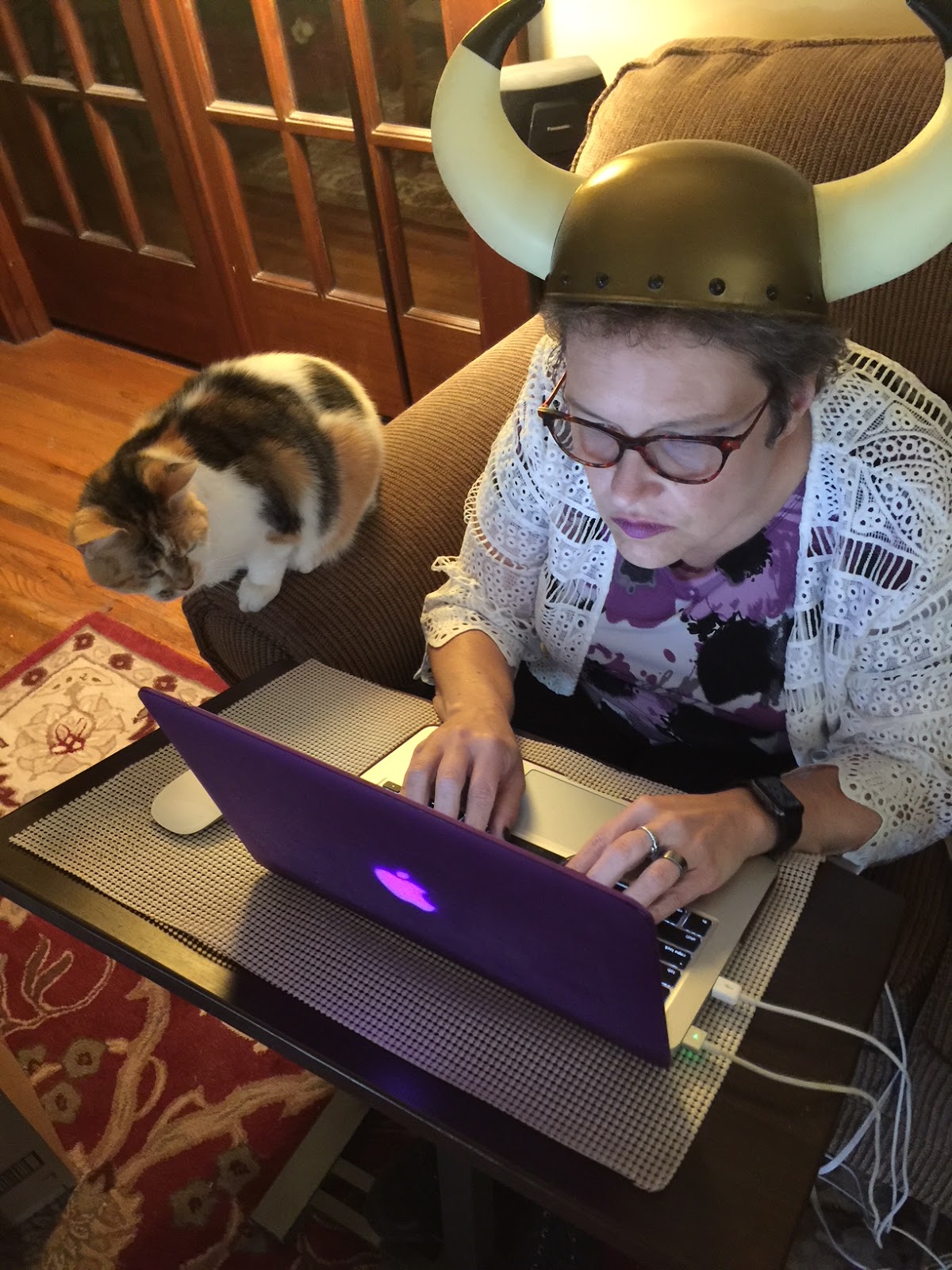
A really quick note

4000 words to go! Phew!

Also: Google Earth and Wikipedia — next best thing to being there in the Owyhee desert. I could never have written this book in my twenties, because the research I’ve done on desert-hardy goats and sheep, natural predator control, biodiesel, underground housing …

You get the idea.

Also — love you all. Quiet time for me now.

Melancholy, foggy morning haiku —

A melancholy, foggy morning haiku —

I stepped into fog —
Perfect leaf laid on my porch,
memory of flame.

IF the above had happened, it would be a mystery — the verb should be “lay”, as in “the leaf sat there”, yet the verb I use here is “laid”, as in “someone put this on my porch”. I meant to do that, to go with the word “perfect”, to indicate that there’s a puzzle here. Why do I think the leaf was placed there? Who — or what — would have laid a leaf on my porch? Why? Does the poem hint at a mystical creature? Will I be disappointed if I figure out the the wind blew the leaf from three houses away and landed it, somehow perfectly, on my porch?

What is the significance of the perfect leaf? What flame is it a memory of? Does this influence who or what I think laid the leaf?

Haiku makes us want to feel, to ride along with the words, rather than think. Thinking is for later.

*************
Today, I start the home stretch of NaNo. I’m way ahead of the game, because I’m a little compulsive about numerical goals, and because gosh, this book has spent thirty years in my mind. I have 10,000 words left to win NaNo — but approximately 60,000 words left to finish the book. And one book half-done (Voyageurs), one three-chapter chunk I’m learning from editing (Voyageurs), and who knows what I can do with the others, knowing what I’ve learned lately.

And then I have searching for editors again.

BAG accomplished!

Big Audacious Goal of the Day accomplished:

4000 words written in about 5 hours (four hours if you subtract the interruptions).
Total: 40,315 words — 5 2000-word days for the win!

How accomplished:
1) Fireplace program on the projection screen
2) One cup of Kenya Nyeri
3) One cup of Phoenix Valley Oolong
4) Occasional visits by Girly-Girl and Snowy
5) Promised myself I would stop in 15 minutes if I couldn’t concentrate

Today’s plot points: A town of the dead, smash-and-grab shopping, and two feral children at a rest stop.

10,000 to go!
Love you all!

This morning: Reluctance to write

I’m not sure why I’m not motivated this morning. It’s bright and early (or at least early) in Maryville, MO; Girly-girl the deadpan calico cat sits next to me and purrs —

If a picture’s worth a thousand words, why do I write?

It’s a perfect day for writing: warm inside, rainy and misty outside. There Will Be Coffee Soon. I have all day to write —

At 5 AM, 4000 words (my weekend goal) is much too daunting.

How shall I deal with this?

1) Break the goal down into a couple parts — four blocks of 1000 seem workable.

2) Start writing for fifteen minutes and let myself quit if I’m still not into it.

3) Drink. The. Coffee. First. It’s Kenya Nyeri, home roasted, and sure to taste somewhere between a good solid cup of coffee and heaven in a cup.

4) Write a more fun part first. Actually, this beginning part is a good, dramatic part — it begins with the protagonist reading a journal left by the last survivor of a plague — but is the plague still contagious?

5) Alternatively, tackle the hardest part first. Right after this segment is a part I haven’t really conceived of first, and it’s kind of a transitional part. These are hard to write without sounding like a voiceover in a movie script: “As a matter of fact, my adventures were just beginning …”

6) Forgive myself if I don’t make the goal. I’m way ahead, as is expected from someone who loves personal challenges.

Talk to you later!

The part I’m most proud of today

I wrote 3600 words today to make up for the 2500 words (yes, I’m aiming for 3000 words, 4000 words on weekends) yesterday, and probably to make up for the fact that I didn’t win NaNo last year. 29,000 words so far.

Here’s my favorite segment of the day — an indigent with mental illness tells a story. Remember this is a rough draft. Really rough:

*********

Pagan paused again for a long time, cocking his head. Then, his voice became that of a child’s, and he spoke:

“I am supposed to be one of them, but instead I got put into the hospital. It was after I woke up, after I started existing. I woke up in a room, and a woman started screaming. I ran outside, and all these big machines tried to kill me, and everything was loud. I started screaming, like the woman. They took me to this white  place, the hospital, and tied me down. Then she told me she was like me, and we were their abandoned children. That’s what she told me, the one who talks in my head. 

“‘Who are they?’ I asked her in her head.

“‘The ones who wander. Sometimes they make us by accident, sometimes on purpose. We are them and we are humans, so they abandoned us.’

“The people who tied me down asked me questions I couldn’t understand: What my name was, where I lived, who my next of kin was. All I could answer with was ‘I’m them and I’m human,’ because those were all the words that I had.

“They untied me, but they kept me in that bright room, and occasionally something would make their name known to me. Someone in white would come into my room and ask me if I wanted the lamp turned on, and I knew ‘lamp’ and ‘on’, and then ‘light’ and ‘food’ and ‘bathroom’

“But I understood the voice from the moment I heard it, because it didn’t talk in words, but in meanings, and it was words I didn’t understand.

“’Who are they?’ I asked again. ‘Who are the ones who wander?’

p.p1 {margin: 0.0px 0.0px 0.0px 0.0px; text-indent: 18.0px; font: 14.0px ‘Courier New’}

“She would not answer me.”

******
This will become important later.

Advising about Advice

My editor redeemed himself.

Not by giving in, not by praising my work, but by naming specific things I needed to work on.  In my case, it’s adding other details happening that don’t have to have to do with the story. Given how I write (from what I’ve seen yesterday), that focus and immersion on the experiences of the protagonist is like riding a train through a tunnel, and I have tunnel vision.

Successful authors don’t want editors to rubber-stamp their work, they want to be pushed to grow.  But we’re all blind to our idiosyncracies that get in the way. That’s why we have editors.

Because authors are intimate with their books, they don’t understand global comments like “it’s a bit choppy”, “drags a bit”, and “needs more cowbell”. There needs to be a more specific, actionable comment like, “You need to include detail that does not involve the plot.” or “you’ve used the word ‘vitriol’ five times in the first chapter — can you find a synonym?”

The other thing about global comments is that sometimes they’re spirit-killing. Unless you’re Dean Koontz, apparently, in this pep talk for NaNo that all editors should read (and I use “should” very sparingly):

https://nanowrimo.org/pep-talks/dean-koontz

Note to my editor: Just as I like to be praised when I finally “get it”, I’ll praise my editor, who I’m sure is reading this blog. Editor, you’re getting it. I don’t remember calling you names, and if I did, I’m sorry.

Note to authors: This is the reason you don’t write the nasty note to your editor when your ire is up. Rant about your feelings and not about your editor. Keep those sadistic fantasies to yourself. Then take a deep breath, and if your editor doesn’t redeem himself, fire him.

*******
Back to NaNo. I wrote about 2500 words yesterday, but I’ll eventually catch up. I’m actually ahead of schedule — at the last checkin, I would be done by November 17th. I won’t be putting in the detail requested above in this story, because it’s not time yet. Now is the time to lay in the skeleton.

Serious setback

I’m struggling today — struggling in a “I don’t know if I want to keep doing this” way. I don’t know what I need from you, dear readers. Bear with me.

I did not reach my goal today. I only made it half-way there. I will struggle to get there tomorrow, if I get there at all.

Today, a friend of a friend who was supposed to edit the first three chapters of my book said something in the guise of advice that has made me feel, more than anything, like giving up:

“A reader is a simple organism.  We expect A, will be happy with B, will grudgingly accept C, and all the other letters are crap.  Stereotypes and tropes exist for a reason.  No matter what someone says about wanting pure original stories, they will get pissed off if the wizard doesn’t carry a staff.”  

I know I can get a bit sensitive about criticism. But usually, I can step aside and say, “Yeah, that needs work,” and I can get to work. I’ll be the first to admit that my words are too big and I need help in pacing the plot. I read advice to writers and implement it the best I can.

But the above comment basically tells me that my viewpoint is not valued, my voice is just wrong, and I have to write at the level of The Flintstones to get published.

I could live with “write at the level of The Flintstones to get published” if that were all that was said. I would keep writing my stuff and not publish it. End of problem.

But the rest of it tears into my very soul.  I do not want to be known for writing Islamic terrorists, white saviors, and Fu Manchu.  I also don’t expect to write stereotypes in terms of “the repressed but sexy librarian”, “the rugged action hero”, and “the desperate sexless nerd.” I expect my characters to be three-dimensional. I in fact try to write outside these stereotypes.

As for tropes, it’s impossible to write without them — Every story I’ve ever written touches on self-discovery, which is a trope called The Hero’s Journey. (Some argue that everything written is the Hero’s Journey, but I’m skeptical.) I’ve written in “boy meets girl, boy loves girl, boy loses girl, boy gets girl back after 150 years” trope. Obviously I subvert tropes.

I firmly believe that words are so important that writers have to choose them carefully. Words have the magic to change perceptions or to freeze them into cages. I believe that roles are held by well-formed characters and stereotypes hold characters hostage.

The worst part, though, is that I can’t even conceive of what this man was talking about. He might have been talking in a different language about a world I didn’t live in.

When I write a book, I don’t say, “Hey, let’s put the clever and debonair robber and the stupid cop and the clueless but hot woman in and first the robber breaks into the bank in a tension-filled scene, and then he sneaks the money out right under the nose of the cop, who chases him, and he carjacks this fast car and the clueless woman falls in love with him.” I don’t shop at “Tropes r Us” to find a plot.

When I write a story, it’s like I have these characters, and yes, I deliberately pick them so that they don’t fall into stereotypes, because people who aren’t white, beautiful, and upper class deserve to have adventures and fall in love (this is why I can’t write romance novels). I write a plot, and the chapters take me traveling through the plot.

I travel with the characters in my mind when I’m writing, seeing the same things and experiencing the same events they do. It’s an intense immersion process (and the only time I can actually visualize). This is how I write. It’s like I’m creating the world I want to live in in the remains of the world I live in, right before my eyes.

In fact, I have trouble editing my books because I don’t get the same intensity I got when I wrote them. Honestly, I don’t know if what I’m doing is readable. That’s the problem — I honestly don’t, because when I get to the editing stage I see that it all makes sense, everything follows logically — but I can’t tell if the pacing is right and I really can’t tell if anyone besides me would find it interesting.

Notes: I have trouble finding beta-readers. Am saving up for an editor who has more experience, but I’m so afraid that I’m going to keep getting critiques of what I am and not what I need to improve.

Thank you for listening.

A shout-out to my childhood town:

Outside of Chicago, the scenery of what the mapmakers in Grand Marais called The Jungle seemed no different than the rural areas of North Ontario or Minnesota. The land was flatter, and in the March weather, the overgrowth of grasses just started to show green through last year’s dried stalks, and the trees in the distance didn’t glow with green buds yet. The farmland that would have spread for miles in a farm economy sat fallow and grey, drought and the collapse of factory farming ending the land’s purpose to the economy. The highway, with its occasional potholes and washboards, was no different than those I had seen North. 

p.p1 {margin: 0.0px 0.0px 0.0px 0.0px; text-indent: 36.0px; font: 12.0px ‘Courier New’}

I turned off the road at a ragged road sign that announced a town with a preposterously French name, hoping to hear some stories there. At the bottom of a graceful hill, I heard the sound of a shotgun close by, a warning shot. I spun the truck around and headed back up the hill. Nobody had shot at me in Chicago proper, but here in the rural Midwest, someone shot at me. 

*******
Writing that was almost more fun than killing off my ex-husband in Gaia’s Hands

Thank you, friends, for reading. Now to go write a few thousand words.

A short excerpt — I’m on a roll on a difficult part

I have a couple hours to write before work today, and I want to get moving, because my mind is playing with a difficult part/concept: What if your first memory is of being full-grown, but totally bewildered by your surroundings:

The faded man sitting next to me introduced himself as David Burris, Valor’s son and Justice’s brother. It seemed odd to me that he looked as if he could be Valor’s father, not vice versa. Then he asked a question, a nonsequitur that nonetheless resonated more than a stranger’s question should have:

“What’s your first childhood memory?” he asked, his gaze searing into me.

My mind spun in panic — I had no childhood memories. I couldn’t get to them. The first thing I remembered in my life was a dream of standing up in my parents’ living room, in the old house where they used to live before they disappeared from society. Durant — my father — wasn’t there, but that wasn’t surprising; I had always known he came into my life later. Three people sat in the room: my mother; plump and curly-haired; a man, tall with long black hair and implacable eyes; and another woman, short and slender, smiling like a grandmother. My mother and the man were bundled up in bathrobes and blankets like they’d just come in from the cold. I couldn’t understand. I stumbled away.

“Come here,” the dark-haired woman said, with a curious gesture of her — I looked down at what I quickly learned was my hand. “Let me look at you.”  

p.p1 {margin: 0.0px 0.0px 0.0px 0.0px; text-indent: 36.0px; font: 14.0px ‘Courier New’}

I stepped backward. “Here” came with the woman’s gesture toward herself. “You” — I guess that meant me. 

*******
So this is obviously written in first person, and the person is a Nephilim but doesn’t know it. Nephilim are born full-grown and biologically learn very, very quickly such that in a week, she understands everything in that room and shows proficiency. But, at the moment she describes in the memory, she knows literally nothing. So I have to write the scene dividing her observations into two parts: things she can describe and understand at the time of reflection, and things recalled at that exact moment. Tough, huh?

Thanks for reading, friends.

Rituals and word counts.

Thank you for keeping up, friends! I made the 20,000 mark today after swearing to write 3,000 words today despite not feeling well. I had time to write during my lunch hour, so I decided to stay on the goal. Specific, measurable, action-oriented, realistic, time-bound.

Honestly, I’m not a horribly organized person who drives toward goals except at NaNo time. I meander most of the year, play with words, set soft goals. NaNo time is different — it’s as NaNo is a ritual I satisfy yearly to belong to my tribe of creatives. It’s like my version of an all-night drumming circle at Midsummer or my First Snow ritual that I no longer hold because nobody’s calendars are clear on that random November night when we get our first inch of snow.

I have to go to class now — don’t tell anyone.

Do you want to read an excerpt tonight? Please let me know!