An Excerpt: A Story about Stories

Day 6 of NaNoWriMo, and I want to get at least 2000 words in before I have to go to work, because it’s a long day and I need to get started soon. I’m at 17,000 words, up 7.000 words, so if I don’t get all the words in today, I’m okay. 

An excerpt (remember this is rough draft time). In effect, what I’m writing is a story about a story:

As I drove down the highway, I thought about Hakeem’s and Bosco’s words — I couldn’t help but laugh at those two young men wanting to — what? Offer themselves up as husbands? Be my protectors? I seldom picked up on those kinds of currents. As role models, my parents gave me the gift of watching their near-perfect relationship, perfect except for my father’s belief that my mother kept a secret he couldn’t crack. However, I didn’t seem to fall for the occasional men who took me out for coffee and complimented me. I literally didn’t understand the process of “I take you out for dinner, you have sex with me.” 

From there, I thought about Sonya’s words. “If you’re looking for the Alvar, you’ll have to look in the worst places.” Wasn’t that always the case with fairy tales? The Hobbits had to throw the One Ring into Mount Doom, a raging volcano. Little Red Riding Hood had to go through a dark forest and visit the wolf to pass through menarche, symbolized by the red hood. Would my quest follow the parameters of the Hero’s Quest?

I was not a hero. I was an academic without a job and without any useful skills except the ability to crack Schmidt locks — and other locks, albeit with the help of a lock pick. I was an anthropologist searching for the inevitable, unpublishable study, a study of the origins of a mythical people. If the Alvar actually existed, what would I do if I found them? If they didn’t exist and I found the human origin of the tale as if it was an urban legend, where would I publish my findings?

Did I chase the legend simply because my mother once told it to me in a bedtime story? 

I pulled myself back to reality and saw a roadblock up ahead, just before Eau Claire.  I slammed on my brakes, nearly skidding as I approached the barricade with three men, all armed with semiautomatic machine guns. When one of them walked up to me, his hand on the strap of the gun slung over his shoulder, I rolled down my window, hands shaking. “What seems to be the trouble?” I asked, trying to school my voice into calmness.

“Your papers,” the man, with the hard voice and face of the military, held out his hand.

p.p1 {margin: 0.0px 0.0px 0.0px 0.0px; text-indent: 18.0px; font: 14.0px ‘Courier New’}

Of course I had identity papers. My parents had warned me that, if I had to bug out of town, that I needed at least a copy of my birth certificate and my drivers’ license. I had not been asked for them before this moment, and I wondered if I had hit a border to a newly formed country.

*******
May you find wonder in your day.
Big Audacious Goal reached for today.

Officially at 13,000 words (give or take a few!) One quarter of the way through!

*******

Afterward, I dreamed that my dad yelled that I had written the story all wrong and that the aftermath of the collapse on Duluth, MN would look nothing like I’d written it. I fled to the bathroom, and tried to put makeup on for some high school banquet I was about to be late for. I had put on skin correctors of different colors for different parts of my face, except they were glossy and glittery in patriotic red and blue and would not smooth in.

I walked into my room, and clicked the mouse on my computer, reading the notes I had taken when I interviewed a Texas secessionist for my story. I remembered standing on the loading dock as he stood there, semiautomatic rifle slung across his back, explaining that the patriots needed to get the country back from the foreigners. I wrote down the words, sickened.

I tried to dress as quickly as possible, sensing that I would never arrive at the banquet that I would be honored at.

I woke up, reminding myself that the words are important and wondering if I was ever going to get them out in an order that would compel people to read them.

Day 3 Nano — Plantsing Away (with story segment)

I think I remember telling people I’m a Plantser in NaNo parlance — I plan, but only so far, using a set of scene synopses instead of a full outline. This is easy to do in Scrivener, which uses a notecard schema for chapter and scene synopses.

When writing, even at 2000 words a day,  I’m restructuring my outline by adding and moving those scenario cards. Yesterday, I realized that NOTHING plotwise was happening between visiting The Jungle, a geographical entity which includes Chicago and Detroit, and Salt Lake City. That’s hundreds of miles, folks. 1400 miles to be exact. I’m sure I could skip over that segment of flyover country, but given that one of the themes of the story is self-discovery (“It’s ‘Eat, Pray, Love’ meets ‘North by Northwest!’) I easily could give my protagonist a few pertinent experiences there. I’ve added a chapter — actually, two half-chapters — to facilitate some adventures here.

I do minor editing on spelling and grammar in the writing stage, but don’t get too bent out of shape about it, because that’s not the idea of the writing stage. The idea is to get a first draft (or in the case of NaNo, half a first draft in a month).

OOPS — back to writing!

*********
Today’s excerpt, written yesterday:

I considered my options for getting off-campus. There was a riot outside the building and my captors within. I didn’t believe the police, or the Guard who had joined them, would be any more sparing of bullets than my captors had been.  

The steam tunnel doors hung open. I had heard about the legendary steam tunnel system — maps of the tunnels existed, handed down and providing adventures to generations of students who could withstand the heat. The cameras that protected students from heatstroke no longer functioned, so the risk was higher than in bygone eras. I taught all of this in Intro to Anthropology each year.

I, however, did not have a map, and imagined myself wandering through the tunnels, some of which were low enough that the explorer had to crawl through. There were rumors of dead ends and caved-in sections — wait. Somewhere in my notes, up in my office, I had documentation of a Charles DeWitt who had, in 2020, painted guide signs in glow-in-the dark paint. All I needed was a flashlight, which I found on a hardhat by the tunnel doors. I flipped the switch; the light functioned.
Now, a destination. I thought about where I was, Hartley Hall, at the north central point of the Quad. My destination was under the Quad to Alfred Wyndham Lab, the science building nearest the east gate. I knew that the tunnel would be anything but straight, given how the tunnels branched out to serve all the buildings. 

What I would need besides the light? I took a long drink from the utility sink in the corner and relieved myself in a dank, muddy corner — I didn’t care about anything but being safe. What else — lock picks. I didn’t have lockpicks in case any doors were locked. Lockpicks — I searched for the smallest bladed screwdrivers I could find, precision screwdrivers, which I found in a large drawer on a workbench labeled SHOP. I swiped the two smallest screwdrivers and a diamond file so I could file them thin if needed. My father, the cryptographer, had taught me how to disable locks from simple tumbler locks to advanced cryptobiometric ones.

p.p1 {margin: 0.0px 0.0px 0.0px 0.0px; text-indent: 18.0px; font: 13.0px ‘Courier New’}

Then I charged through the doors into the unknown.

A good start to my NaNo novel —

“Once upon a time, there were beings who looked like people, only they weren’t the people you see every day. For one, they were stronger than ordinary people, and they lived a lot longer than ordinary people do. They existed to help people understand who they were and where they came from.  By the few who knew them, they were called Ancestors, Archetypes, or sometimes Alvar.

“They lived in a realm far away, yet as close as a thought. In this realm, they existed rather than lived, mere vessels for the ancient memories they held. Some of them tired of this passive role, and wanted to go Earthside to see these people they represented. So they jumped to Earthside, which was only a thought away, defying their Oldest. These Alvar occasionally chose to bring children into the world, which defied their Oldest to a degree that could not be forgiven. Of those Alvar were born the Earthed Alvar, who lived among people.

“There was one of the Alvar who was born of the male Kiowa Alvar and a female Alvar of legend, Lilith. They left him (for Alvar were born full-grown) with the Kiowa to learn about them and to help them. All he remembered of his birth was that two people, his parents, told him he was special and that he was never to give it away to anyone. 

“The Kiowa shaman named him “Old Man” even though he looked young, and as time passed, he did not age as the others did. Eventually, the band felt frightened of him because of his lack of aging, and he left to join other bands of the First People to hide his true age. He understood that others grew old and died, and he didn’t understand why he didn’t. He also wondered why he had never been young like the babies born to the Kiowa.

“Eventually, he was kidnapped by evil people who put him in chains, people who didn’t realize he was Alvar, but he escaped by jumping – something he had forgotten he could do – back to the place where the Kiowa, his original people, banded. They had gone away, but he became a cowboy, moving from place to place and job to job so that his true nature – which he didn’t understand – wouldn’t be detected.

“He lived like that for years, and finally found himself at a place of learning, so he could discover who he was. He fell in love with a woman named Allie, who looked at him as if she knew him, and asked him lots of questions that tipped close to uncovering his secret. One day, Allie took him to talk to their professor, and she, Mari, told Will that she was different in the way he was.  Mari told Will and Allie about the Alvar, and Allie grew to love him even though he was not like her. 

“One day, they made a child, born fully grown as children of Alvar and humans were born. All of the pain of Will’s past washed over him at the sign of his offspring, and his mind shattered. He disappeared before Mari or Allie could stop him. Allie never stopped loving him, or the child they had together, and she surrounded that child with all the love she could muster, love enough for two.”

“Mom,” I groused, “that’s not a bedtime story for a child – that’s an anthropological treatise.” I wasn’t joking – My mother, Alice Schmidt, was a preeminent anthropologist who studied Plains cultures at the arrival of white people. The story went that she had been trained by the famed Native American anthropologist MariJo Ettner, who disappeared ten years before and left her research notes to my mother. Alice Schmidt disappeared soon after, when my dad retired, and an anthropologist named Elaine Smith was hired halfway across the country from where Alice and her husband disappeared. I remember the safe house when we were in transition to our new identities, and the day I became Annie Smith.

“What do you expect?” my mother asked, her green eyes laughing. “You ask an anthropologist to tell a bedtime story, and you get anthropology. If you told a bedtime story, it would be a fable about an encrypted ghost that terrorized hackers.” Mom, of course, was right – not only because I had chosen to become a sociologist specializing in urban legends, but because I was my father’s daughter – and my father had been, before his retirement, a key government encryption expert. In other words, his programs were the ghost in the system.

“So that’s the bedtime story you told me?” I chided, hiding the fact that I couldn’t remember my childhood once again. 

“It was the best I could do,” Mom shrugged, then looked at me searchingly, as she often did. My dad strolled in – although I was my father’s daughter, I didn’t share his blond hair and blue eyes. My looks came from my mother – dark wavy hair and pale skin and freckles. “I packed up your car,” he sighed. “Could you pack more stuff next time so I actually get a workout?”

“What, and give up my life as a pauper?” I snorted, and hugged my father, who came to just above my chin. I hugged my mother, plump where I was slender. I studied their faces, which looked just a little older, just a bit more worn, than my first memories of them fifteen years before.

p.p1 {margin: 0.0px 0.0px 8.0px 0.0px; text-indent: 37.1px; font: 13.0px ‘Courier New’}

It was the last time I would see them. Three months later, they were murdered by assailants unknown.

Word Sprints

Word sprints help you write fast, hence the name. They may or may not have a prompt to help you with a topic to write on. They can be timed (10 minutes, 20 minutes, an hour); they can be word counts (100, 200, 1000 words); they can be housed on Twitter (NaNo Word Sprints), done in groups or individually, and can even take the form of competitions.

The whole purpose of word sprints is, like NaNoWriMo, to get your words on paper. You can edit later. I may be using more word sprints this year because I’m not having as many conversations with my characters as I usually do. (I need a good amount of time at a coffeehouse this weekend with Richard to help flesh out plot and character.)

Not everyone believes in the common philosophy behind NaNo and writing sprints — that is, that the words need to get put on paper, in whatever form, before you can polish your work into a novel. This columnist is very much against NaNo, thinking it gives less talented people a license to make their friends read their bad work. (I would have welcomed her point of view had she not come off as a caustic snob who likes to piss on others’ dreams).
************

Here’s the result of a ten-minute word sprint for my WIP, with the prompt of “Someone is getting thirsty”:

The next day I’d wished I’d stayed at the curious place where I had dropped off the stranger the night before. The air shimmered with the heat; I sweated until I couldn’t sweat more. My goal was to drive out of Owayee and back toward the larger highways, because everything in this heatbox looked the same — the short scrubby shrubs, the baked-mud ground pebbled with rocks of varying size, the lack of true greens and flowers. Was it simply going back the way I came? Even with a map, I wasn’t quite sure what highway I looked at. 

There was a lake by where I’d dropped off the affable, enigmatic Daniel. If I could get back to the lake, I would be near water and could take shelter with the commune. They had offered me shelter, but I wanted to continue on my quest. 

Of course, my compass, I thought, and grabbed it from the passenger’s seat with one hand. Of course, as luck would have it, the compass couldn’t recognize true north. I thought the commune had been true north from where I was on the road. 

I drank the last dregs of water from my jug, remembering that I’d filled two five-gallon water bags from the commune’s reservoir. They had been generous. Mari, the leader, had smiled at me and said, “We have plenty more where that came from, Annie.” I felt like crying as the nausea hit me. Then I felt the truck shimmy as my front right tire ripped from the rim.

***********

Is this a first draft? Yes. Upon reexamining it, I know it’s going to take some more filling in, and some wordsmithing. I use “of course” two times consecutively to start sentences. I don’t like “true greens and flowers” as a phrase, exactly, because it brings to mind lettuces rather than vibrant green hues. “There was a lake” should read “I recalled there was a lake”. Her recall of the commune could be slightly more descriptive.

But that was 25 words a minute on something I hadn’t thought about five minutes before.

I’m okay with that.

NaNos — your first draft (with footnotes!)

Dear NaNos (and other readers):

The first draft is not the time to polish your manuscript, or second-guess your ideas or get judgy* about your writing. You can do that later, after you’ve gotten 50,000 or so words on the page**. The first draft is the place to get your ideas on the page — whether that is fleshing out an outline (planner) or channeling creative spirit without constraint (pantser***).

You will be tempted to thoroughly read what you write. Don’t do so — keep writing the words. Keep letting the ideas flow. Don’t censor yourself when you write at first draft point — welcome the plot absurdities and scenery-chewing, the mystical subways and talking trees****. You have plenty of time later to decide whether to keep them or not*****.

The 50,000 word first draft is not to make you a novelist. It’s to make your future as a novelist possible through helping you break through the psychological barrier that makes you think you’re not a novelist******.

So go for it! It might change your life!*******

**********************
Footnotes:

* although colloquial, I like this word better than “judgmental” simply because of the sound of it.

** this is not actually the length most novels should be for the market. It is, however, the winning number of words for NaNoWriMo.

*** as in “flying by the seat of your pants”.

**** oops, I’m the one with the mystical subways, not you. You know what I mean, though.

***** hint: If they detract from the plot and character, get rid of them.

****** NaNoWriMo has loopholes one can exploit if one doesn’t want to write a novel. There’s all sorts of other projects one can undertake — a script, an autobiography, historical fiction …

******* or maybe not. But it’s worth trying.

Prepping the Next Story Part 1

I will be writing for NaNoWriMo this November. I think I explained this phenomenon before, so jump to the next paragraph if you’ve read this before: NaNoWriMo is a worldwide writing committment, where the participants commit to 50,000 words — which is well on the way to finishing a novel. In thirty days, 50,000 words equals 1,667 a day.

I started participating in  NaNoWriMo because I’ve been known to easily abandon hobbies and free time activities. It runs in the family — my mother had an attic full of bolts of material, often purchased on sale, and scraps of velveteen and brocade that she planned to use someday for a Project. Mom’s projects, like mine, were never small,  and like me, Mom expected to start a project at expert status. As an illustration, the scrapbook for my wedding sits unfinished, and Richard and I just celebrated our tenth anniversary.

NaNo changed that for me — primarily because it gave me a Big Audacious Goal. I could say “I’m going to write a 50,000 word book” to my friends and they’d say “OOOOH!” And then, having committed to the goal, I had to actually write it to save face. And then, at the end of the month, I had a book I had to take seriously and start learning how to edit — that, as you know, has taken a while. And now I have the discipline to write over and over.

This year for NaNo, I’m going to start writing the “dirty commie gypsy elves” book that I’d conceptualized twenty-five or so years ago, which has neither gypsies or elves, nor are they dirty.
How do I start?

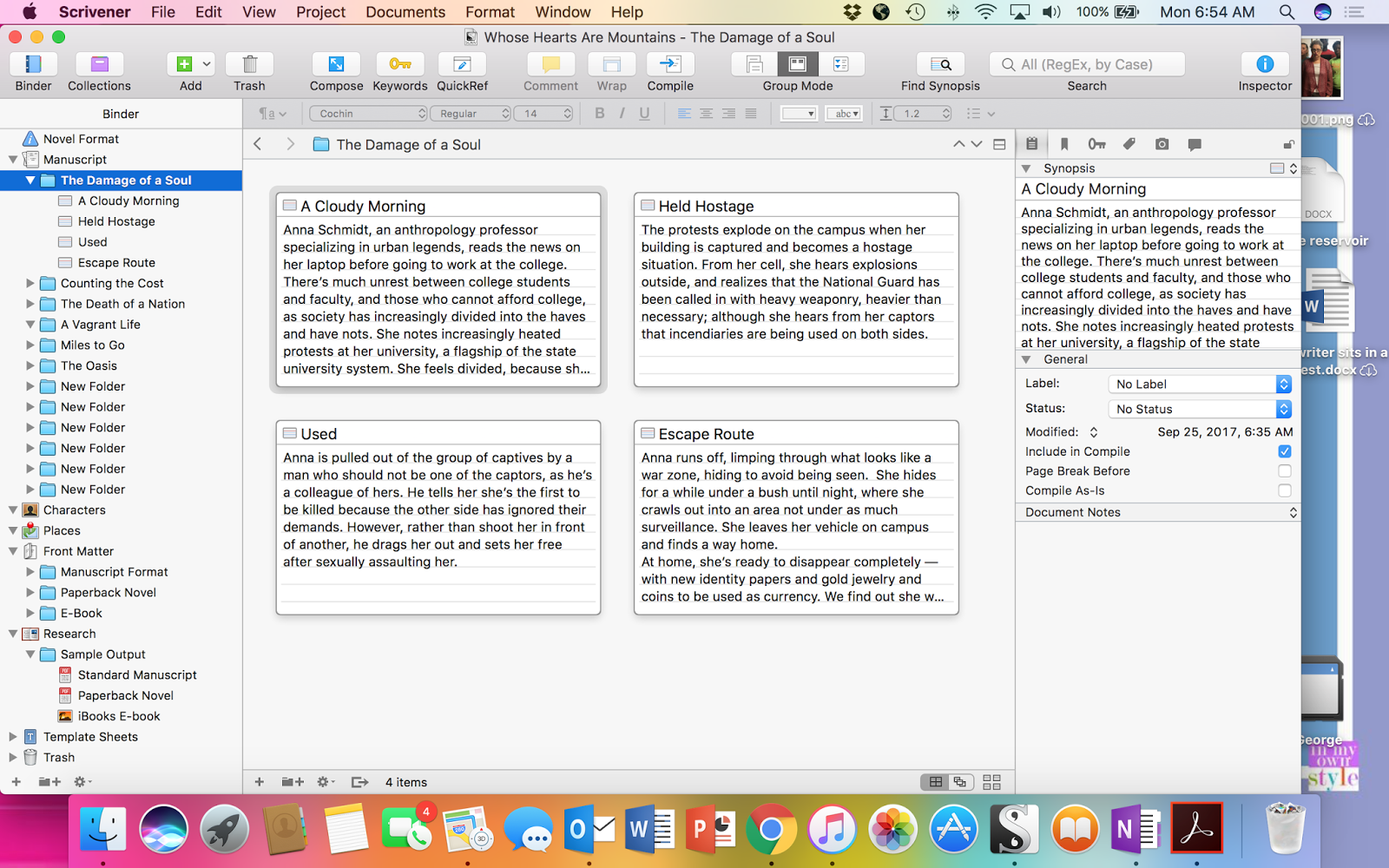
I’ve done this before — I start with a loose outline of major plot events, which looks like this:

On the left-hand side at the top is the outline for the book. I have the chapters added, with six titled, and the first chapter with its subchapters named and visible. The cards in the middle are the synopses for each section.  There are some commands at the right I will set up later.

That’s what I will be doing for the next couple of days, so that my book has some time to percolate in my mind in October after I edit another book.   Wheeeeeeee!