While My Garden Sleeps

While my garden sleeps, I make big plans for it. Each year I learn more about how to make it bigger and more interesting. I have always had what one calls a “green thumb”, although I’ve also had my share of mistakes.

When I was seven years old, my mom’s cousin Dale Hollenbeck brought me all the spindly, sickly plants on his shelves to try to bring back to life. By some mystery, it turned out that I could actually keep them alive. I may not have brought them back to vigor, but I could at least give them a fighting chance at a couple more years.

I didn’t know a lot about gardening, as was evidenced by the time I planted a kidney bean in a peanut butter jar in the pure clay soil of our backyard. By some miracle, the bean came up — well, the stem came up, but the bean itself with its seed leaves remained in the clay. I was left with a botanical mystery — the headless chicken of the plant world, which persisted in its barely animate form.

Perhaps the most important childhood moment for me as a gardener was the discussion I had at age 14 with my neighbor and almost-grandfather, Johnny Belletini. Johnny taught me a small but extremely important lesson — all plants had names, even weeds, and even the weeds could be useful. Most importantly, he taught me about dandelion wine. This led to a very enthusiastic me running back to my house with a dandelion wine recipe in hand and forbidding my parents from mowing the lawn until I picked all the dandelion flowers for wine. (Note: there is nothing forbidding a fourteen-year-old from making dandelion wine in US statute. They just can’t drink it.) My parents and I spent four good years making wine as a result, until I left for college. But I digress.

I didn’t get back into growing plants (or winemaking, for that matter) until after I got my Ph.D., mostly because I had neither the time nor the place to garden. I dabbled in landscaping my wee rental house in Oneonta NY with shade plants because that’s all I had to work with. When I moved to Maryville and bought a house, however, my dreams of gardening blossomed (ahem) again. My taste in gardening developed.

At my first house, I had no basement, no sunny windowsills — and a taste for cottage flowers that would frame my cute little acquisition. I couldn’t find the plants I wanted at the local greenhouse. My father and I built me the world’s smallest greenhouse out of four wooden-framed storm windows, and I started seeds there every year for a while., running a cord out the back door to the chicken house heater that kept it warm. If the electricity went out, an entire crop could be ruined, and that happened at least once.

I live in a bigger house now with my husband, and this house has a full basement. In the room that used to be the coal room, the previous owner fitted it with shelves. We fitted it with shop fluorescents and grow bulbs, and I now have a grow room big enough to handle 12 seed flats.

The gardening theme at this house: Everything I plant needs to have something edible about it except for the moon garden, whose plants tend to be white-flowered, strongly scented, and toxic. Right now, I have the seed flats waiting for seeds at the right planting time. I have some seeds cold-stratifying in the basement refrigerator with some roots that I will plant in the spring. I have a piece of ginger which I hope will sprout so I can plant it for a bigger yield later this year.

As always, I have big plans for the garden as it slumbers in its February torpor.
Making the Best

Despite the repeated dreams for years that I go back to teach at Oneonta, I am back in Maryville, MO, setting up for the new school year at Northwest Missouri State University. Unless I can find a way to afford the housing costs without having a mortgage in my retirement, I will likely retire here in Maryville.


The difference between a dream and a goal, however, is a plan. At this point the plan depends on two different external factors — whether the college will be hiring for someone in my position or whether I will wait for the way to open, as we Quakers say, and if it doesn’t, I wasn’t supposed to live in Oneonta.

Meanwhile, I am working to make the best of my life now. What have I missed about Oneonta? An atmosphere where differences are accepted, if not embraced. A place where I can be myself and feel accepted. In other words, in words misattributed to Thomas Paine, “I do not agree with what you have to say, but I’ll defend to the death your right to say it.” 

I feel like I haven’t gotten this in Maryville, but how correct are my observations? I have experienced reactions that feel like censorship when I talk about my bipolar disorder, for example, but I have also received support, mostly over Facebook from my Facebook friends, many of whom are in psychology and social work. I have felt awkward talking to people here, because I feel passionate about writing and the obsession of the day, but I felt awkward in Oneonta because I was the only one around me not passionate about something (other than winemaking, which was my thing while I was in Oneonta). 

As much a haven as Oneonta has been, I didn’t start writing in earnest until I had spent some time in Maryville, where the writer’s circle skews children’s, Christian’s, and cookbooks. (I’m literally scared to go to their meetings because my works question the current state of Christianity, as do I)

Do I really need a haven? Or do I need to push against something to create and grow? Do I need to feel like an iconoclast? An outsider? I don’t know; I’m thinking.

And in the meantime, maybe Maryville is the best thing for me because I don’t have what I need here.

Coffee in (not quite) Paradise

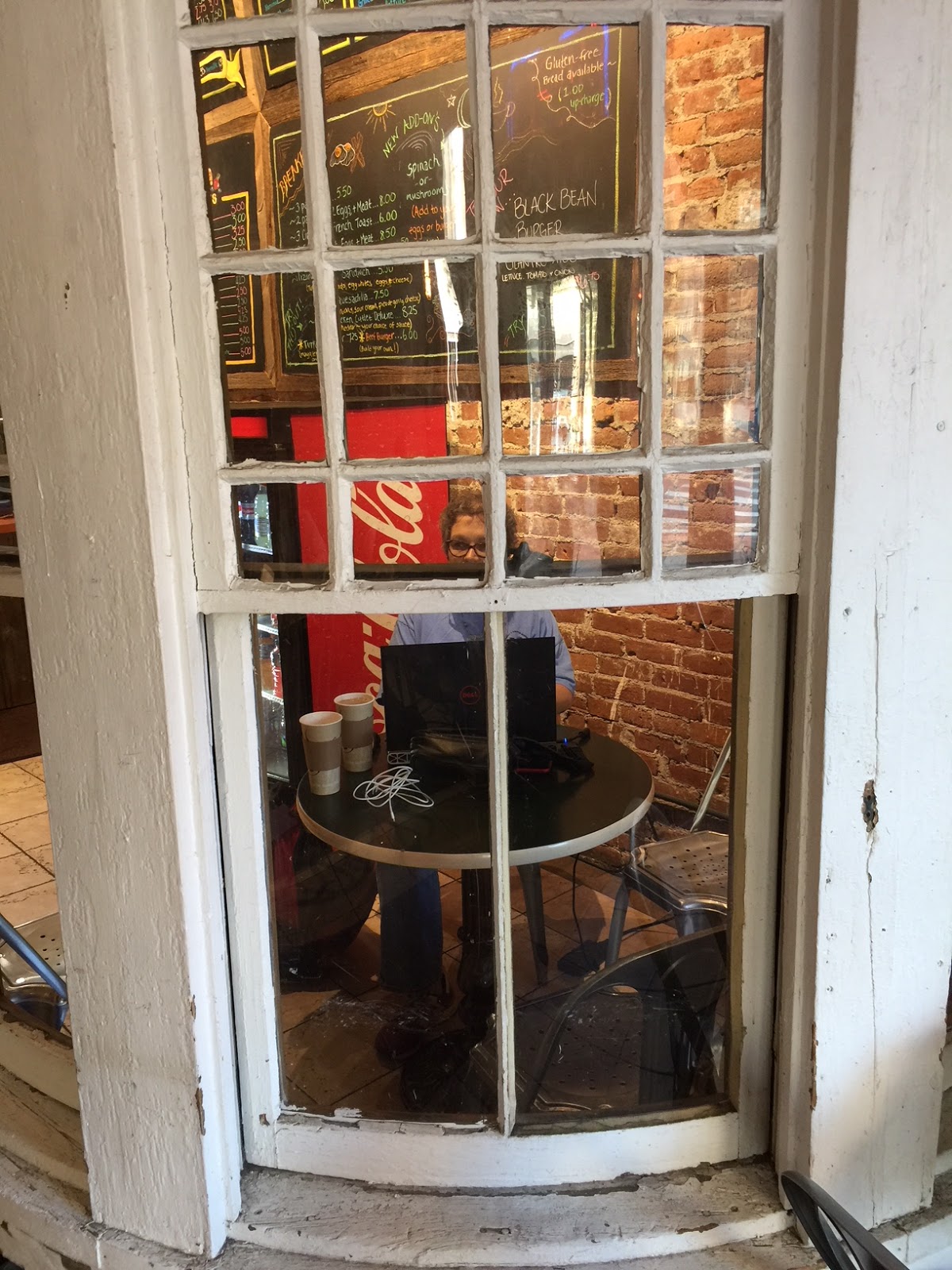
I’m sitting at Latte Lounge in Oneonta right now, sipping my husband’s caramel steamer and wishing we had a real (non-corporate) coffeehouse in Maryville. To be fair, we have close — the best Starbucks in the 50 states, attached to the campus library,

Yes, this is a bay window.

Oneonta still has a bit of a hippie vibe, with quirky coffeehouse spaces, the Autumn Cafe (a former food coop turned restaurant), and a head shop (the tacky price you pay for the health food stores and artisan delights). The summer traffic has gotten worse and the hotels get quickly packed due to the demand from club baseball tournaments, which Oneonta has capitalized on. The local artisan’s store features a writer who writes romantic suspense with a witch as the main character and publishes through Llewellyn Press (the leading pagan press). The attitude of New York State lends itself to diversity of opinion — “You have a right to live your life, and I have a right to live mine”. I suspect things still got heated during the last election.

There is a local Quaker meeting here, as there always has been, and I suspect that it (like most Quaker meetings) has very few attenders. But there is a Quaker meeting.

People are friendly here, whether from Upstate (the mostly rural majority of New York) or Downstate (NYC — or “The City” as it’s known here — and its suburbs). They can’t drive worth a damn, but they’re friendly.
You can learn a lot about a town by what it treasures. Maryville, MO treasures kids and church, which is great if you have kids and a church denomination to belong to. As a childless Democratic Socialist and pacifist, I don’t fit into any of the local churches. (The most liberal church in town will not take any constructive criticism, which is one of the things most apparent about Missouri — the attitude of “It’s ours, don’t question.” I was brought up to question everything.)
Oneonta treasures creativity. It has its own arts venue separate from the University. It has the aforementioned artisan booths, local writers, unique restaurant dishes, quirky coffeehouses and quirkier people. I would imagine that, with two colleges and a head shop, Quakers and witches and Unitarians, many families with children would find it a less than ideal place to raise a family. 
It will be hard to leave today, to get back to Syracuse and take the train back to the Heartland and then drive back to a place that reminds me too much of my hometown in Illinois, with its ugly secrets and its resistance to reflection and growth. But I have miles to go before I sleep, it seems, and that includes another year teaching at Northwest Missouri State University.
Which brings up a question:  How can I make my current home liveable? I’ve lost friends over simple requests to examine their use of words to be less derogatory of the neurodiverse. I have friends. and even though I worry they wouldn’t like me if they knew who I really was (the granddaughter of a witch, a Democratic Socialist, convinced that everyone will go to Heaven if there is a Heaven) but they accept my sense of humor and my bipolar disorder. It might help to find groups to connect to outside of town to make up for the lack of church affiliation and connections through children’s activities. I may have to drive 90 miles for the nearest Quaker meeting now and again.
But I will retire someday, and if we can find the money for a house (Oneonta has higher housing prices and older, bigger houses) we will settle down here.

They Say You Can Go Home Again …

I have a tendency not to look back. When I leave a place, I know it will change and the people I knew will leave. It is the nature of life in academia, where most of the people you know are students who graduate and faculty who find themselves elsewhere.

I went to college at a huge university, University of Illinois, with its 40,000 students. I knew very few fellow students, and it was only when I found a core of like-minded people — a couple faculty members, a few students, a few townies — that I felt an attachment to people for the first time.

When I left Urbana-Champaign for Oneonta New York, I was alarmed at how small the city and the college were. Soon, however, I grew to enjoy the artistic quirkiness of the town, and I got to know people through coffeehouse culture. I had a network of friends — not close friends, but friends I occasionally spent time with, and some who kept me sane when my marriage broke up (for reasons I don’t talk about, but it was much more dramatic than “we grew apart”)

I left Oneonta after five years for a guy. (Not the guy I’m married to). I have always been a “bloom where I am planted” sort of person until I moved to Maryville, MO. After twenty years there, I have not really bloomed. I have grown into a crabbed, stunted plant in hardscrabble soil with little nourishment. I don’t know why I feel this way — Maryville is a college town. It has activities at the university, and my colleagues are quirky. But I have not felt nurtured nor safe here.

Actually, I do know the reason why — Maryville was the town where two underage girls thought they were creeping out to meet a dreamy high school football player at a party. They were plied with alcohol and passed out. One was raped by the dreamy high school football player, who was the grandson of a state legislator. The charges were dropped by the prosecuting attorney. You might have heard of the girl — her name was Daisy Coleman, and she was 14 or 15 at the time.

The fact that some people could say “You didn’t know the whole story” when the girl was clearly underage makes me feel like living in Maryville is one lurking trigger, even years later. Bad things may happen everywhere, but the level of support the young man got, the fact that Daisy’s family was driven out of town, the condescending coverage the local newspaper gave the protestors — Maryville turned from a difficult town to find nurture in to a burg swarming with ugly shadows.

But now, finding myself back in Oneonta, I am looking back. The town has changed; it’s a little bigger and a lot busier and the signs on the businesses on Main Street could use a little beautification. The college has gotten so many new buildings I hardly recognized it. But my favorite restaurants — Brooks BBQ and the Autumn Cafe — are still here, and there’s lots of coffeehouses (I’ve already found my favorite).

I would love to move back to Oneonta someday. I may never find it; the cost of housing is somewhat higher and we’re a one-income household so we don’t have much set back in savings. Oneonta had become home to me, just like Urbana-Champaign had, but maybe I can’t go home again.

Dream House

Clapboards and fieldstone,

Perfect grey shingles —
a house as old as church bells,
as solid as a name.
A Volvo in the driveway,
a little rust on it, but still —
they say you can go home again
but it won’t be the same
I watch the story
through dime-store curtains
as you embrace your father,
take the Jeep and drive away. 
While in my kitchen,
dandelion wine
serves to remind me 
of the passage of these days.
CHORUS: (2x)
This is your dream house
you say this is your dream house,
this is your dream house,
I’m living in your dream house.
Once you told me,
you’d always lived there,
walked past the house I’m living in
and wondered what was inside.
Then you fell silent,
turned away quickly,
I thought I saw the hungry gaze
of a very quiet child.
CHORUS (2x)
And if you could
run up the stairs and down the hall,
look out the window
where the hayloft used to be,
would you still dream of it,
see how I’ve grown to love it,
would you then understand it,
understand me?
CHORUS (2x)
And in my kitchen,
dandelion wine
serves to remind me 
of the passage of these days.
******************
I wrote this song about 25 years ago when I lived in Oneonta New York in a carriage house dating from probably the late 1800’s. I loved that house, and at one point in my life swore I’d own it someday. 
I’m now back in Oneonta, and it’s different. It’s picked up more of the tourist trade by hosting baseball tournaments — I’m assuming this is farm league, as the Yankees have a farm team here. There are more coffeehouses than there were when I lived here, and more ethnic restaurants, but my favorite hangout still exists (and is owned by someone I used to know).
There’s lots of traffic out on New York 28, whizzing by the bed and breakfast. 
In a perfect world, the stars would align and I would find a way to afford the more expensive housing costs out here. I would retire early and find a job out here, and write in the local (independent) coffeehouse and eat once a week at the Autumn Cafe. I would make new friends at the coffeehouse like I used to, and I would have the carriage house as a writing retreat.
These are dreams, though, and I know reality has a way of exerting itself over dreams.