Coffee in (not quite) Paradise

I’m sitting at Latte Lounge in Oneonta right now, sipping my husband’s caramel steamer and wishing we had a real (non-corporate) coffeehouse in Maryville. To be fair, we have close — the best Starbucks in the 50 states, attached to the campus library,
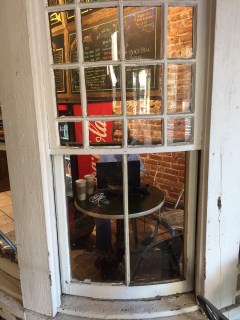
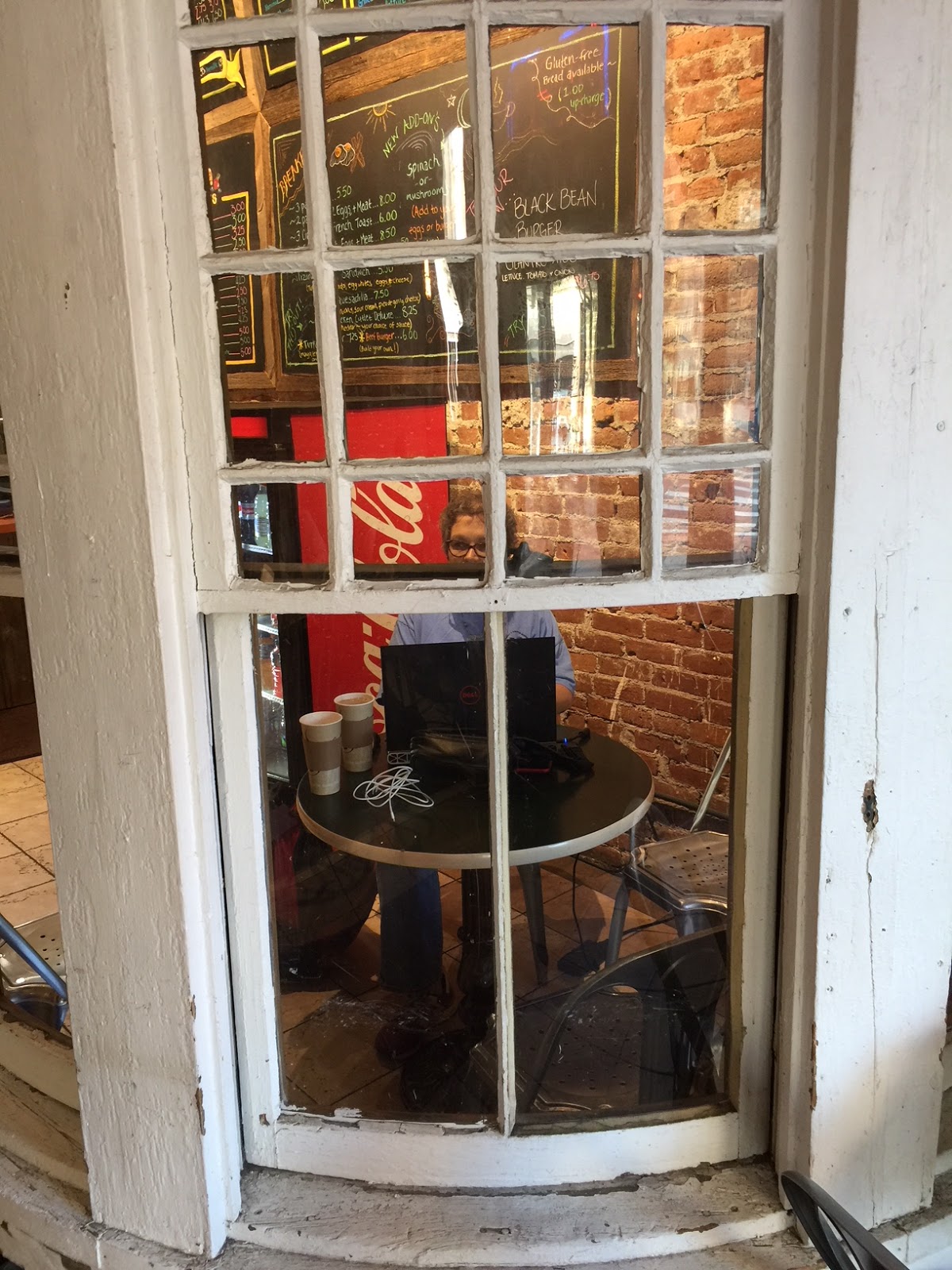
Yes, this is a bay window.

Oneonta still has a bit of a hippie vibe, with quirky coffeehouse spaces, the Autumn Cafe (a former food coop turned restaurant), and a head shop (the tacky price you pay for the health food stores and artisan delights). The summer traffic has gotten worse and the hotels get quickly packed due to the demand from club baseball tournaments, which Oneonta has capitalized on. The local artisan’s store features a writer who writes romantic suspense with a witch as the main character and publishes through Llewellyn Press (the leading pagan press). The attitude of New York State lends itself to diversity of opinion — “You have a right to live your life, and I have a right to live mine”. I suspect things still got heated during the last election.

There is a local Quaker meeting here, as there always has been, and I suspect that it (like most Quaker meetings) has very few attenders. But there is a Quaker meeting.

People are friendly here, whether from Upstate (the mostly rural majority of New York) or Downstate (NYC — or “The City” as it’s known here — and its suburbs). They can’t drive worth a damn, but they’re friendly.
You can learn a lot about a town by what it treasures. Maryville, MO treasures kids and church, which is great if you have kids and a church denomination to belong to. As a childless Democratic Socialist and pacifist, I don’t fit into any of the local churches. (The most liberal church in town will not take any constructive criticism, which is one of the things most apparent about Missouri — the attitude of “It’s ours, don’t question.” I was brought up to question everything.)
Oneonta treasures creativity. It has its own arts venue separate from the University. It has the aforementioned artisan booths, local writers, unique restaurant dishes, quirky coffeehouses and quirkier people. I would imagine that, with two colleges and a head shop, Quakers and witches and Unitarians, many families with children would find it a less than ideal place to raise a family. 
It will be hard to leave today, to get back to Syracuse and take the train back to the Heartland and then drive back to a place that reminds me too much of my hometown in Illinois, with its ugly secrets and its resistance to reflection and growth. But I have miles to go before I sleep, it seems, and that includes another year teaching at Northwest Missouri State University.
Which brings up a question:  How can I make my current home liveable? I’ve lost friends over simple requests to examine their use of words to be less derogatory of the neurodiverse. I have friends. and even though I worry they wouldn’t like me if they knew who I really was (the granddaughter of a witch, a Democratic Socialist, convinced that everyone will go to Heaven if there is a Heaven) but they accept my sense of humor and my bipolar disorder. It might help to find groups to connect to outside of town to make up for the lack of church affiliation and connections through children’s activities. I may have to drive 90 miles for the nearest Quaker meeting now and again.
But I will retire someday, and if we can find the money for a house (Oneonta has higher housing prices and older, bigger houses) we will settle down here.

My Yard

I live in a two-story foursquare house that was built in 1905. It’s what is known as a kit home, as it has simplicity of lines and design elements that were found in mass-produced home kits that could be delivered and assembled at the home site.

The previous owners were a man named Robert Pleasance and his wife. By all indications, Mr. Pleasance was a bit of a tinkerer. Remnants of an engine lift in the garage, a workbench and old-fashioned intercom system in the basement, the handmade concrete birdbath with fountain (that regretfully didn’t work anymore)…

The yard, as a result, has beautiful bones as a landscaper would say, and just as many quirks that I acknowledged with a shrug. On the plus side: the back yard was fenced in with chain link, except for two gates leading from side yards to back yard, which were old-fashioned iron fence and gate, painted white. There were stone steps to the back that, although weathered, were not a complete ruin; The back yard was just right for a small patio and a decent garden.

The quirks: Mr. Pleasance had torn down an old brick one-car garage once he built his big garage/workshop (which looks uncannily like a pole barn with foldout doors) and built a hill with fine dirt and scree from the demolition. In other words, he reproduced a Mediterranean hill in a non–Mediterranean climate, which meant nothing but weeds, and even scarce ones at that. I appreciated the recycling at the same time I wondered what I could possibly do with this hill other than let the weeds grow. Also, there was a trellis serving as a grape arbor, but the grapes had been neglected and the arbor more so — it had been cobbled together from narrow iron pipes and cattle panels, and had started listing to the left. The grapes, still alive, had abandoned the trellis for the fence.

We’ve been wrestling with the yard a little at a time. Much of the backyard is a cluster of raised beds for vegetable gardening (heirloom and quirky varieties you can’t get in a store) which surround a small patio and grill. (If we have guests, we’ll have to move off the patio, it’s that small.) The bars that remain for the trellis will be used, with the cattle panel, to grow squash temporarily until we get the trellis back. Then we will plant more grapes and make the shady garden into a meditation nook or something.

The hill — we’ve found things that are falling in love with the hill — herbs. It turns out many herbs grow on scree — thyme, mint, sage, oregano, rosemary — and we’re getting good results with these. The tarragon, surprisingly, is growing better than anything I’ve seen grow before. We still have a lot of the hill to fill up, but we’re pulling weeds to keep it looking like it will become the quirky haven we hope to see.

Dissecting Gaia’s Hands and Learning Nothing Yet.

Maybe Gaia’s Hands wasn’t the best book to enter to Kindle Scout.

I’ve proofread it, demolished it, paired it with another book, trimmed that back so that I have two instead of four main characters, re- and re-proofed it, and still when I look at it I wonder if it’s a solid novel.

I’ve never known what to do with it. I love its plot lines — discovering one’s mystical abilities, a convincingly menacing pattern of harassment to one of the main characters, a taboo May-December romance (taboo because the woman is older than the man). I adore its characters — a talented botany professor, a precocious young poet, his best friend the surly engineer, the refined yet hangdog lab assistant Ernie, enigmatic waitress Annie, and even the smooth dean and hostile department chair Jeanne has to face.

But I’ve never known what to do with the book. The scenes almost come off as vignettes, with the connections between strands unapparent at first. The plot is subtle, not as action-packed. The characters carry it, but I always wonder if the book starts too slowly. I edit it again and feel something’s not quite there, I don’t know what the “something” is. With all the improvement I’ve done in writing for the past six years, there’s something in Gaia’s Hands too quirky for prime time.

Gaia’s Hands strikes me as a YA, except the male protagonist is too old at 20, the female protagonist is way too old at 50, and there’s not enough angst. (For all the harm Twilight did to women’s expectations of men — it’s okay to be a stalker? Really? — it did angst exceedingly well. And it sold.)

I look at Gaia’s Hands and feel like it’s missing something. Despite my greater level of experience, my writing skills, better knowledge of writing dynamics — my writing is missing something, and I can’t tell what. Maybe my style, my “voice” isn’t acceptable. I don’t know, but I wish I could figure it out.