The human race owes its survival to resilience.
Got a rejection for a short story yesterday. I’m not too upset; I think I shoehorned my entry into the theme and it didn’t quite fit. I only have one thing out there now, and that’s Prodigies with a major press. The likelihood of this being accepted is very low, I’ll admit, but it will still hurt a lot if I get rejected.
What from there? Try to shop out the dev-edited version of Voyageurs, which is short at 70,000 words but we’ll see. Work on the rewrite of Apocalypse (which will take a few months at best guess) and send it back to my dev editor. See what tweaks might help Prodigies‘ saleability and shop it back out. Send Whose Hearts are Mountains to dev edit. See if I can salvage Gaia’s Hands in case Apocalypse gets sold and it needs a prequel. Write something else, maybe finish Gods’ Seeds.
It’s hard work, and so far has been fruitless. But if I’m going to be published, I want it to be my best, and my expectations have been raised by beta-readers and dev editors and my own revelations about where my stories could go.
Someday, I hope,my hard work will bear fruit.
I manifest resilience in my life, and I find it’s one of my most enduring characteristics.
There are many ways in which my life has been privileged — I was born into a white middle class family, I have been gifted with a good deal of analytical and verbal intelligence — but I have had to overcome a childhood of bullying, unstable parenting, sexual abuse, and the beginnings of what was later diagnosed as Bipolar 2. I have made it to 55 years old with a reasonably well-balanced life.
As I wrote that, I realized that I (as I suspect many do) began to conflate resilience with accomplishment and judging my resilience by the degree of my accomplishment. This transmogrifies an ordinary, developable skill into an attribute of the rarefied few. This is the script of what I referred to yesterday as inspiration porn: ” … overcame a difficult childhood/debilitating disease/life-shattering accident to become a lawyer/doctor/marathon runner/fill in the blank with an accomplishment most of us reading the story couldn’t manage. If I look at what I’ve accomplished (a modest career at a small Masters I university where I’ve made few waves, six novels that I can’t get an agent for/published) I don’t feel very resilient. But if I look at what I’ve survived, and the current quality of my life, I feel very resilient indeed.
If we want people to be resilient, we have to believe that resilience is ordinary, is learnable, is measurable by one’s quality of life and not their level of achievement.
Resilience is a concept that has passed from the psychological lexicon to everyday language. The American Psychological Association defines resilience as “the process of adapting well in the face of adversity, trauma, tragedy, threats or significant sources of stress — such as family and relationship problems, serious health problems or workplace and financial stressors” (American Psychological Association (APA), 2019). More simply put, it is the ability to bounce back.
The person with resilience as a trait recovers from being let go from a job by planning to regain employment rather than falling into helplessness. They recover from life-altering trauma stronger than before. They star in our inspirational stories, and we admire them for their blossoming in the face of adversity, their ability to bounce back.
We need to remember two things about resilience. The first one, as the APA (2019) reminds us, is that resilience is a common trait. People in general have displayed this trait countless times, after major disasters such as Hurricane Katrina; terrorist attacks such as 9/11 and Oklahoma City, as well as during common events such as illness, death of a loved one, and loss of a job.
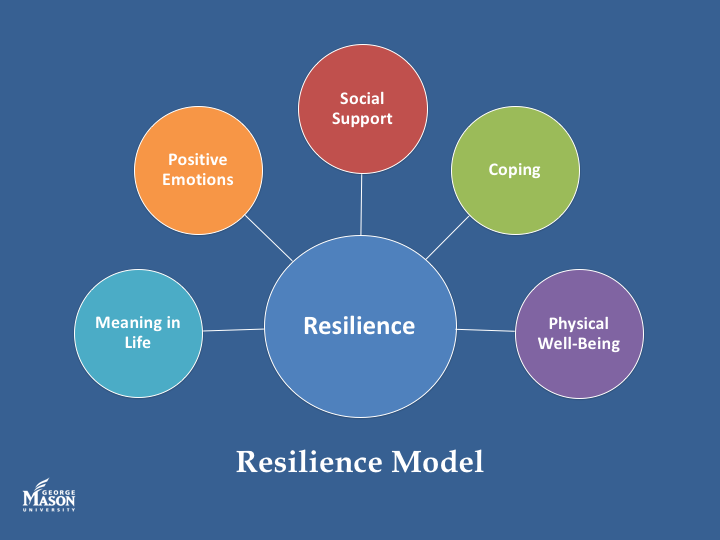
The other thing we need to remember is that resilience is fostered by a series of internal and external factors. The biggest factor in resilience, according to the APA (2019) is “caring and supportive relationships both inside and outside the family“. This is not a small thing; people need other people to make sense of adversity and tragedy.
Other factors include:
Sometimes the things I need are not the things I thought I needed.
I needed the bad yearly evaluation, because without it, I would not have been able to talk honestly with my boss about what I had been going through for the last two years illness-wise. I would not have gotten the kick in the butt to do better, nor would I have realized that my boss cared about how I was doing.
I needed to have my writing rejected, because I would never have been pushed to get beta-readers on the job. Not only do they help me improve, but they are reading my stuff and that feels good.
I needed to feel like I was the most uninteresting person on earth (isn’t depression grand?) so I would see the places where I am geekily interesting — edible plants and herb garden, persistence in fishing even though I catch nothing, wanting to learn everything, moulage, the ability to talk to anyone about anything, addiction to coffee, dedication to writing …
I needed to have that terrible school year — two terrible school years filled with depression and illness. Even though I have a lot of work (writing, disaster mental health class, redesigning a class) this summer I feel relaxed because I can take a day to go off to St. Joseph and drink at a quirky old coffeehouse.
I needed to break my heart on that crush, because it showed me how understanding my husband is about my periodic idiosyncracies in looking for the muse, a person who subtly infuses my creative soul with energy. (Crushes would lose their power if one did anything about them, so they’re supposed to go nowhere. Dear muse, if you are reading this, thank you.)
I needed to feel alone, because if I hadn’t, I wouldn’t have realized how much it means to me that I have readers. I love you all!
This afternoon and tomorrow, I have the privilege of participating in the Dear World college tour. Apparently, it’s a chance to tell one’s story, followed by a portrait with a pertinent phrase from one’s story written on one’s face and body (don’t worry, it’s not a nude portrait).
I’ve been thinking about what my story is. I thought at first it was about my bipolar and my fear of stigma about that. But I realized that the true story is bigger, the worries about it are bigger, the payoff is bigger.
My story is not about survival, and it’s not about recovery.
My story is about resilience. Resilience is defined as the ability to recover quickly from adversity.
As a child, I faced a lot of adversity — by the time I was sixteen, I had been raped once by acquaintances, sexually abused a handful of times, and endlessly bullied at school. I had grown up in an atmosphere of unpredictability, threats of abandonment, and broken promises. (If I have any relatives reading this, I am sorry if you struggle with this account of my childhood. But it did happen.)
But there were also some of the things in place that helped me not just survive, but flourish. My father was a pillar of stability. There were teachers at school who recognized my intelligence and encouraged me to use it. My speech therapist, Miss Gimberling, who I met with from kindergarten to fifth grade, encouraged me to draw and talk. I later learned she stood in for a school psychologist. My intelligence may have helped. Since then, I’ve survived a marriage failure that hooked into my trauma, bounced back from my department at the college being disbanded and being thrown into a department I didn’t think I had a lot in common with, and gotten through the negative experience of inpatient behavioral health ward.
But with all this and bipolar disorder going on, I earned a Ph.D in 1993. I’ve taught as a professor for almost 25 years. I’ve learned a lot, using knowledge instead of defensiveness in meeting the world. I still have to use all those strategies I’ve learned to cope, and sometimes I struggle when the medication fails. I still have bad days. But I’m willing to take those two steps forward before one step drags me back.
And I’ve always enjoyed life. I’ve always collected people’s stories, told stories, laughed at random moments nobody else laughs at, communed with nature, indulged my alter-egos, worn obnoxious lipstick that matches my outfits, followed the exploits of famous internet cats, taught classes outrageously, sworn egregiously, worn cat outfits for Halloween, set Big Audacious Goals and accomplished them, fallen in love, fallen in limerance, fallen in limerance AGAIN, and gotten kissed by more people than you might think, in usually ludicrous circumstances. And to look at me, you wouldn’t believe I’m anything but an older woman with obnoxious lipstick.
I wonder if I should be writing this. Introspection doesn’t necessarily fit into a blog about writing. Except it does, because it explains where stories come from.