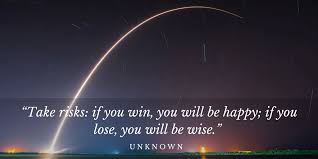
Day 3 Lenten Meditation: Risk


Without risk, there is no reward. There is only buckling in to the forces inside and outside of us.

Many examples of healthy, responsible risk-taking exist. Investing money for return on investment, dating, expressing one’s feelings, submitting creative works for publication, going up for a promotion. Confronting corruption and injustice, changing the status quo and being authentic also take risks.

Risk instills fear — of rejection, of failure, of loss, of negative consequences. Many people focus on the loss instead of the potential gain, and we call them risk-averse. Avoiding risk has its cost — lost opportunity, lack of progress, and a dearth of fulfillment. 

Choosing risk for its potential rewards may require changing one’s mindset with one or more of the following:

  • Examining the fear against the potential return
  • Believing that one will survive the worst case scenarios
  • Feeling the fear and taking the risk anyway 
Without risk, there is no reward. There is only buckling in to the forces inside and outside of us.

Getting from goals to accomplishments

Sometimes I write in this blog when I don’t seem to have a lot to say. It’s not because I love to hear the sound of my “voice”, although some would argue I do. Rather, it’s to keep a routine going so I don’t lose a good habit.

Routine is what helps us develop good habits. That, and a reward for doing them, since in the short run doing what we’ve always done feels better. Habits, as unglamorous as they are, are what turn long term goals into accomplishments.

As a professor teaching positive psychology and behavioral economics, I have an interest in the whole idea of how to change habits. The behavioral economics idea behind behavior is that we’re naturally going to choose the immediate reward over the long-term benefit. There’s proof behind this; behavioral economists (including my favorite, Dr. Dan Ariely) do research to support their hypotheses, like any good professor.

I am trying out a program called Fabulous, which helps people develop good habits. It is based on behavioral economics, and Dan Ariely is one of its driving forces. The program uses environmental cues (such as putting your sneakers by the door if you’re training yourself to exercise), social cues (reminders on the app and encouragement), repetition, and rewards (praise and leveling up). I’m not necessarily going to recommend it, because membership costs $50 a year, but I think the reasoning behind it is sound, having read some of the research myself.

To go back to my blogging habit — I have writing on my daily to-do list, along with one hour of writing activities daily. I set aside some time each morning to write; my computer is my environmental cue.

And my reward? Reading the stats on my Blogger page to see people from many different countries reading this blog.