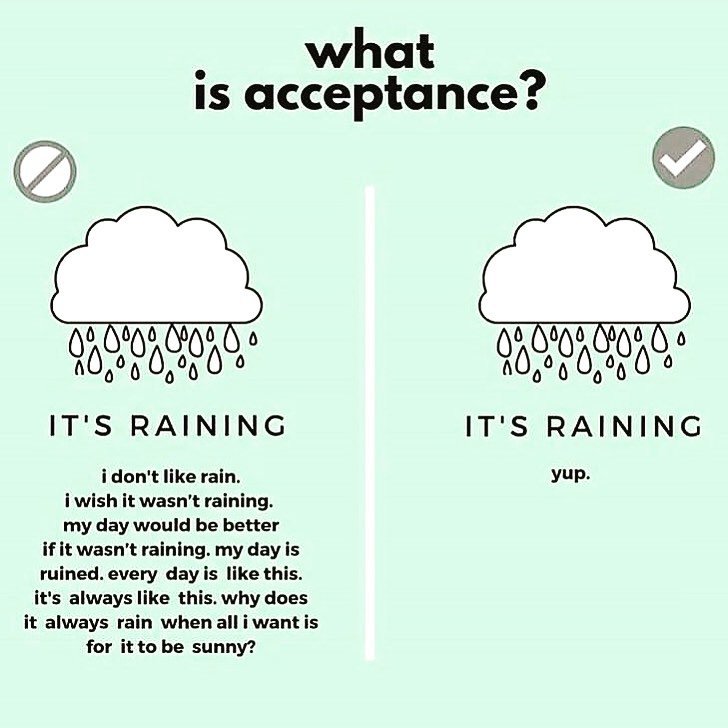
At the risk of sounding cliche, I don’t think I can start this better than using the Serenity Prayer:
Lord, help me to accept the things I cannot change,
the courage to change the things I can,
and the wisdom to know the difference.
In the time of pandemic, we have a lot we cannot change. We cannot change the fact that the virus is out there or how virulent it is. We can’t change that we’ve been put under a shelter-in-place ordinance. We can’t change the shortages in the stores. All we can do is accept.
But we can change some things. We can plan our shopping to minimize our exposure to others. We can keep our hands clean and wear masks to keep from getting the contagion. We can take care of ourselves physically and mentally. We can spread love through social media.
How do we know the difference? After all, there are people out there breaking social distancing rules, some of whom now have COVID-19 and are regretting their actions. Their bravado didn’t change the contagion. Some people are raging at the situation, which is the opposite of acceptance. Knowing the difference requires self-examination and the question “How?” How can my actions change the situation? How can my influence create a new path? If there’s nothing you can do, then it’s time to accept.
Tag: UULent
Day 35 Lenten Meditation: Confession
I consider myself a mystic, but I don’t know whether I believe in the God I’ve been been presented with.
Day 35 Lenten Meditation: Rain
I could use a good spring rain right now. A real gullywasher, where there’s no question of going out in it unless one wants to get drenched. And then I would go out into that rain and feel it drench me to my skin.
There is something purifying about standing in a torrential shower. From the skin to the soul, rain washes away all the dirt of the day. It chills my skin, reminding me that I am alive.
Day 34 Lenten Meditation: Reach
The word “reach” implies two things: 1) that there is something we desire just beyond our grasp, and 2) that we will exert effort to get it.
We as humans are programmed to want what we don’t have. Without desire, our race would have died a long time ago. So we reach — with our hands to grasp, with our effort to accomplish, with our curiosity to discover, with our frustration to understand, with our loneliness to love.
I would argue that our need to reach out is a sacred thing, but only when balanced with compassion. It is possible to desire too much, to reach with a greedy fist, to wrest with that hand what others need to survive. It is entirely too possible to keep grasping and keep wanting, with no desire to visit the things already obtained.
So we as humans stand at a ledge, grasping. If we reach out too far, if we reach out too often, we will fall into the chasm. We will cease to be with others, surrounded only by what we have obtained. The thing that will keep us from falling down the chasm is to balance “I want” with “I care”.
Day 33 Lenten Meditation: Love
What can I say that hasn’t already been said about love?
- Agape – love of humanity.
- Storge – love of family
- Philia — love of friends
- Pragma – love which endures.
- Philautia – self love
- Ludus – flirtatious/playful love
- Eros – romantic and erotic love.
Day 32 Lenten Meditation: Surrender
This is a difficult column for me to write, because I am the sort of person who wants to fix things, to do things, to make things happen. I don’t like getting into situations where I can’t make things happen.
I don’t surrender easily. I am convinced that if I beat my head against something long enough, I will accomplish it.
Some things, however, don’t lend themselves to beating one’s head against something long enough. A pandemic, for example. I sit here, helpless. I can do nothing. I can’t even sew well enough to make masks.
This is the point where I have to surrender. I’ll be honest, I don’t believe that God will take away the pandemic, or that it’s His will that millions of people will get this disease. My God, when I believe in him, gives comfort and strength and the clarity for us to use our minds to solve things. So I don’t surrender to God’s will. I surrender to my own imperfect humanity.
Day 31 Lenten Meditation : Support
One of the most enduring traits of humanity is its ability to support each other during times of crisis. Just some of the supports I have seen during shelter-in-place are the following:
- Education units (pre-K through higher education) quickly mobilizing to online without a break, and with sensitivity to students’ needs
- Textbook publishers allowing free access to online textbooks over the duration of the sheltering
- Internet Archive offering free access to their library
- Local Facebook groups helping each other meet needs
- Outreach by the Instagram cat community reminding us to take care of ourselves (I suppose there are others, but I tune into the cat community)
- Countless others
- Harbor Freight’s donations of N95 masks and face shields to hospitals
- People on social media reaching out to the more vulnerable
- And so many I’m not aware of
Day 30 Lenten Meditation: Inspiration
As a writer, inspiration is where the universe and my imagination connect, whether that be the world outside my door or the world inside my head. And where the two interact, sparks fly, and I am driven to put pen to paper and translate the gestalt impressions of the interaction.
Inspiration is open to all of us, not just creatives. It still marks the intersection point of internal and external worlds even if one is inspired to clean the kitchen or plant a garden.
How can we encourage inspiration? We can by being open to the world outside our heads. We have already experienced, and are always experiencing, the world inside our heads. We need something new to reflect on and to ruminate on.
A change of scenery helps. Sheltering in place during the pandemic makes for a monotonous experience, but one’s scenery can also be changed by reading or watching videos. All that is needed is inducement of the spark by external experience.
Open-mindedness certainly helps. We all interpret the world according to an inner framework, a set of rules that governs our perception of reality. Don Juan Matus, in Carlos Castaneda’s writings, called this the tonal, but that’s not important. What is is that our inner construct of reality filters our world for us. If we let go of it, even a little piece of it, just for the briefest moment, we can see our world differently and be inspired.
Right now, we need to feel inspired. We need to feel that spark to motivate us, whether toward mundane or glorious tasks. Inspiration will help us see our social isolation as opportunity and allow us to remodel our inner and outer spaces to be more creative, more pleasing, and more nurturing.
Day 29 Lenten Meditation: Trust
It’s easy to make a blanket statement that we should trust people more. This statement, however, is simplistic and wrong.
We should be careful who we trust. There are people out there who would use our trust to secure unfair financial gain from us. There are those who would use our trust to destroy our lives. There are those who would use our trust to elevate themselves to the level of a cult leader, which we have seen in the form of cults of personality, religious cults, fringe political movements, and militant cults.
We cannot blindly trust. So how do we manage trust safely?
1) Don’t use heuristics as a substitute for information. A heuristic is an information-sorting rule that substitutes, often poorly, for the actual information. We use heuristics every day to our peril: “He’s a clergyman. I can trust him with my kids.” “I heard it on TV — it must be correct.” “Nothing illegal could be happening in such a nice neighborhood.” We should be asking questions: What are this person’s actual credentials? Do they extend to the area in which we are trusting them?
2) Practice risk/benefit. Does the risk of having our trust betrayed outweigh the benefit of trusting? Use this to set a boundary around every decision involving trust: Would I trust this politician to take out my appendix? Would I trust the person I’ve just met to take care of my children? Would I trust anyone other than my spouse with my bank account number?
3) Weigh the emotional against reason. We often choose to trust for emotional reasons — relief, cease from worry, desire. Emotions can be powerful, but they can be countered by rational thinking as I’ve outlined above: information, risk/benefit. Force yourself to wait.
4) Be extra cautious in times of turmoil. We are desperate to trust, so we become less discriminating; we want to believe and so we give our trust to the unscrupulous. Remember that, if it’s too good to be true, it probably is.
To some extent, we need to trust, or else we will miss out on our connection with others. We will miss out on having our needs met. We will not thrive. However, we can trust wisely and protect ourselves, in times of turmoil and in times of calm.
Day 28 Lenten Meditation : Fire
It’s difficult to reflect right now, as I am scared of what’s happening in the United States. But I want to keep my daily rituals as a method of surviving this mentally.
*********
Fire consumes. It destroys — houses, forests, lives.
Fire warms and feeds. When we capture and contain fire, it becomes a lifesaving force in our houses.
Fire soothes, as we watch it dance in a fireplace.
Fire inflames — we use it as a metaphor for passion.
Fire reflects human complexity in its many, many aspects, which might explain why we’re so fascinated with it.