Day 41 Reflection: Travel

I don’t do tourism well. 

Sightseeing overloads me with buildings, paintings, terrain with no context. A whirlwind of “I have to see the Mona Lisa” and “You haven’t visited here until you’ve seen the mountains.” I see things without understanding their context, and I drift along from thing to thing.

When I travel, I want to engage with my destination. I want to learn, to make sense. I want to experience the destination with all my senses and make sense of it in my mind. 

I want my tour guide to take me to the mountains and point out the flora there, explaining to me what plants make good tea and honey. I want them to show me the restaurants where the locals eat so I can get a feel for their lives, to set me up in an artsy coffeehouse so I can observe people. Tour guides aren’t equipped to do that, so I have to do it myself. Travel becomes a research project, but that’s okay.

My biggest preparation as a traveler, however, is internal. I prepare myself for the cultural differences and adopt humility, because I am the outsider and will make mistakes. I open myself up to gratitude for the experience. 

Travel without gratitude, in my opinion, is hardly worth the time spent. 
Day 40: Sanctuary

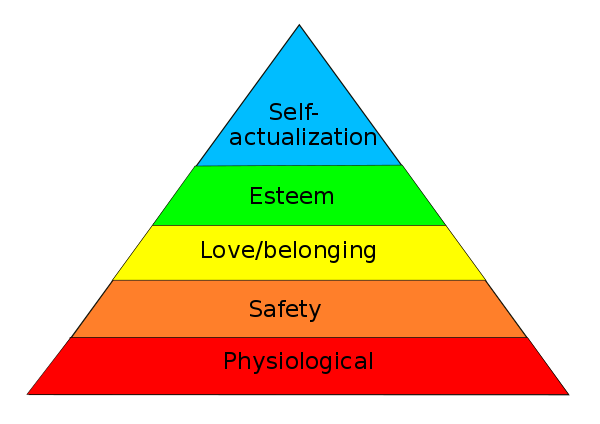
According to Abraham Maslow, psychologist, humans have a hierarchy of needs. The model (which everyone who has ever taken a psychology class will recognize) looks like this:

The hierarchy starts at the bottom, with physiological needs at the bedrock. Without food, clothing, and shelter, nothing in the upper levels matter.

Notice where safety is — right above physiological needs like food, clothing, and shelter. Safety is that fundamental, that we need it before we need love and esteem, and even when we having love and esteem, if that safety erodes at any time, we revert to needing that more than anything at any level above it.

To feel safe, we need spaces where harm cannot enter. We need a physical space secure from intrusion and hazard. We need a workspace free from threat and abuse. We need playspaces for children free from guns and bullying. We need a society free from scapegoating, discrimination, and hatred.

We can’t change the spaces out of our control, so we need ourselves or others to create protective spaces for us. We call these spaces our sanctuaries, our hideaways from the hazards of the outside, where we can be ourselves without danger.

Sanctuary cities have been in the news lately, with President Trump threatening to drop busloads of migrants off to these cities. The mayors of these cities do not see this as a threat, but an opportunity to provide sanctuary as a concrete action rather than as an ideal. These cities do sacred work in providing sanctuary to those who face an unsafe and insecure life.

Who is unsafe in our society? Name them, and then find a way to provide sanctuary. Eliminate white nationalism in your corner. Question the number of black males who get killed by the cops; question why whites get the benefit of the doubt. Stand up to bullies, including those in the administration of school districts. In Maslow’s hierarchy, people cannot thrive unless they’re safe. Help people to thrive.


Day 39 Reflection: Love

My best lesson on love (and massage) I learned from a man named Patch Adams.

Patch, a doctor, clown, and force for delightful subversion, used to visit the university I attended, University of Illinois, where he would lead workshops as an Artist-in-Residence. I didn’t know who Patch was at the time, although all my juggler friends did, so I didn’t know what to expect when I ended up at a massage workshop led by him.

I remember being one of many students sprawled around a dimly lit community room in Allen Hall, where Patch had not arrived yet. All of a sudden, this tall, wiry guy with baggy pants and high-top shoes and a handlebar mustache bounds in ranting “You’re not touching! How can you give a massage when you’re not even touching!” 

As you can tell, I was about to go through a transformative experience.

In this workshop, we did not learn technique. We learned love, with instructions like this:

“Don’t give massage if you want to get into someone’s pants. If you want to get into someone’s pants, say to them, ‘I want to get into your pants.'”

“People need touch, and you need practice. Offer to rub someone’s back. Or even their hand.”

And the most important message: “Whenever you massage someone, think ‘I love you.'” 

This workshop happened some thirty years ago, and I still remember these things vividly. When I’m not too preoccupied with my own woes, I walk down the street thinking “I love you” to the world around me. 

This is what I remember when I think about love.


Day 38 Reflection: Art

Art marks us as human. Its purposes hark back to human needs.

Art engages. It pulls us out of our reverie and asks us to pay attention to it.  Sometimes it asks subtly; sometimes it demands. We study the piece, its angles and contours, its shading and hues. We ponder the meaning. We decide we like it or we don’t, and we find ways to describe why or why not.

Art speaks. Art expresses emotions, emotions we feel uncomfortable talking about, and evokes emotions in the viewer. We feel emotions we may have buried or forgotten. We identify with a work of art because of its ability to evoke emotions.

Art transcends. Art comes to mean more than the idea, the skill, the sweat that goes into creation. It becomes an ideal, an inspiration, a door into the unexplainable. It puts us in touch with something bigger than us, if only for a moment, before our minds ground us on earth again.

Art expresses both the creativity and desires of our humanness and our inexplicable tie with divinity.

 (Note: I just discovered that Lent has more than 40 days, or else I don’t know how to count. Easter Sunday is on the 21st, and today’s the 12th, and I’m on day 38. Apparently, this is because the Sundays are not counted. Who knew?)

Day 37 Reflection: Recovery

Life passes peacefully, and then something bad happens. A town floods, a loved one dies, one’s dignity is violated. We feel lost, betrayed, angry that we have suffered this loss. 

Then comes the slow process of recovery. Recovery doesn’t come quickly; we must go through the feelings that come with loss, the anger and the sadness and the fear. There’s no going through this quickly. We can’t recover from someone else’s timetable.
 
When we recover from a catastrophic event, we do not return to normal. That place is gone, destroyed by the event. We journey to a new normal, a normal where the event fades into memory and its changes to our lives are reconciled with the past.


Day 35 Reflection: Build

“Build” is a verb that needs an object. We want to know what someone is building, whether it be a home or a skyscraper or a framework for a theory. In other words, building must have a goal. 

To build has different connotations than to create, because creating can happen out of seemingly nothing, while building connotates taking materials and putting them together in ways that make them useful.

This is why we talk about building our futures, not just creating them. Futures need to be solid and believable. They need to hold our future selves without buckling. We are not comfortable with simply creating our future; we want them to take form and show structural soundness. So we build upon the skills and abilities we already have, the existing structure of our lives, and the resources we think we can acquire. 

We are all builders of our own lives and those of our families. As builders, we must hone our skills, our abilities to put the pieces of our lives together to make a harmonious and functional whole.

Day 34 Reflection: Grace

“There but for the grace of God go I.”

I hate this phrase with a white-hot passion. First of all, it paints God’s grace as favoritism that preserves some from trials and tribulations while smiting others. Or perhaps it hints at some virtue the speaker possesses that keeps a retributive God from smiting them. Or judges someone for handling their tribulations in a way that makes their life worse.

No matter, the phrase paints a deity that plays favorites in handing out grace and a world of the holy haves and have-nots. 

This is not how grace works at all. The Wikipedia entry for divine grace defines it as:

[…] the divine influence which operates in humans to regenerate and sanctify, to inspire virtuous impulses, and to impart strength to endure trial and resist temptation; and as an individual virtue or excellence of divine origin. (Wikipedia, 2015).

In this context, grace gives us resilience in life. This makes sense, because one of the purposes of religion is to give people meaning in life, particularly helping to make sense of life when bad things happen. 

So divine grace is something all of us have, whether or not we would call it that. It is the sense of greater-than-ourselves that we rely on in the face of loss. Grace plays no favorites; it does not reward some and neglect others. 

“There but for the grace of God go I” is a very comforting construct, because it suggests that God protects the believer from harm or loss. None of us, however, are immune; God does not arrange the lives of Her followers.  It’s a good thing that real divine grace exists to help us through the bad times.

Day 32 Reflection: Transcend

A space exists beyond the mundane, one untouched by everyday drama and the pursuit of worldly things. As humans, we are allowed fleeting glimpses of this place.

Some spy it in the forest, when a ray of light pierces the canopy and illuminates the path. Some discover it in service, when the Divine has touched their understanding of the Other. Some find it in prayer, others in meditation, yet others in solving a difficult problem.  Many stumble across it without seeking and are dazzled by its singular beauty.

But only for a moment. We were not meant to dwell in the transcendent, for to do so would destroy what makes us human: our drive, our basic needs, our social connections. We would starve to death in beauty.

Best we go back to our mundane world after touching the transcendent, to live our lives with a little more grace than before.

Day 31 Reflection: Forgiveness

Don’t forgive unless you’re ready to.

This goes against the common spiritual wisdom that we should be ready to forgive our transgressors, that forgiveness sets us free. Maybe that’s true, and we should forgive the person who cut us off in traffic. 

But there are hurts so deep, so debilitating, that easily forgiving them feels like self-betrayal. Forgiving betrayal, murder, assault — all these feel too heinous to forgive. And yet people clamor to tell the sufferer that they should let go, forgive. Often these people who press others to forgive have something to gain — family members of the violator, the church of the violator, the violator themselves. 

Withholding forgiveness gives a sense of power, maintains the anger that may be needed to recover. Anger is not evil; it’s an emotion. Righteous anger helps us see our value, helps us recover. (Rage, however, consumes us and it’s best not to play with anger until it becomes rage). 

There comes a time, though, when the anger holds us in the past, when we’ve grown beyond the hurt, we have found ourselves again. Then it’s time to forgive.

Day 30 Reflection: Suffering

Suffering exists because someone’s basic needs aren’t being met. Food and water, health, safety and security — without enough of these people suffer. Suffering causes distress — fear, anguish, pain. 

Society holds onto a narrative that paints suffering as ennobling. We admire the hungry villagers, the mentally tortured artist, the once-vibrant person dying of cancer. 

We should admire people’s resilience in the face of suffering, but we should not dismiss their suffering as ennobling. We should instead do the humane thing — see what we can do to help reduce their suffering. It may be that we can provide simple help like food and drink. Maybe we work to dismantle unjust structures that cause people to suffer, like reducing racial bias in policing. Even companionship, understanding, and acceptance may be enough to ease suffering.

Suffering is not noble, but weathering it together may be.