You Are a Writer

Dear Readers — this is for all of you. All of you are writers whether or not you think you are.

Becoming a writer requires only one thing: That you write.

You suspect it’s not as simple as that. You’re right, of course.

You may stare at the page, clutching your lucky pen, but no ideas come to mind.  There are many ways to break that impasse: take the pressure off and just write, freeform, on whatever comes to mind. Interrogate a dream (my favorite method). Do word sprints — a method where you use a prewritten suggestion and write on that topic, exercising your mind in a non-threatening way. Because writing is threatening — you risk internal reflection, growth, exploration of disconcerting topics. And maybe, possibly, recognition. Give yourself a pep talk — you are a writer! You can withstand the threats of reflection and exploration.

Then, you follow the flow of writing, and you feel the flow of ideas — until you don’t. You stare at the page in front of you, where words abruptly stopped in the middle of the page. You have several options at this point: create an outline and fill in the plot points so you know where to go. Write what you know. Research the details you’re not sure of. Take a break. Think of a future, more exciting scene and write that.  Give yourself a pep talk — you are a writer! All writers face that moment when ideas run dry.

When you’re done with your manuscript, you face the most important and most difficult part — editing. You need to edit because, while your words flowed, your grammar, punctuation, and continuity did not. You may find that your characters ended up on a yacht with no indication why. Or one of your characters practices “elf-defense” and there are no elves in the story.  Maybe your protagonist changed race. Little things like that. This part of editing you may be able to do yourself. Give yourself a pep talk — you are a writer! Tedious as this is, you can do it.

The other type of editing you will find more challenging, and that is reading for plot, flow of ideas, and readability. You may be so used to your story by then that you can’t recognize problems with description, plot holes, characterization, and other aspects that will make or lose the reader’s interest. You may feel threatened by someone else reading your manuscript — “oh, G-d, what if they don’t like it?!” Give yourself a pep talk — you are a writer! You can bear the criticism and use it to make yourself better.

Writing is not just a creative process — it’s a journey of growth. Few writers get their first work published — I thought I would, but I have since edited it so many times, it’s no longer my first work! I sent that revised, revised, and revised document out on queries later this week, and I’m holding my breath that an agent takes the hook. I’m giving myself a pep talk — I am a writer! I can withstand rejection again!
Cats and the Writer

Someday I will write about writing about sex — but today is not that day.  I’m feeling silly today, so instead, I’ll write about cats.

If I believe the memes on Facebook, all writers have cats. I’m pretty sure not all of them do, but the number of cat/writer memes far outstrip the number of dog/writer memes.

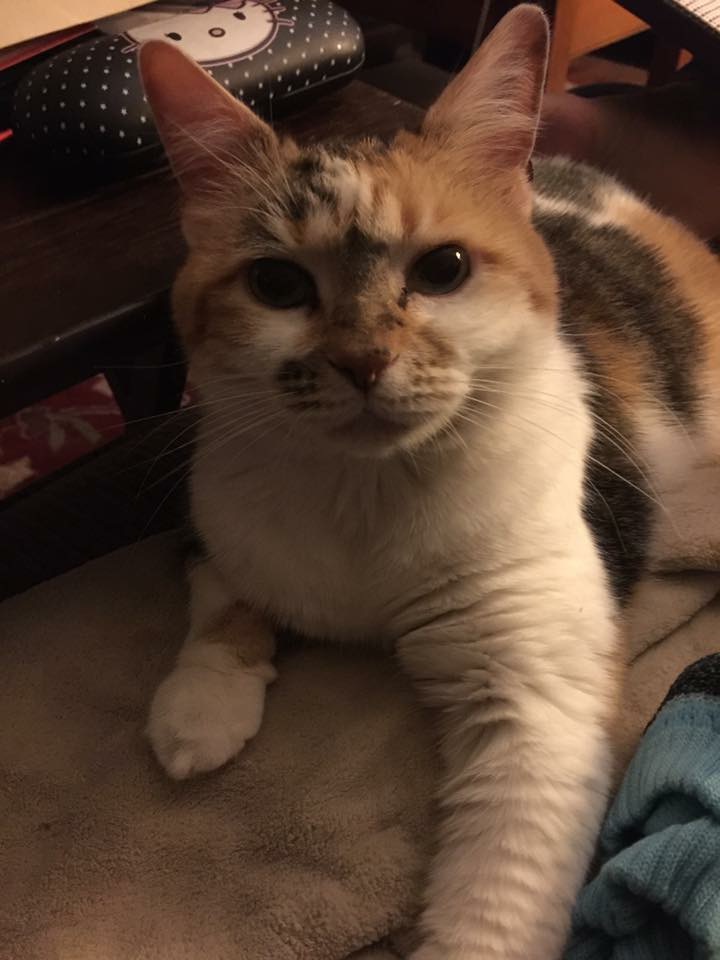
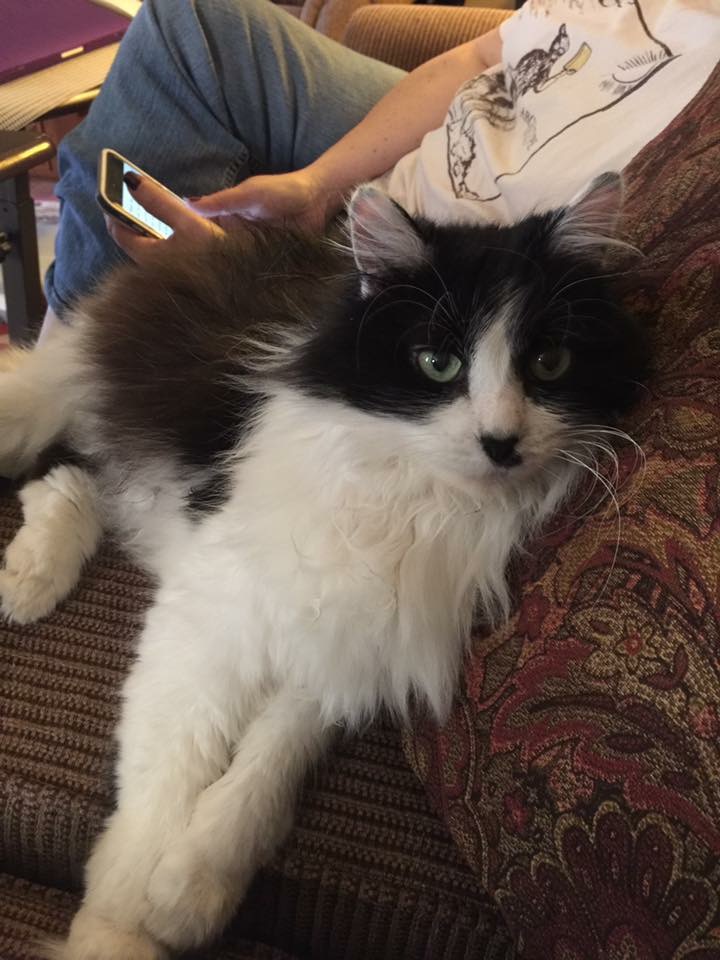
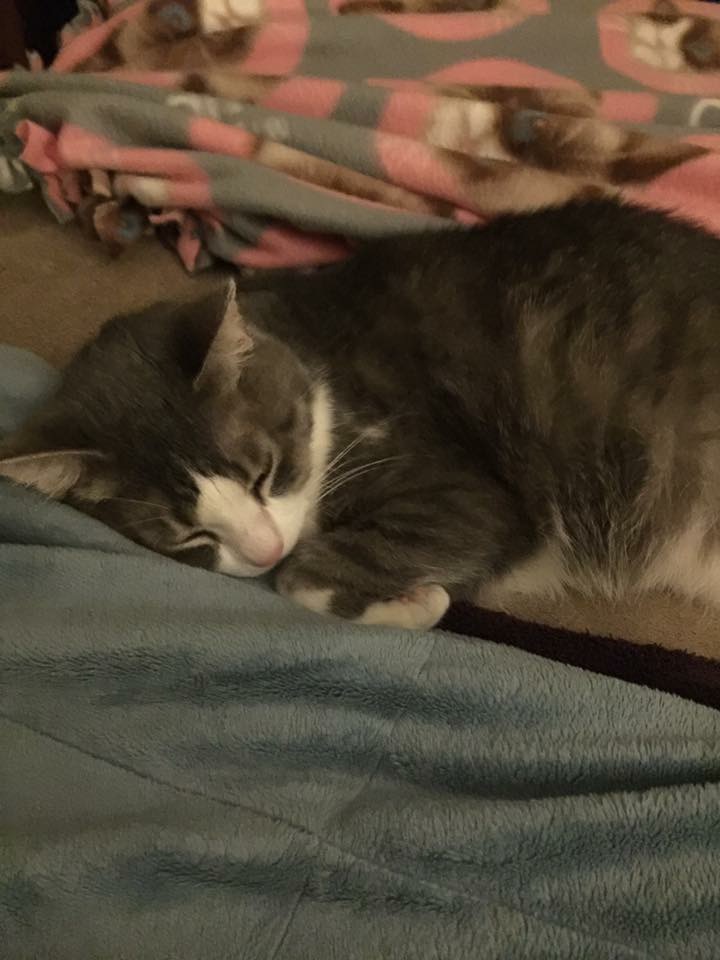
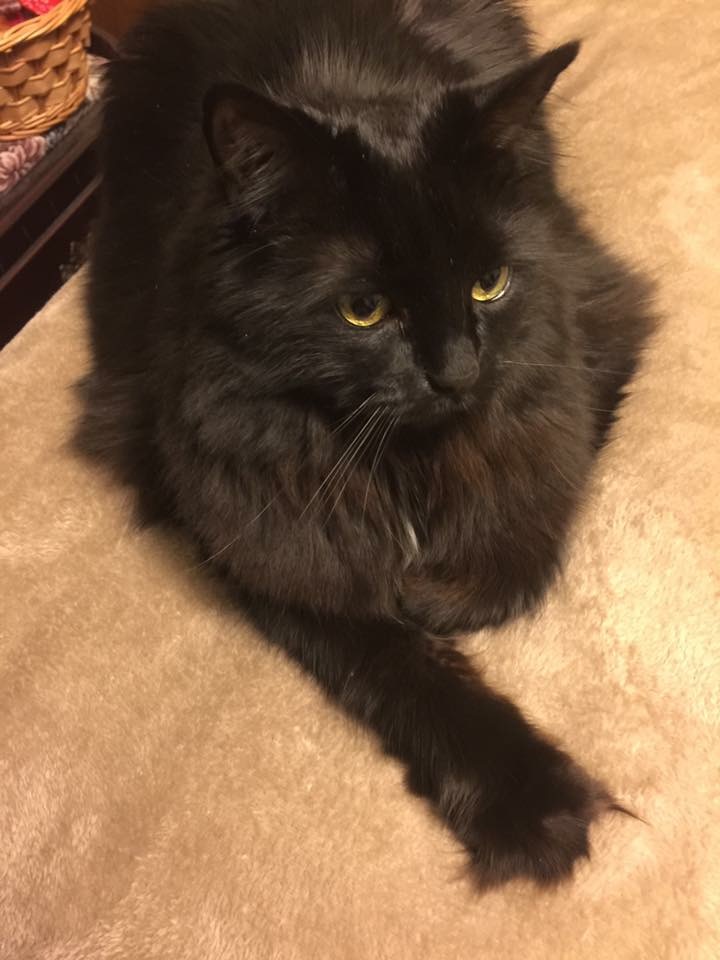
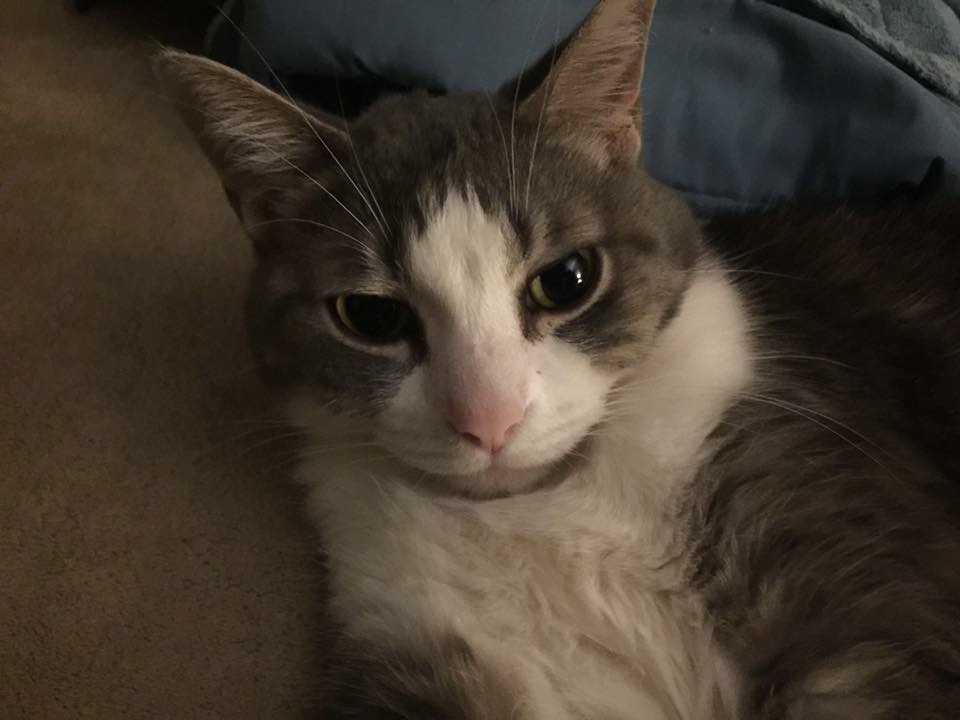
I have four cats — the luxurious Snowy (pure black; named for the irony value); the mischievious Me-Me,  a petite grey and white; the caterwauling calico Girly-Girl, and the rotund black-and-white grump Stinkerbelle. They help me write as you might imagine — when I sit in the living room at my computer desk, they interrupt me by biting my toes (Me-Me), butting my arms (Snowy), and yelling at me (Girly). Think of these as enforced work breaks.

Exhibit 1: My cats: Snowy, Me-Me, Girly-Girl, and Stinkerbelle

I thought I could involve them in the writing process — “Me-Me, could you proofread this passage for me?” (Me-Me stares at me with her huge, adorable eyes and licks my nose.) Ok, maybe not.

Many writers love cats. My favorite example was Ernest Hemingway, who loved cats so much he let them wander his estate. Due to the high number of polydactyls (extra-toed) cats on his estate, extra-toed cats became known as “Hemingway Cats”.

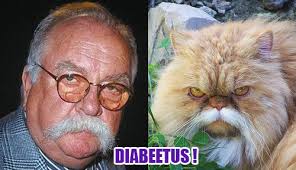
Perhaps cats inspire writers to imagine. After all, their faces — darling, elegant, curmudgeonly, bewildered — display character traits that can be used in our stories. People personify cats in cat memes — for example, Diabeetus cat (who looked like Wilford Brimley, who starred in commercials about diabetes.)

Exhibit 2: A picture of Wilford Brimley and Diabeetus cat:

Writers even sneak cats into their stories. Robin D. Owens, in her Celta science fiction, writes a collection of telepathic cats who pick their owners. (She also has other animals, but I’m ignoring that for the sake of my thesis here). Cats have become detectives, as in Lilian Jackson Braun’s The Cat Who… series. The same things that drive cat-haters up the wall — their fickleness, their curiosity, their dignity, their mischief-making — make them good characters.
Why cats and not dogs? Dogs have different characteristics — they are usually perfect companions, and we associate them with hunting and with sitting by the fireplace. We don’t associate them with something that will break open a plot or withstand being gifted with anthropomorphic traits (like Diabeetus Cat above. 
I have to go now — Girly-Girl has arrived for my enforced distraction …

For the Love of Coffee

On Facebook, coffee is a sacrament. Have you noticed this? Coffee jokes, coffee witticisms, coffee mugs. If you subscribe to writing-related pages on Facebook, you’ll quickly become convinced that coffee is the fount of all inspiration. For many of us, it is. (Those of you in the United Kingdom don’t understand this because your coffee usually is Nescafe instant and some boiling water. That is not coffee.)

Some of you reading this don’t fancy coffee and prefer your caffeine another way. For example, tea — sweet, unsweet, green, oolong, Earl Grey. Most of the people I’ve met who drink Earl Grey were English majors or Star Trek: Next Gen fans. Or Mountain Dew — all the people I’ve met who prefer Mountain Dew are computer programmers. Read on, because it may help you understand us coffee drinkers.

Why do so many writers prefer coffee? It could be because of the allure of coffeehouses* as places to write. Perhaps it’s knowing the mystique of the coffee’s journey from coffee cherry to processing method to grinding to brewing. Maybe it’s just that coffee is a socially sanctioned form of stimulants.

Coffee drinkers, like writers, appreciate the history of coffee. The apocryphal story of the discovery of coffee goes like this: An Arabic shepherd, feeling weary, sat under a bush to rest after making a fire to boil water. After he let the water cool, he notices one of his goats take a drink and then bound around the pasture with leaps and hops. The shepherd witnessed this, took a drink of the water, and no longer felt tired.**

Can you write without coffee? Yes — any ritual will help you get in the mindset, and writers have plenty of rituals — Using a fountain pen to write, writing in a dedicated Moleskine book, writing in a blog as a warmup, listening to music … Coffee is just another ritual. With caffeine added.***

*****

*  You will find the best ambience in indie coffeehouses. Consider yourself lucky if you have access to these. Chain “stores” that sell nationally recogized brands, not so much. Only one Starbucks in the US, in my opinion, has true coffeehouse ambiance, and it’s the Starbucks at Northwest Missouri State University, in the library. I work at that university and hold some of my office hours here.

**  I question this account for a couple reasons: 1) I’ve seen goats. They dance like they’re overcaffeinated ALL THE TIME. (Meet the crazy goats at Goats Gone Grazing Acres for an example.) 2) The herder boiled his water to be sanitary, only to drink it after a goat slurped it up? I prefer the story without the dancing goat.

*** Full disclosure: I am a coffee snob. In this household, we buy small lot green coffee beans and roast them at home in a small-batch drum roaster. We brew in a French press. We check for flavor notes. It’s really quite obnoxious. Really.

Procrastination

We procrastinate for several reasons:

  1. Because the tasks lack challenge (Housework, for example)
  2. Because the tasks are too challenging (Getting up in the morning?)
  3. Because the tasks are monotonous (Housework, for example)
  4. Because of fear of failure (Why I have five manuscripts that I haven’t marketed aggressively)
  5. Because of fear of success (Honestly. Success changes lives)
  6. Because we just dislike the task (Housework, for example)

In other words, we want to perform tasks that are challenging but not too challenging, have enough novelty to engage us but utilizes our skills, and offer reasonable success that doesn’t fall outside our comfort zone. If we don’t perceive that the task will grant us all that, we procrastinate.

Many factors inside and outside ourselves can create an atmosphere ripe for procrastination. Illness and worry can ramp up our belief that tasks are too challenging. Depression can enhance our feelings of failure. Jarring background music may burden us with more challenge, while bland or crowded surroundings may increase our perception of monotony.

The process of writing yields all sorts of procrastination pitfalls.  Some tasks — proofreading, for example — can be boring. Revising a novel or poem can challenge writers to the point of stress. Search and replace on a document can be monotonous (Scrivener, which is what I use to compose my writing, has no automatic replace). The difficulty in breaking into the market with one’s writing can enhance fear of failure, and daydreaming can enhance fear of success. Some parts of writing, such as writing a synopsis, can be annoying.

We can trick ourselves out of procrastination. Some tricks I use are:

  1. Breaking the task into smaller pieces. For example, I lay out the outlines for my books in quarter-chapters. Instead of feeling that sense of accomplishment only after finishing a chapter, I feel it with every quarter-chapter. (Small, frequent doses of accomplish reduce the fear of failure and the monotony).
  2. Switching up where I write (this is why writing retreats are so popular)
  3. Skipping forward to a more rewarding part of the book (more challenge, more motivation)
  4. Skipping forward to a less challenging part of the book (in my current book, that means writing in the Michigan hideout part of the story — less challenging than piecing together the malls in Gdynia (which is pronounced Goo-DOON-ya for you English speakers)
  5. Starting my writing day by promising myself I can quit writing after 10 minutes (I’m dealing with minor depression today — this is my best strategy for writing with depression).
Procrastination is not our friend, but we can negotiate a cease-fire with it.
Thanks for reading. I love you all.

Change or Die

As you might have read here before, I’m writing a book.  I woke up yesterday morning and decided my novel fell into the Young Adult category.  I decided to rename the book “Prodigies”. Then I decided that, instead of splitting the narrative into four different segments with four different first-person narratives, that I would retain one first-person narrative throughout.  So in about three minutes, I changed everything but the characters and the plot.

When I first started shaping this story, I wanted to write in the viewpoints of all the characters because — so cool! so experimental! so avant-garde! I loved my characters; I wanted to give them all stories — the eighteen-year-old mixed race violist who spent her life in residential music schools; the seventeen-year-old graphic artist whose talent is edged by madness; the 26-year-old teacher and mentor who has declared war against a shadowy conspiracy; the 28-year-old veteran with PTSD and a talent he will not reveal. But one of the rules of writing is to limit your protagonists to one (or maybe two if you must) because readers prefer reading the story through one person’s eyes. I chose Grace, the violist, because I felt she saw and interacted with the characters the best:

******

I stood in front of Room 16, afraid if I knocked too loud at that time of the night, I would attract the attention of those large men who served the Ivanovs. If I knocked too quietly, I would not wake Ichirou at all, especially as the bedroom lay beyond the suite —
As I dithered, I realized that I could go outside and throw rocks at the kid’s second-story window. As if that wouldn’t attract attention. As if I could figure out which window was his.
The door opened, and Ichirou hissed at me, “You may want to keep the grumbling down.” 

“Thank you, Captain Obvious,” I hissed back as I let him pull me into his room and close the door silently.
“I’m just saying …” Ichirou took a deep breath. “How do we get out of here?” I noticed he wore jeans and a t-shirt with his hoodie over it, and his laptop sat by the door. 

“What about Ayana?” I whispered, remembering that Przemysław had said he wasn’t sure about Ayana.
“Ayana told me to go with you.” Ichirou picked up his computer bag and peered through the peephole. “Of course,” he muttered. “A reverse peephole.”
“Should we — “
“Go go go!” Ichirou hissed, then grabbed my free hand and trotted across the lounging area, bumping into a chair. He threw the curtains open and pulled the window sash up. “Watch your step; it’s a bit far to the fire escape.”
Ichirou tried the fire escape first; his laptop appeared to unbalance his small frame for a moment, until he lurched forward and pulled himself onto the metal step and gripped the railings.
My turn. I perched on the sill, judging the difference between myself and the fire escape. I would not have to jump; if I shifted far enough to the right and stepped a bit, I could reach the step with my foot and shift my weight to grab the railing. Hopefully my viola would survive the maneuver.
As I swung myself onto the fire escape, we heard a gunshot, then another.
We ran down the fire escape. The pounding of our feet met the pounding of my heart.

p.p1 {margin: 0.0px 0.0px 0.0px 0.0px; text-indent: 18.0px; font: 13.0px ‘Courier New’} p.p2 {margin: 0.0px 0.0px 0.0px 0.0px; text-indent: 18.0px; font: 13.0px ‘Courier New’; min-height: 15.0px}

*****

I also wanted to move away from “The Ones Who Toppled the World” because I’m afraid that title oversells the plot. They don’t topple the world, but they certainly do a number of the United Nations. (What do you think of “The Ones Who Toppled the Nations”?)

I guess I wanted to say that a writer should not be so wedded to something in their story that they will not walk away from it. If change improves the story, by all means change!

An excerpt — just to tease you.

This is an excerpt from the story I’m currently editing:

The sun had barely peeked over the horizon when Luke Dunstan strode around the site of the coming Apocalypse.  He observed a brightening sky streaked with fuschia, an apple orchard etched in grey, squat houses surrounded by shadowed herbs and flowers. As an Archetype, Luke needed no sleep; because few of the humans were yet awake, he could walk alone.

He considered the plight of the collective against beings of his race and their vicious Nephilim fighting force, who fully intended to kill not only the humans of the collective, but the Archetype who held all women’s lives — his daughter Lilith.

Luke concealed his tears.

OMG Motivation

I’ve just finished with my spring semester grading and — I’m having trouble motivating on my editing.
I start a chapter of one of the books, and so many things seem much more interesting — Facebook. Instagram. My blog — oh, wait. I’m in my blog, aren’t I?
.
.
.
Oh, sorry. I just checked Facebook again. Nothing happened. Isn’t that always the case?

Why do people procrastinate? Sometimes they’re afraid they’re not up to the challenge. Sometimes they have very low attention spans. Sometimes they’re bored — ding ding ding!

Editing isn’t sexy like writing is. In writing, I meet (and fall in love with) my characters, they talk to me, their actions and beliefs and feelings flesh out the direction of my outlined plot, I get to know them. I create a world that’s more diverse (but perhaps no more tolerant) as the one I grew up in, one where a dying elderly woman can fall in love with a faun.
.
.
.
I’ve checked Instagram twice and Facebook once. Just saying.

How to do a boring task like editing and do it well? Break it up into little pieces. Start it and promise yourself you’ll quit if you haven’t warmed up to it in ten minutes. PUT AWAY THE iPHONE.

Or maybe I just need a break. Where’s my iPhone?